
Last verified: September 27, 2026. Every rule, tax rate and price in this guide to where to stay in France was read at the source cited, on the date above. Gîte, chambre d’hôtes, hostel and campsite prices were observed on the operators’ own booking pages that day for the dates named.
Where to stay in France is two decisions, and most people only make one. In 2025 the country took 102 million international visitors, its own record and still the most of any country (Atout France, 2025 tourism results, February 2026). On January 1, 2026 it had 16,291 registered hotels and 7,370 campsites to put them in (INSEE, tourist accommodation on January 1, 2026, February 2026).
So the choice isn’t short of supply. It goes wrong in two predictable ways: too many bases, and the wrong kind of bed for the region. A hotel suits Paris. It wastes the Dordogne. Below, I match eight bases to the trip first, then explain the seven lodging types, with 2026 prices, the legal definitions and the rules that changed. It sits inside the complete France travel guide, which covers everything else.
Disclosure: Some links in this guide may earn us a commission, at no extra cost to you. It never changes what we recommend.
Key Takeaways
- Choose the base first, then the bed: a hotel in Paris, a gîte in the Dordogne, a chambre d’hôtes in the Loire.
- Budget by the average: French hotel rooms cost €133 a night in 2025 and Paris rooms €239 (In Extenso).
- Check any rental for its registration number. Paris caps main-home lets at 90 nights a year.
Where to Stay in France: What’s Covered
Where to Stay in France: Match the Base to the Trip
Pick one base per three or four nights, chosen by the trip rather than the hotel. Prices move by region fast. On cozycozy’s booking-platform panel of 30 destinations, a summer 2026 night averaged €175, up 4.2 percent. Marseille jumped 27 percent and Normandy fell 9 (Le 10 Minutes Hôtelier, cozycozy summer 2026 panel, July 2026). That’s a summer snapshot on one panel; In Extenso’s all-year hotel average, used below, is €133.
Why so few moves? Every move costs you a morning of packing and a check-in during the best light of the day. Then match the kind of bed to the kind of place, because France’s lodging types aren’t interchangeable.
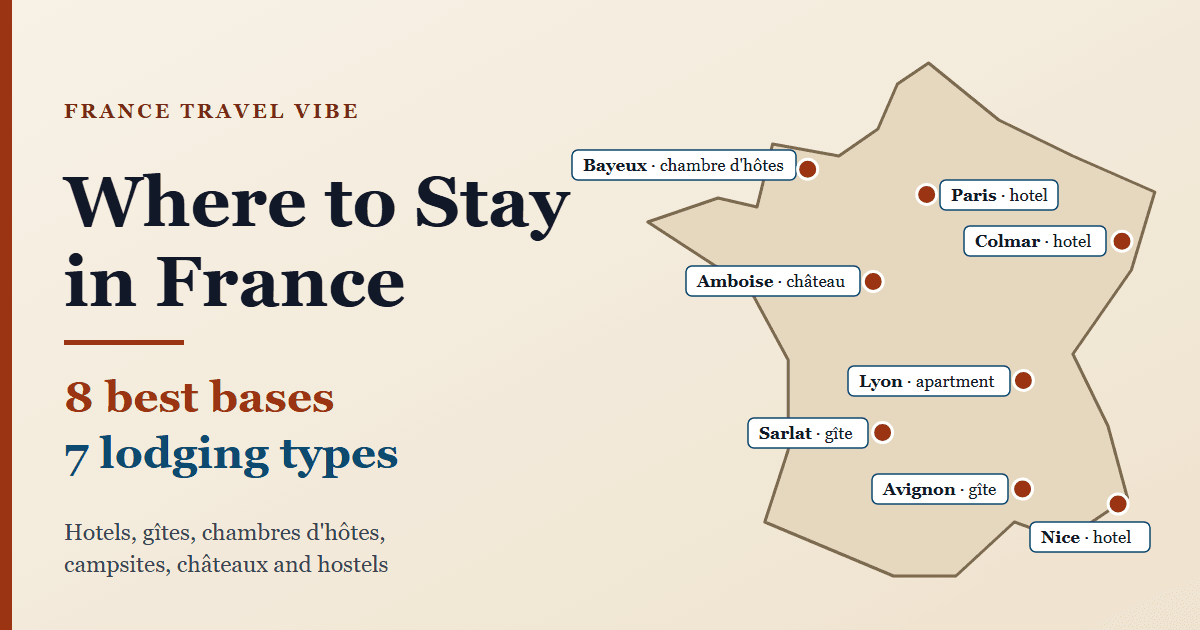
| Your trip | Base | What I’d book | Nights | The full guide |
|---|---|---|---|---|
| First trip, city | Paris: the 1st to 7th, or the 11th | A hotel or aparthotel | 3 to 4 | Paris guide |
| Riviera without a car | Nice | A hotel near the tram | Up to 5 | Nice guide |
| Provence villages | Avignon, then the Luberon | Hotel in Avignon, gîte with a car | 3 + 3 | Provence itinerary |
| Loire châteaux | Amboise (or Tours, Blois) | Chambre d’hôtes or château hotel | 2 to 3 | Loire châteaux |
| Caves and river valleys | Just outside Sarlat | A weekly gîte | 4 to 6 | Dordogne guide |
| D-Day coast | Bayeux | Chambre d’hôtes or small hotel | 3 | Normandy itinerary |
| Wine villages | Colmar | Old-town hotel | 2 to 3 | Alsace Wine Route |
| Food and rail hub | Lyon (or Bordeaux) | City hotel or apartment | 3 | Lyon vs Bordeaux |
Paris needs one central base, not three. The 5th and 6th suit a first, walkable visit; the 3rd and 4th have the Marais evenings; the 11th is cheaper. My guide to where to stay in Paris compares them arrondissement by arrondissement, with 3-star prices for each.
Nice wins the Riviera on transport. It has the airport and the station, and under five days I’d base there and day-trip. The three-way case is in Nice vs Cannes vs Antibes.
Provence takes two bases. Avignon is the only one with a fast train from Paris and a walkable centre. The Luberon week works best from a rented house with a car; getting around France covers the rental.
The Loire is the shortest hop of the lot. Amboise is the best first base, a walk from its château, and it’s the start of cycling the Loire Valley from one bed.
The Dordogne is gîte country. Sarlat charges town-centre rates in season, and the houses ten minutes out don’t. Plan four nights at least.
Normandy runs from Bayeux, 2 hours 12 minutes from Paris on the fastest train (SNCF Connect, Paris to Bayeux, 2026), with the D-Day beaches on its doorstep. Alsace runs from Colmar, where the village shuttles start. Strasbourg is 31 minutes away by train on average (SNCF Connect, Strasbourg to Colmar, 2026). That’s why it’s also the base for the Alsace Christmas markets.
Lyon or Bordeaux is a city break with rail links, and my seven tests settle which one fits.
Four more bases in one line each. Marseille: stay within fifteen minutes’ walk of the Vieux-Port (Marseille guide). Brittany: five nights across two bases (Brittany guide). The Alps: give them their own base, in Chamonix in summer or a ski resort in winter. Everything else: the best places to visit in France ranks twelve regions by crowd and cost.
What Are the Main Types of Accommodation in France?
When you work out where to stay in France, there are seven types to choose from, and hotels are less than half of the market. In 2025 French hotels sold 220.2 million nights, campsites 147.6 million and other collective lodging 97.6 million (INSEE, occupancy of collective tourist accommodation in 2025, May 2026). Holiday rentals are counted separately, and they’re huge.
In 2025, guests booked 213 million nights in France through Airbnb, Booking and Expedia. That’s more than a fifth of the EU’s total, and Paris led every city in the EU with 26.3 million (Eurostat, short-stay accommodation booked via online platforms, June 2026). That’s a different count from INSEE’s, so don’t add the two together.
So the honest answer is rarely just “a hotel”. Here’s the whole field on one page. The gîte, chambre d’hôtes, hostel and campsite prices are what I found on the operators’ own booking pages on September 27, 2026, for the dates shown. They’re a snapshot, not an average.
| Type | What it is | What it cost | Breakfast | Paris tax, 2026 | Best for |
|---|---|---|---|---|---|
| Hotel | Graded 1 to 5 stars by accredited inspectors | €133 average room in 2025; €62 super-budget to €369 luxury | Priced separately unless stated | €2.60 to €11.70, €15.93 for a Palace | Cities, short stays |
| Chambre d’hôtes | A room in the host’s home, 5 rooms at most | €50 to €144 for two, median €95 (Dordogne, a July 2027 Saturday) | Included by law | €2.60 | Villages, meeting people |
| Gîte | A self-catering house, usually by the week | €495 to €1,400 a July week for four (one €3,663 outlier left out), median €685; €464 median in October | You cook | By its rating, or 1 to 5% of the price | Families, slow trips |
| Apartment or short let | A furnished tourist let with a registration number | Varies too much to average | You cook | By its rating, or 5% plus surcharges if unrated | Cities, longer stays |
| Campsite | Graded 1 to 5 stars, like hotels | €19 a pitch for two with a car, plus €4.40 for power (a town-run site, 2026) | No | €0.65 to €1.95 | Summer, families |
| Château stay | A label, not a legal category | From chambre d’hôtes prices up | Often included | By its rating | Loire and Dordogne |
| Hostel | Mostly the HI France network | From €30.60 a bed (HI Paris, October 16, 2026) | Varies | €2.60 | Solo travellers |
How Do French Hotel Star Ratings Work?
French stars measure equipment and service, not charm. The rating is voluntary, runs from 1 to 5 stars and lasts five years. An inspection body accredited by Atout France awards it, and 4 and 5-star hotels also get a mystery visit (Atout France, hotel classification, 2025). Above the stars sits the Palace distinction: 33 hotels in 2026, 13 of them in Paris (Atout France, Palace list, June 2026).
So what does a star buy? A lift, air conditioning, longer reception hours, bigger rooms. Since 2022 the grid has also scored sustainability, with 27 green criteria and 12 of them compulsory (Atout France, the hotel classification changes, March 2022). A spotless, friendly 2-star can beat a tired 4-star. Read recent reviews before you read the stars.
The rules just tightened, too. From September 1, 2026, an expiring rating stays valid only while renewal is under way. Even then, it lapses six months after its fifth anniversary (Légifrance, décret n° 2026-14 of January 14, 2026). Fewer lapsed stars will hang on the door.
The stars also set your tax. The tourist tax runs by star band, so a 5-star room in Paris carries €11.70 per adult per night and a 1-star €2.60. And breakfast may be extra. Since 2015 a French hotel must state whether breakfast and internet are served and whether they’re in the price. It must also post its check-in and check-out times at reception (Légifrance, the order of December 18, 2015 on hotel price display).
Price climbs a similar ladder. In 2025 the average French room cost €133 a night and the average Paris room €239. Segments ran from €62 for super-budget to €369 at the luxury end (In Extenso, 2025 hotel results, via Voyages d’Affaires, February 2026).
The 3-star is France’s workhorse. It’s the biggest band, with 5,718 hotels open in 2025, and it sold 87.8 million nights (INSEE, hotel stock and occupancy in 2025, July 2026). Budget chains such as ibis budget, B&B Hotels, Campanile and Première Classe fill the two cheapest segments on the chart below. I priced 11 of those chains in 10 cities in my guide to budget hotels in France. For room size and the “double means one bed” trap, see my first-time-in-France tips.
Gîte or Chambre d’Hôtes: What’s the Difference?
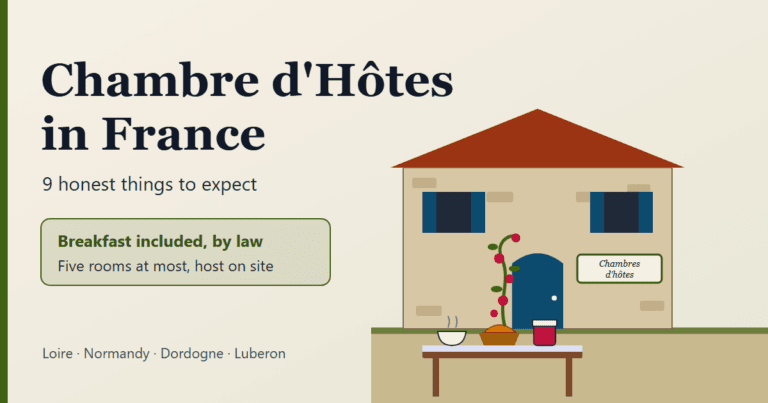
A chambre d’hôtes is a room in the host’s own home, with breakfast, and French law caps it at five rooms and 15 guests. A gîte is a whole house you run yourself. The stays show it. In 2025 the Gîtes de France network averaged 8 nights per gîte booking and 2 per chambre d’hôtes, across 28.17 million nights (TourMaG, Gîtes de France 2025 results, March 2026).
The chambre d’hôtes, by law
It isn’t a vibe; it’s a legal category. The price must include breakfast, served by the host, plus bed linen and towels. Each room gives access, directly or indirectly, to a shower room and toilet, which may be across the landing. Each room must be at least 9 m², not counting the bathroom. And the host has to greet you in person: a key box on its own isn’t allowed (service-public.fr, chambres d’hôtes rules, page verified May 21, 2026). Anything bigger is a guesthouse or a hotel.
The optional dinner, the table d’hôtes, has rules too. It’s one menu, at one shared table with the host, for room guests only. It’s the part people either love or dread. If your French is shaky, go anyway; dinner is where you’ll pick up the most.
It suits villages more than cities, which is why I’d book one in the Loire or around Bayeux. What a chambre d’hôtes stay is actually like, from arrival to the bill, has its own guide. For tax, it sits in the lowest band with 1-star hotels, €2.60 even in Paris.
The gîte, by the week
Gîtes de France is the biggest label, with 56,000 properties and 43,000 owners. Clévacances, another national label, lists about 8,000 (Clévacances, September 2026). Booking terms follow a pattern. On the Calvados and Ardèche networks’ terms, you pay 25 percent up front and the balance 30 days before arrival. A damage deposit is taken on arrival, and cleaning and some utilities are extra (Gîtes de France Calvados, terms of sale).
Cancel without insurance and it bites. You lose 25 percent up to 21 days out and 50 percent from 20 to 8 days. From 7 to 2 days it’s 75 percent, and after that it’s everything (Gîtes de France Ardèche, terms of sale). Saturday-to-Saturday changeovers are a strong custom, not a rule, so check each listing.
And the season changes everything. On September 27, 2026, I priced two-bedroom Dordogne gîtes for four for a July 2027 week, nine months out, and an October 2026 week, three weeks out. The July median across 34 listings was €685, about €24 per person per night. October’s, across 16, was €464. The seven houses that appeared in both searches were 19 to 52 percent cheaper in October. What stopped me when I lined the two up: the cheapest July gîte I found, at €495, cost more than the typical October one.
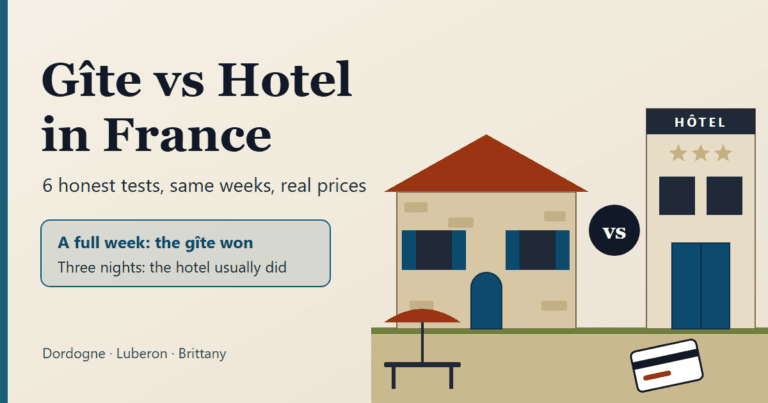
It’s the natural base for the Dordogne and the Luberon. It’s a poor one for Paris. For a full week it usually costs less than a hotel as well, as my gîte vs hotel comparison shows for the same weeks in three regions. One naming trap: a gîte d’étape is a hikers’ bunkhouse, not a holiday house, the kind you’ll meet on the Chamonix trails.
Can You Still Rent an Airbnb in France?
Yes, and for a family or a long stay a rental still works well. But the rules tightened. The Le Meur law of November 19, 2024 requires a registration number on every furnished tourist let. It also lets towns cut the yearly cap on renting out a main home from 120 nights to 90 (service-public.fr, what the furnished-let law changes, January 2025).
Paris applied that 90-night cap from January 1, 2025 (Ville de Paris, rentals limited to 90 days, December 2024).
You may read that the new national register opened on May 20, 2026. It hasn’t. The government says the national registration service is due in the fourth quarter of 2026 (DGE, the single rental-registration service, updated July 2026). Until then, numbers issued by town halls stay valid, and hosts will get several months to switch.
For you, it means one check: look for the number on the listing. Platforms have to take down listings without one, so an unregistered flat can simply vanish between booking and arrival. That’s a risk to price in, not a pattern I can measure.
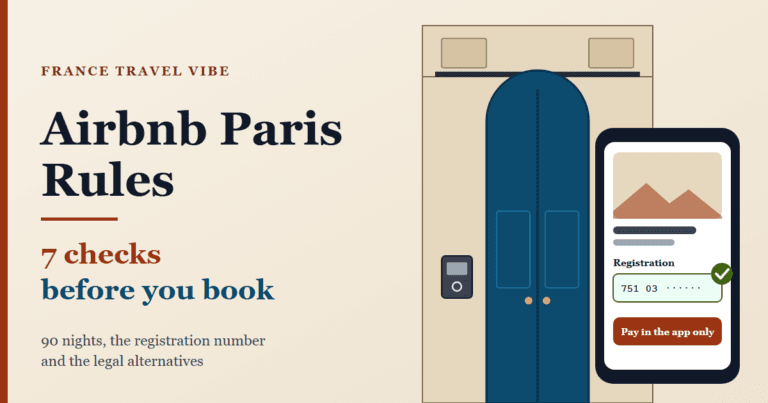
In Paris, a whole-flat listing should be the host’s main home, rented 90 nights a year at most. Renting a room inside someone’s main home needs no permit (Ville de Paris, furnished holiday rentals rules). Before you book a flat there, run the seven checks in my guide to the Airbnb Paris rules. By the end of 2024 the city had over 95,000 declared lets, about 78,000 of them main homes (Ville de Paris). Nationally, hosts face fines of up to €10,000 for not registering and €20,000 for a false number (service-public.fr).
Tax works differently, too. An unrated let pays a percentage of the nightly price, 1 to 5 percent, rather than a flat band; France’s tourist tax, city by city has each town’s rate.
Is Camping in France Worth It?
Yes, if you choose by the stars, and in summer it’s the cheapest way to stay in France. France holds 29.3 percent of Europe’s campsites, more than any other country (DGE, campsites and leisure parks, updated August 2026). INSEE counts 7,370 sites with 848,302 pitches, and 45 percent of those pitches are in 4 and 5-star sites (INSEE, tourist accommodation capacity on January 1, 2026, February 2026).
Campsites use the same 1 to 5-star grading as hotels. At the top end you get pools, mobile homes and glamping tents. At the bottom sit the town-run municipal sites, cheap and simple. Aixe-sur-Vienne’s, for example, charges €19 a night in 2026 for a pitch for two with a car. Power is €4.40 more, and the tax is 20 cents a head (Aixe-sur-Vienne town hall, campsite rates).
Is it a French thing? Mostly. About 70 percent of campers are French, and British summer camping nights slipped from 4.6 million in 2025 to 4.4 million in 2026 (INSEE, Saison touristique d’été 2026, September 2026). So in August you’ll be camping among French families, which is half the fun. Book early for the coast. My guide to camping in France covers the stars, the wild camping rule and what a pitch costs.
Hostels
Hostels changed hands this year. FUAJ, France’s historic youth-hostel association, went into liquidation, and on May 27, 2026 a court approved a takeover by the Office national des auberges de jeunesse. Onaj kept 36 of FUAJ’s 40 hostels, about 4,200 beds (Onaj, press release on the FUAJ takeover, June 2026). A bed at HI Paris Yves Robert started at €30.60 for October 16, 2026 when I checked.
Can You Really Sleep in a Château?
Yes, and there are three ways to do it: a château hotel, a chambre d’hôtes in a château, or a whole château gîte. Relais & Châteaux alone lists more than 150 hotels and restaurants in France, out of 580 worldwide (La Tribune de l’Hôtellerie, Relais & Châteaux 2026 members, July 2026).
The second big label changed its name. Châteaux & Hôtels Collection is now Teritoria, and it joined the Logis group on October 1, 2025 (Industrie Hôtelière, A new momentum for Teritoria, December 2025). In July 2025 it had 211 properties in France, and 129 of them were rated 4 or 5 stars (HR-Infos, Logis and Teritoria, July 2025). “Château” on a sign isn’t a legal category, so check what the stars and the reviews say.
The budget route is the chambre d’hôtes in a château. You get the stone staircase and the breakfast for a price near the top of the guesthouse range. In my Dordogne search, the Maison d’hôtes du Château at Saint-Rabier was €140 a night for two with breakfast, against a €95 median for chambres d’hôtes.
The two regions for it are the Loire, with its five best châteaux, and the Dordogne. Off-season is the lever at the hotels. In my price check of château hotels in France, the same hotels were a median 31% cheaper on a November Tuesday than on a July Saturday, while château B&Bs barely moved.
What Gets Added to the Bill?
Three things get added to the room price: the tourist tax, breakfast if it isn’t included, and, for a gîte, cleaning plus a damage deposit. The tax is per person per night, set by each town within a national range. In 2026 that tops out at €4.90 for a Palace and €0.80 for a chambre d’hôtes or hostel (collectivites-locales.gouv.fr, 2026 tourist tax ceilings).
Paris then adds three surcharges, the largest worth 200 percent of the base for the region’s transport authority. That turns those ceilings into €15.93 and €2.60 (Ville de Paris, 2026 tourist tax tariff). Unrated rentals pay a percentage instead, capped at the town’s top rate.
On a real trip, it adds up. Two adults, seven nights, a Paris 4-star: €118.30 in tax alone. Put the same couple in a chambre d’hôtes and it’s €36.40. For a gîte, add the cleaning fee and budget for the deposit you’ll get back. The rest of the daily sums are in what a trip to France actually costs.
Is France expensive overall? Less than its reputation. Eurostat puts French restaurant and accommodation prices 16 percent above the EU average for 2025. That’s dearer than Italy or Germany, but cheaper than the Netherlands, Denmark or Switzerland (Eurostat, price level indices, July 2026). Within France, the gap is Paris: its average room costs about 80 percent more than the national one.
How Far Ahead Should You Book?
Book furthest ahead for the places that fill, because summer on the coast is decided months out. In 2025 Paris hotels were 80.1 percent full (INSEE, Île-de-France tourism in 2025, March 2026), against 62.3 percent nationally. Higher-rated places run fuller. Among hotels, the 4-star band ran fullest, at 68.1 percent (INSEE, hotel occupancy in 2025, July 2026). Campsites follow suit: 5-star sites ran at 57.9 percent against 27.1 percent for 1-star (INSEE, campsite occupancy in 2025, July 2026).
For July and August in Provence, the Riviera or Brittany, the good places go four to six months ahead. Gîte weeks go early too, because owners sell them whole, so one family’s booking takes the house for seven nights. Given the cancellation scale above, I’d insure any gîte booked more than a month out.
The other thing to book around is the calendar. Paris set its all-time monthly record in June 2025. Concerts and Fashion Week filled the city, and the average daily rate hit €514.05 (CoStar, Paris room rates at an all-time high, July 2025). That’s more than twice In Extenso’s €239 all-year average. The best time to visit France, month by month shows which weeks to dodge.
My habit is to check the event calendar before I check a single room. Moving a trip by seven days does more than any comparison site.
Frequently Asked Questions
What is the best region to stay in France for a first trip?
Paris for three or four nights, then one regional base. Choose Nice if you won’t drive, and Provence or the Loire if you will. French hotel rooms averaged €133 a night across 2025 and Paris rooms €239, according to In Extenso. On one booking panel, summer in Provence and the Riviera averaged €231, above Paris’s €182.
What is the difference between a gîte and a chambre d’hôtes?
A chambre d’hôtes is a room in the host’s home with breakfast included, capped by law at five rooms and 15 guests. A gîte is a self-catering house, usually rented by the week. In 2025 Gîtes de France stays averaged eight nights in a gîte and two in a chambre d’hôtes.
Can you still rent an Airbnb in Paris?
Yes. A host can rent out their main home for up to 90 nights a year, and every listing must show a registration number. The national register is due in the fourth quarter of 2026. Renting a room inside the host’s main home needs no permit, according to the Ville de Paris.
Is breakfast included in French hotels?
Not always. Since 2015, French hotels must state whether breakfast is served and whether it’s included in the room price. A chambre d’hôtes is different: breakfast is part of the price by law. In my Dordogne search for a July 2027 Saturday, a chambre d’hôtes for two cost a median €95, breakfast included.
What does a French hotel star rating mean?
It’s a voluntary 1 to 5-star grade for equipment and services, valid for five years and awarded after an inspection by an Atout France-accredited body. It isn’t a charm score. In 2026, 33 hotels also hold the Palace distinction above five stars, 13 of them in Paris.
The Bottom Line on Where to Stay in France
Where to stay in France comes down to two choices, made in the right order.
- Pick the base by the trip, one base per three or four nights.
- Match the bed to the region: hotels in cities, gîtes in the countryside, chambres d’hôtes in villages.
- Budget from the averages: €133 a hotel night nationally in 2025, €239 in Paris.
- Check every rental for its registration number, and remember Paris’s 90-night cap.
- Add the tax and the breakfast, because neither is always in the room price.
- Book gîtes and summer coasts early, and look at October.
Start with your base’s own guide above, then build the route with a 7, 10 or 14-day France itinerary and the complete France travel guide.