
Last verified: October 2, 2026. Every rule here was read at the source cited on that date. Every chambre d’hôtes price was read on Gîtes de France on October 1 and 2, 2026, for the nights named. Prices move, so I re-run the same searches before each update and change the date above.
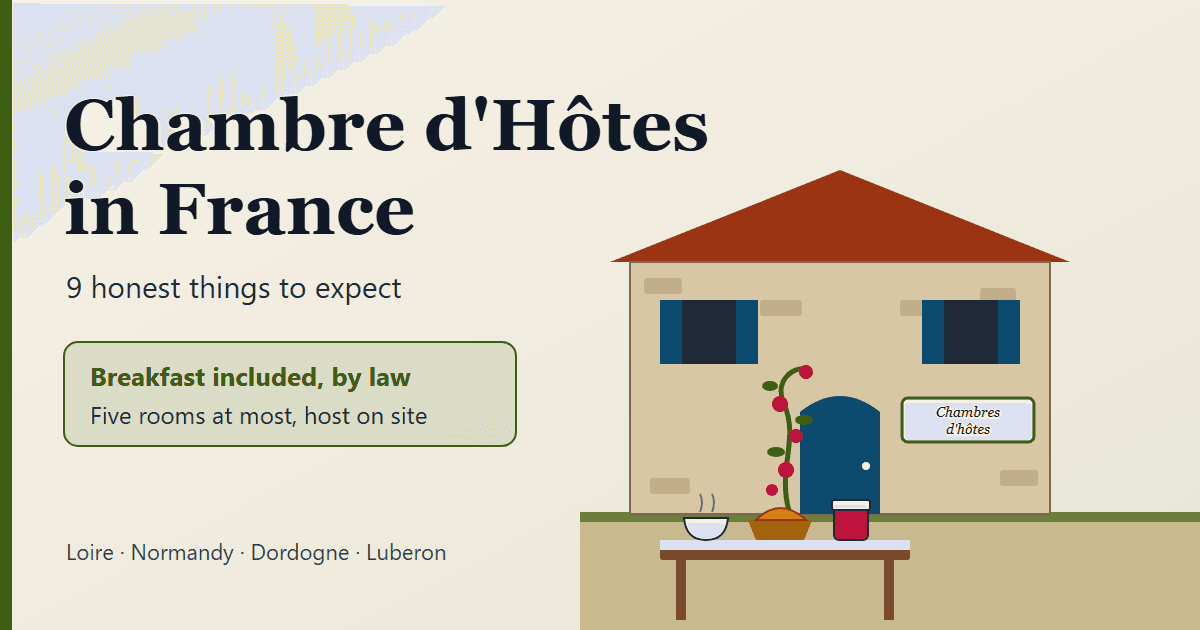
A chambre d’hôtes is the one French bed where the law says the owner has to greet you in person and make your breakfast. It’s a room in someone’s home, sold by the night, with the morning meal included. In my sample of 41 houses I could book for a July 2027 Saturday, two people paid a median of €95.
English advice on these places tends to be either a legal summary or a sales pitch. Neither tells you what the stay is actually like, what it costs, or whether you’ll need your French. So I searched the 85 chambres d’hôtes Gîtes de France lists around Amboise, Bayeux, Sarlat and Gordes and read 36 host profiles. Then I walked through a stay from booking to goodbye. This is the B&B chapter of my guide to where to stay in France.
Disclosure: Some links in this guide may earn us a commission, at no extra cost to you. It never changes what we recommend.
Key Takeaways
- Breakfast, linen and a personal welcome are the law, and a chambre d’hôtes has five rooms at most.
- Budget about €95 a night for two. My July 2027 sample ran from €50 to €165, and summer cost barely more than spring.
- One night is fine, even on a July Saturday. Only 1 in 5 houses serves dinner, and about half the hosts list English.
Table of Contents
1. What Is a Chambre d’Hôtes, Exactly?
A chambre d’hôtes is a furnished room in the host’s own home, rented to tourists by the night with breakfast. It’s capped at five rooms and 15 guests at a time (service-public.fr, opening a chambre d’hôtes). Go over that and it legally becomes a “chambre chez l’habitant”, run under rules closer to a hotel’s.
There are about 60,000 of them in France (DGE, les chambres d’hôtes, February 2025). Unlike hotels, they never get official stars. You’ll see private labels instead, like the “épis” (ears of wheat) of Gîtes de France, which grades many of them.
They’re small. Of the 72 houses I counted, the typical one had 3 guest rooms. A quarter had a single room, which is really a spare bedroom with a very good breakfast attached. Only 11 sat at the legal cap of five.
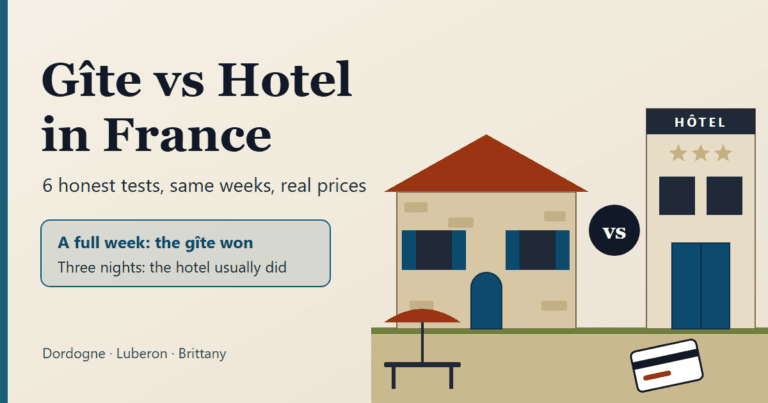
If you’re weighing one against a self-catering house, a gîte is a whole home you run yourself, usually by the week. Gîte vs hotel in France prices that choice in detail.
2. What Does French Law Guarantee You?
French law guarantees breakfast, linen, a personal welcome, a minimum room standard, a posted price and a proper bill. Everything else, from dinner times to how you pay, is the host’s house rules. Knowing which is which saves a lot of awkwardness.
The law, as service-public.fr and the DGE set it out, against what each host decides for themselves (service-public.fr; DGE):
| Topic | What the law says | What’s up to the host, so ask |
|---|---|---|
| Breakfast | Included in every night’s price, served by the host in person | What time, where, and what’s on the table |
| Linen | Bed linen and towels supplied, changed to suit your stay | Extra towels, pool towels |
| Welcome | The host greets you in person; a key box alone isn’t allowed | Your arrival window, late check-in |
| Bathroom | Access to a shower room and toilet, directly or indirectly | Whether it’s private or across the landing |
| Room | At least 9 m² without the bathroom, ceilings of 2.20 m, cleaned daily at no charge | Size above the minimum, air conditioning |
| Prices | Posted outside, at reception and in each room, dinner with drinks included | Discounts for longer stays |
| Bill | Itemised, with each service and the total; up to €3,000 fine if prices or bills are missing | Cards, cash or transfer |
| Dinner | One menu, one table, guests only, extra charge | Whether it’s offered at all, and on which nights |
The bathroom line surprises people most. “Access” means the bathroom may sit across the landing rather than behind your own door, so check the listing if a private one matters to you.
3. How Much Does a Chambre d’Hôtes Cost?
In my sample, two people paid a median of €95 a night, breakfast included, for Saturday July 17, 2027. Across the 41 houses I could book, prices ran from €50 to €165. For context, the average French hotel room cost €133 in 2025, before breakfast (In Extenso via TourMaG, February 2026).
I searched Gîtes de France, the biggest label, within 15 km of four bases on October 1 and 2, 2026. Near Amboise the median was €105, near Bayeux €87.50 and around Sarlat €102.50. Near Gordes only two houses were bookable, at €82 and €151, so treat that one as a glimpse, not a figure.
Here’s what surprised me: summer barely costs more. The same ten houses near Sarlat cost 7% more in total on a July Saturday than on a Friday in May. Four didn’t change their price at all, and the biggest rise was €20. Near Bayeux, all ten bookable houses charged exactly the same in May and July.
Gîtes behave differently. When I priced the same Dordogne gîtes for July and October, they were 19 to 52 percent cheaper in the autumn (where to stay in France). That’s a different pair of months, but the gap is hard to miss. So if you’re travelling in high summer, a chambre d’hôtes is where the value is. The Dordogne guide covers what to do once you’re there.
Add the tourist tax on top. For a chambre d’hôtes, each town sets it between €0.20 and €0.80 per adult per night in 2026. Some add local surcharges (service-public.fr, taxe de séjour). In Paris, with its surcharges, it’s €2.60. The rate has to be posted in your room (service-public.fr). France’s tourist tax, city by city has the details. For the rest of the trip budget, see what a trip to France costs.
4. Can You Book Just One Night, Even in July?
Yes. I searched two nights, Saturday to Monday, July 17 to 19, 2027. I got the same houses as for the single Saturday night, at exactly double the price. That was 19 of 19 near Amboise and 10 of 10 near Bayeux. None of them demanded a second night, even on a peak July Saturday.
That fits the averages. Across Gîtes de France in 2025, a chambre d’hôtes stay lasted 2 nights on average. A gîte stay lasted 8 (TourMaG, Gîtes de France 2025 results, March 2026). Gîtes are another story: near Carnac, none of 75 family gîtes would take three July nights in my gîte vs hotel test.
That’s why I’d plan a road trip around chambres d’hôtes: two nights in the Loire, one in Normandy, two in the Dordogne. It works on two wheels too. On a Loire cycling trip, a different house each night is the whole point. A few hosts do set a two-night minimum in peak weeks, so read the listing before you plan around it.
5. Why Half the Houses Aren’t Bookable Online
Often it’s because small hosts keep their own calendar, though from the outside that looks the same as a full house. For that July Saturday, only 41 of the 85 houses listed around my four bases could be booked online. Near Gordes it was just 2 of 12. I can’t tell whether the rest were full, closed, or simply not on the online calendar. So if a house you like isn’t bookable online, email or phone the host before you give up on it.
With only 12 houses listed within 15 km of Gordes, the Luberon is where I’d book earliest. The Provence itinerary puts several of them on the same day’s route. Before you pay a deposit, check what kind it is. The French difference between arrhes and an acompte matters if you cancel, and my gîte vs hotel guide explains it.
On paperwork, a chambre d’hôtes is declared to the town hall on its own form (Cerfa 13566). That’s separate from the registration scheme for furnished holiday rentals (service-public.fr). So don’t expect the 13-digit registration number you’d see on an apartment listing.
6. Arrival: What Happens at the Door
Your host meets you, because the law says they have to, so agree an arrival time before you set off. A chambre d’hôtes isn’t a 24-hour hotel desk. Your host may be at the market, at work or putting the children to bed. I send a short message the day before with an arrival window, and another if I’m running late.
The welcome is usually a short tour of your room, the bathroom, the breakfast room and the garden. Your host will also explain any rules about keys, quiet hours or the gate. Many houses have a guest sitting room. Some have a fridge or a corner kitchen. Ask what time breakfast is served, because you’ll be eating it at that time.
Ask how you’ll pay, too. Not every small host takes cards, and I found no rule saying they must. Settle it when you book, not at checkout.
You’ll almost certainly want a car. Near Amboise, the nearest train station was 1 to 11 km from the house, 3.5 km for the typical one I read. Near Bayeux it was 3 to 10 km. The Dordogne and Luberon listings didn’t give distances, so check the map before you count on a station. Getting around France compares renting a car with going by train.
7. Will Your Host Speak English?
About half will. Of 36 host profiles I read, 19 listed English. That was 8 of 12 near Amboise, 4 of 8 near Bayeux, 3 of 8 around Sarlat and 4 of 8 near Gordes. The Loire led clearly. If you’re planning that route, the five best Loire châteaux is the place to start.
If your host doesn’t speak English, the stay still works. Five lines cover nearly everything: “Bonjour, madame / monsieur”, your arrival time, “À quelle heure, le petit-déjeuner ?”, whether you’d like dinner, and “Merci, c’était parfait.” A translation app does the rest, and most hosts are patient with a guest who tries. Expect a handshake on arrival. The cheek kiss, la bise, is for friends, so wait for your host to offer it. Start every exchange with bonjour. It matters more in France than almost anywhere, as my first-time-in-France tips explain.
Dinner is the real test, and it’s easier than it sounds. Most fellow guests will be French, and Gîtes de France’s biggest foreign markets are Belgium, Germany and the UK, so someone at the table may well speak some English. Ask your host about the food, the house or the village; those questions need few words and get long answers. And if the conversation runs ahead of you, nobody minds a guest who just listens and eats well.
8. What Is Breakfast Like, and What Is Table d’Hôtes?
Breakfast is included, served by the host at a set time, and it’s usually sweet. Expect bread, a croissant or two, jams (often homemade), butter, yoghurt, fruit, juice and coffee or tea. Some hosts add cheese, eggs or a cake. Dinner, the table d’hôtes, is optional and much rarer: only 16 of the 85 houses in my sample offered it.
Table d’hôtes has its own rules (service-public.fr):
- One menu. You don’t choose your starter, main or dessert.
- One table, shared by all the guests, usually with the host.
- Guests only. It’s not a restaurant, so friends staying elsewhere can’t join.
- Local food, preferably from the area.
It costs extra, and its price has to be posted, drinks included. Book it when you book the room, or at the latest that morning, because your host shops for exactly the people eating. Tell them about allergies or a vegetarian diet early. With one menu, there’s no second option on the night. Check the posted price to see which drinks it covers. A host who serves alcohol needs a licence and a day’s training, so don’t be surprised by a short wine list.
Should you say yes? I would. You’ll eat well, meet the other guests, and your French will improve more in two hours than in a week of ordering coffee. If you love it, a cooking class in France is the natural next step. The meal-time rules the table d’hôtes runs on, from the apéritif to the 20:00 start, are in my French culture guide.
9. Paying, Tipping and Leaving
Pay the way you agreed when you booked, and ask for the bill. It’s your right. It must list each service with its quantity and price, and the total due (DGE). The tourist tax is either added to the bill or already in the room price, depending on how the town collects it. Either way, the rate is posted in the room. If something on the bill looks wrong, ask before you pay. A small host would rather fix it at the table than read about it in a review.
Checkout is usually mid to late morning. Ask the night before, especially if you’d like breakfast early for a long drive. Leave the room tidy, but don’t strip the bed. Daily cleaning is part of the price.
Tipping isn’t expected. A thank-you and a warm review mean more to a small host than a few euros. If you had dinner, settle that and any drinks with the room. And say goodbye properly before you leave. After two days at someone’s breakfast table, a wave from the car feels rude. For the same welcome under a slate roof, château B&Bs cost a median €177 for two in my guide to château hotels in France. For the opposite kind of night, with no host and no breakfast table, see my guide to camping in France.
Frequently Asked Questions
Is breakfast included in a chambre d’hôtes?
Yes, by law. Every night’s price must include breakfast, served by the host, plus bed linen and towels. If the price doesn’t include breakfast, the place isn’t legally a chambre d’hôtes. Dinner, the table d’hôtes, is optional and always charged extra.
How much does a chambre d’hôtes cost in France?
I searched Gîtes de France in October 2026 for a July 2027 Saturday. Two people paid a median of €95 a night with breakfast, from €50 to €165 across 41 houses. The same houses near Sarlat and Bayeux charged the same or slightly less in May. Add a tourist tax of €0.20 to €0.80 per adult per night.
Do you have to eat dinner with the hosts?
No. Table d’hôtes is optional, and only 16 of the 85 houses in my sample offered it. If you do book it, there’s one menu, served at one shared table, usually with the host, for room guests only.
Do chambre d’hôtes hosts speak English?
About half do. Of 36 host profiles I read on Gîtes de France, 19 listed English. The share was highest near Amboise, at 8 of 12. A few French phrases and a translation app cover the rest.
Can you stay just one night in a chambre d’hôtes?
Usually, yes, even on a July Saturday. In my search, every bookable house near Amboise and Bayeux took a single night on July 17, 2027. Across Gîtes de France the average stay is just two nights.
The Bottom Line
- Breakfast, linen and a personal welcome are the law. Dinner times, payment and house rules are custom, so ask.
- Budget about €95 a night for two, plus a small tourist tax. Summer costs barely more than spring.
- One night is fine, which makes a chambre d’hôtes the natural bed for a road trip.
- Agree your arrival time the day before, and settle how you’ll pay when you book.
- Book dinner early if it’s offered, and say yes at least once.
- Expect French at about half the houses, and start every exchange with bonjour.
A chambre d’hôtes suits a road trip through the Loire or Normandy, so look at the Loire châteaux or my Normandy itinerary for where to stay. In a city like Paris, a hotel is the easier choice. To pick your base for the whole trip, start with my guide to where to stay in France.