
Last verified: October 17, 2026. The fares, tolls and fuel prices for getting around France on this page were checked against SNCF, Ouigo, the APRR and VINCI Autoroutes toll grids and French pump-price data on the date above. Transport prices move constantly, so I re-check this page monthly and update the date each time.
France banned flying on routes the train covers in under 2.5 hours. Think about that for a second: the state looked at getting around France and legislated the answer. City to city, the train wins, and Paris–Orly to Lyon, Bordeaux and Nantes flights are simply gone (European Commission, Implementing Decision (EU) 2022/2358, 2022).
That doesn’t make the train the answer to everything. Getting around France well means mixing four tools: TGV, budget rail, a rental car, and very occasionally a plane. Most advice skips the numbers that actually decide it, meaning tolls, luggage fees and airport transfer time. This page runs the math for you, mode by mode, then gives you a decision rule by itinerary. Which destinations are worth the train time is the other half of the question, and I rank the best places to visit in France partly on exactly that.
Disclosure: Some links in this guide may earn us a commission, at no extra cost to you. It never changes what we recommend.
Key Takeaways
- The TGV carried a record 168.4 million passengers in 2025, up 3.5% on 2024 (L’Echo Touristique, 2026). For city-to-city trips it beats driving on both time and cost.
- Budget fares are real: Ouigo sells Paris–Marseille from €16 and Paris–Nice from €19 (OUIGO, 2026). Driving Paris–Marseille costs around €168 in tolls and fuel before you’ve paid for the car.
- Rent a car for rural France only (Provence villages, the Dordogne, Brittany’s coast, wine routes), and rent it locally, not in Paris.
- The bus market just shrank to one player: BlaBlaCar Bus shuts down by the end of 2026, leaving FlixBus as France’s only national coach operator (NewMobility, 2026).
Table of Contents
Is the Train the Best Way to Get Around France?
For city-to-city travel, yes, and it isn’t close. In 2025 the TGV network carried a record 168.4 million passengers, 3.5% more than 2024 and nearly 18% more than 2019 (L’Echo Touristique, Record de voyageurs dans les TGV, 2026). And 86.6% of those trains arrived on time (SNCF Open Data, 2025). The French themselves keep voting for the train, in record numbers.
The network is a star with Paris at the centre. High-speed lines radiate out to Lille, Strasbourg, Lyon, Bordeaux, Nantes and Marseille, and the trains run at up to 320 km/h. Strasbourg is 1h46 from Paris. Bordeaux is 2h04. Marseille is about 3 hours (SNCF Connect, 2026). No airport on earth gets you city centre to city centre at that speed. Closer in, the same network runs the day trips from Paris, four of which ride the €2.55 Île-de-France flat fare.
Three train types matter when you’re getting around France. The TGV (branded inOui and Ouigo) is the fast one between big cities. Intercités are classic long-distance trains on routes the TGV skips. TER regional trains are the workhorses that reach smaller towns, with flat regional pricing and no reservations needed. Local networks work the same way: on the Riviera a single ticket costs €1.70, as my Nice travel guide sets out.
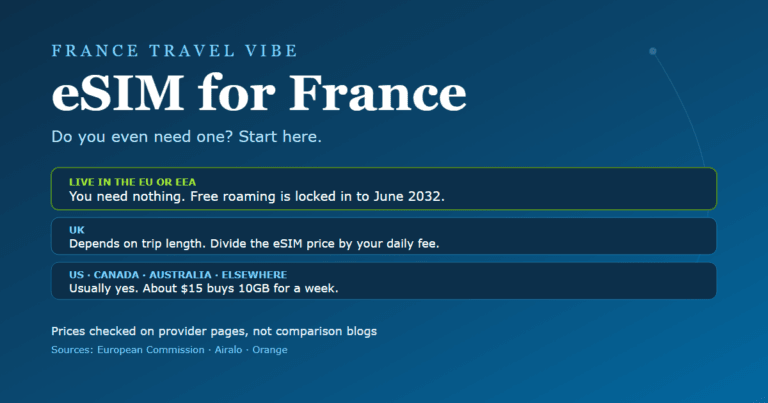
One habit saves you more money than any other: book early. TGV fares open around four months out and climb as seats sell. The same Paris–Lyon seat can cost €16 or €95 depending on when you click. Want the cheap end of that range? Set a calendar reminder for the day your travel month opens. Download offline maps before you travel too, which saves you when the signal drops between stations. Check whether you even need mobile data in France.
Getting around France by rail is one of the five decisions a first trip turns on. My complete France travel guide covers the other four: entry rules, budget, timing, and where to go.
TGV inOui vs Ouigo: What’s the Real Difference?
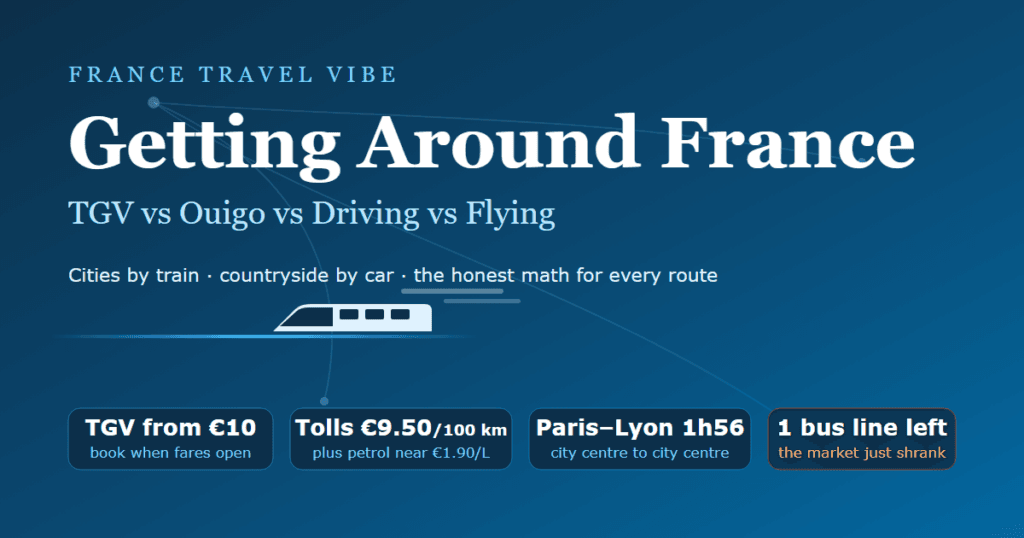
Same trains, same tracks, same speed, different business model. Ouigo is SNCF’s budget brand, with fares from €10 and Paris–Marseille from €16 (SNCF Connect, Ouigo, 2026). inOui is the full-service version, starting around €29 booked ahead (Seat61, Paris to Nice by train, 2026). Ouigo runs like a budget airline on rails: the base fare is real, and everything else costs extra.
Here’s what “extra” means in practice. Ouigo’s basic Essentiel fare includes one handbag (40 × 30 × 15 cm) and one cabin bag (55 × 35 × 25 cm); an additional bag is €5 when booked online, and choosing a seat costs €3 for a duo, square or triple seat, with or without a power socket, or €7 for a solo seat (OUIGO, bagages, 2026; SNCF Connect, Voyager avec OUIGO, 2026). There’s no café car. Children ride for a flat €5 on Ouigo Train Classique and €8 on the high-speed Ouigo.
| Ouigo | TGV inOui | |
|---|---|---|
| Typical advance fare | From €10–19 | From ~€29 |
| Large luggage | €5 supplement | Included |
| Seat choice | €3–7 | Included |
| Power socket | Paid option | At every seat |
| Café car | No | Yes |
| Flexibility | Low, fees to change | Fare-dependent |
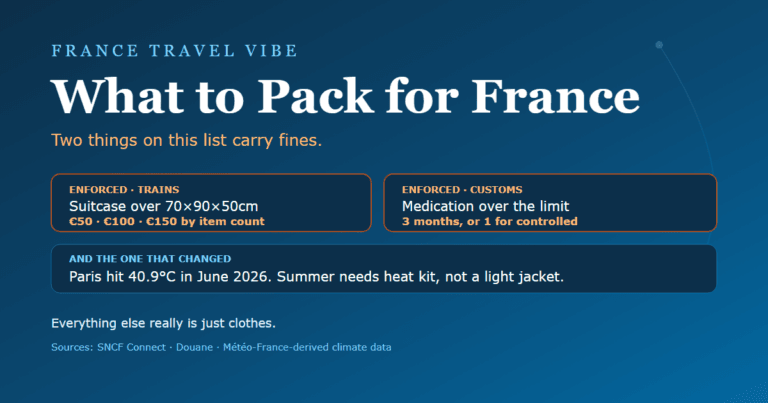
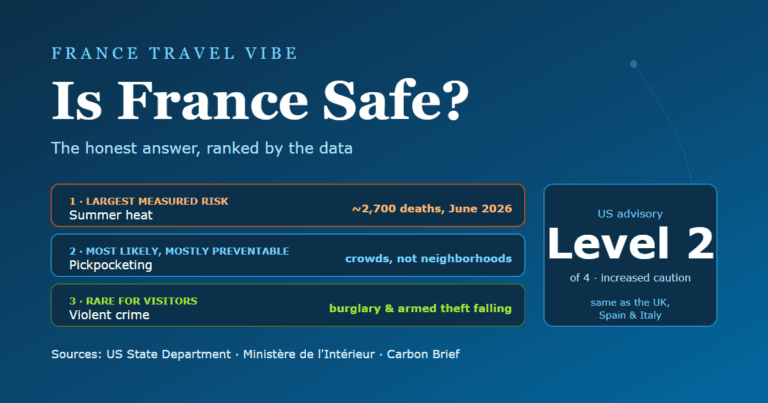
The gotchas bite harder than the fees. Ouigo asks you to arrive 30 minutes before departure, and boarding closes 5 minutes out. Miss that and the €16 fare becomes a €95 same-day replacement. Some Ouigo services also use secondary stations, so check whether yours leaves from the station you expect before you book the hotel next to the wrong one. Crowded platforms are also where pickpockets work, which my guide to whether France is safe covers station by station. Size matters too: SNCF fines oversized bags, so check what to pack for France before choosing a suitcase.
So which do you book for getting around France? Travelling light with a fixed date: Ouigo, no hesitation. Carrying a big suitcase, or wanting the option to change trains: price the inOui fare with luggage and flexibility included before assuming the “cheap” ticket is cheaper.
When Should You Rent a Car in France?
Rent a car for the countryside, never for the cities. In my October 2026 Europcar search, a week’s economy Renault Clio from Avignon TGV station in early November, booked three weeks ahead with unlimited mileage, came to $27.69 a day ($193.81 for the week, about €24 a day) before any insurance, and a compact Peugeot 308 to $34.61 a day; Europcar quotes in your home currency (Europcar, Avignon, 2026). Airport desks and July or August dates run well above that. That money buys you the one thing rail can’t: the roads between villages.
Some regions are genuinely built for driving. Provence’s hill villages, the Dordogne’s river castles, the Loire’s smaller châteaux, the Alsace wine route, Normandy beyond the main D-Day shuttle stops: public transport in these places is sparse, and the drive itself is the attraction. The Loire needs a qualifier too: four of the five main châteaux need no car, since Chenonceau has its own station 400 metres from the gate. Alsace is the other real exception on that list: a flat €4 regional coach fare and a railway that stops in the vineyard make it genuinely doable without a car. Champagne and Beaune are too, and I’ve compared wine tasting in France by train region by region. Could you see Provence by bus? Technically. You’d spend half your holiday at bus stops.
The trick that saves both money and sanity: rent locally, not from Paris. Take the TGV to Avignon or Bordeaux, then pick up the car at the station there. You skip Paris traffic, skip three days of paid parking, and skip 700 km of tolls, and the car works only the days it earns its keep. The same logic runs north: my six-day Normandy itinerary collects the car in Bayeux for the half of the trip that needs one, and my guide to whether to tour or drive the D-Day beaches covers the camera tolls on the A13 out of Paris. Worth pricing before you book: what a Provence village charges you to park reaches €30 a day in Gordes.
Three practical notes before you book. Most French rental fleets are manual. Automatics exist but cost more and sell out first, so reserve early if you need one. City driving needs a Crit’Air air-quality sticker for low-emission zones; order it online for a few euros before you travel. And parking in any big French city runs €20–40 a day, which is the quiet budget-killer nobody mentions. My honest France trip budget breaks down what each piece costs per day.
If getting around France in July or August involves a rental car, book it when you book the flights. High-season demand roughly doubles the January price, and the seasonal price swing hits rental counters as hard as hotels.
How Much Does Driving in France Actually Cost?
More than the map suggests, and it makes driving the expensive default for getting around France. French autoroutes are excellent and tolled nearly everywhere, at roughly €9–10 per 100 km on the main corridors south (call it €9.50 as a working average): the operators’ own 2026 grids price Paris to Lyon at €41.30 for a car, Lyon to Marseille at €28.10 and Aix to Nice at €21.20 (APRR, tarifs de péage 2026, 2026; VINCI Autoroutes, tarifs des principales liaisons 2026, 2026). Rates rose another 0.86% on average on February 1, 2026, the smallest rise since 2021 according to the transport ministry (UFC-Que Choisir, 2026). Petrol sat near €1.90 a litre in August 2026 and had climbed to about €2.14 by mid-October, which adds €7 to €15 to each of the drives below (prix-carburants.gouv.fr, 2026).
Run the actual numbers on the three classic routes, using the operators’ 2026 grids and a 6.7 L/100km car at the August price of €1.90 a litre (add €7 to €15 a route at October’s €2.14):
- Paris → Lyon (465 km): about €41 in tolls plus €59 petrol, for ≈ €100
- Paris → Marseille (775 km): about €69 in tolls plus €99 petrol, for ≈ €168
- Paris → Nice (930 km): about €91 in tolls plus €118 petrol, for ≈ €209
Compare that with Ouigo’s €16 to Marseille and €19 to Nice. Driving those routes solo costs ten times the train fare, before the rental car, before parking. In 2026, with €69.40 in tolls and petrol near €1.90 a litre, a Paris–Marseille drive runs about €168 in road costs alone, against a €16 advance Ouigo fare on the same route (APRR and VINCI Autoroutes, 2026; OUIGO, 2026).
Paying at the péage is painless: cash, card, or a Liber-t electronic tag that lets you roll through the orange “t” lanes without stopping. Want to avoid tolls entirely? The free routes nationales exist and are often lovely, but budget nearly double the driving time. One more transport cost to know: the CDG taxi forfait is fixed at €56, and fake taxi drivers at CDG still charge far more.
Can You Still Fly Domestically in France?
Mostly no, and for getting around France you mostly shouldn’t want to. France’s climate law bans scheduled domestic flights wherever several direct trains a day cover the route in under 2.5 hours. The European Commission cleared the measure in December 2022, and decree n° 2023-385 applied it from May 2023 for an initial three years to the Paris-Orly routes to Lyon, Bordeaux and Nantes, which no airline had flown since Air France dropped them in 2020 (European Commission, Decision (EU) 2022/2358, 2022; Banque des Territoires, 2023; BTN Europe, 2023). On several surviving corridors the train is nearly twice as fast door to door once you count check-in and transfers (Euronews, Taking the train can be almost twice as fast as flying, 2025).
The door-to-door math is what kills flying. A “1-hour flight” is really 30–45 minutes to the airport, an hour of security buffer, the flight, then another transfer at the far end. Summer 2026 made it worse. Works on the RER B meant the trip from central Paris to Charles-de-Gaulle could take up to 90 minutes (The Connexion, Summer works bring disruption to Paris public transport, 2026). Airport trains run only every 15 minutes, and the line shuts down early each night. Your €39 flight just cost you five hours.
When does flying still earn its seat? Three cases: Paris–Nice when your dates make the 5h50 train awkward, Paris–Toulouse (no high-speed line yet), and Corsica, which you can’t reach by rail at all. For everything else the train is faster, less stressful, and emits a small fraction of the carbon. Arriving from abroad instead? Your airport entry now involves biometric EES checks; my EES and ETIAS border guide covers what changed.
What Happened to Buses in France?
The market collapsed to a single operator, and almost every guide is still recommending a company that’s shutting down. BlaBlaCar announced on April 21, 2026 that BlaBlaCar Bus will close by year-end, leaving FlixBus as France’s only national coach network (NewMobility, BlaBlaCar is shutting down its bus division, 2026). Fares have already jumped as much as 50% on some routes since the news (Ulysse, 2026). If a blog tells you to “compare FlixBus and BlaBlaBus,” it was written before spring 2026.
FlixBus advertises domestic fares from €2.99, and its own route pages in October 2026 showed Paris–Lyon from €18.48 (14 departures a day, about 4h30) and Paris–Marseille from €38.97 (10 a day, about 9h10) (FlixBus, Paris–Lyon and Paris–Marseille, 2026). The trade-off hasn’t changed: Paris–Lyon is about 2 hours by TGV and 4.5 hours or more by coach. The bus wins in exactly three situations: rock-bottom budgets, routes the TGV skips, and overnight legs where the bus doubles as a bed.
Don’t confuse the bus with the app that’s staying. BlaBlaCar’s original carpooling marketplace continues, and it remains the cheap fallback for exactly the rural gaps where trains and coaches thin out. A shared ride from a regional town to a village often costs less than the taxi you’d otherwise need for the last 20 km.
One more of the cheap ways of getting around France deserves a mention here: Ouigo also runs slower “Train Classique” services from €10 on conventional lines to places like Nantes and Lyon. Slower than the TGV, cheaper than almost everything, and your luggage rides free.
Which Way of Getting Around France Fits Your Itinerary?
Match the tool to the trip shape, not the other way round. Cities by train, countryside by car, tight budgets on Ouigo or FlixBus, and planes only for Corsica or the far corners. That one sentence is 90% of getting around France done well.
Here’s how getting around France plays out on the three most common trip shapes:
- Paris plus one city (Lyon, Bordeaux, Marseille, Strasbourg): all rail, no exceptions. Book the TGV the day fares open and you’ll pay less than the airport transfers alone would cost. Marseille is the clearest case, and my Marseille travel guide lands you in the centre in 3h03. Picking Lyon or Bordeaux as that one city comes down to seven numbers.
- Paris plus a region (Provence, Dordogne, Loire, Alsace): TGV to the regional hub, rental car from the station there. You get high-speed for the long haul and wheels where they matter.
- The grand tour (three-plus regions in two weeks): mostly rail between hubs, with one or two short local rentals. Resist the urge to drive the whole loop; the tolls, fuel and one-way drop fees will quietly eat a day of your budget each travel day.
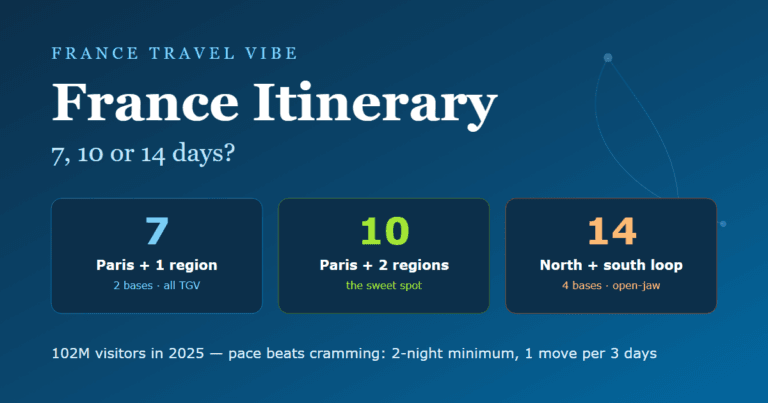
How many days you have changes the answer too. My 7 vs 10 vs 14 day France itinerary comparison pairs each trip length with the transport mix that fits it. Doing the classic run south? The Paris to Provence route guide walks it step by step.
One last cost that surprises people: nightly city taxes on your hotel bill vary by how you travel, because campsites and hostels pay a fraction of hotel rates. The full table is in my France tourist tax guide.
Frequently Asked Questions
Is it better to drive or take the train in France?
Train between cities, car in the countryside: that’s getting around France in one line. The TGV covers Paris–Bordeaux in 2h04 with 86.6% punctuality (SNCF Open Data, 2025), while the same trip by car means 5+ hours and roughly €135 in tolls and fuel. Rural regions like Provence and the Dordogne flip the answer: there, the car wins.
What is the difference between TGV inOui and Ouigo?
They’re the same high-speed trains under two brands. Ouigo starts at €10–19 with budget-airline rules: €5 for extra luggage, €3–7 for seat selection, no café car (SNCF Connect, 2026). inOui starts around €29 and includes luggage, seat choice and power at every seat.
How much are tolls in France?
Roughly €9–10 per 100 km on the main routes south, with rates up 0.86% on average since February 1, 2026. From the operators’ 2026 grids: Paris–Lyon €41.30, Paris–Marseille about €69, Paris–Nice about €91, per car, each way (APRR and VINCI Autoroutes, 2026). Petrol, about €2.14 a litre in mid-October 2026, comes on top.
Can you get around France without a car?
Yes: getting around France without a car works for most trips. The TGV, Intercités and TER networks link every major city and most mid-size towns, and 168.4 million passengers rode the TGV in 2025 (L’Echo Touristique, 2026). You’ll only miss the car in rural wine and village country, where a short local rental fills the gap.
Are there still cheap buses in France?
One network remains: FlixBus, from about €5 booked ahead. BlaBlaCar Bus announced in April 2026 it will shut down by year-end, and fares have risen as much as 50% since (Ulysse, 2026). BlaBlaCar’s separate carpooling app continues and stays useful for rural gaps.
The Bottom Line on Getting Around France
Getting around France rewards one mindset: think in combinations, not in either/or.
- Default to the TGV between cities: record ridership, 86.6% punctuality, and fares from €10–19 if you book when they open.
- Add a car only where it earns its keep: rural regions, picked up locally at a TGV station, never in Paris.
- Do the door-to-door math before flying. The 2.5-hour flight ban exists because the train usually wins; summer 2026’s 90-minute CDG transfers made the case for you.
- Book everything early. Trains, cars and the last remaining bus line all price by demand now, and August prices punish the spontaneous.
Start with my complete France travel guide to slot getting around France into the bigger plan, covering budget, timing, entry rules and all. Then book the train before the fare curve does what fare curves do.