
Last verified: October 19, 2026. I re-checked every fare on this page against Lignes d’Azur’s September 2026 fare guide and the airport’s 2026 taxi rates on the date above, and they hold. The fares, tax bands and cruise rules all changed in 2026, so I re-check this page monthly.
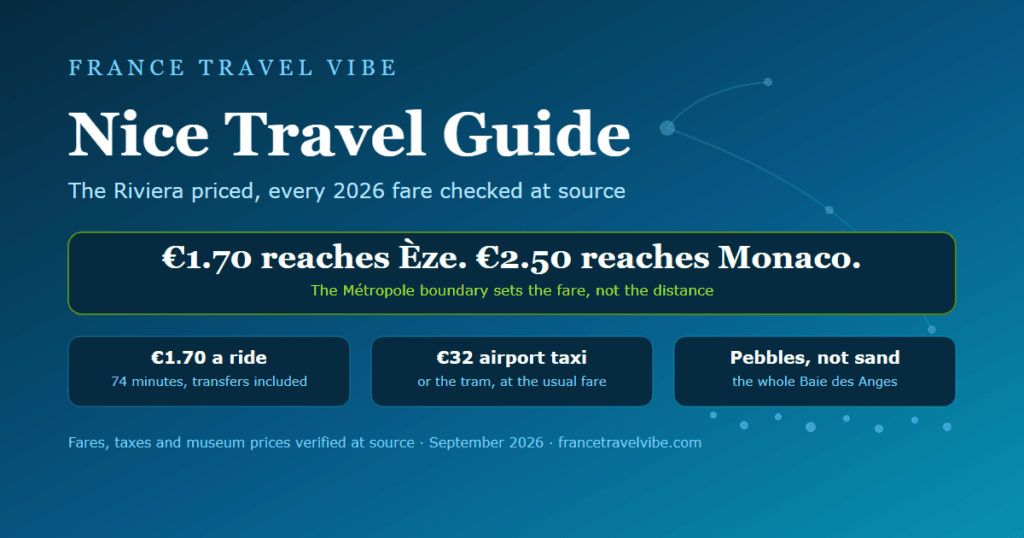
A tram ticket in Nice, France costs €1.70, and it is good for 74 minutes with transfers. That same ticket takes you out of the airport terminal, along the coast to Villefranche-sur-Mer, up to the perched village of Èze, and back. A taxi from the airport to the city centre is a fixed €32 (Nice Côte d’Azur Airport, taxi fares, 2026).
Disclosure: Some links in this guide may earn us a commission, at no extra cost to you. It never changes what we recommend.
Most Nice travel guides never mention either number. They rank the sights and describe the light. Then you arrive and find the beaches are stones, the machines don’t sell paper tickets, and the bus to Monaco needs a different ticket than the bus to Èze.
So here’s the practical half. This Nice travel guide prices a day in 2026 euros and maps which coastal towns your basic ticket already covers. It also says what the beaches are really like, and explains the rule change that quietly reshaped summer here.
Key Takeaways
- A €1.70 Lignes d’Azur ticket runs 74 minutes with transfers and reaches Villefranche, Beaulieu, Cap-Ferrat and Èze, all inside the same Métropole (Lignes d’Azur, 2026).
- Leaving that Métropole for Monaco, Menton, Antibes or Cannes takes the €2.50 Ticket Azur.
- The airport tram costs €1.70. The fixed taxi fare is €32.
- Nice’s beaches are smooth pebbles, not sand. A private sunbed runs €30–70.
- Since December 2025 the state, not the city, caps cruise arrivals along this whole coast.
Table of Contents
Is Nice a Good Base for the French Riviera?
Yes, and for one unglamorous reason: infrastructure. Most Nice travel guides answer this with adjectives. In 2025 Nice Côte d’Azur handled a record 15.23 million passengers, up 3.2%, on 163,052 commercial flights (Nice Côte d’Azur Airport, 2025 results, 2026). No other town on this coast pairs an international airport with a mainline station and a dense local network.
That combination lets you run a Riviera trip with no rental car at all. Cannes has the station but not the airport. Antibes has neither at that scale. From Nice you can reach eight coastal towns and be home for dinner. That’s a different holiday from the one where you spend an hour a day hunting for parking.
The trade-off is honest enough. Nice is a working city of about 350,000 people, not a resort. The bus station has queues and the Old Town has scooter noise. The eastern Promenade belongs to joggers and dog walkers more than to anyone on holiday. On long stays I’ve come to prefer that. You get bakeries serving locals in February, not just terraces serving tourists in July.
It also has a heritage listing most visitors never hear about. Since 27 July 2021 the city centre has been on the UNESCO World Heritage List as “Nice, Winter Resort Town of the Riviera” (UNESCO World Heritage Centre, 2021). Not a summer resort. A winter one. That tells you more about how to plan a trip here than any list of beaches will.
Where Nice sits against the rest of the country is settled in my ranking of the best places to visit in France. The whole-trip picture lives in my complete France travel guide. If you’re still weighing bases, the Riviera’s three contenders are Nice, Cannes and Antibes, and only one of them has the airport.
How Do You Get from Nice Airport to the City?
Tram line 2, from a stop inside the terminal, for €1.70, the standard city fare, with no airport premium (Lignes d’Azur, Guide des tarifs, September 2026). The official fixed taxi fare to central Nice is €32, and the fares onward are steeper: €72 to Antibes, €85 to Cannes, €95 to Monaco (Nice Côte d’Azur Airport, 2026).
There’s a catch almost nobody warns about, and it lands in your first ten minutes. Nice no longer sells single-use paper tickets. It belongs at the top of any Nice travel guide. You need a rechargeable contactless card, which costs €2 and is refundable, or the operator’s app. A €2 “Solo Secours” fare exists for people caught out, but it’s sold on board buses only, not at the tram stop where you’ll be standing.
Buy the card at a tram-stop machine before you queue for a taxi. Load it with a Multi voyages ticket. That starts at €1.70 a journey, covers one to 100 journeys, and several travellers can share one card as long as each person validates (Lignes d’Azur, 2026). Two adults and a week of riding fit comfortably on one card.
The €10 Aéro ticket covers an airport return with transfers. It’s the only fare on the network that loses on arithmetic: two €1.70 singles do the same job for €3.40. I’ve never found a reason to buy it.
What Getting Around Nice Costs, Ride by Ride
€1.70 per journey, valid 74 minutes with transfers, on trams and city buses alike. Passes run €7 for a day, €13 for two days, €20 for a week, €36 for a fortnight and €60 for a month (Lignes d’Azur, Guide des tarifs, September 2026). Children under four ride free.
Do the arithmetic before buying a pass, because most visitors lose on one. A €7 day pass needs more than four paid rides in 24 hours to beat singles. Nice is also a walking city. The Old Town, the Promenade, the port and Place Masséna sit within twenty minutes of each other on foot, so a normal sightseeing day means two rides, not five. Few Nice travel guides run that sum.
The same test kills the bigger regional pass for most trips. The Pass Sud Azur Explore covers every network in the Alpes-Maritimes and Monaco: train, tram, bus and coach. It costs €35 for three days, €50 for seven and €80 for fourteen (ZOU! Région Sud, 2026). At €11.67 a day, the three-day version needs about five paid journeys daily before it pays. Ride hard, all day, every day, and it wins. Take one day trip and potter the rest, and it loses.
Then there’s the ticket that decides your day trips, and it’s the most misunderstood fare on the coast. The Ticket Azur costs €2.50. It buys one journey on the Lignes d’Azur network plus a single transfer, within 2h30, onto an interurban Alpes-Maritimes line. Its whole purpose is to get you out of Métropole Nice Côte d’Azur territory (Lignes d’Azur, 2026). Which means it isn’t a general regional ticket at all. It’s an exit ticket. Everything inside the Métropole is already covered by the plain €1.70 fare.
For how the regional and high-speed networks connect Nice to the rest of the country, my guide to getting around France prices TGV against TER and the rental-car option. And the national daily-spend picture sits in my France trip cost breakdown. Coming down by train, the Paris to Provence route guide covers the stations and booking windows on the way south.
Which Day Trips Are Worth It from Nice?
The fare depends on one thing no Nice travel guide explains: whether the town sits inside Métropole Nice Côte d’Azur. Its 51 communes include Villefranche-sur-Mer, Beaulieu-sur-Mer, Saint-Jean-Cap-Ferrat, Èze and Cap-d’Ail (Métropole Nice Côte d’Azur, 2026). All four cost €1.70. Monaco, Menton, Antibes and Cannes sit outside it, so they cost €2.50.
| Destination | Inside the Métropole? | Bus fare | By train | Worth |
|---|---|---|---|---|
| Villefranche-sur-Mer | Yes | €1.70 | ~10 min | Half day |
| Beaulieu-sur-Mer | Yes | €1.70 | ~13 min | Half day |
| Saint-Jean-Cap-Ferrat | Yes | €1.70 | Walk from Beaulieu | Half day |
| Èze village | Yes | €1.70 | Èze-sur-Mer + climb | Half day |
| Cap-d’Ail | Yes | €1.70 | ~18 min | Half day |
| Monaco | No | €2.50 | ~22 min | Half day |
| Menton | No | €2.50 | ~35 min | Full day |
| Antibes | No | €2.50 | ~25 min | Full day |
| Cannes | No | €2.50 | ~30 min | Full day |
The workhorse is the ZOU! 600 bus. It runs Nice–Villefranche–Beaulieu–Èze-sur-Mer–Cap-d’Ail–Monaco–Roquebrune–Menton every 15 to 20 minutes (ZOU! Région Sud, 2026). One line, most of the coast.
Bus or train? The bus wins on views and loses on time. It hugs the corniche, so the drop to the water sits on your right the whole way. It also gets stuck behind everything that stops. The train is faster and spends much of the trip in cuttings and tunnels. My rule after enough of both: bus out in the morning for the coast, train back in the evening for your dinner.
By train, Nice to Monaco takes about 22 minutes. One-way fares are generally quoted around €5 to €6 on SNCF’s regional TER services. Treat rail fares as approximate. They shift with promotions and discount cards in a way the flat bus fares don’t.
One warning about Èze, because the name covers two places. Èze-sur-Mer is the station on the water. Èze village is the hilltop one in the photographs, roughly 400 metres above it. The 82 and 602 buses go up. The footpath also goes up, and it is a proper climb, not a stroll.
Are Nice’s Beaches Sand or Pebbles?
Pebbles. Smooth grey stones run the whole length of the Baie des Anges, because several rivers empty here. Every Nice travel guide says so. Few price what it costs you (Best of Nice, beaches guide, 2026). Private beaches with padded loungers are popular in Nice for a reason, and the reason is underfoot.
This is the mistake I watch people make every summer. They book Nice for a beach holiday, arrive with a thin towel and no water shoes, then spend the week renting a lounger they never budgeted for. Sunbeds run about €30 to €70 per person by beach and season. Ruhl Plage on the Promenade lists a sunbed with umbrella at €32, and a double bed with umbrella at €125 (MySunbed, Ruhl Plage tariffs, 2026).
Two cheap fixes make the public beach perfectly good. Water shoes, which turn the walk into the water from a wince into nothing. And a mat rather than a towel, because a towel over stones is still stones. My France packing guide has the full seasonal list.
If you want actual sand, it’s a €2.50 bus ride away in Antibes and Juan-les-Pins. Closer in, Villefranche’s Plage des Marinières is the softest option inside the Métropole, and it’s a €1.70 ride.
The compensation for pebbles is water clarity. Sand beaches cloud the moment a swell arrives. These don’t. Swim off Nice in late September and you get warm, clear water and roughly a tenth of the August crowd.
What to Do in Nice: Three Places That Carry a First Visit
Three things carry a first visit: the Cours Saleya market, the climb up Colline du Château, and one art museum. The flower and produce market runs Tuesday to Saturday, 06:00 to 17:30, and Sunday until 13:30. It’s closed Monday, when the same square fills instead with a brocante of around 200 antiques traders, roughly 07:00 to 18:00 (Nice Côte d’Azur Tourist Office, 2026). If you’d rather cook what the stalls sell, a market-morning cooking class in Nice starts here at 9:30, Tuesday to Sunday.
Turn up on a Monday expecting flowers and you’ll get something better, if you knew to expect it. Nobody tells you that, and I’ve watched it produce more disappointed faces than any other detail in Vieux Nice.
Colline du Château costs nothing. It’s the hill at the eastern end of the Promenade, with the view every postcard uses, and a free lift by the Hôtel Suisse spares you the steps. Go in the last hour of light. I climb it on my first evening in the city every time, because it sorts the map out in your head before you start walking it.
The museums split into two systems, and that split is what most Nice travel guides get wrong at the ticket desk. The municipal ones share a pass: €15 for four days across all of them, covering Matisse, Masséna, Palais Lascaris, the Beaux-Arts and more. Musée Matisse alone is €12, free for under-18s, students and jobseekers, and it closes on Tuesdays (Musée Matisse Nice, 2026). The Musée de la Photographie Charles Nègre is €5 (Musée Charles Nègre, 2026).
The Musée national Marc Chagall is the exception, and it’s the one most visitors want. It’s a national museum, so it is not on the municipal pass: €10 normally, €12 during exhibitions, free for under-18s and free for everyone on the first Sunday of each month. Also closed Tuesdays. Two paid museums plus Chagall in four days, and the €15 pass has already paid for itself.
Ticket-buying itself is worth a moment of care here, as it is anywhere with a queue and a tourist. My guide to common France tourist scams covers the resale sites. And the unwritten rules of a first French trip covers the greeting that earns you better service in every shop on Cours Saleya. What to order once you’re there is in my French food guide, region by region.
The Cruise Rules Changed, and Most Nice Travel Guides Have Them Wrong
Since 9 December 2025, cruise arrivals along this coast are capped by the state, not the city. The decree was signed by the Prefect of the Alpes-Maritimes and the Mediterranean Maritime Prefect. It limits each port to an annual average of 2,000 disembarked passengers per call day, with a hard ceiling of 3,000 on any single day (Préfecture maritime de la Méditerranée, 2025).
Almost every Nice travel guide still quotes the wrong numbers, and here’s why. In January 2025 the city’s then-mayor, Christian Estrosi, signed a municipal decree barring ships over 450 passengers from Nice and capping Villefranche-sur-Mer. On 13 July 2025 the Nice administrative court suspended it: a mayor has no authority over shipping movements, because that power belongs to the prefect (Seatrade Cruise, court ruling, 2025). The 450-passenger figure that still circulates describes a rule that was struck down.
Two more limits matter for planning a summer day. Only one ship a day may use each anchorage if it carries more than 1,300 passengers, and in July and August each zone is capped at 15 such calls a month. Lines that signed the Sustainable Mediterranean Cruise Charter get priority when calls are allocated.
What does that mean standing on the quay at Villefranche in August? Fewer mornings where three thousand people land at once. The bay still takes ships, but the days when the village population doubled before lunch are now the exception the decree is designed to prevent.
When Should You Visit Nice?
September, which is the month this Nice travel guide is built around. The sea is at its warmest of the year and the August crush has gone. In 2025 Côte d’Azur hotels, Monaco included, averaged more than 85% occupancy from June to September and came close to 90% in August, their best year on record (Côte d’Azur France tourism observatory, 2025 review, 2026). Nice’s own hotel and residence stays rose 7% to 6.6 million that year (Riviera Radio, 2026).
June no longer counts as shoulder season here: it sits inside that 85% stretch. My month-by-month guide to the best time to visit France ranks all twelve nationally, and the Riviera’s curve now peaks earlier than the country’s.
Winter deserves a serious look, which is the point that UNESCO listing was making. Hotel rates fall and the light is extraordinary. February also brings the two biggest events on this coast. Carnaval de Nice runs 9–28 February 2027 on the theme “Vive l’Amour”, overlapping Menton’s Fête du Citron from 13–28 February (Fête du Citron, 2027).
Then there’s what you pay for the room, where Nice quietly beats the capital. Tourist tax here runs from €0.27 a night at a one-star campsite to €6.43 in a palace. A 3-star room carries €2.28 per person per night: the metropolitan rate plus a 34% surcharge for the Ligne Nouvelle Provence Côte d’Azur (Métropole Nice Côte d’Azur, 2026 schedule, 2026). Paris tops out at €15.93. If the room rate itself is the problem, my comparison of budget hotel chains in France prices the cheap end in ten cities.
City-by-city rates across the country sit in my guide to France’s tourist taxes. If the Riviera is one leg of a longer trip, 7, 10 or 14 days settles how long to give it. Heading west afterwards? Provence’s markets and hill villages, and the Calanques beyond Marseille, pick up where this coast ends.
Frequently Asked Questions
How many days do you need in Nice?
Three full days plus one day trip. The city itself, meaning Vieux Nice, the Promenade, Colline du Château and a museum, fills a day and a half comfortably. The extra days buy you the coast rather than more Nice, and at €1.70 to €2.50 a ride, they’re the cheapest days of the trip.
Is Nice a good base for the French Riviera?
Yes. It’s the only Riviera town pairing an international airport (15.23 million passengers in 2025) with a mainline station and a dense bus and tram network. Villefranche, Beaulieu, Cap-Ferrat and Èze sit inside the same Métropole, so €1.70 reaches them; Monaco, Menton, Antibes and Cannes need the €2.50 Ticket Azur.
Are the beaches in Nice, France sand?
No. They’re smooth pebbles along the whole Baie des Anges, because several rivers empty here. Bring water shoes and a mat, or pay roughly €30–70 for a private-beach lounger. Ruhl Plage lists €32 for a sunbed with umbrella (MySunbed, 2026). The nearest real sand is Antibes and Juan-les-Pins.
How do you get from Nice airport to the city centre?
Tram line 2, from inside the terminal, for €1.70, the ordinary city fare. The official fixed taxi fare is €32 (Nice Côte d’Azur Airport, 2026). Buy a €2 rechargeable card at the tram stop first: Nice no longer sells single-use paper tickets, and the on-board €2 backup fare isn’t sold at tram stops.
Is Nice expensive?
Less than the rest of the Riviera. Rides are €1.70, museums run €5–12, and tourist tax on a 3-star room is €2.28 per person per night against Paris’s €15.93 top band (Métropole Nice Côte d’Azur, 2026). Hotel occupancy above 85% from June to September is what makes the room itself expensive.
The Bottom Line
Nice is the cheapest place on this coast to be based, and the reason is a boundary most visitors never see on a map.
- €1.70 goes further than you think: Villefranche, Beaulieu, Cap-Ferrat, Èze and Cap-d’Ail are all inside the Métropole.
- €2.50 is the exit fare: Monaco, Menton, Antibes and Cannes.
- Buy the €2 card first: no single-use paper tickets are sold.
- The beach is pebbles: water shoes, or €30–70 for a lounger.
- September beats August, and February beats its reputation.
- The cruise cap is 2,000, not 450. The number most Nice travel guides still print was struck down in court.
I first checked every figure here against the operator’s own website in August 2026, and re-checked the fares in October. I re-check monthly, because the fares, the tax bands and the cruise rules all changed within the last twelve months, and they’ll change again.
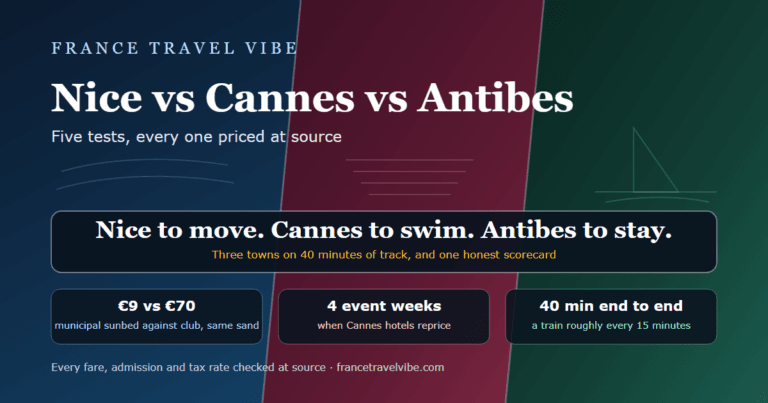
Still choosing a base? Nice wins on transport, and for a first Riviera trip that is usually the whole argument. Nice, Cannes and Antibes compared runs the full three-way scorecard. And my Paris guide prices the other end of the country, if you’re doing both.
Continue planning
Once Nice is fixed as your base, getting around France covers the trains that get you here, what a France trip costs sets the daily budget, and the best places to visit in France shows where the Riviera ranks against the other eleven.