
Last verified: October 17, 2026. Prices, journey times and crowd data on this page are drawn from my continuously verified France guides and were checked on the date above. I re-check monthly and update the date each time.
In 2025, a record 102 million international visitors came to France. That is the highest count any country has ever recorded (Campus France, 2026). Here’s the number nobody quotes next to it: the average visitor spent just €760 for the entire stay. Most France trips are shorter, closer and more modest than the two-week fantasy the brochures sell.
Which is exactly why the first France itinerary decision isn’t the route. It’s the length. Seven, ten and fourteen days produce three genuinely different trips. Picking wrong is how you end up seeing five towns through train windows. This page compares all three honestly, with 2026 prices on each.
Disclosure: Some links in this guide may earn us a commission, at no extra cost to you. It never changes what we recommend.
Key Takeaways
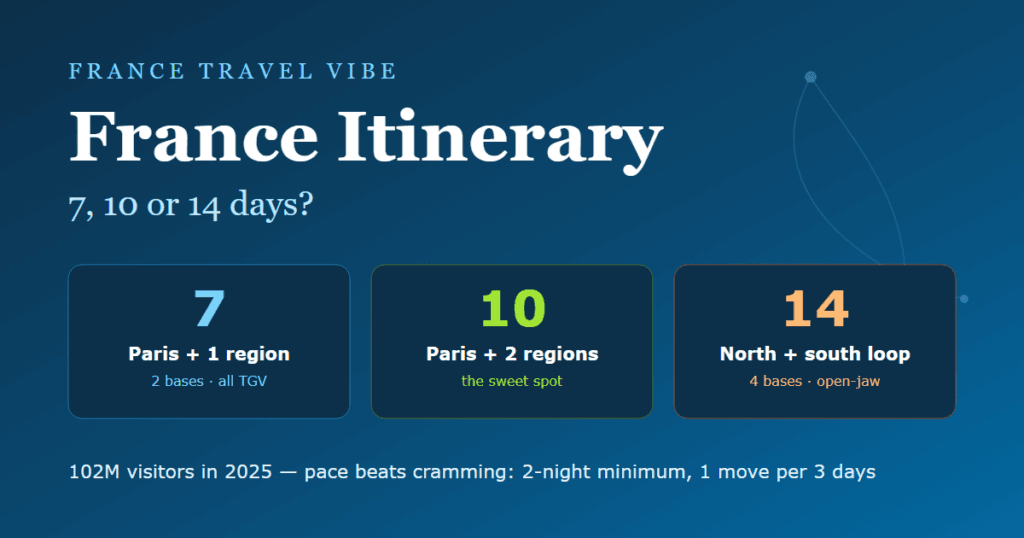
- Seven days = Paris plus one region. Ten days adds a second region. Only fourteen earns a north-plus-south loop.
- France drew a record 102 million visitors in 2025 (Campus France, 2026), so pacing beats cramming: two-night minimum per base, one move every three days.
- Budget from my verified 2026 model: a mid-range trip runs about €1,414 per person for 7 days, €2,020 for 10 and €2,828 for 14, flights excluded.
- September first, May second: the seasonal verdict applies to every length.
Table of Contents
How Many Days Do You Need in France?
Seven days is the honest minimum for a first France itinerary, and ten is the sweet spot. International visitors average close to a week per stay. In 2025 France logged 102 million of them, up from 100 million the year before (Campus France, 2026). Record crowds reward travelers who go deeper in fewer places.
The math behind that is simple. Every base change costs you roughly half a day door to door: pack, check out, transfer, check in, reorient. Add an arrival day that produces no real sightseeing, and a 7-day trip with two bases has about 5.5 usable days. The same week with five bases has four.
That’s the quiet flaw in most published France itinerary advice. Most published 7-day plans route four or five bases: Paris, the Alps, Provence and the Riviera in one week (Rough Guides, France itineraries, 2026). Charming on paper. In practice, roughly two of those seven days are spent in transit, which is a poor trade in the world’s most-visited country. In 2026, with 102 million annual visitors and US arrivals up more than 10% (Campus France, World’s leading destination, 2026), my rule for every France itinerary is fixed: no base under two nights, one move per three days.
Length is one of five decisions a first trip turns on. My complete France travel guide covers the other four: entry rules, budget, timing and transport.
What Fits in 7 Days? Paris Plus One Region
Three nights in Paris, four in one region. That’s the whole answer, and the TGV is why it works. Bordeaux is 2h04 from Paris, Marseille 3h02, and the Loire under two hours (SNCF Connect via my transport guide, 2026). One region is genuinely reachable without sacrificing a day to the move. If that region is really a city, Lyon and Bordeaux are the two to choose between. My Paris travel guide covers what those city nights should actually contain. And if one of those Paris days comes free, the best day trips from Paris are all under 90 minutes out by train.
Which region? Three pairings cover most first trips. Paris + the Loire for châteaux worth picking and an easy pace. Paris + Normandy for the D-Day coast and Mont-Saint-Michel. Paris + Provence for the south, using Ouigo’s €16 Paris–Marseille fares to keep the long hop cheap. Pick by interest; all three respect the two-night rule. For the full shortlist, see the 12 best places to visit in France, ranked by crowds and train time.
One habit protects the whole week: treat day one as an arrival day, not a sightseeing day. Border checks now include biometric EES registration for non-EU arrivals, and this summer’s RER B works can stretch central Paris to Charles-de-Gaulle to 90 minutes (The Connexion, Summer works disruption, 2026). A 3pm landing means a market dinner, not the Louvre. Plan it that way and nothing downstream slips.
What Does 10 Days Unlock?
A second region, and the classic version is the reason ten days is the France itinerary sweet spot. Three nights Paris, four in Provence, three on the Riviera, all by rail, and my guide to basing yourself in Nice covers those last three nights, once picking between Nice, Cannes and Antibes is settled: in 2026 Ouigo sells Paris–Marseille from €16 and Paris–Nice from €19 booked ahead (OUIGO via my transport guide, 2026).
The northern alternative deserves equal billing: Paris, Normandy and the Loire as a loop, which keeps every hop under three hours and suits history-first travelers. Either shape stays inside the rule: three bases, two moves, eight usable days.
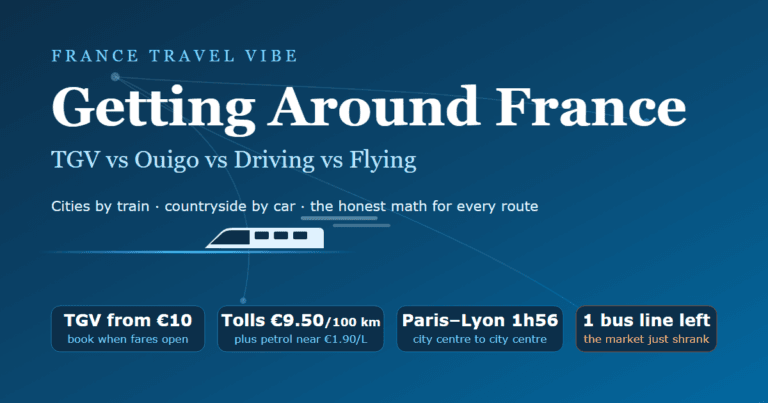
Ten days is also where a short car rental starts earning its keep. Two or three days with wheels out of Avignon or Bayeux unlocks the hill villages and the quieter D-Day sites, then the TGV handles the long legs. Rent locally at the station, never in Paris; the full mode-by-mode math is in my getting around France comparison.
| 7 days | 10 days | 14 days | |
|---|---|---|---|
| Bases | 2 | 3 | 4 |
| Shape | Paris + 1 region | Paris + 2 regions | North + south loop |
| Nights | 3 + 4 | 3 + 4 + 3 | 4 + 3 + 4 + 3 |
| Usable days | ~5.5 | ~8 | ~11.5 |
| Transport | TGV only | TGV + optional 2-day car | TGV + 1–2 local rentals |
| Mid-range cost pp* | ~€1,414 | ~€2,020 | ~€2,828 |
Is 14 Days Enough for North and South?
Yes: fourteen days is the first length where a real north-plus-south France itinerary works without cheating the two-night rule. Four bases at 4+3+4+3 nights covers Paris, Normandy or the Loire, Provence and the Riviera with 11.5 usable days. And with overnight stays up 7.5% in 2025’s record year (Campus France, World’s leading destination, 2026), four pre-booked bases beat fourteen improvised nights.
Two structural tips make the loop work. Run it north to south, so the trip ends on the coast rather than in a rush back to Paris. And price an open-jaw ticket: into Paris, home from Nice or Marseille. It usually costs little more than a return and saves the 5h50 backtrack across the country. Ending in Marseille? My Marseille travel guide makes the last three nights the calanques.
Who actually needs fourteen days? Second-trippers who’ve done Paris, food-and-wine travelers stacking two regions, and anyone crossing an ocean to get here. If the flight cost eight hours of your life, a week on the ground is a thin reward.
What Does Each France Itinerary Cost in 2026?
Using my verified 2026 model (€106 a day budget, €202 a day mid-range per person, flights excluded), a 7-day France itinerary runs about €742–1,414, ten days €1,060–2,020, and fourteen days €1,484–2,828 (my France trip cost breakdown, 2026). Those model rates come from itemized real prices, not guesses. The same arithmetic prices ten days for two at €2,112 budget and €4,048 mid-range.
Notice the cost does not scale the way you’d expect. Your flight costs the same whether you stay 7 days or 14, so the per-day price of the whole trip falls as it lengthens. A 7-day trip also skews expensive per day for another reason: more of it is Paris, and Paris runs €100–230 a day against €85–100 in the regions.
How does that square with France’s official €760 average spend per visitor? In 2025, international visitors spent €760 per stay on average across €77.5 billion in tourism revenue (Campus France, 2026). That average includes day-trippers from Belgium and families staying with relatives. It’s not a budget; it’s a reminder that averages lie. Two real line items belong on your list instead. Paris charges tourist tax up to €15.93 a night on top of room rates. The Louvre’s non-EU ticket hit €32 after 2026’s 45% rise.
When Should Your France Itinerary Run?
September first, May second. The same verdict at every length. That ranking comes from my month-by-month data. Paris hotels averaged €239 a night across 2025 but hit a record €514.05 that June (my best time to visit France ranking, 2026). June has left the shoulder season entirely.
Length changes how much the season matters. A 7-day winter city trip barely notices the cold, and it banks the €380–450 winter transatlantic fares against €850–1,200 in peak summer. A 14-day August loop feels every degree and every queue. This summer’s third heatwave pushed the Paris region to red alert (Travelers Today, France’s Third Heatwave, 2026). The longer the itinerary, the harder you should aim for September. My France safety guide covers the summer heat risk in full.
Which France Itinerary Fits You?
Match the length to the traveler, then hold the pacing rule. First trip and one week: Paris plus the Loire or Normandy. Returner with ten days: the south loop, Paris to Provence to the Riviera. Crossing an ocean, or stacking two regions you love: take the fourteen. Whatever you pick: no base under two nights, one move per three days.
Two final placement tricks from the transit math. Put your longest stay in the middle of the trip, where you’re most adjusted and least rushed. And spend your last night in the departure city, not three hours from it. A missed morning TGV before a flight is the most expensive mistake in France travel.
Frequently Asked Questions
How many days do you need in France?
Seven days minimum, ten ideally. International visitors average close to a week per stay, and France’s record 102 million visitors in 2025 (Campus France, 2026) make depth beat breadth. Seven days covers Paris plus one region properly; ten adds a second region.
Is 7 days enough for France?
Yes, for Paris plus one region. With TGV times of 2h04 to Bordeaux and about 2 hours to the Loire, one regional base works cleanly. It’s not enough for a north-south loop: at roughly half a day lost per move, a five-base week spends two days in transit.
How much does a 10-day France trip cost?
About €1,060 per person on a budget and €2,020 mid-range in 2026, flights excluded; my itemized model prices ten days for two at €2,112 and €4,048 (France Travel Vibe trip cost breakdown, 2026). Add flights, plus tourist tax by city.
Should I rent a car for a France itinerary?
Only for rural legs, rented locally at a TGV station. Tolls average about €9.50 per 100 km and city parking runs €20–40 a day, so the car earns its cost in Provence’s villages or rural Normandy, never between major cities (my getting around France comparison, 2026).
What is the best month for a France itinerary?
September, then May. Paris hotels averaged €239 a night across 2025 but hit a record €514.05 that June, and June now behaves like peak season (my month-by-month ranking, 2026). The longer the trip, the more September pays off.
The Bottom Line: Pick the Days First, Then the Route
Every good France itinerary starts with an honest length decision, because length controls everything else: pace, cost, season sensitivity and how much of the country you genuinely meet.
- 7 days: Paris + one region, 2 bases, ~€742–1,414 per person on the ground.
- 10 days: the sweet spot. Paris + two regions, 3 bases, ~€1,060–2,020.
- 14 days: the only honest north-plus-south loop, 4 bases, ~€1,484–2,828.
- Every length: two-night minimum per base, one move per three days, day one is an arrival day.
Start with my complete France travel guide to slot the length into the full plan, then lock the season with the month-by-month ranking before you price a single hotel.