
Last verified: October 19, 2026. I re-checked the Gordes parking bands and the Palais des Papes prices against the commune and the monument on the date above, and moved the fuel figure to the October price. The other fares, admissions and rules were checked in August against the operator or the commune that sets them: Zou! Région Sud, Les Baux-de-Provence, the Abbaye de Sénanque and the Vaucluse and Bouches-du-Rhône prefectures. I re-check this page monthly.
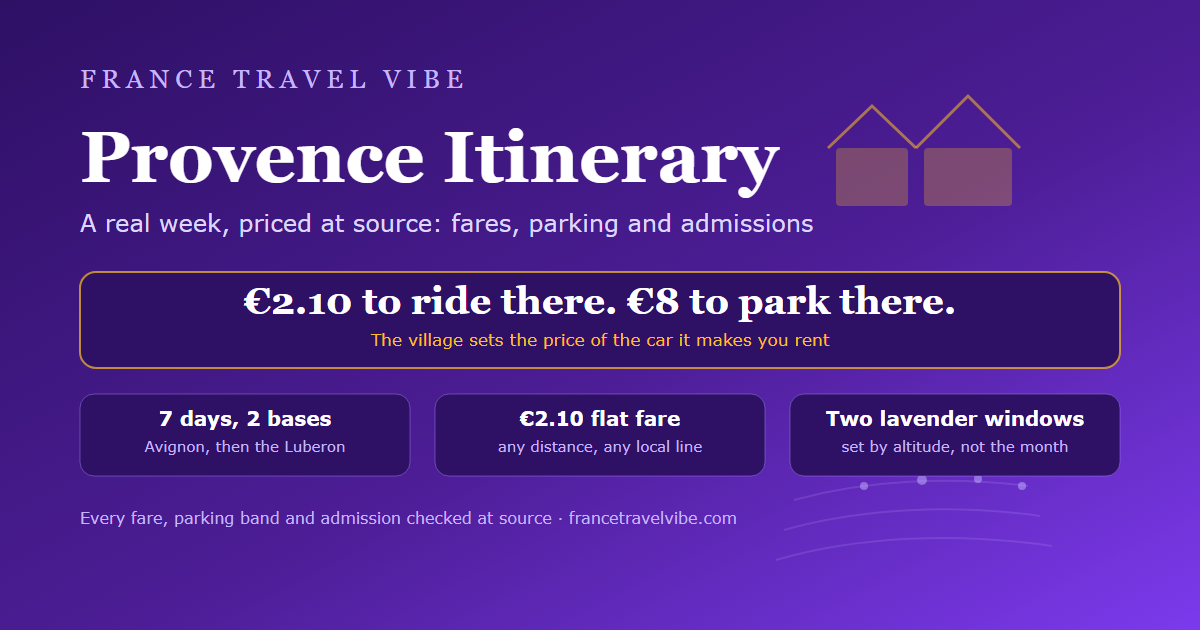
Gordes gives you 30 minutes free. After that it’s €8 for up to four hours, €10 up to eleven, and €30 if you’re still there past that (Commune de Gordes, 2026). That is the real price of a hill village, and I have never once seen it printed in a Provence itinerary.
Most of them read the same way. Rent a car, see five villages a day, photograph the lavender. They don’t tell you what the week costs, which village charges what, or that the abbey everyone photographs bans you from its field.
Disclosure: Some links in this guide may earn us a commission, at no extra cost to you. It never changes what we recommend.
So here’s a Provence itinerary with the numbers left in: seven days, two bases, the fares and parking bands that decide the route, and the four rules that changed for 2026.
Key Takeaways
- Give Provence seven days and two bases. Five works if you drop either the Luberon or the Alpilles.
- The villages charge for the car they force you to rent. Gordes wants €8 for four hours, €30 past eleven (Commune de Gordes, 2026).
- A Zou! regional bus is €2.20 flat, any distance, or €2.60 if you pay on board (Zou! Région Sud, September 2026).
- Sénanque forbids access to its lavender field, to protect the monks’ harvest (Abbaye de Sénanque, 2026).
- From June 1 to September 30 the prefectures close the hills by decree, publishing the next day’s map at 6pm.
Table of Contents
How Many Days Do You Need in Provence?
Seven, split across two bases. Avignon TGV sits 2 hours 33 minutes from Paris on the fastest service, so the region is a comfortable second stop rather than an expedition. Five days works if you accept losing either the Luberon or the Alpilles. Under four, and you’ve booked a driving holiday with villages attached.
The two-base rule matters more here than almost anywhere else in France. Distances look trivial on the map. Twenty kilometres between hill villages is a 40-minute drive on roads that were not built for this, ending at a paid car park with a queue in front of it.
I run it as three nights around Avignon and four in or under the Luberon. The first half is walkable and rail-served. The second half is the part that needs wheels, and only for those days.
Ten days changes the answer, but not the way people expect. It doesn’t buy a third base. It buys slack: a second market morning, a day held back for whenever the hills close, and one afternoon spent doing nothing in a square. A Provence itinerary that has no spare day in it is a schedule, not a holiday.
Where Provence sits against the other regions is in my ranking of the best places to visit in France, and if you’re still deciding how long the whole trip should run, 7, 10 or 14 days settles it. Arriving from Paris? The Paris to Provence route guide covers the stations, fares and booking windows.
Provence rewards two bases rather than one. Avignon TGV is 2 hours 33 minutes from Paris, and the Virgule shuttle covers the last stretch into Avignon Centre in about five minutes. The mistake first-timers make is single-basing and driving out and back daily, which turns a short region into a long commute.
Do You Need a Car in Provence?
For the hill villages, mostly yes. For the market towns, no. One journey on a Zou! Proximité bus costs €2.20 bought ahead, and the same ticket is valid on every proximité line inside the department, whatever the distance (Zou! Région Sud, September 2026). Pay the driver instead and there’s a €0.40 surcharge, so €2.60.
That flat fare is the part nobody explains. Avignon to Apt is about 50 kilometres and costs the same €2.20 as a hop between two neighbouring villages. Buy ten journeys for €15.40 and it drops to €1.54 a ride. Alsace runs the same trick at a flat €4. The €20-a-year Carte Zou! Malin takes a single to €1.50.
Now the honest half. Line 906 links Avignon and L’Isle-sur-la-Sorgue in about 50 minutes, and it runs 12 times a day with two Sunday services, which happens to be the town’s big market day. That’s a real bus service.
The hill villages are thinner. Line 917 covers Coustellet, Gordes, Roussillon and Apt four times each way, Monday to Saturday, and not at all on public holidays. But four is enough. It reaches Gordes at 08:14 and comes back through at 12:46 and 15:26, with Roussillon 20 minutes further along the same line (Zou! Région Sud, line 917 timetable from 1 September 2026).
So a car-free Gordes and Roussillon day genuinely works, six days a week, for two tickets. What it costs you is flexibility, an early start, and a climb from the Gendarmerie stop up into the village.
The connections are the part worth planning. At Coustellet the 917 meets line 907 into central Avignon and line 915 out to Avignon TGV, and the timetable prints the exact interchange times on the sheet. Tell the driver you’re connecting when you board.
Renting is still the right call for most weeks. Just rent it locally, at Avignon station, for the days it earns its keep. My comparison of TGV, Ouigo and driving runs that maths route by route, and what a France trip costs per day puts it in a budget.
What Does It Cost to Park in a Provence Village?
In Gordes, €8 for up to four hours, €10 up to eleven, and €30 beyond, with 30 free minutes at the meter and charges running 08:00 to 19:00 every day (Commune de Gordes, 2026). Les Baux starts gentler at €5 for one hour, then jumps to €35 at the eleven-hour mark (Mairie des Baux-de-Provence, 2025 schedule).
Look at what those two tariffs actually do. They are not really parking charges. They are turnover management, priced to move you out before lunch.
Capacity is the other half of the story. Gordes runs three paid car parks holding 96, 270 and 120 vehicles, plus around 60 metered spaces in the centre. That is under 550 spaces for one of the most photographed villages in France.
Which brings me to the mistake I watch people make every summer. Arrive at eleven and you queue for a space, pay the four-hour band, walk a hot street selling the same soap in six shops, and leave having seen nothing. Arrive at eight and the same village is a working place with the shutters going up. Two villages a day is the ceiling. The third one is always the one that ruins the day.
Coaches pay their own way in, incidentally: €50 for four hours in Gordes, €75 beyond, and €25 a day at Les Baux. When a village prices its coach bays that precisely, it’s telling you what it is managing.
The Seven-Day Provence Itinerary, Day by Day
Three nights in or near Avignon, four in the Luberon, with the car collected on day three and dropped on day seven. Two rented days instead of seven is the single biggest saving in this Provence itinerary, worth more than any admission discount once fuel sits near €2.14 a litre (prix-carburants.gouv.fr, October 2026). That shape also survives contact with the parking tariffs, the market calendar and the heat, which is more than most published routes manage.
| Day | Base | Anchor | If it rains, or it’s Monday |
|---|---|---|---|
| 1 | Avignon | Palais des Papes, ramparts, the bridge | Musée Calvet, Les Halles |
| 2 | Avignon | Pont du Gard | Châteauneuf-du-Pape |
| 3 | Move east | L’Isle-sur-la-Sorgue on a market morning | Fontaine-de-Vaucluse |
| 4 | Luberon | Gordes early, then Sénanque | Coustellet and the lavender museum |
| 5 | Luberon | Roussillon and the ochre trail | Bonnieux, Ménerbes, Lacoste |
| 6 | Luberon | Les Baux and the Carrières des Lumières | Saint-Rémy-de-Provence |
| 7 | Out | Aix-en-Provence, or Valensole in season | Apt on a Saturday |
Days one and two are deliberately car-free. Avignon is small enough to walk, the Pont du Gard is an easy half-day, and hiring a car for two days you’ll spend inside a walled city is money set on fire. Pick it up at the station on the morning of day three and the rental period matches the part of the week that needs it.
I’d resist the urge to add a fifth village anywhere in here. Every published Provence itinerary I’ve read stacks Ménerbes, Lacoste, Oppède and Bonnieux into one afternoon, which works on a map and collapses in a car park.
Days four and five are the ones this Provence itinerary is really built around. Gordes wants an early start and a strict exit before the parking band turns over. Roussillon is the softer of the two, and the ochre trail is short enough to fit either side of lunch.
Day six crosses into the Alpilles, which feels like a different region and mostly is. Day seven depends on where you fly from: Aix if you’re routing through Marseille, Valensole if it’s early July and lavender is the point.
Cut day five first if you only have six, and day two if you only have five. Day four is the one that justifies the whole trip, so protect it.
The admissions are worth pricing before you go, because they cluster. Avignon alone can absorb €40 a head in a morning.
Two of those deserve a note. Pedestrian access to the Pont du Gard costs nothing, and the €9 covers a whole vehicle however many of you there are and however long you stay (Pont du Gard, 2026). And the Sentier des Ocres at Roussillon is €3.50 for adults, free under 10, no booking, two loops of roughly 30 and 50 minutes (Destination Luberon, 2026).
Pack for stone streets and heat rather than for the photos. My season-by-season packing list covers the July version, which is not the same trip as the May one.
Which Markets Should You Plan the Week Around?
The markets are the skeleton of the week, not a bonus. L’Isle-sur-la-Sorgue runs Thursday and Sunday, 07:00 to 13:00, all year (Office de Tourisme de L’Isle-sur-la-Sorgue, 2026). Miss the Sunday one and no amount of rerouting on Monday gets it back.
| Day | Market | Note |
|---|---|---|
| Monday | Cavaillon | Confirmed on the bus operator’s own timetable |
| Tuesday | Gordes | Morning only, and the village fills fast |
| Wednesday | Saint-Rémy-de-Provence | The Alpilles anchor, 08:00 to 13:00 |
| Thursday | L’Isle-sur-la-Sorgue, Roussillon | The quieter of the two Isle days |
| Friday | Carpentras | The biggest in the Comtat |
| Saturday | Apt | Morning, and the Luberon’s working market |
| Sunday | L’Isle-sur-la-Sorgue, Coustellet | Antiques as well as produce |
Three of those days come from an unexpected source. The Zou! bus timetable for line 917 prints the market calendar on its own schedule sheet: Cavaillon Monday morning, Gordes Tuesday morning, Apt Saturday morning. When the transport operator schedules around the markets, that tells you how the region actually runs.
Buy accordingly. With no kitchen you want olives, cheese, bread, fruit and a bag of the almonds, not the lavender sachets. And go early, for the reason in the section above: the stalls are picked over by ten and the heat has arrived. The unwritten rules of French daily life apply hardest at a market stall, and my French food guide covers the regional dishes worth hunting down.
One practical warning about pace. A market morning is a half day, whatever you tell yourself when you plan it. Two hours of stalls, an hour of coffee, and the drive to wherever you’re going next eats the rest. Build a Provence itinerary that pairs each market with one village and nothing else, and you’ll actually see both.
Lavender Is Two Seasons, Not One
Lavender doesn’t have one window, it has two. The Valensole plateau, at about 590 metres, peaks between late June and the first week of July, with the harvest from mid-July. The Pays de Sault, above 800 metres, blooms later and holds into August with a fraction of the crowds. Altitude, not the calendar, decides your dates.
Sénanque is the picture everyone wants, and it comes with a rule almost nobody prints. Access to the lavender field is forbidden, to protect the monks’ harvest (Abbaye de Sénanque, 2026). You photograph it from the road above, and that is the whole experience.
The abbey’s own field turns violet from about June 25 and is cut between July 15 and 20. Entry is €8 for adults, €6 for students, €4 for children. Guided tours run in French only, so non-French speakers want the HistoPad self-guided visit, which covers 11 languages. It’s shut on Sunday mornings.
One geographic correction, because it costs people a day. Valensole is not in the Luberon. It’s roughly 90 minutes east, which makes it a full day out of your week rather than a stop between villages. If your Provence itinerary treats lavender as a stop, it will quietly become a five-hour round trip instead.
The fields are working farmland, not scenery. Park in the marked areas, never at a field entrance or on a service track, and keep out of the rows. A drone needs the owner’s permission. Where the fields are and how to shoot them properly belongs in its own guide.
Timing the whole trip around it? My month-by-month guide to visiting France sets the wider calendar.
Can You Hike the Luberon in Summer?
Only if the map says so that day. From June 1 to September 30, access to the forest massifs is set daily by prefectural decree, and the next day’s map is published at 6pm (Préfecture des Bouches-du-Rhône, 2026). Not a booking. A decree, refreshed every evening.
Vaucluse runs four levels across 15 massifs, including the Petit and Grand Luberon, the Monts de Vaucluse, Mont Ventoux and the Dentelles de Montmirail. Green means open. Yellow means open, go in the morning. Red closes the massif for the whole day. Red extreme bans everything (Préfecture de Vaucluse, 2026).
This is not theoretical. In August 2026 the Vaucluse prefecture shut the Petit Luberon and several other massifs outright under very severe fire risk. Even the ochre trail at Roussillon closes at extreme risk.
So how do you plan around it? Walk before eleven. Keep a village morning in reserve for the day the map goes red. And never drive an hour to a trailhead without checking the evening before, which takes about fifteen seconds on the prefecture’s own map.
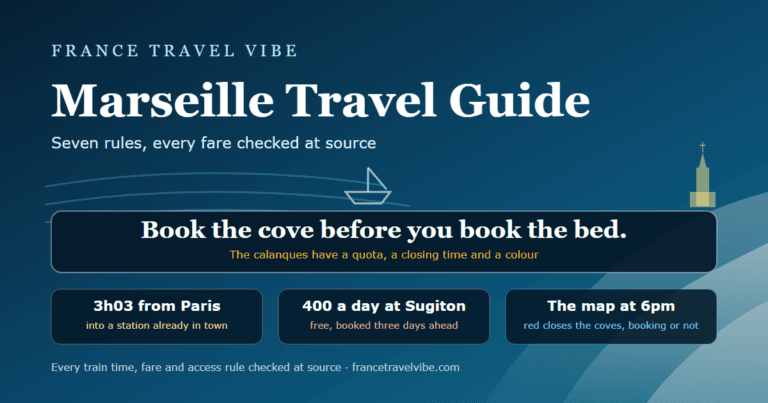
That heat is the same story from the other side. Southern France ran hot enough in 2026 to close sites elsewhere in the country, and Provence runs hotter than the Paris figures that made the news. My honest safety guide covers the wildfire and heat side properly, and my Marseille guide covers the calanques side of the same map.
Where to Base Yourself, and What Changed for 2026
Avignon, for a first week. It’s the only base with a mainline station 2 hours 33 minutes from Paris, a walled centre you can cross on foot, and a monument that reopened a new visit route on May 1, 2026 with rooms never previously shown (Palais des Papes, 2026). L’Isle-sur-la-Sorgue wins if you want the market on your doorstep, Saint-Rémy if the Alpilles are the point, and Aix if you’re arriving from Marseille rather than Paris. In the smaller villages a chambre d’hôtes is often the best bed in town, and breakfast is included by law. Saint-Rémy also keeps a cooking school on its Wednesday market, and cooking classes in Provence prices it against Paris and Nice.
The one I’d argue against for a first Provence itinerary is a farmhouse in the middle of the Luberon. They photograph beautifully and they commit you to driving to dinner every night, on unlit roads, after wine. Base in a village with a bakery and a restaurant, and the car stays parked in the evenings.
The old complaint about Avignon TGV sitting outside town is dead. The Virgule shuttle links it to Avignon Centre in about five minutes, roughly 35 times a day, and it’s usually covered by a through ticket.
Three things changed for 2026, and the palace is the first. That new route comes with a WebApp in six languages, and the building work behind it runs until spring 2027, so expect scaffolding somewhere. Budget two to two and a half hours, and from €16 for the palace alone or €19.50 with the bridge and the gardens. I’d take the combined ticket: the bridge on its own is a ten-minute stop and a shrug.
Second, the Festival d’Avignon fills the city for the first three weeks of July. In 2026 it ran July 4 to 25 with the IN and OFF aligned. The 81st edition lands in July 2027 with dates not yet announced, so if your week is in July, book beds early or base yourself outside the walls.
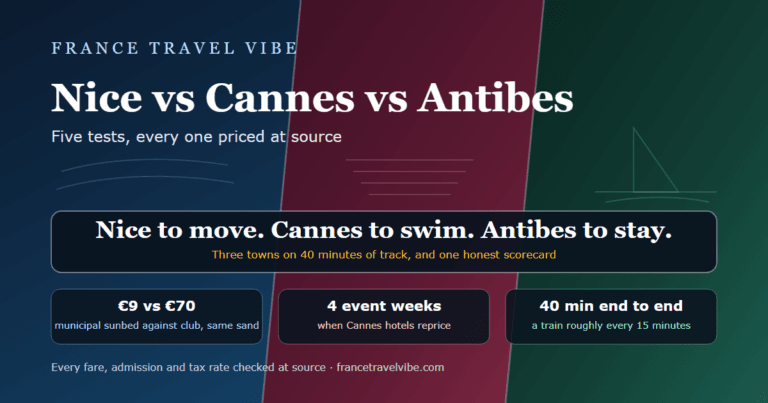
Third, fuel. SP95-E10 sat near €2.01 a litre in August 2026 and had climbed to about €2.14 by mid-October (prix-carburants.gouv.fr, 2026), which quietly changes the car-versus-train sum on the long legs. What your room costs on top is in my guide to France’s tourist taxes, and if the Riviera is the next leg, basing yourself in Nice picks up where this week ends, and Nice, Cannes and Antibes compared settles which town to base in.
Frequently Asked Questions
How many days do you need in Provence?
Seven, across two bases: three nights around Avignon and four in the Luberon. Five works if you drop either the Luberon or the Alpilles. Under four, and a Provence itinerary turns into a driving holiday, because the distances are short but the roads are slow and every village charges to park.
Do you need a car in Provence?
For the hill villages, mostly. But line 917 reaches Gordes and Roussillon four times each way, Monday to Saturday, for €2.20 a journey, and line 906 links Avignon and L’Isle-sur-la-Sorgue about 12 times a day. Paying the driver instead of buying ahead adds €0.40.
When is lavender in bloom in Provence?
Two windows. Valensole, at roughly 590 metres, peaks from late June into the first week of July. The Pays de Sault, above 800 metres, holds into August. Sénanque’s own field is violet from about June 25 and cut between July 15 and 20 (Abbaye de Sénanque, 2026).
What does it cost to park in a Provence village?
Gordes gives 30 free minutes, then charges €8 up to four hours, €10 up to eleven and €30 beyond. Les Baux runs €5 for one hour up to €10 for ten, then €35 at eleven. Both charge 08:00 to 19:00 every day, public holidays included.
Can you hike in Provence in July and August?
Only when that day’s map allows it. From June 1 to September 30 the prefectures set massif access daily and publish the next day’s colour code at 6pm. Red closes a massif for the whole day, and in August 2026 the Petit Luberon was shut outright.
The Bottom Line
- Seven days, two bases. Three nights around Avignon, four in the Luberon, car only for the days it earns its keep.
- The villages charge for the car they force on you. €8 for four hours in Gordes, €30 if you linger, under 550 spaces in total.
- €2.20 goes anywhere in the department, and a car-free Gordes and Roussillon day works Monday to Saturday.
- Lavender is two seasons at two altitudes, and Sénanque’s field is off limits at both of them.
- The hills close by decree in summer. Check the map at 6pm the night before, then plan the morning.
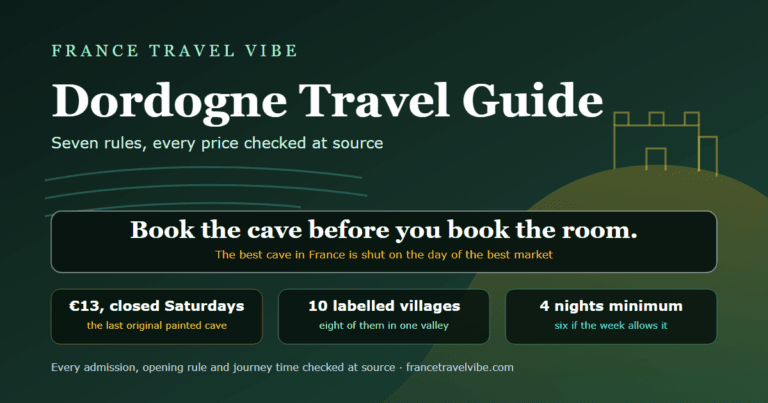
Build the Provence itinerary around those five things and the region stops fighting you. Still choosing the region itself? My ranking of the best places to visit in France puts Provence against the other eleven. Fitting it into something longer is what 7, 10 or 14 days is for, and the complete France travel guide covers everything before you land. Want the same slow pace with caves and castles instead of lavender? The Dordogne travel guide does the same job for the southwest.