
Last verified: September 3, 2026. Every train time, ferry fare and booking rule in this Brittany travel guide was checked against the body that sets it. That means SNCF Connect’s live route pages, the island operators’ own tariff grids, and the Rennes métropole’s low-emission zone rules. Two aggregator train times turned out to be wrong, and one tax figure I couldn’t verify at all, so I left it out. I re-check this page monthly.
Rennes, the fastest gateway on my list of the best places in France, is 1 hour 25 from Paris (SNCF Connect, 2026). The region behind it spent summer 2026 as the place the rest of France fled to. Then the Finistère prefecture shut the hills for fire risk. Brittany, France’s Celtic north-western corner, is not the simple cool alternative the coverage made it, and that’s exactly why it’s worth understanding properly.
Most guides to Brittany skip the train times, the ferry fares and the booking rules entirely, which matters here more than in most of France. Easy to reach. Surprisingly easy to get wrong.
So I checked everything myself. This Brittany travel guide is written as seven rules, each with a number attached and a source behind it. It also gives a straight answer on the car, the rain and the Mont.
Disclosure: Some links in this guide may earn us a commission, at no extra cost to you. It never changes what we recommend.
Key Takeaways: the seven rules
- Rule 1: five nights, two bases. Four is the floor, and the north and south coasts are about 2h30 apart by road.
- Rule 2: Rennes is the door, not the destination. It’s 1h25 from Paris, and the coast is roughly an hour beyond it in every direction (SNCF Connect, 2026).
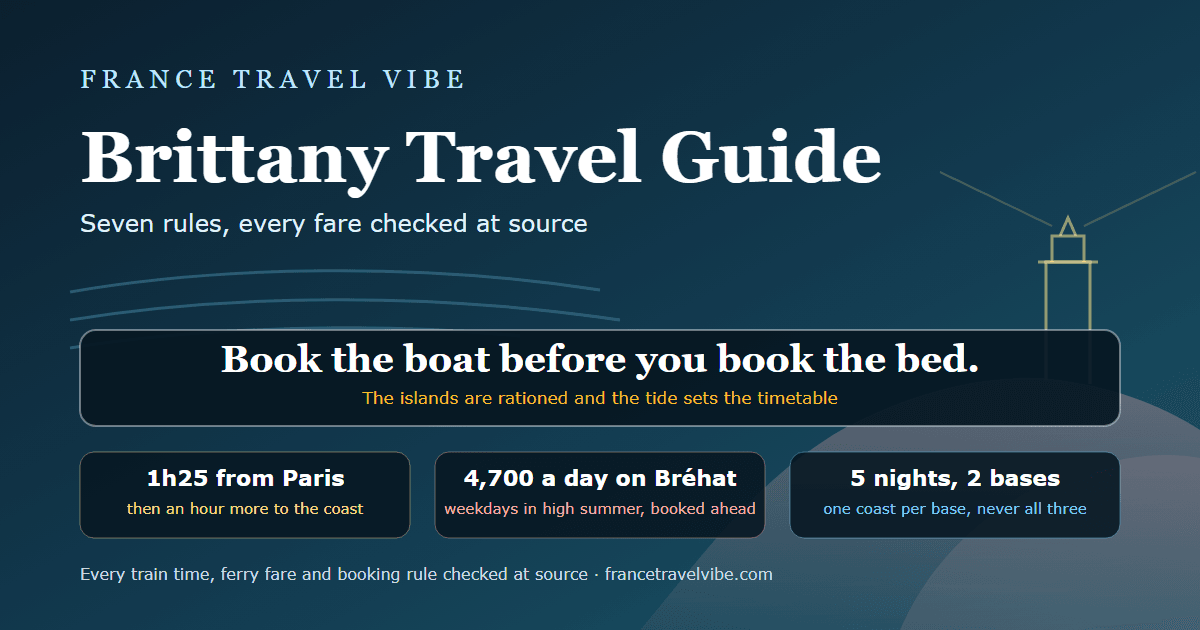
- Rule 3: book the boat before the bed. Bréhat held weekday arrivals to 4,700 in summer 2026, and Belle-Île’s ferry runs about €38 to €41 return (Côtes d’Armor Destination; BreizhGo Océane, 2026).
- Rule 4: Mont-Saint-Michel is in Normandy. A €25 return coach from Saint-Malo gets you there and back for lunch.
- Rule 5: one coast per base. Rennes runs a low-emission zone, so collect the car at Saint-Malo and you never touch it.
- Rule 6: June or late September, not August. The region France fled to in 2026 had four heat waves and fire closures of its own.
- Rule 7: read the tide table first. Saint-Malo’s range reaches 13 metres, and the equinox tides hit on September 28.
What’s in This Guide
What Is Brittany, and How Many Days Do You Need?
Five nights across two bases is the right answer, and four is the floor. Brittany is the peninsula at France’s north-western corner, with 2,730 km of coastline, about a third of the national total (Brittany Tourism, 2026). It has its own Celtic language. Its capital sits 1 hour 25 from Paris, and the coast everyone pictures sits another hour beyond that.
Forget the four departments, because nobody plans by préfecture. Plan by coast instead, and there are three real choices. The north has Saint-Malo, Dinan, the Pink Granite Coast and Bréhat. The far west has Brest, the Crozon peninsula, the Pointe du Raz and Ouessant. The south has Quimper, Carnac, the Gulf of Morbihan and Belle-Île. Four nights buys one coast done properly, five buys the north and the south with a travel day between them, and ten buys all three plus the islands.
Anything less than four turns into a queue for a boat. Ask me how I know.
One thing to settle before you book anything: this is not the South of France. If you want heat, olive trees and a warm sea, you’ll be disappointed, and it’s better to know now than on the quay at Roscoff.
What makes it different is not the scenery, though the scenery is good. It’s that the place has its own culture and it’s still alive. About 107,000 people speak Breton, and the speakers are getting younger: their average age fell from 70 in 2018 to 58.5 in 2024 (Région Bretagne, Enquête sociolinguistique 2024, 2025). The fest-noz, the night dance, went on UNESCO’s intangible heritage list in 2012, and about a thousand are still held every year (UNESCO). How Breton identity sits alongside the Basque, Alsatian and Corsican kinds is in my French culture guide. For how Breton identity compares with the Basque, Alsatian and Corsican ones, see my guide to French regional cultures.
And there’s the path. The GR34, the old customs officers’ trail, runs more than 2,000 km around the entire coast, about 100 days at 20 km a day (Brittany Tourism, GR 34). You’ll walk a piece of it whether you plan to or not.
My ranking sets the region against eleven others in where Brittany ranks among the best places to visit in France. Still shaping the wider trip? How many days France really needs covers the seven, ten and fourteen-day shapes, and my complete France travel guide handles entry rules and costs end to end.
How Do You Get to Brittany, and Do You Need a Car?
TGV to Rennes in 1 hour 25, then decide. There are 27 trains a day from Paris Montparnasse, from €10 booked early, and Saint-Malo, Brest, Quimper and Vannes all have direct trains too (SNCF Connect, checked September 2026). A two-base trip works car-free. The islands, the Pink Granite Coast and the Crozon peninsula don’t, and a car in Rennes now needs a Crit’Air sticker.
SNCF’s own route pages, rather than an aggregator, give the rail spine: Paris to Saint-Malo is 2h28 fastest and direct, 15 trains a day. Vannes is 2h21, 16 a day. Brest is 3h16, 13 a day. Quimper is 3h21, 15 a day (SNCF Connect, 2026).
From Rennes the coast is closer than the map suggests. Saint-Malo is 42 minutes fastest, 55 on average, on 22 trains a day from €12. Brest is 1h56 and Quimper 1h59, both from about €10 on the cheapest regional fares (SNCF Connect, 2026).
A car? Not for the towns. Yes for the coast between them. The Pink Granite Coast has no station. Neither does the Crozon peninsula, the Pointe du Raz or the road to the Bréhat boats. That matches what my guide to getting around France says about rural regions generally, and Brittany’s coast is the clearest case of it.
The Rennes low-emission zone
Now the rule nobody else prints. Rennes runs a zone à faibles émissions, a low-emission zone (ZFE), and it’s the only one at a fast Brittany gateway. Inside the ring road, cars with no Crit’Air classification have been banned since 1 January 2025. Crit’Air 5 joins them on 1 January 2027, Crit’Air 4 in 2029 and Crit’Air 3 in 2030 (Rennes Métropole, 2026). A French hire car carries the sticker already. A car driven over from Belgium, Germany or the UK does not.
Two things soften it. The ring road itself is outside the zone, so a driver who collects a car and heads straight for the coast never enters it. And a Pass ZFE 24h lets a restricted car in for a day, up to 52 times a year, with no paperwork beyond noting the date (Rennes Métropole, 2026). Simplest of all: pick the car up at Saint-Malo station instead.
From Britain, Portsmouth to Saint-Malo is an overnight crossing of roughly 11 hours (Brittany Ferries). Plymouth to Roscoff runs about 6 hours by day, and it is the only route into western Brittany (Brittany Ferries, 2026). Both land you in the region with a car and no ZFE to think about.
Flying in, three airports matter for a first trip: Rennes, Brest and Dinard, the last a short drive from Saint-Malo’s walls and the one to check for UK departures. Lorient, Quimper and Lannion have smaller airfields with thin schedules. Nantes, just outside the region, is the southern gateway for Vannes and Carnac.
If you only have a day, Rennes works as a return trip from the capital. My guide to the day trips that work from Paris by train puts it beside the others. Island coverage is patchy, so my note on which French network your eSIM actually rides on is worth two minutes before you leave.
Which Islands Need a Booking, and What Do the Boats Cost?
Bréhat in high summer, and the boat first, always. The island of flowers held weekday arrivals to 4,700 between 8.30am and 2.30pm from July 28 to August 22, 2026, under a municipal order first issued in 2023 (Côtes d’Armor Destination, 2026). Three companies sell the crossing in advance. Belle-Île costs about €38 to €41 return and takes 50 minutes. Ouessant is €39.80 return in high season and 1h15 from Le Conquet.
I’m writing this after the 2026 window closed, so read it as the rule for 2026 and the pattern since 2023, and expect it again next July. It exists because Bréhat has about 400 year-round residents, took up to 6,000 day visitors on peak days in 2021, and sees more than 400,000 a year (Europe 1, 2023). The cap runs Monday to Friday only. Weekends are uncapped and, by the local press’s own advice, quieter (France 3 Bretagne, July 2026).
Each of the three islands is a different trip. Bréhat is a half day with no car and no bike, ten minutes off the Arcouest pier near Paimpol. Belle-Île is two nights with a bicycle. The BreizhGo Océane boat from Quiberon takes 50 minutes and runs about 20 round trips a day in July and August against 5 in midwinter (Belle-Île-en-Mer tourist office, 2026). Vehicle space is tiny and sells out. The adult return is €37.80 in low season and €40.70 in high, valid to 3 January 2027 (BreizhGo Océane).
Ouessant is the end of the world, and the crossing is the filter. Penn Ar Bed charges €39.80 return from 1 July to 30 September and on May and June weekends, and €33.50 the rest of the year (Penn Ar Bed, Tarifs 2026). Ages 4 to 17 pay €22. A single is half the return. Le Conquet is the main port, 1h15 out. Molène, Sein and the Glénan archipelago exist too. I’ll leave them there rather than turn this Brittany travel guide into a gazetteer.
Three of the places in my best-places ranking now cap daily visitors. Bréhat is the only one in the north. The lesson is the same on all three: the boat is the scarce thing and the hotel is not, so book it first.
Zooming out from the coast, my ranking of the experiences worth your time in France prices fifteen of them, five free, and flags the four you have to book before you fly.
Is Mont-Saint-Michel in Brittany?
No. It sits in Normandy, about a kilometre east of the Couesnon river that marks the border, and every Breton will tell you it was stolen. It’s also about an hour from Saint-Malo by a coach that costs from €15 single and €25 return, with tickets sold online and not on board (Keolis Armor, 2026). That makes it the easiest half-day in the region that isn’t in the region.
I mention the border because at least half the people I talked to on the Saint-Malo ramparts believed the Mont was Breton. One couple had booked a Saint-Malo hotel specifically to be “near it in Brittany”. They were near it. They just weren’t in the right region, and neither is the Mont.
The practical answer is to do it as a morning from Saint-Malo and be back for lunch. The Keolis Armor line runs from two stops in town, daily from April to early November. A combined Rennes to Mont to Saint-Malo ticket costs the same €25 (Keolis Armor, 2026). I won’t repeat the Mont’s parking bands or the abbey price here. My six-day Normandy itinerary already prices them, and the two posts are meant to be read together.
Saint-Malo itself deserves a plain paragraph. It’s the granite walled town rebuilt after 1944. It takes an estimated 2.5 million visitors a year, and the last butcher inside the walls has been replaced by a souvenir shop (franceinfo, 2023). That’s what August does to it. Come in June or September and it’s a different town.
Basing in the capital instead? My Paris travel guide covers the four-day first visit. Saint-Malo is a direct 2h28 from Montparnasse for the day the city gets too much (SNCF Connect, 2026).
Where to Base Yourself: Three Coasts, One Choice
Saint-Malo or Dinan for the north, Vannes or Quimper for the south, one base on each coast, and no third unless you have ten nights. Every Brittany travel guide has a favourite base; the right one depends on which coast you choose. The south is where the French go. The Gulf of Morbihan took 21 percent of Brittany’s tourist nights in 2025, the Saint-Malo and Cap Fréhel coast 16 percent, and the Loire-Océan coast 14 percent (Tourisme Bretagne via L’Écho Touristique, 2026). That split explains why the Pink Granite Coast still feels empty in June.
Dinan is the base most guides recommend for the north, and it holds up. It’s a medieval hill town with rail to Saint-Malo and buses to Dinard, and it’s quieter at night than the port. Saint-Malo wins if you want the sea from the window and the Mont coach from the door.
The Pink Granite Coast around Ploumanac’h has no station, which is the whole reason it stays under-visited. Car day, from either northern base.
Brest is the base nobody recommends and the one that reaches Ouessant, the Crozon peninsula and the Pointe du Raz. The headland is free to walk; its last published tariff, for the 2024 season, charges €8 a car to park, with the first 15 minutes free (Pointe du Raz Grand Site).
In 2025 the south gained its anchor. UNESCO inscribed the megaliths of Carnac and the Morbihan shores on 12 July 2025, a group of more than 550 sites spread across over 1,000 km². It is France’s 54th World Heritage property and Brittany’s first (UNESCO). More useful than the badge is the practical rule. From April to September the alignments are guided-tour only, at €13 an adult and €7 a child, and from October to March you can walk into them free. The perimeter path is free all year (Carnac tourist office; Alignements de Carnac, 2026).
Vannes, 2h21 from Paris, is the base for Carnac and the Gulf (SNCF Connect, 2026). For the far south-west there is Quimper, the prettiest Breton city and, at 3h21 from Paris, the one that costs you a morning to reach.
Pick one. Then see which kind of bed to book there.
The interior exists too, and 2026 was a reminder that it’s wilder than it looks. The prefecture closed the woods, moors and heaths of 42 Finistère communes from July 11 to 15, including the Monts d’Arrée and the Crozon peninsula, for fire risk (franceinfo, 2026).
When Should You Go, and What Did Summer 2026 Change?
June or late September, and 2026 made the case louder. Brittany was France’s summer refuge on paper. August occupancy rose 1.6 points and revenue per available room rose 6.1 percent on 2025, and the coast passed 90 percent occupancy at the peak (Alliance France Tourisme, 2026). The region’s own board counted four heat waves in the same season (Tourisme Bretagne via TourMaG, 2026).
Here’s the part the national coverage missed. The demand shift was real. Before the summer, a SiteMinder survey of 12,000 travellers put Brittany first among French holidaymakers’ intended destinations for the first time. It took 23 percent, ahead of Provence-Alpes-Côte d’Azur at 22 and Normandy at 17 (SiteMinder, Changing Traveller Report 2026, via TendanceHotellerie). People came looking for cool.
What they found was a different summer. Tourisme Bretagne’s own season review says attendance from April 1 to August 20 stayed “close to recent years”. Stays got shorter, bookings went last-minute and spending tightened. Some leisure sites closed for up to ten days under heat and fire orders. French visitors took 76 percent of nights; Belgian nights rose 13 percent and North American nights nearly 15 percent (Tourisme Bretagne via TourMaG, 2026). On August 8 a vegetation fire at Brasparts in the Monts d’Arrée needed 75 firefighters (France 3 Bretagne, 2026).
So the region filled up because it was supposed to be the cool option, at the exact moment it stopped being one. The conclusion isn’t “avoid Brittany”. It’s that the reason to come was never August temperature. It’s June and late September, when the coast empties, the fire orders lift and the sea is at its warmest.
The rain, and the 2025 baseline
The rain is really Finistère’s problem, not Brittany’s. Brest averages 1,174 mm a year over 130 rain days, and also 2,117 hours of sun (Météo-France, normales 1991 to 2020). Rennes and the Gulf of Morbihan are drier. Pack for both, and my list of what to pack for a wet coast has the layers.
The 2025 baseline matters, because it was a good year. Insee counted 22.4 million nights in the region’s commercial lodging from April to September, up 5.7 percent and just short of the 2023 record. Campsites took 14.6 million of them, hotels 5.1 million. Foreign nights rose 11.6 percent, with Germans, the British and the Dutch the top three (Insee Flash Bretagne 116, December 2025). For how French campsites, stars and pitch prices work, see my guide to camping in France.
One more note for the summer months. Green algae wash up in a handful of shallow bays every year. Air Breizh monitors 17 points across seven bays from May 15 to October 15, and affected beaches are signposted locally (Air Breizh, 2026). The school-holiday calendar is in my month-by-month guide to timing a France trip.
The Costs No Brittany Travel Guide Prints
The big-ticket items here are boats, not museums. Belle-Île and Ouessant together cost about €80 a head in high-season return fares (BreizhGo Océane; Penn Ar Bed, 2026), and Bréhat’s shuttle price only appears at booking. Carnac’s guided tour is €13 and the Mont coach is €25 return. The coast path, the beaches and the tide are free (Penn Ar Bed; BreizhGo Océane; Keolis Armor, 2026).
Transport is the real saving. Regional trains from Rennes start at €10 to €12 a single on the cheapest fares, and 22 of them run to Saint-Malo every day (SNCF Connect, 2026). A car is only worth its cost for the coast days. Hire it for two of the five, not all five.
Accommodation splits by type more than by town. Insee’s summer count puts campsites at about 65 percent of the region’s commercial nights (Insee Flash Bretagne 116, 2025). That is why a walled-town hotel in Saint-Malo and a pitch fifteen minutes out are priced like different countries. The daily budget shape matches what a France trip actually costs per day.
On the nightly tourist tax I’ll give you no Saint-Malo number.
Two reasons, and both deserve a paragraph. The agglomération’s 2026 grid adds a 10 percent departmental surcharge on top of a base rate (Saint-Malo Tourisme), which is exactly the shape that produces wrong figures elsewhere. There’s a bigger reason too. The Région Bretagne asked for a 200 percent regional surcharge on the tax from January 2026 to fund transport. That would take a two-star hotel night from about €0.90 to €2.70 (franceinfo, November 2025). I couldn’t confirm whether the budget law kept it, so check the line on your booking. My guide to French tourist taxes covers how the base rate and the surcharges stack.
The free things are the point of the place. Walk the GR34 from any hotel door, stand on the ramparts at high water, and remember that every beach is free. In September most are empty by four.
What Every Brittany Travel Guide Gets Wrong About the Tide
The tide table, not the clock, decides when Saint-Malo is worth walking. The range here reaches 13 metres, the biggest in Europe (Ille-et-Vilaine Tourisme). Most guides plan the town around opening hours. Plan it around the coefficient, the 20-to-120 scale the French use for tide strength, and everything else falls into place.
I planned my Saint-Malo day around opening hours and the sea planned it around me. The walk out to the Grand Bé, the island with Chateaubriand’s grave, only exists at low water, and the beach under the ramparts vanishes completely on a big coefficient. Wet shoes. A lesson that stuck: the town’s own tide calendar is a better itinerary than any guidebook.
Anything over 90 is a show. The autumn equinox tides of September 27 to 29, 2026 reach 97, 99 and 98, and October 27 hits 100 (Saint-Malo tourist office, Les grandes marées 2026). Waves come over the sea wall on the Sillon, and the whole town turns out to watch.
So the five-night order is this: three nights in Saint-Malo, two in Vannes. Arrive by direct train. Do the Mont as a morning on day two. Give the Pink Granite Coast a car day and Bréhat the next morning, then cross south for Carnac and the Gulf. The island boats want booking before the hotel, and the ramparts day goes wherever the coefficient is highest.
| Day | Morning | Afternoon | Evening |
|---|---|---|---|
| Day 1 | Paris to Saint-Malo, 2h28 direct | Ramparts at high water, then the Grand Bé at low | Dinner inside the walls |
| Day 2 | Coach to Mont-Saint-Michel, €25 return | Back to Saint-Malo for lunch; Dinan by train | Dinan old town |
| Day 3 | Collect the car at Saint-Malo station | Pink Granite Coast, Ploumanac’h | Back to Saint-Malo, third night |
| Day 4 | Bréhat, boat booked weeks ago | Drive south to Vannes, about 2h45 from the pier | Gulf of Morbihan at sunset, first Vannes night |
| Day 5 | Carnac guided tour, €13 | Quiberon peninsula (the Belle-Île boat is the ten-night extension) | Second Vannes night; train home next morning, 2h21 |
Collect the car at Saint-Malo, not Rennes, and the low-emission zone never comes up. Day 3 is the long one, about two hours each way to Ploumanac’h, so start early. Give it ten nights and you add Brest, Ouessant and the Crozon peninsula. Winter is a genuine option too. My best-places ranking called it “moody rather than unpleasant”, and that’s accurate, with the tide show at its best and the towns to yourself.
On food, one sentence: the crêpe is Brittany’s dish, the galette is the savoury one, and cider comes in a bowl. The rest of the country’s dishes are in my French food guide. Etiquette is another matter. The unwritten rules of visiting France cover the habits that Breton bars in particular reward.
Frequently Asked Questions
Is Brittany worth visiting?
Yes, if you want coast, walking, islands and food rather than heat. Brittany has 2,730 km of shoreline, about a third of France’s, the GR34 path runs the whole length, and Rennes is 1 hour 25 from Paris. It’s not the South of France: Brest averages 130 rain days a year. In 2026 French holidaymakers ranked it their first-choice summer destination for the first time.
How many days do you need in Brittany?
Five nights across two bases is the right answer and four is the minimum. The north coast (Saint-Malo, Dinan, the Pink Granite Coast, Bréhat) and the south (Vannes, Carnac, the Gulf of Morbihan, Belle-Île) are about 2h30 apart by road. Each island needs a booked boat and a full day, or a half day for Bréhat. Ten nights adds Brest, Ouessant and the Crozon peninsula.
Is Mont-Saint-Michel in Brittany or Normandy?
Normandy, by about a kilometre. The Couesnon river marks the border and the Mont sits on the Norman side. From Saint-Malo the Keolis Armor coach takes about an hour and costs from €15 single or €25 return, with tickets sold online rather than on board.
Do you need a car in Brittany?
Not for a two-base trip by train, yes for the coast between the stations. Saint-Malo, Brest, Quimper and Vannes have direct trains from Paris and €10 to €12 regional fares from Rennes. The Pink Granite Coast, the Crozon peninsula and the Pointe du Raz need a car. Rennes runs a low-emission zone inside its ring road, so collect the car at Saint-Malo station and avoid it entirely.
What is the best month to visit Brittany, France?
June or September. July and August bring French school holidays, Bréhat’s 4,700-a-day weekday cap, and in 2026 four heat waves plus fire closures in the Finistère hills. Late September in Brittany, France adds the equinox tides at Saint-Malo, which reach coefficient 99 on September 28, 2026. The tidal range there, Europe’s biggest, reaches 13 metres.
The Bottom Line
- Book in this order: boat, bed, car. Bréhat capped weekday arrivals at 4,700 in summer 2026 and Belle-Île’s ferry sells out its vehicle space (Côtes d’Armor Destination, 2026).
- Give it five nights and two bases. Saint-Malo is 42 minutes beyond Rennes and Quimper about two hours. A north-and-south trip needs a travel day in the middle (SNCF Connect, 2026).
- The Mont is in Normandy. Do it as a €25 morning from Saint-Malo and come back for lunch.
- Collect the car at Saint-Malo, not Rennes. The low-emission zone bans Crit’Air 5 from January 2027 and the ring road is the only part you’d ever need.
- Come in June or late September. August filled the coast past 90 percent occupancy this year. The equinox tides, the best free show in the region, arrive on September 28 (Tourisme Bretagne via TourMaG, 2026).
If this Brittany travel guide leaves you with one line, make it this one. France went to Brittany this summer to escape the heat, and the region’s real season was never August. Book the boat first, read the tide table second, and the rest of the week arranges itself around the sea.