
Last verified: August 28, 2026. Every fare, admission and journey time in this Lyon vs Bordeaux comparison was checked against the body that sets it, from the two airports’ own operators to the museums’ own ticket pages. Four figures in circulation elsewhere turned out to be stale, so I re-check this page monthly.
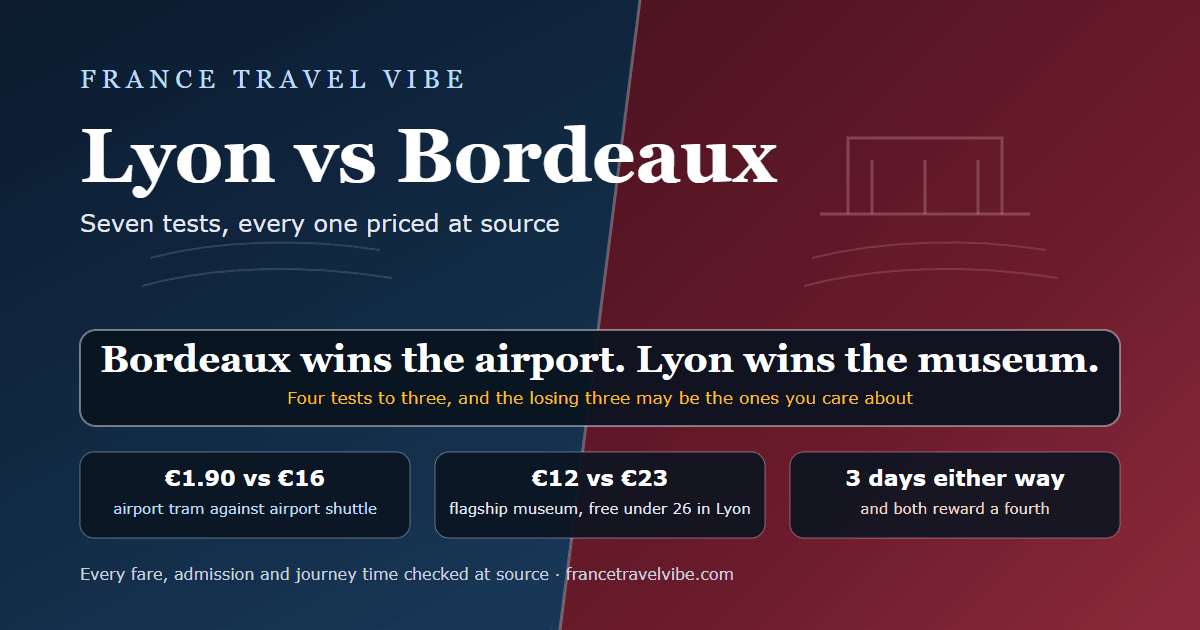
Lyon vs Bordeaux comes down to a choice most people make on vibes. Both cities sit about two hours from Paris on the same kind of train. Getting from Bordeaux’s airport into the centre costs €1.90. Getting from Lyon’s costs €16. That is the first sign these two are not the interchangeable pair the lists make them.
Here’s the problem with almost every Lyon vs Bordeaux comparison I’ve read: it resolves into food versus wine and stops. Two of the results on page one are forum threads, which tells you how little real work has been done on this question. Nobody prints a price. Nobody counts what each city puts inside a two-hour train ride.
So I ran seven tests, each with a number attached. Four go one way, three go the other.
Disclosure: Some links in this guide may earn us a commission, at no extra cost to you. It never changes what we recommend.
Key Takeaways
- Bordeaux is cheaper to arrive in, Lyon is cheaper to actually visit. The airport tram into Bordeaux is €1.90 against Lyon’s €16 Rhonexpress (Bordeaux Airport, Lyon Aéroports, 2026).
- Lyon wins the culture bill. Musée des Confluences charges €12 and is free under 26, against €23 at La Cité du Vin, and the 48-hour city card is €41.90 against €48, or €44 against €48 at list price.
- Lyon reaches far more in a day. Annecy is 1h51 direct; Bordeaux’s two headline trips are Saint-Émilion at about 35 minutes and Arcachon at about 50.
- Bordeaux is the easier walk. It is flat, and its UNESCO centre covers 1,810 hectares in one continuous stretch. Lyon is built on two hills.
- Autumn 2026 is Bordeaux’s value window, after July fires burned about 42,000 hectares in Gironde and the city’s own wine festival was cancelled for the year.
Table of Contents
Lyon vs Bordeaux: Which Should You Actually Pick?
Pick Lyon if you’re travelling to eat and want the widest day-trip radius in France outside Paris. Pick Bordeaux if you want a flat, walkable city with vineyards on the regional train. Lyon logged roughly 9.5 million overnight stays in 2025 against Bordeaux Métropole’s 6.96 million, so you’re choosing between a big city and a medium one (Tribune de Lyon, L’Essentiel, 2026).
Four kinds of traveller, four answers. If food is the point of the trip, Lyon, and it isn’t close. If wine is the point, Bordeaux, but by less than the branding suggests. If you’re travelling with a stroller, a big suitcase or a knee that complains, Bordeaux, because Lyon is built on two hills and the funicular is transport rather than a novelty. And if this is a first France trip pinned to Paris, Lyon, because it sits on the rail spine south and Bordeaux is a spur.
The seven tests are arrival cost, getting around, the culture bill, food, wine, walkability and day-trip reach. I’ll take them in that order and keep score.
One frame worth dropping before I start: “second city”. It flatters both and predicts nothing. Lyon is much the bigger metropolitan area, Bordeaux is nowhere near second by population, and neither fact tells you which one you’ll enjoy more. What decides it is how you like to spend a day.
For the wider ranking, our pillar puts both in context alongside ten other regions in where Lyon and Bordeaux rank among the best places to visit in France.
What Does Each City Cost the Moment You Arrive?
Bordeaux, comfortably, and the gap is bigger than any hotel comparison. Tram line F runs from the airport into the centre on a standard €1.90 ticket, 35 minutes to Hôtel de Ville and 45 to Bordeaux Saint-Jean, every 10 minutes on weekdays and Saturdays (Bordeaux Airport, 2026). Lyon’s Rhonexpress is a separate premium shuttle at €16.00 online, €28 return, 29 minutes (Lyon Aéroports, 2026).
That is roughly €14 a head before you’ve unpacked, and €28 for a couple.
Two honest qualifiers. First, that line F link is new: it opened on 6 December 2025, which is why nearly every guide still routes you onto tram A, the 2023 extension. Both work. Line F is the direct one. Second, Lyon has a TGV station inside its airport and another at Part-Dieu, so if you arrive by train the €16 never happens and the two cities converge instantly.
Getting around, Bordeaux stays ahead but narrowly. Ten journeys cost €15.70 in Bordeaux against €20.50 in Lyon, and that Lyon figure is the new one: TCL fares rise on 1 September 2026, an average of 1.72 percent (Tout Lyon, 2026).
Then the third test flips the result.
The Lyon City Card is selling at €29.90 for 24 hours, €41.90 for 48, €52.90 for 72 and €63.90 for 96, discounted from a list price of €32, €44, €56 and €68, and it covers 26 museums plus unlimited transport and a Saône cruise (Lyon Tourist Office, 2026). The Bordeaux CityPass runs €37, €48, €56 and €62 for the same durations, covering 15 museums, La Cité du Vin, the Bassins des Lumières, one guided tour and unlimited transport (Bordeaux Tourisme, 2026). Lyon comes in cheaper on two days either way: €6 at the price the tourist office is charging now, €4 if that discount lapses back to list.
And the flagship museums are not close at all. Musée des Confluences charges €12, with free entry for under-18s and students up to 25 (Musée des Confluences, 2026). La Cité du Vin charges €23 for a dated adult ticket, €9 for a child aged 6 to 17 (La Cité du Vin, 2026).
Score after three tests: Bordeaux 2, Lyon 1. The airport gap is the loudest number in this post, and it is also the one that matters least if you arrive by TGV.
For what the rest of a French week costs, our France trip cost breakdown does the daily arithmetic, and the nightly tourist tax on your room is set city by city in our guide to France’s tourist taxes.
Is Lyon or Bordeaux Better for Food?
Lyon, and it isn’t close. But the reason isn’t the one the guidebooks give. Lyon’s advantage is not that it has more good restaurants. It’s that the cheap ones are protected. The official label certifies exactly 22 bouchons, awarded by the Lyon chamber of commerce with the tourist board, out of hundreds of places using the word (Office du tourisme de Lyon, 2026).
Twenty-two. That’s the whole filter, and it’s the most useful number in this section. Look for the plaque; it’s one of the four labels in my French food guide. If a place calls itself a bouchon and can’t show you one, it’s a restaurant with a theme. If you’d rather cook Lyon than order it, a Croix-Rousse market cooking class is the cheapest market morning in France at €143.
What I’d tell a friend: eat at noon in Lyon, not at one. The bouchons fill with people who work nearby, the room has an argument going, and the food arrives at the pace the kitchen wants. The second sitting is a thinner meal in the same chairs. I’ve had it both ways and the difference isn’t subtle.
Bordeaux’s case is better than its reputation, and I’d rather say so than run the cliché. The 2026 Michelin guide, which lists 668 starred restaurants nationally, gave new stars to Circle and Les Loges in Lyon and to Cent33 in Bordeaux (Guide MICHELIN, 2026). Bordeaux’s market culture is strong, and its mid-range eats better per euro than Lyon’s tourist-facing bouchons do.
Still: one city has a certified register of working-class restaurants and a lunch ritual to go with it. That’s test four to Lyon. Bordeaux 2, Lyon 2.
Is Bordeaux Still the Better Wine Trip in 2026?
Yes for access, and the access is genuinely remarkable. Saint-Émilion is about 35 minutes from Bordeaux Saint-Jean on a regional train, in a village of 2,500 residents that takes more than a million visitors a year (Bordeaux Tourism, 2026). No car, no tour booking, no designated driver.
The caveat is the last mile, and I’d rather you heard it here than at the station. Saint-Émilion’s platform is not in the village. The tourist office’s own access page describes about a twenty-minute walk, uphill, with pavement on only part of the route. There’s also a tuk-tuk shuttle at €5 a person between 10:30 and 18:00, and taxis on advance booking (Office de Tourisme du Grand Saint-Émilionnais, 2026). In August heat with a toddler, that walk is the whole day’s mood.
Now the part no English-language guide is telling you. Bordeaux’s vineyard is shrinking fast. Gironde had 91,543 hectares in production in 2025, still France’s leading wine department at 13 percent of national potential. The direction of travel is down, though. The department shed roughly 9 percent in a single year, more than 21,000 hectares have been grubbed up since 2023, and 28 percent of France’s 27,926 hectares of 2026 grubbing candidates sit in Gironde (DRAAF Nouvelle-Aquitaine, Essentiel no. 80, June 2026; Vitisphere, 2026).
There’s a second signal, and it’s louder than it looks: Bordeaux Fête le Vin has no 2026 edition at all. The wine council couldn’t fund one. It returns 7 to 11 July 2027, expanded, alongside the Tall Ships Race (Ville de Bordeaux). A city whose global brand is wine has skipped its wine festival.
What does that mean for your trip? Not gloom. It means a wine region with time for you. Fewer coaches, more of the person pouring, and estates that will talk properly because they need to. That is a better tasting than a busy one, and it is temporary.
Lyon’s counter-case deserves a hearing too. Beaujolais starts about 40 minutes north, Burgundy is a straightforward hop, and the northern Rhône begins south of the city. Lyon is a wine base. It just isn’t a famous one.
Test five to Bordeaux, on access. Bordeaux 3, Lyon 2. How Burgundy, Bordeaux and Champagne actually compare once you’re pouring is a separate question, and a separate guide. For the third option there’s the Alsace wine route, where the cellar tastings are usually free.
Which City Is Easier to Walk?
Bordeaux, and this is the test most comparisons skip. Bordeaux is flat, and its listed centre is enormous: UNESCO inscribed the Port of the Moon in 2007 across 1,810 of the city’s 4,455 hectares, the largest urban ensemble ever listed at the time (UNESCO). You can walk the whole thing without a gradient.
Lyon’s listed area is different in kind. Vieux Lyon was inscribed in 1998 within a zone of roughly 500 hectares, and it’s the largest Renaissance quarter in France (Lyon Tourist Office, 2026). Denser, older, and stacked on a hillside.
Which brings me to the hill tax. Lyon has two of them, Fourvière and Croix-Rousse, and a twenty-minute walk on the map is a funicular ride in practice. That’s fine if you’re travelling light. It is not fine with a suitcase on cobbles, and it’s the single thing that makes Bordeaux the easier city for anyone with a stroller or a bad knee.
Lyon’s compensation is that the hills are why the views exist, and the traboules, those covered passageways cutting between streets, are a genuinely strange pleasure you can’t get anywhere else. Worth the climb. Just know it’s a climb.
Test six to Bordeaux. Bordeaux 4, Lyon 2. Pack accordingly, and our season-by-season packing list has more on shoes than you’d expect.
Lyon vs Bordeaux on Day Trips: What Two Hours Buys
Lyon, by a distance, and this is where it takes the last test back. Annecy is 1h51 on a direct train, with more than a dozen departures a day and several of them running direct (SNCF Connect, 2026). Vienne and its Roman theatre are about half an hour. Beaujolais starts around forty minutes north. The Alps sit behind all of it.
Bordeaux’s list is shorter and its two headline days are excellent. Saint-Émilion is the 35-minute one. Arcachon is about 50 minutes on TER line 41.2, with 25 return trips a day. From there the Baïa line 3 bus reaches the Dune du Pilat in roughly 25 minutes, running year round except Sundays and holidays. A line 101 express is added in July and August (Dune du Pilat, 2026).
Here’s the rule those numbers produce. Bordeaux is a city with two great days attached. Lyon is a hub with a region attached. If your trip has four days and a hunger for variety, that difference decides it.
One honest limit: Chamonix from Lyon is a stretch, not a day trip, whatever the blogs say. Give the Alps their own base. And for how to read a day-trip time properly, including the last-mile trap that ruins half of them, our day trips from Paris guide works through the same arithmetic, while getting around France covers the fares and the booking window.
Test seven to Lyon. Final score: Bordeaux 4, Lyon 3. Close enough that the three Lyon wins are the ones some readers will care about most.
September Is the Answer, and 2026 Is Why
Go in September or early October, to either city. For Bordeaux this autumn is the value window of the year, and the reason is uncomfortable: on 5 August 2026, fifteen Gironde tourism bodies put more than €2 million behind a shoulder-season recovery campaign after the July fires (Région Nouvelle-Aquitaine, 2026).
From 22 July 2026, fires in Gironde and the Landes burned about 42,000 hectares, forced roughly 220,000 evacuations and destroyed more than 240 buildings (Préfecture de la Gironde, 2026). That happened west and north of the city, in the pine forest and parts of the Médoc. Bordeaux itself came through undamaged, and the tram network never stopped.
The damage to the season was severe anyway. Some Bassin d’Arcachon operators reported bookings down 80 percent (Tourmag, 2026). That is what the recovery campaign was built to answer.
So should you go? Yes, and September is exactly when. The city works, the vineyards are into harvest, the coast is open, and an autumn booking now lands somewhere that actively wants you there. That is not disaster tourism. It’s just good timing.
Lyon’s seasonal problem is the opposite and much smaller: August. The bouchons close, the city thins out, and the thing you came for is on holiday. Lyon’s first quarter this year was soft too, with attraction entries down 6.1 percent to 186,994 (ONLYLYON Tourisme, 2026).
Winter splits them cleanly. Lyon’s Fête des Lumières runs Saturday 5 to Tuesday 8 December 2026, free and unticketed (Fête des Lumières, 2026). Bordeaux has no wine festival this year at all. If your dates are flexible into December, that’s a real argument.
Our month-by-month timing guide has the national picture, and is France safe covers how to read official advisories without panicking.
Three Days in Lyon, Three Days in Bordeaux
Three days works in either city, and the shapes differ more than the totals. Lyon is two hill mornings and three long lunches. Bordeaux is one walking day, one vineyard day and one coast day. The bill differs too: Lyon’s flagship museum charges €12 against €23 at La Cité du Vin (Musée des Confluences, La Cité du Vin, 2026).
| Day | Lyon | Bordeaux |
|---|---|---|
| 1 | Vieux Lyon on foot, funicular to Fourvière and the Roman theatres, bouchon lunch at noon | Port of the Moon on foot, the water mirror, Bassins des Lumières (€16) |
| 2 | Les Halles in the morning, Croix-Rousse and the traboules, Musée des Confluences (€12) | Saint-Émilion by TER, back for dinner |
| 3 | Vienne or Beaujolais by train | Arcachon and the Dune du Pilat, bus from the station |
| Add a 4th | Annecy, 1h51 direct | La Cité du Vin (€23) and the Chartrons |
Notice where the money goes. A Lyon three-day sightseeing bill built on the Confluences and a couple of city museums lands near half of Bordeaux’s, because Bordeaux’s two headline sights are €23 and €16 while Lyon’s is €12 and free for anyone under 26.
Compressing to two days? In Lyon, drop the day trip and keep both hills. In Bordeaux, drop Arcachon and keep Saint-Émilion. Pairing either with the capital is the standard shape, and our France itinerary comparison works through how many nights that actually needs, with the Paris travel guide covering the first half.
Heading further south afterwards? Lyon sits on the line to Provence and the coast, which is the strongest structural argument for choosing it. From Bordeaux, the natural next move is inland to the Dordogne’s caves, castles and river villages, or west to the Basque coast.
Frequently Asked Questions
Is Lyon or Bordeaux better to visit?
Lyon for food and day trips, Bordeaux for wine and walkability. Lyon’s official label certifies 22 bouchons and puts Annecy within 1h51 by direct train. Bordeaux is flat, its UNESCO centre covers 1,810 hectares in one continuous walk, and Saint-Émilion is about 35 minutes away by regional train. Three days suits either.
Which is cheaper, Lyon or Bordeaux?
Lyon vs Bordeaux on cost splits down the middle. Bordeaux wins arrival: its airport tram is €1.90 against Lyon’s €16 Rhonexpress, and ten journeys cost €15.70 against €20.50. Lyon wins culture: the 48-hour city card is €41.90 against €48, and the Musée des Confluences charges €12 with free entry under 26, against €23 at La Cité du Vin.
How many days do you need in Lyon or Bordeaux?
Three in either, and both reward a fourth. Lyon needs two hill mornings plus a lunch culture that doesn’t compress, then a day trip. Bordeaux needs one walking day, one vineyard day and one at Arcachon or the Dune du Pilat, which is about 75 minutes away counting the connecting bus.
Can you visit Bordeaux’s vineyards without a car?
Yes. Saint-Émilion is roughly 35 minutes from Bordeaux Saint-Jean by regional train. The catch is the last mile: the station sits outside the village, and the tourist office describes a twenty-minute uphill walk with pavement on only part of the route, plus a €5 tuk-tuk between 10:30 and 18:00. The Médoc genuinely wants a car or a tour.
Is Bordeaux worth visiting after the 2026 fires?
Yes. About 42,000 hectares burned in Gironde and the Landes from 22 July 2026, west and north of the city in the pine forest and parts of the Médoc, and Bordeaux itself was undamaged. Fifteen regional tourism bodies backed an autumn recovery campaign with more than €2 million, so shoulder-season Bordeaux is quieter and better value than usual.
The Bottom Line
Lyon vs Bordeaux, settled in one line: Lyon to eat and to range, Bordeaux to walk and to drink. The scorecard finished 4 to 3 for Bordeaux, which is a lot closer than the food-versus-wine framing implies, and the three tests Lyon won are the ones a certain kind of traveller cares about above everything else.
If you’re going this autumn, take Bordeaux. Not because it beat Lyon on points, but because a region that lost 42,000 hectares in July and cancelled its own wine festival is a region with time, space and attention to give you, and that will not be true for long.
If your trip is next spring, or if the point of it is dinner, take Lyon.
Either way, book the dates against the season before you book anything else. Where Lyon and Bordeaux rank nationally puts both against ten other regions, and if you’re still assembling the shape of the trip, start with the France travel guide.