
Last verified: September 30, 2026. Every gîte and hotel price here was read on Gîtes de France and Booking.com on September 30, 2026, for weeks in late May and July 2027. Prices move daily, and many hotels load next summer’s rates late, so I re-run the same searches before each update and change the date above.
Gîte vs hotel in France has a clearer answer than you’d think, even though the French themselves split almost evenly. In 2025, French travellers spent 176.9 million nights in rentals, gîtes and B&Bs and 171.3 million in hotels on their personal trips (INSEE, tourism demand survey 2025, July 2026).
Most English advice on gîtes comes from people selling them, and none of it puts a price next to a hotel. So I did. I priced both for the same weeks in the Dordogne, the Luberon and Brittany, for a couple and for a family of four. This is the gîte chapter of my guide to where to stay in France.
Disclosure: Some links in this guide may earn us a commission, at no extra cost to you. It never changes what we recommend.
Key Takeaways
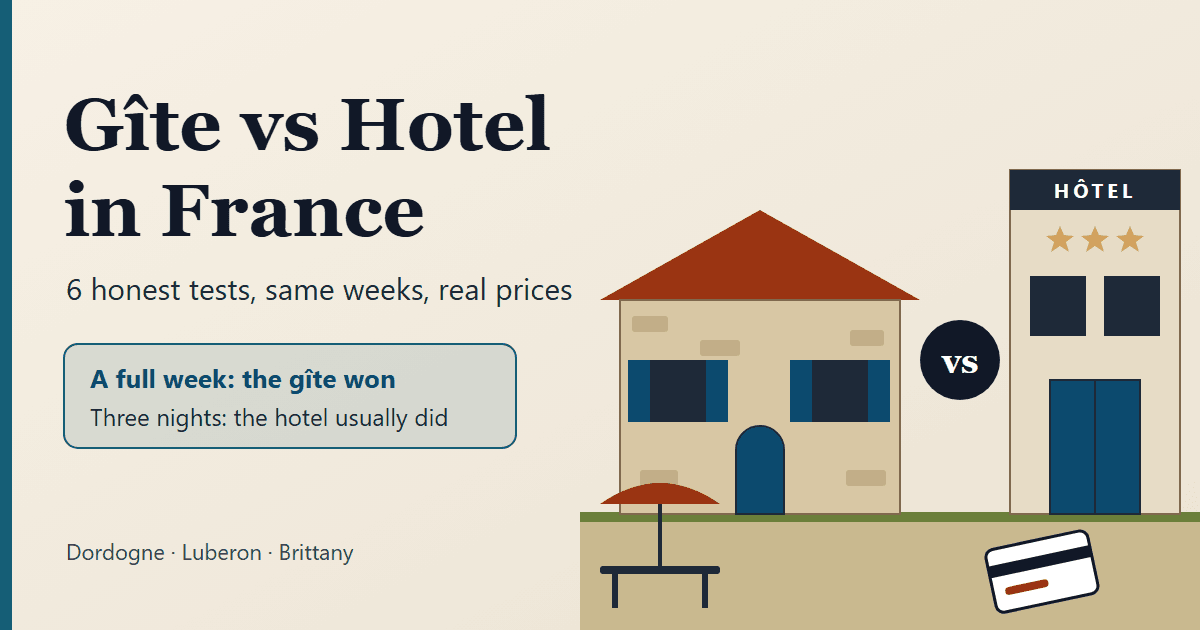
- A full week? Book the gîte. It beat 2-3 star hotels in all 12 week-long tests I ran, by €90 to €1,390, couples included.
- Three nights? It depends on the region. The hotel mostly won in the Dordogne. Elsewhere few gîtes would take you in summer, and on the Brittany coast in July none would.
- Budget for a car and cleaning. Most gîte prices leave both out.
Table of Contents
Gîte vs Hotel in France: The Short Answer
For a week or more in the countryside, the gîte wins, whether you’re two or four. When I priced the same weeks on September 30, 2026, the median gîte beat the median 2-3 star hotel in all 12 week-long tests. Three nights is another story: the hotel mostly won in the Dordogne, and elsewhere few gîtes would take the booking in summer. In a city like Paris, a hotel is simply easier.
The six tests came out like this:
| Test | Gîte | Hotel | Winner |
|---|---|---|---|
| A week for a family of four | €915 to €1,060 in July | €1,415 to €2,380 in July | Gîte, by €355 to €1,390 |
| A week for a couple | €680 to €727 in July | €770 to €1,689 in July | Gîte, by €90 to €973 |
| Three nights | Cheaper outside the Dordogne, if one will take you | Bookable, but scarce on the coast | Hotel in the Dordogne; few gîtes elsewhere in summer |
| Extras on the bill | Cleaning, linen, tourist tax | Breakfast, parking, tourist tax | Draw |
| No car | Hard work | Easy in a town | Hotel |
| Space, kitchen, garden | A whole house | One room | Gîte |
The real divide isn’t how many of you there are. It’s how long you’re staying. Why? Because you pay for a gîte by the week, and for a hotel by the night.
What Is a Gîte, and How Is It Different From a Hotel?
A gîte is a whole self-catering house or flat, usually rented by the week, and the biggest network has plenty of them. In 2025, Gîtes de France had 56,000 properties run by 43,000 owners, and logged 28.17 million nights (TourMaG, Gîtes de France 2025 results, March 2026).
A hotel sells you a room with service, by the night. A gîte sells you a house with a key, and you run it yourself. You shop, you cook, you strip the beds on the last morning if the listing asks you to.
Both have ratings, but they aren’t the same scale. Hotels carry one to five official stars, which my guide to where to stay in France explains. Gîtes de France grades its houses with one to five “épis”, ears of wheat. Clévacances, the other big label, grades one to five against a checklist of 133 points (Clévacances, the label).
One naming trap: a gîte d’étape is a hikers’ bunkhouse, not a holiday house. You’ll meet those on the Chamonix trails, not in a family rental search.
What about a chambre d’hôtes? That’s a room in the owner’s home with breakfast, and my France-wide lodging guide compares the two side by side. At Gîtes de France in 2025, the average stay was eight nights in a gîte and two in a chambre d’hôtes (TourMaG, 2026). That gap tells you what each one is for, and my chambre d’hôtes guide covers what a stay is actually like.
Test 1: Which Is Cheaper for a Family of Four?
The gîte, in every region and both weeks I priced. For the July week, a two-bedroom gîte near Sarlat had a median of €1,060, against €1,415 for a 2-3 star hotel. Near Gordes it was €915 against €2,100. Around Carnac, €990 against €2,380 (Gîtes de France and Booking.com, observed September 30, 2026).
Here’s how I did it. On September 30, 2026, I searched Gîtes de France for two-bedroom gîtes within 15 km of each town, for two adults and two children. I searched Booking.com for 2 and 3 star hotels in the same area, asking for one room. The weeks were Saturday 17 to Saturday 24 July 2027 and Saturday 29 May to Saturday 5 June 2027. I took medians, not averages, so one château doesn’t skew the result.
The most useful thing I found wasn’t a price. It was how few hotels there are. Each hotel search found just 1 to 10 bookable 2-3 star hotels. Each gîte search for a week found 25 to 94 houses. Chain hotels cluster in cities and by motorways instead, as I found when I priced budget hotels in France. Gordes had four or five such hotels on Booking.com, depending on the dates, and Carnac had one, so I added the nearby towns of L’Isle-sur-la-Sorgue, Auray and Quiberon. The Luberon villages and the Carnac coast are gîte country.
The late-May week tells the same story: the gîte was €429 cheaper near Sarlat, €1,261 near Gordes and €845 around Carnac. Sarlat is the closest contest because Sarlat is a hotel town. If you want that base, my Dordogne guide covers the caves and market days, and the Luberon and Brittany sit in my Provence itinerary and my Brittany guide.
A family of four, staying a week and paying about €1,060 in July near Sarlat for a two-bedroom gîte against €1,415 for a 2-3 star hotel, saves €355. Near Carnac the same week saves €1,390, because the few hotels there are expensive (Gîtes de France and Booking.com, observed September 30, 2026).
Test 2: Which Is Cheaper for a Couple?
For a full week, still the gîte, but only just in the Dordogne. A one-bedroom gîte near Sarlat had a July median of €680, against €770 for a 2-3 star double. Near Gordes it was €716 against €1,689, and around Carnac €727 against €980 (Gîtes de France and Booking.com, observed September 30, 2026).
That Sarlat gap is €90 for the week. The gîte still won, but one cleaning fee could wipe that out. The Luberon is different. For two people there, a gîte week cost less than half the hotel week.
Shorter stays flip the result. For three July nights near Sarlat, the hotel cost €348 against €485 for a gîte. A three-night gîte isn’t a pro-rata bargain, since in my searches it cost roughly 60 to 70 percent of the full week.
Hotel prices keep climbing too. In 2025 the average French hotel room cost €133 a night, up 1 percent (TourMaG, In Extenso 2025 hotel results, February 2026). Breakfast is extra at most French hotels, so add it to the hotel side. Only 3 of the 147 hotel results I read came with breakfast. For the rest of your daily costs, see what a trip to France actually costs.
So when does the gîte week start to pay? The chart below shows the July week near Sarlat, where the contest is closest.
Test 3: Can You Book a Gîte for Less Than a Week?
It depends heavily on where you go. Near Carnac, not one of the 75 family gîtes available for the July week would take three nights, Tuesday to Friday. Near Gordes, 4 of 42 would. Around Sarlat, 32 of 56 would (Gîtes de France, observed September 30, 2026).
To measure this, I ran the same search for three midweek nights inside each week, then divided by the number of gîtes free for the whole week. It’s a rough gauge of who’ll take a short stay, not a count of each owner’s stated rules. But the pattern is hard to miss.
One-bedroom gîtes for couples followed the same shape: 69 percent took three July nights near Sarlat, 11 percent near Gordes, and none near Carnac.
Why so strict? Gîtes are built around French family holidays. In 2025, 84 percent of Gîtes de France guests were French (The Local, France’s gîte network announces modernisation plan, June 2026). The average gîte stay was eight nights (TourMaG, 2026). Owners sell summer by the week, usually Saturday to Saturday, because that’s how their main customers book.
So if your plan is three regions in ten days, hotels suit you better. If it’s one region for a week, the gîte suits you better.
Test 4: What Does a Gîte Week Really Cost Once Everything’s Added?
More than the headline, because most gîte prices leave cleaning and linen out. Near Sarlat, about a third of the gîtes I read were marked “tout compris”, meaning linen and cleaning included. Near Gordes, none were. Around Carnac, only 7 of 120 were (Gîtes de France, observed September 30, 2026).
So read the listing before you compare. Where cleaning isn’t included, you either pay a fee or clean the house yourself before you leave. Linen may be a hire charge, or you bring your own.
Then there’s the deposit. In French law, the word on your contract matters:
- Arrhes: if you cancel, you lose them. If the owner cancels, they must pay you back double.
- Acompte: this commits you. If you cancel, you owe the full price, unless the house is let again.
That comes from service-public.fr, renting a holiday home (checked August 2026). The same page says a holiday let needs a written contract, and that the owner returns the security deposit on the terms the contract sets. There’s no legal cap or deadline on that page, so read the contract.
The payment schedule and cancellation scale most gîtes use are in the gîte booking terms section of my lodging guide. In short, a quarter goes up front and the rest falls due 30 days before arrival.
Both pay the tourist tax, and hotels add breakfast and parking. For an unclassified rental, the tourist tax is 1 to 5 percent of the price per person per night, set by the town. Hotels and star-rated rentals pay a fixed rate by category instead. The details and city rates are in France’s tourist tax, city by city. On my searches, Booking.com showed €5 to €87 in taxes for the whole stay, so it’s rarely what decides the choice.
Test 5: Do You Need a Car for a Gîte?
Almost always, because most gîtes sit outside towns. Of the 40 family gîtes I read near Sarlat for the July week, only 7 were in Sarlat itself. The other 33 were in villages up to 15 km out (Gîtes de France, observed September 30, 2026). The bakery, the market and the sights are all a drive away.
A hotel in Sarlat, Avignon or Vannes lets you walk to dinner and take a train out. From a gîte ten minutes out of Sarlat, you’ll drive to everything, including the morning bread run. For a couple, that car can cancel out a small gîte saving. For a family, it’s usually part of the plan anyway.
If you’re weighing train against car for the whole trip, my guide to getting around France prices both. Without a car, pick a hotel in a town with a station. With one, the gîte opens up the countryside, and my Dordogne guide shows how far the sights sit from Sarlat.
Test 6: Space Goes to the Gîte, Service to the Hotel
The gîte gives you space; the hotel gives you service. That’s not a close call. A two-bedroom gîte for four gets you a kitchen, a living room and often a garden. In the Sarlat sample, the family hotel price bought one family room, or two rooms in some cases (Booking.com, observed September 30, 2026).
For families with young children, that space is the point. Naps happen in a separate room. Dinner can be at six, which matters in France, where many restaurants don’t serve dinner before 7 or 7:30 pm. My first-time France tips cover the meal-time rule.
Cooking also saves more each year. In 2025, food prices in France rose 1.2 percent and restaurant prices 2.1 percent (INSEE, consumer prices 2025, January 2026). That gap is small, but two restaurant meals a day for four people is where a gîte week really saves.
The hotel wins everywhere else. You get a daily clean, breakfast downstairs, and someone at the desk at 10 pm when you arrive late. A gîte has a key handover at a set time, often with an owner who speaks mostly French. That’s worth knowing before you book, since 84 percent of the network’s guests are French (The Local, 2026).
Is a Gîte the Same as an Airbnb?
It can be the same house, sold two ways. The difference is who stands behind it. Gîtes de France is a network of owners, with a label that inspects and grades each house, and in 2025 it turned over €863 million, up 4 percent (The Local, 2026). Airbnb is a platform that lists.
Many owners list on both. The label gives you a grade you can trust, a written contract and a French organisation to complain to. The platform gives you reviews, English-language booking and its own refund rules.
Registration rules are tightening for both. France’s new national registration service for holiday lets is due in the fourth quarter of 2026, and until then a local town-hall number stands in (service-public.fr, furnished tourist rentals registration, July 2026). Paris has its own, stricter rules, which my guide to the Airbnb Paris rules explains.
How Do You Book a Gîte Safely?
Book through a label or a platform, and get a written contract before you pay. French law requires one for a holiday let (service-public.fr, 2026), and it’s your best protection. A genuine owner will send it without being asked twice.
My checklist:
1. Book on the label’s site or the platform, never through a stranger’s email. 2. Read the contract for “arrhes” or “acompte”. It decides what you lose if you cancel. 3. Check what’s included: linen, cleaning, heating, a cot, the pool dates. 4. Never pay by bank transfer “to save fees”. That’s the classic rental scam, and my France tourist scams guide shows how it works. 5. Book summer weeks four to six months ahead, since each booking takes the whole house for seven nights. 6. Insure any gîte booked more than a month out. The cancellation scale is steep. And if a gîte week is over budget, a campsite mobile home is the cheaper self-catering route, as my guide to camping in France explains.
Frequently Asked Questions
Is a gîte cheaper than a hotel in France?
For a full week, yes. When I priced the same weeks in September 2026, the median gîte beat the median 2-3 star hotel in all 12 week-long tests, by €90 to €1,390. For three nights the hotel mostly won in the Dordogne, and elsewhere few gîtes would take the booking in summer.
Can you rent a gîte for less than a week?
In the Dordogne, often: 32 of 56 family gîtes near Sarlat would take three nights in July 2027. On the Brittany coast in July, none would, and near Gordes only 4 of 42 would. Outside summer, far more owners accept short stays.
What is usually included in a gîte?
A furnished house with a full kitchen. Linen, cleaning and sometimes heating can cost extra, and none of the 98 Gordes results I read included linen and cleaning. The owner takes a refundable deposit, returned on the terms in your written contract.
Do you need a car to stay in a gîte?
Almost always. Of 40 family gîtes I read near Sarlat for a July 2027 week, 33 were in villages outside the town. Without a car, a hotel in a town with a station is the better choice, and far easier with children.
Is a gîte the same as an Airbnb?
It can be the same house. A gîte label such as Gîtes de France, with 56,000 properties, inspects and grades each one and uses a written contract. Airbnb is a platform that lists homes. Either way, French law requires a written contract for a holiday let.
The Bottom Line
- A week or more: book the gîte, for two or for four. It won all 12 of my week-long tests.
- Under a week: a hotel in the Dordogne. Elsewhere, check first: few gîtes take short summer stays, and on the coast in July none do.
- Read the contract for arrhes or acompte before you pay.
- Budget for cleaning, linen and a car. Most gîte prices leave them out.
- Book summer weeks early, and insure them.
Gîte vs hotel in France isn’t really about price once you know your trip length. Pick your base first with my guide to where to stay in France, then set the rest of your budget with what a trip to France costs.