
Last verified: October 19, 2026. I re-checked the admission prices on this page against the monuments’ own sites on the date above, and the Paris to Strasbourg time on SNCF Connect. The 2026 summer quotas closed at the end of August and reset season by season, so I re-check this page monthly and update the date each time.
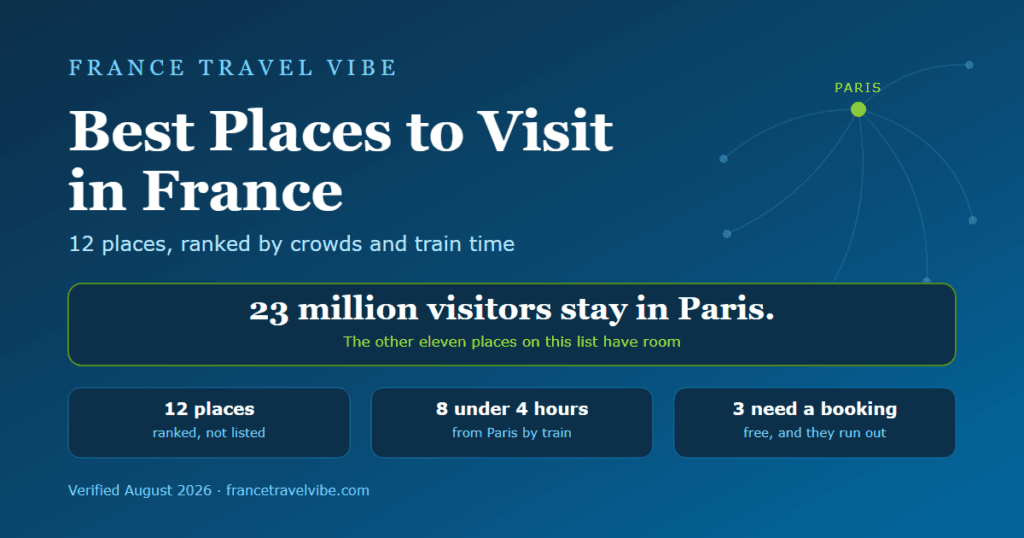
France took 102 million international visitors in 2025 (Atout France, 2025 tourism review, 2026). More than 23 million of them never left the Paris region (Visit Paris Region, 2025 annual review, 2026).
That gap is the whole reason this list exists. Most rankings of the best places to visit in France sort the same twelve postcards into a slightly different order. None of them tells you which places now turn people away without a reservation. Or which are an hour from Paris and which are five and a half. Or which month ruins each one.
So I ranked these twelve on what they actually cost you: travel time, crowd pressure, and the 2026 rule you need to know before you book. Beauty is assumed. Everything on this list is beautiful. The question is what it takes to enjoy it. Once you’ve picked, where to stay in each region is its own guide.
Disclosure: Some links in this guide may earn us a commission, at no extra cost to you. It never changes what we recommend.
Key Takeaways
- France logged 102 million international visitors in 2025, and over 23 million of them stayed in the Paris region (Visit Paris Region, 2026). The crowding is a distribution problem, not a volume one.
- Eight of these twelve places sit under four hours from Paris by train. Strasbourg is 1 hour 45 minutes.
- Three now cap daily visitors: Sugiton cove in the Calanques at 400 people a day, Bréhat at 4,700, Porquerolles at 6,000. All three are free and all three need booking.
- Two places per ten days. Not five.
- September is the single best month on this list, and it isn’t close.
What’s on This List
Where Do France’s 102 Million Visitors Actually Go?
Into Paris, mostly. The Paris region drew 49.1 million visitors in 2025, including a record 23 million international ones, up 3% on 2024 (Visit Paris Region, 2025 annual review, 2026). That’s close to a quarter of everyone who came to France, landing in about 2% of its territory.
Push past the capital and the picture inverts. Residents of France account for more than two thirds of summer nights in its hotels, campsites and holiday residences (INSEE, 2025). That’s the domestic crowd, and it clusters in July and August. Outside those weeks, whole regions run quiet.
Here’s the part nobody frames properly. France doesn’t have a crowd problem; it has a distribution problem, and it’s laid over 28,000 km of railway reaching nearly 8,800 communes, 2,700 km of it high-speed (SNCF Réseau, “Comprendre le réseau ferré français”, 2026). The country’s own tourism agency has spent €1.9 billion through its Destination France plan trying to move people off the same five spots. You can do it yourself in an afternoon of booking.
Working out the rest of the trip? My complete France travel guide covers entry rules, costs and transport in the order you hit them.
How I Ranked These Twelve Places
Four things, and none of them is scenery. I ranked the best places to visit in France on friction, and in 2026 four questions actually change a trip. How long does the train take? Does the place need a reservation? How hard does peak season hit it? And will it hold you longer than a day?
I weighted those in that order, because they’re the ones that break trips. A place four hours away isn’t worse than a place two hours away. It just costs you a half-day each way. On a ten-day trip, that’s a fifth of your holiday. Beauty doesn’t compound like that.
Two things kept places off this list. Corsica earns a spot on every other ranking and misses this one purely on overhead: a ferry or a flight, plus a car, plus a minimum week to justify it. And Biarritz has a genuinely short season. Both are excellent. Neither belongs on a list built around access.
One more filter, and it comes from getting it wrong myself. I’ve given places four nights that needed two, and two nights to places that needed a week. Colmar is small and you’ll see it properly in a day and a half. The Dordogne swallowed a week and I still left with a list. That mismatch costs more than any ticket price on this page, so each entry below says roughly how long it holds you.
The 12 Best Places to Visit in France
Ranked by what they cost you in travel time and crowd pressure, not by beauty. Train times are the fastest scheduled services from Paris, checked in August 2026. Average journeys run longer, and I’ve flagged where the gap is wide.
Before the list, one piece of context on where the pressure concentrates. Four sites absorb an extraordinary share of France’s sightseeing traffic, and three of them sit inside the Paris region.
1. Paris
It ranks first because nothing else in France concentrates this much in this little space, and because you’ll fly into it anyway. The Louvre drew 9.0 million visitors in 2025, the world’s busiest art museum; Versailles took 8.4 million (News Tank Culture, citing the château, 2026) and the Eiffel Tower 6.75 million paying visitors (Paris.travel statistics, 2026).
One 2026 change matters to your budget: non-EU admission to the Louvre went from €22 to €32 on January 14 (CNN, 2025). One change goes the other way: Notre-Dame’s nave is free again, and the bell towers reopened in September 2025 at €16 for the 387-step climb (Paris je t’aime, 2026). My Paris travel guide prices every one of these and says which need booking, and my guide to Louvre tickets has the full 2026 museum picture.
Holds you: four days, comfortably. Go: September, or February if you want it cheap.
2. Provence
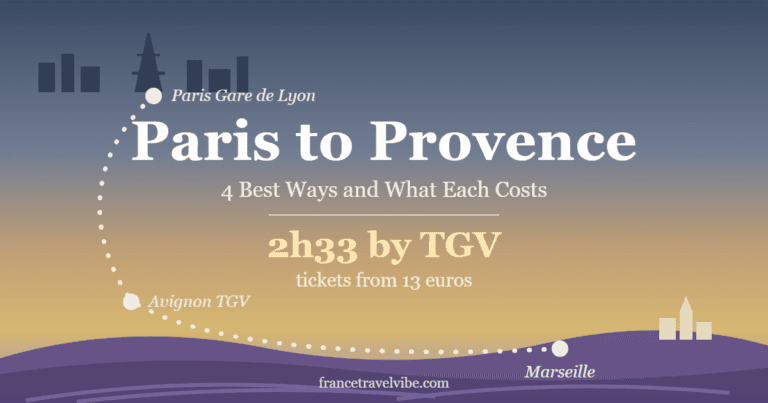
Avignon is 2 hours 33 minutes away on the quickest service, and the classic route down from Paris takes one booking to set up. What waits there is hill villages, Roman aqueducts and the weekly markets that make Provence worth far more than its lavender fortnight. My own rule here is to shop before breakfast: by ten the stalls are picked over and the heat has arrived. My week in Provence, market by market builds the route around exactly that, and prices what each village charges to park.
Heat is the real planning constraint now, not crowds. At the peak of the July 2026 heatwave, Météo-France held 37 departments on red alert at once, and the month closed as the hottest July the country has ever recorded (franceinfo, 2026). May, early June and September give you the same landscape at a temperature you can walk around in.
Holds you: five to seven days with a car. Go: May, June or September.
3. The French Riviera
Nice is the longest haul on this list at 5 hours 30 minutes by TGV. I’d still make the trip. You get the old town, the Cours Saleya market, and a string of coastal towns reachable on the regional bus network without ever renting a car. Riding those buses along the corniche costs pocket change and beats the coast road in a hire car, and my guide to using Nice as a Riviera base prices every one of them, and if you’re torn between the three main towns, choosing your Riviera base comes down to five priced tests.
Something changed here in 2026 that nobody has told visitors. Since 9 December 2025 an interprefectoral decree caps every port in the Alpes-Maritimes, meaning Nice, Villefranche-sur-Mer, Cannes and Menton, at an annual average of 2,000 disembarked passengers per call day, with a hard ceiling of 3,000 on any one day and one ship a day per anchorage for vessels above 1,300 passengers (Préfecture maritime de la Méditerranée, 2025). Cannes had already moved on its own, refusing ships carrying more than 1,000 passengers (Seatrade Cruise, 2026). Peak-day crowds along that coast are measurably thinner than they were.
Holds you: four days as a base. Go: late September and October, when the sea is still warm.
4. Normandy and Mont-Saint-Michel
Mont-Saint-Michel is the most visited site in France outside Paris, taking roughly 3 million visitors a year, a third of them in summer, on an island of under 4 km² with 30 permanent residents (France 24, 2023). One August day in 2022 brought more than 36,000 people.
Unlike the Calanques or the Riviera ports, it has no quota and no entry fee planned for 2026 (Ulysse, 2026). Nothing manages the crowd except your own timing, which means arriving before 9am or after 5pm, or not in August. The D-Day beaches an hour west are the opposite experience: quiet, and worth a full day, and my D-Day beaches tour comparison settles whether to book a guide or drive yourself. My six-day Normandy itinerary puts them and Mont-Saint-Michel in one route, priced at source.
Holds you: three days. Go: May or late September.
5. The Loire Valley
The fastest trains reach St-Pierre-des-Corps, on the edge of Tours, in a little over an hour. That’s closer to Paris than most people assume, and it buys the densest concentration of châteaux in Europe.
The trap is trying to see them all. Chambord now asks €31 if you’re neither a national nor a resident of the European Economic Area, against €21 if you are, a two-tier structure it introduced on January 14, 2026 (Domaine national de Chambord, “Horaires et tarifs”, 2026). Three châteaux in a day is how a beautiful valley turns into a queue. Pick three for the whole trip and cycle between two of them. My guide to which châteaux to pick when you cannot see them all narrows it to five, and prices every one.
Holds you: three days. Go: April to June, or September.
6. Alsace: Colmar and Strasbourg
Strasbourg is 1 hour 45 minutes from Paris on the fastest TGV (SNCF Connect, 2026), which is the best access-to-difference ratio in France. You get a different language history, different food and half-timbered towns that look nothing like the rest of the country.
December is the exception season here. The Christmas markets are the one winter draw in France that justifies its crowds, and they’re the reason Alsace hotels sell out two months ahead. The wine-route villages between the two cities are emptiest in May and October.
Holds you: three to four days. Go: May, October, or December if you want the markets.
7. Lyon
Two hours from Paris, and the most under-visited big city in France relative to what it offers. The Roman theatres, the Renaissance passageways of Vieux Lyon and a food culture that runs from bouchon lunches to a covered market that takes a full morning.
It’s also the practical hinge of a southbound trip: Paris to Lyon to Provence runs along one rail spine, and Lyon is the only stop on it that never feels like a compromise. Eat at noon here, not at one. The bouchons fill with people who work nearby, and the second sitting is a different, thinner experience. If you are weighing it against France’s other great second city, here is how Lyon and Bordeaux compare on cost, food and day trips.
Holds you: two to three days. Go: any month except August.
8. Bordeaux
Two hours four minutes from Paris, a restored riverfront, and vineyard visits that start twenty minutes from the tram network. Set against Lyon, Bordeaux wins on arrival cost and walkability and loses on the culture bill. Set against Burgundy and Champagne it wins on scale, and my guide to wine tasting in France prices all three at the cellar door.
One caveat for summer 2026 planning. Wildfires had burned roughly 115,000 hectares nationally by late July, and the Gironde blazes came close enough to Bordeaux that Macron mobilised the military (France 24, 2026). The city itself came through undamaged. Still, check conditions before booking a summer stay out in the pine country west of it.
Holds you: three days, more with vineyard trips. Go: May, June, or September into the harvest.
9. The Dordogne
The one place here where a car stops being optional, and the one that repays a long stay. Prehistoric cave paintings, fortified villages stacked above the river, and Saturday markets that still serve the people who live there rather than the people photographing them. I spent a week and left with a list of what I had missed.
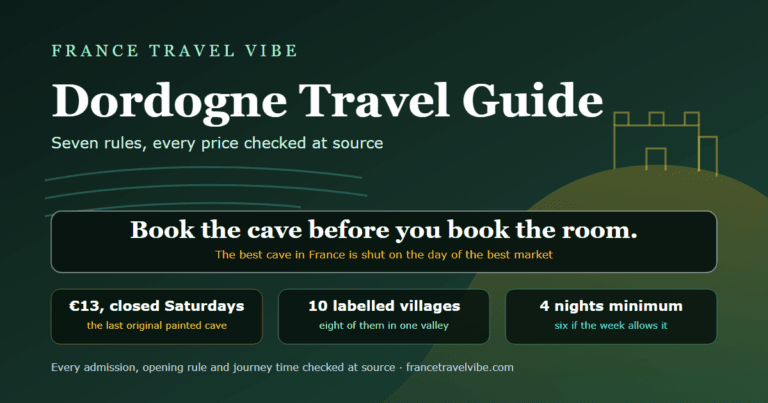
Trains reach Sarlat in about 4 hours 48 minutes from Paris, usually with a change, and the rail line does not get you around the valley once you arrive. Budget for the car. My guide to the Dordogne has the caves, castles and river villages priced and booked in the right order.
Holds you: a week, easily. Go: June or September.
10. The French Alps: Annecy and Chamonix
Annecy’s fastest trains run 3 hours 43 minutes from Paris, and the lake is clean enough to swim in through September. In winter the same valleys turn into ski country, and my guide to skiing in France prices twelve resorts.
Pressure here is easing, which is unusual. INSEE recorded mountain-area attendance down 2.9% in the first quarter of 2026 against a national rise of 1.0% (INSEE, Informations rapides no. 120, 2026). Summer is the underrated half of the year up here, and Chamonix hiking for beginners is where I’d start: the same valleys, a third of the winter price.
Holds you: four days. Go: late June to September for hiking, January to March for snow.
11. Brittany
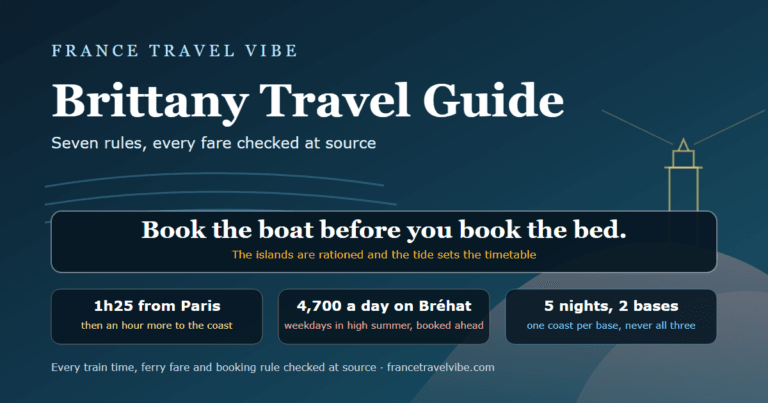
Rennes is 1 hour 25 minutes from Paris, the fastest gateway on this list, and from there the coast opens into fishing ports, tidal islands and a Celtic culture with its own language.
Bréhat, the flower-covered island off the north coast, holds weekday arrivals to 4,700 under a municipal order running July 28 to August 22 in 2026, booked through the Arcouest shuttle (France 3 Bretagne, 2026). It illustrates the wider pattern: this coastline absorbs enormous French holiday traffic in August and almost none in June.
Holds you: four to five days. Go: June or September.
12. Marseille and the Calanques
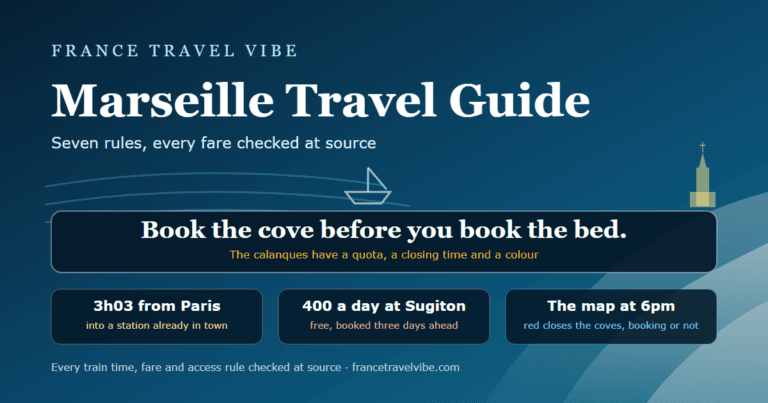
Three hours three minutes from Paris, and the most misjudged city in France, a working port with 26 centuries behind it, not a Riviera resort. My Marseille travel guide gives it seven rules, with every fare and the calanques’ booking dates checked at source.
The limestone inlets east of the city are the draw, and they are now actively managed. Reaching Sugiton means walking down through pine and scrub for the better part of an hour, then walking back up in the afternoon heat, which is its own kind of filter. Sugiton cove admitted 400 people a day between June 27 and August 30, 2026, on a free but mandatory reservation, down from the 2,000 to 4,000 who used to arrive on peak days (Made in Marseille, quoting the park’s director, 2026). The park has renewed the scheme through 2027 (Parc national des Calanques, 2026). Turn up without a booking in July and you will be turned back at the trailhead.
Holds you: three days. Go: May, or October when the water is still swimmable.
Which Places Need a Reservation or Have a Cap in 2026?
Three of the places on this list will refuse you entry without a booking. Sugiton cove in the Calanques took 400 people a day from June 27 to August 30, 2026 (Made in Marseille, 2026), and the park has renewed the scheme through 2027. Porquerolles holds peak-season arrivals to 6,000 a day, rationed through the number of ferry seats sold (Var Actu, 2026). Bréhat caps weekday arrivals at 4,700 (France 3 Bretagne, 2026). Every one of those bookings is free. Every one of them runs out.
The Riviera ports work differently. Since December 2025 the state caps disembarked passengers across the whole Alpes-Maritimes coast, at 2,000 a day on annual average and 3,000 maximum, which produces the same result on the ground: fewer 3,000-passenger arrivals landing in one morning (Préfecture maritime de la Méditerranée, 2025).
And then the absence that matters most. Mont-Saint-Michel is the busiest of the best places to visit in France outside Paris, and it has no quota and no fee planned for 2026. Nothing stands between a July morning and 20,000 people on one causeway except the hour you choose to arrive.
How Far Is Each Place from Paris by Train?
Eight of the best places to visit in France are under four hours from Paris on the fastest scheduled services, and the Loire is barely over an hour. Distance is rarely the reason to drop a place from a French itinerary; connections and changes are.
Nobody publishes these side by side, so here they are in one table, checked in August 2026 against SNCF Connect, Trainline and Seat61. These are fastest scheduled times. Average journeys run longer, sometimes by an hour, and the gap is widest on the routes with fewer direct trains.
| Place | Station | Fastest from Paris | Book ahead? | Best window |
|---|---|---|---|---|
| Loire Valley | St-Pierre-des-Corps | ~1h02 | No | Apr–Jun, Sep |
| Brittany | Rennes | 1h25 | Bréhat: yes | Jun, Sep |
| Alsace | Strasbourg | 1h45 | Dec markets: hotels | May, Oct, Dec |
| Normandy | Caen | 1h54 | No | May, late Sep |
| Lyon | Lyon Part-Dieu | 2h00 | No | Any but Aug |
| Bordeaux | Bordeaux St-Jean | 2h04 | No | May, Jun, Sep |
| Provence | Avignon TGV | 2h37 | No | May, Jun, Sep |
| Marseille | Marseille St-Charles | 3h03 | Calanques: yes | May, Oct |
| French Alps | Annecy | 3h43 | No | Jun–Sep, Jan–Mar |
| Dordogne | Sarlat (1 change) | ~4h48 | Car needed | Jun, Sep |
| French Riviera | Nice-Ville | 5h30 | No | Late Sep, Oct |
Budget travelers have a second layer here. Ouigo, SNCF’s low-cost TGV brand, sells advance fares from €10, and a new Ouigo Classic route opened between Paris and Bordeaux in spring 2026 at about 5h30 (Sortiraparis, 2026). Slower, but a third of the price.
Two of these twelve need a car once you arrive, not instead of the train: the Dordogne, and Provence beyond Avignon. My guide to TGV vs Ouigo vs driving has the full math on when renting wins.
When Should You Visit Each Region?
September, for almost every place on this list. French hotels recorded 69.2 million overnight stays in the third quarter of 2025 against 42.2 million in the first (INSEE, Informations rapides, 2026). The pressure is concentrated in about ten weeks, and it drops off a cliff the moment schools go back.
Regional timing splits north and south. Provence, the Riviera and Marseille peak in July and August. That’s now a heat question as much as a crowd one. Paris set an all-time June record of 40.9°C in 2026, and the south runs hotter than that. Normandy, Brittany, Alsace and the Loire are at their best from May to June and again in September. The Alps run two seasons with a quiet gap in between, and Alsace adds a December exception for its markets.
August deserves its own warning. It is the month that undoes most of the best places to visit in France: French families take their holidays then, city restaurants shutter for two or three weeks, and coastal traffic peaks. The first September week is the one I keep going back for: warm water, open kitchens, and hotel desks willing to negotiate again. My month-by-month guide to timing a France trip scores all twelve months on weather, crowds and room rates.
How Many of These Can You Fit in One Trip?
Two, in ten days. Three if two of them are next to each other and you accept losing a day to each move. That is not caution. It is arithmetic. A Paris-to-Provence transfer eats a half-day once you count checkout, the trip to the station and finding your next bed.
Three routes work particularly well, and each is built around a rail spine rather than a rental car:
- Paris + Normandy (10 days): four days in Paris, one travel day, four in Caen or Bayeux with a Mont-Saint-Michel run.
- Paris + Alsace + Burgundy edge (10 days): the shortest transfers on this list, all under two hours.
- Paris → Lyon → Provence → Riviera (14 days): the classic southbound line, three stops, no backtracking.
The mistake I see most often isn’t picking the wrong places. It’s picking the right places in the wrong order, so the trip zig-zags. Sort your shortlist by the train map before you sort it by preference, and a fortnight will hold three regions comfortably.
Working out the length? My comparison of 7, 10 and 14-day France itineraries shows exactly what each adds, and how much you can see without moving hotels at all.
Where Should You Go on a Second or Third Trip?
Skip Paris. On a repeat visit, three places pay back most: the Dordogne, Brittany’s coast, and the Alsace wine route between Colmar and Strasbourg. All three are slow. All three stay under-visited relative to what they hold.
The logic is depth over coverage. A first France trip is about the greatest hits; a second is about staying somewhere long enough to notice that France was never one culture. Sit in a Breton bar as the conversation slides out of French, or read a Provencal street sign beneath its official name, and the point makes itself. Breton, Alsatian, Provençal and Basque identities are genuinely distinct, in language, food and architecture, and none of them reveals itself in 48 hours.
That’s also the argument for the two places on this list without a big-name anchor. Brittany has no Louvre and the Dordogne has no Mont-Saint-Michel, which is precisely why they still feel like themselves in August.
Once the region is picked, the next question is what to do there. My ranking of the best things to do in France prices fifteen experiences, five of them free, and flags the four you have to book before you fly. And for how the regions differ in temperament, not only in scenery, my French culture guide explains one Republic and its many cultures.
Frequently Asked Questions
What is the most visited place in France outside Paris?
Mont-Saint-Michel, at roughly 3 million visitors a year, about a third of them in summer (France 24, 2023). The island covers under 4 km² and has 30 permanent residents, which is why it feels crowded at volumes a city would absorb without noticing.
Where should I go in France for a first trip?
Paris plus one region. Of the best places to visit in France, that pairing is the one first-timers get most out of, and ten days is the practical floor for two areas, since travel days eat roughly a fifth of a shorter trip. The four pairings that work best are Normandy, the Loire Valley, Provence and Alsace, all under three hours from Paris by train.
Do any places in France limit visitor numbers in 2026?
Yes, three on this list. Sugiton cove in the Calanques admitted 400 people a day from June 27 to August 30, 2026 (Made in Marseille, 2026), Porquerolles rations peak-season arrivals to 6,000 through ferry seats, and Bréhat caps weekday arrivals at 4,700 (France 3 Bretagne, 2026). Booking is free for all three, and all three fill early.
What is the cheapest way to reach these places from Paris?
Ouigo, SNCF’s low-cost TGV brand, with advance fares from €10 (Sortiraparis, 2026). A Ouigo Classic route opened between Paris and Bordeaux in spring 2026 at about 5h30, roughly twice the TGV journey time, at a fraction of the fare.
When is the least crowded time to visit France?
September, then May. French hotels took 69.2 million overnight stays in Q3 2025 against 42.2 million in Q1 (INSEE, 2026), and that summer peak collapses the week schools return. October works too, especially on the Riviera, where the sea stays swimmable.
The Bottom Line
Pick two places, sort them by the train map, and go in September. That is the shortlist of the best places to visit in France in one sentence.
- The crowding is concentration, not volume. Over 23 million of France’s 102 million visitors stay in one region.
- Eight of twelve are under four hours from Paris. Alsace is 1h45, the Loire barely an hour.
- Three now need a free booking: Sugiton, Porquerolles, Bréhat. Mont-Saint-Michel has no cap at all, which makes your arrival time the only tool you have.
- Two regions per ten days, three per fortnight, and never more.
- September beats July everywhere on this page: on price, temperature and crowds at once.
France is targeting €100 billion in annual tourism revenue by 2030, up from €77.5 billion in 2025 (Atout France, 2026). More visitors are coming, not fewer, and the caps on this page are the first of many. Booking a shoulder-season trip is the cheapest hedge available.
Next decision: if it’s a first trip, start with Paris. If your dates are already set, start with the itinerary math.
Continue planning
Once you’ve picked your two places, the rest falls into order. My complete France travel guide covers entry rules and costs end to end, my month-by-month guide to timing a France trip settles when to go, and what a France trip actually costs per day puts a number on it. For the route itself, compare how the same trip changes at 7, 10 and 14 days, then work out TGV vs Ouigo vs driving. Starting with the capital? My Paris travel guide prices a four-day first visit and says what to book before you fly. First trip to France at all? The unwritten rules of a first French trip are worth ten minutes before you land. Got a spare day in the capital? My guide to the best day trips from Paris prices eight of them, and four cost €2.55 each way by train. Heading south instead? My Nice travel guide does the same for the Riviera, where one €1.70 ticket reaches four coastal towns. Going north-west? My Brittany travel guide prices the island boats and the trains beyond Rennes. Inland from there, my seven-day Provence itinerary runs the markets and the hill villages, where a bus costs €2.20 and Gordes charges €8 to park. And Nice vs Cannes vs Antibes settles which of the three base towns deserves your nights, on five priced tests. West of the Riviera, my Marseille travel guide closes the coast: the 3h03 train, the 400-a-day calanque quota and the 6pm fire map.