
Last verified: September 5, 2026. Every train time, fare and access rule in this Marseille travel guide was checked against the body that sets it. That means SNCF Connect’s live route pages, the Calanques National Park’s own reservation and closure notices, the préfecture’s massif rules, RTM’s fare pages and the operators’ tariffs. Because the park’s summer rules are re-issued each spring, I re-check this page monthly and update the date above each time.
On July 8, 2026, the weather station at Marignane recorded 40.5°C, the hottest reading in more than a century of measurement there (Maritima, Journée historique, July 2026). By then the préfecture had already shut every forest massif in the department, including all of the calanques. Anyone with a Sugiton booking for that day lost it. Marseille, France, the country’s oldest city and its second largest, spent the summer proving that the coast everyone comes for is now a managed national park with rules.
Most guides describe the calanques as scenery. In 2026 they have a quota, roads that close at 7am and a colour map that resets at 6pm. Around them sits a city whose reputation runs about ten years behind its hotel prices. Few guides mention either.
So I checked everything myself. This Marseille travel guide is written as seven rules, each with a date, a fare or a bus line attached and a source behind it. It also gives a straight answer on safety, on the heat, and on the order to do the three days in.
Disclosure: Some links in this guide may earn us a commission, at no extra cost to you. It never changes what we recommend.
Key Takeaways: the seven rules
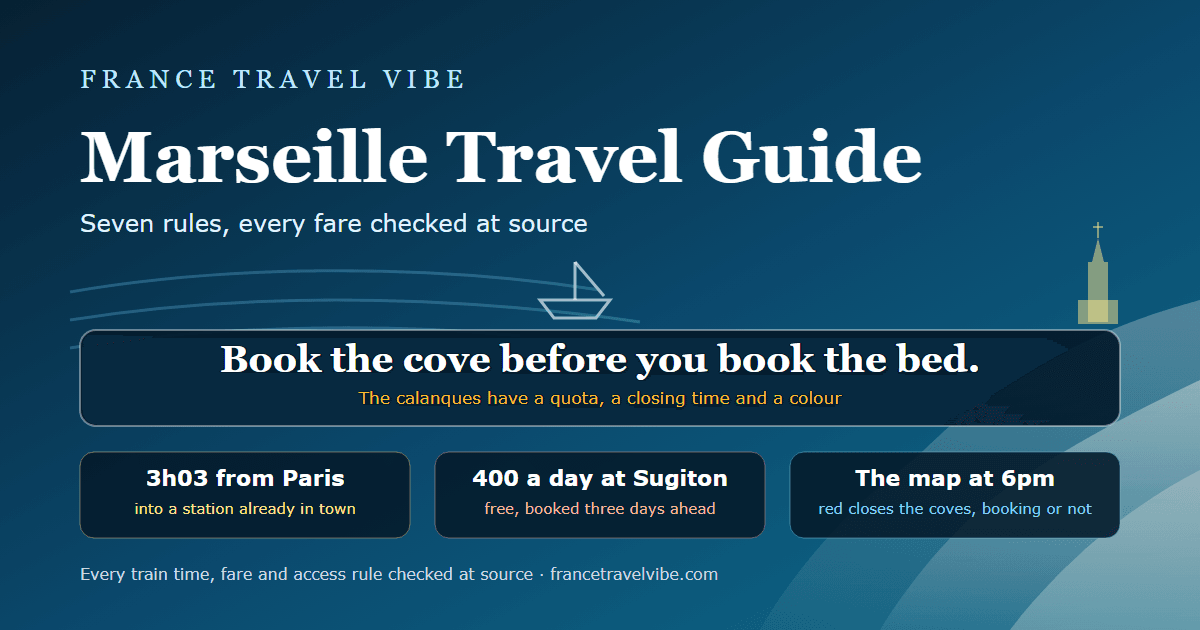
- Rule 1: three nights, not a day trip. Visitors already average 4.2 days here, and a day from Aix buys the Vieux-Port and the basilica and nothing else (Provence Tourisme, visitor survey published 2025).
- Rule 2: take the 3h03 train, not the flight. Saint-Charles is in the city centre and Ouigo sells the seat from €16 (SNCF Connect, checked September 2026).
- Rule 3: book Sugiton three days out. From late June to the end of August, plus three shoulder weekends, the cove admits 400 people a day. Its free booking opens at 9am three days ahead and closes at 6pm the day before (Parc national des Calanques, 2026; quota per Made in Marseille, June 2026).
- Rule 4: don’t drive to the coves in summer. Every day from June 12 to August 30, the Sormiou, Morgiou and Callelongue roads close to cars from 7am to 7pm.
- Rule 5: check the colour map at 6pm. From June 1 to September 30 the préfecture rates every massif for the next day. Red closes the park, and cancels your Sugiton booking with it.
- Rule 6: May or October, not July. Summer 2026 gave Marignane 41 days above 35°C, double the previous record (Météo-France via ICI Provence, August 2026).
- Rule 7: stay within a walk of the Vieux-Port. Metro, island boats and calanques buses all start there, and in summer 2026 the average hotel night hit €188, above Paris.
What’s in This Guide
What Is Marseille, and How Many Days Do You Need?
Rule 1. Three nights. Marseille was founded by Greek sailors around 600 BC and marks 2,600 years in 2026, which the state’s Saison Méditerranée built its opening sequence around (Saison Méditerranée 2026). Its visitors stay 4.2 days on average and spend €79 a day (Provence Tourisme, visitor survey published 2025, fieldwork 2019 to 2022). One night for the city, one for the calanques, one for the islands and museums, with the fire map deciding the order.
It sits twelfth on my ranking of the best places to visit in France, and I called it the most misjudged city in the country there. Here’s what I meant. It’s a working port city, not a Riviera resort. Its beaches are small and municipal, and its old town, Le Panier, is six streets on a hill. What it has instead is a national park inside the city limits, with limestone inlets you can reach by city bus.
Visitors know this better than the guidebooks do. That same survey put French travellers at 73 percent of stays, and the biggest foreign markets in order were Germany, Algeria, the United States, Italy and the United Kingdom. Nice’s profile is the inverse, at 71 percent foreign (Maritima, Tourisme à Marseille, February 2026). Winter took 31 percent of stays here and the summer core only 20, so the city has a real off-season trade.
Settle two things before booking. This is not a beach holiday, and if that’s what you want, Nice is 2h36 east and does it better. And it is not a day trip. Visitors who come from Aix or Avignon for the afternoon see the Vieux-Port, climb to the basilica, and leave without touching the reason to come. Marseille is Provençal too, and my guide to French regional cultures explains what that means beyond the accent.
Still shaping the wider trip? How many days France really needs settles the seven, ten and fourteen-day shapes, and my complete France travel guide handles entry rules and budgets end to end.
How Do You Get to Marseille, and Do You Need a Car?
Rule 2. From Paris Gare de Lyon the TGV takes 3h03 on the fastest of 25 daily trains and arrives at Saint-Charles in the city centre, from €16 on Ouigo (SNCF Connect, checked September 5, 2026). No car. Marseille is the one city in Provence where the station is already where you’re going. Everything in this Marseille travel guide is reachable by metro, bus or boat.
Flying still exists and rarely wins. France’s short-haul ban only removed routes with a rail alternative under 2h30, so Paris to Marseille kept its 1h20 flights. Add the airport hour, the flight and the shuttle in from Marignane, and by my count the door-to-door time lands at 3h45 or more, against the train’s 3h03. My guide to the four ways from Paris to Provence prices each of them and sources the ban.
If you do fly, Marseille Provence took 11.28 million passengers in 2025, its busiest year (TourMaG, bilan 2025, January 2026). International traffic was 70 percent of the total. Ryanair is the biggest airline there, with over a third of the seats (Air Service One, 2025), which is why UK and Irish fares run low. A shuttle to Saint-Charles costs €8.30 single or €13.40 return (RTM grid via Économie Matin, September 2025).
For American readers, the map changes in 2027. United will fly daily from Newark to Marseille from June 4 to September 5, 2027. A Washington to Toulouse route opens that April too. Together they’re the only US to France services landing in neither Paris nor Nice (The Connexion, List of direct US-France flights grows, August 2026). It’s announced, not yet on sale as I write, and it makes Marseille the natural first night of a Provence trip rather than the last.
In town, RTM runs two metro lines, three trams and the buses on one ticket. A single costs €1.70 from a machine or the app, or €2.00 on board. A 24-hour pass is €5.20 and a 72-hour pass €10.80 (RTM tariff grid as listed by Économie Matin, September 2025). That 72-hour pass covers the calanques buses, which matters more than any museum discount.
Onward, Nice is 2h36 on the fastest of 21 daily trains, from €30 (SNCF Connect, September 2026), and Cassis is about 22 minutes by TER (SNCF Connect, 2026), though its station sits 3 km above the port with a shuttle bus down. Avignon and the villages are the other direction. For the wider question of when a rental car earns its cost in France, my transport guide has the arithmetic; for Marseille itself you won’t need one.
How Do the Calanques Work: Quotas, Closed Roads and the Colour Map?
Three systems stack on top of each other from June to September, and a visitor has to clear all three. Sugiton admits 400 people a day on a free, mandatory online reservation. In 2026 the season ran on June 20 and 21, every day from June 27 to August 30, and on September 5, 6, 12 and 13 (Parc national des Calanques, 2026; quota per Made in Marseille, June 2026).
Other coves need no booking, but the roads to three of them close, and a daily fire colour can close everything.
Rule 3: the Sugiton reservation
The cove and its neighbour, Pierres Tombées, took peaks of 2,500 people a day before the cap. Under their feet the soil was sliding towards the beach (Parc national des Calanques, 2026). Bookings open at 9am three days before your visit and close at 6pm the day before. You book up to five people at once, up to eight times a season, and children under three don’t count. Rangers at the cove check the confirmation email, so have it on your phone.
Two details from the booking page that most guides skip. If the massif is closed for fire risk, every reservation for that day is cancelled automatically and cannot be moved. And the park’s board has renewed the scheme through 2027, so read this as the rule, not a trial. An English explainer sits on the park’s site. Chamonix is copying the system for Lac Blanc from summer 2027.
Rule 4: the roads that close at 7am
Roads down to Sormiou, Morgiou and Callelongue closed to cars from 7am to 7pm on June 5 to 7. From June 12 to August 30, 2026 they closed every day. Sormiou and Morgiou closed again on September weekends (Parc national des Calanques, calendrier juin-septembre 2026, June 2026).
Inside the park, the alternative is the city bus. Take line 20 to Callelongue from the line 19 terminus at the Madrague de Montredon, line 22 to Les Baumettes for Morgiou, or line 23 to La Cayolle for Sormiou. For Sugiton, take B1 or 21 from Castellane or the Rond-Point du Prado to the Luminy terminus (Marseille Tourisme, How do I get to the Calanques?).
Then you walk. From Luminy, Sugiton is about 45 minutes down and an hour back up (Marseille Tourisme, walking tours of the calanques). Morgiou is about an hour from the Baumettes stop, Sormiou about an hour from La Cayolle. Callelongue is at the bus terminus. From the Cassis side, En-Vau is over an hour on foot from the Port-Miou car park, with Port-Pin on the way.
Rule 5: the 6pm colour map
From June 1 to September 30, the préfecture rates every forest massif in the Bouches-du-Rhône for the following day, in four colours. It goes up around 6pm on its interactive map and in the Mes Calanques app (Préfecture des Bouches-du-Rhône, Accès aux massifs forestiers, updated August 2026).
Red means no land access to the park at all and the Route des Crêtes closed. Boats may sail past the coves but not land (Parc national des Calanques, Risque incendie). Only the Frioul archipelago stays reachable.
I learned to check the map with the evening drink and keep a museum morning in reserve. Otherwise it’s a bus to Luminy and a closed gate, and on the record day in July that was the whole city’s experience. That map is the calanques’ real timetable. Plan the three days so that either of the last two can be the calanques day.
The boats, and the plan B
By sea is the other way to see them, and the only way on a red day. Year-round, the Frioul and Château d’If shuttle leaves the Vieux-Port at €17.70 return for one island (RTM, Lebateau Frioul aller et retour, tariffs in force September 2025). Both islands cost about €26, with a lower rate for métropole pass holders (Fréquence-Sud, July 2026).
Landing on If is separate: €7, free under 26 for EU residents (Château d’If, Centre des monuments nationaux). On a mistral day the If boat doesn’t run at all, and the operator’s notice says so, per the same Fréquence-Sud page.
Calanques cruises from the Vieux-Port start at about €20 for a short loop and run to catamaran days at €89 and up (CheckYeti, 2026). From Cassis, the local boatmen run circuits of three, five, eight and nine calanques, from about an hour to 2h20. They run whenever the weather allows (La Visite des Calanques, 2026). None of the boats lets you land inside the park in summer. They show you the coast; the swimming happens on foot.
That same evening-map habit runs the whole region. My Provence itinerary teaches it for the Luberon trailheads, which run on the Vaucluse préfecture’s equivalent map.
| Calanque | Bus and stop | Walk, one way | Summer 2026 road rule | Booking | By sea |
|---|---|---|---|---|---|
| Sugiton | B1 or 21 to Luminy | about 45 min down, 60 up | no road | 400 a day, June 27 to Aug 30 plus six weekend days | no landing |
| Sormiou | 23 to La Cayolle | about 60 min | closed to cars 7am to 7pm, June 12 to Aug 30, Sept weekends | none | no landing |
| Morgiou | 22 to Les Baumettes | about 60 min | closed to cars, same dates | none | no landing |
| Callelongue | 19 then 20 to the terminus | at the stop | closed to cars 7am to 7pm, June 5 to 7 and June 12 to Aug 30, no September closures | none | no landing |
| Port-Pin and En-Vau | TER to Cassis (station 3 km above town, shuttle bus down), then Port-Miou on foot | about 40 and 70 min from the car park | park car parks fill early | none | Cassis boats pass, no landing |
| Frioul and If | boat from the Vieux-Port | none | none | none | €17.70 return, If entry €7 |
Sugiton is one of the four bookings on my ranking of the experiences worth your time in France, and the only one of the fifteen that is free.
Is Marseille Safe?
In the districts a visitor uses, yes, and the préfecture’s own 2025 review is the evidence. General delinquency fell 4.1 percent across the city and 12.7 percent in the hypercentre, the arrondissements around the Vieux-Port where the four bases in this guide sit. Burglaries fell 5 percent and vehicle theft 7 (ICI Provence, Bilan 2025 de la délinquance à Marseille, February 2026). Violence against persons rose 3.9 percent in the same year. Both numbers are true, and they describe different Marseilles.
The drug trade is real, and I’m not going to soften it. Police made 3,770 trafficking arrests in 2025, up 11 percent, and the number of open dealing points fell from 181 in 2021 to 89 (ICI Provence, 2026).
What the préfecture declines to publish is how many people were killed or wounded in it. Drug-related killings fell from 49 in 2023 to 24 in 2024, the latest published count, which the European Parliament cited in 2025 (European Parliament, procedure summary). That violence is concentrated in the northern districts, kilometres from any sight in this guide, and its victims are overwhelmingly people inside the trade, though not only them.
What actually affects a visitor is the same thing that affects one in Paris: pickpockets and phone snatching, around Saint-Charles station, on the metro and along the Canebière. France as a whole sits at US advisory Level 2, unchanged (US State Department, France travel advisory). British advice adds a wildfire warning for the south from April to October (GOV.UK, France safety and security). Neither singles out Marseille.
So the honest reframing is this. In 2026 the measurable risk to a summer visitor was not crime. It was a 40°C afternoon on a limestone path with no shade, and that is the subject of Rule 6. My national safety guide puts heat at the top of the list for the same reason. For the station and metro tricks specifically, the scams that actually get tried in France covers them one by one.
When Should You Go, and What Did Summer 2026 Do to Marseille?
Rule 6. May or October, and 2026 removed whatever argument July had left. Marignane hit 40.5°C on July 8, breaking a record of 39.7°C that had stood since 1983. Summer closed with 41 days above 35°C, double the 2003 record, and 51 tropical nights against a normal 33 (ICI Provence, L’été 2026 se distingue par sa persistance selon Météo-France, August 2026). Météo-France’s forecaster called the season remarkable for its persistence, not its peaks.
Normals show why the shoulders win. Marignane’s mean daily high is 23.5°C in May, 27.9 in June, 30.7 in July, 30.5 in August, 25.9 in September and 21.3 in October. A year brings 532 mm of rain over about 53 wet days (Météo-France, fiche climatologique Marseille-Marignane, normales 1991-2020). October in Marseille is a warm May somewhere else, and the sea is still swimmable.
Second variable: the mistral, and it cuts both ways. It clears the sky, drops the temperature, cancels the If boat and raises the fire colour, sometimes all on the same day. One morning I’d set aside for the island turned into a morning on the Corniche watching the sea go white, which is its own reason to be there. The wind decides, whatever the ticket says.
Heat does the same from the other direction. On the record day in July the massifs were already shut before the temperature peaked (Maritima, July 2026). A calanques day in high summer is a lottery run by the weather.
October’s case is simple. Sugiton’s reservation season ends in mid-September, and the road closures fall back to weekends and then stop. On September 30 the colour map switches off, and the water holds its warmth for weeks after the air cools.
May’s case is the same picture from the other side: everything open, nothing yet closed. This year the city ran its 2,600th-anniversary opening from May 15 to 24 (Saison Méditerranée 2026), and that spring mood is the one to catch. Those three reservation weekends in June and September are the shoulder days everyone else has also spotted.
For the national month-by-month picture, when to visit France sets Marseille against the north. A week here can hold 35°C and a mistral in the same seven days. What to pack for France is worth the two minutes before the case gets closed.
Where to Stay, and What Every Marseille Travel Guide Gets Wrong About Cruise Days
Rule 7. Within a fifteen-minute walk of the Vieux-Port, because the metro, the island boats and the calanques buses all start there. In summer 2026 the average Marseille hotel night reached €188, up from €148 a year earlier. That put it ahead of Paris at €182 and Nice at €175, on a cozycozy panel of 30 destinations reported by Le Figaro (Le 10 Minutes Hôtelier, July 2026). July occupancy ran near 95 percent (Ulysse, August 2026).
That is a booking-platform panel, not an official count. And it rose from a base that was already busy: the tourist office’s own figure was 81 percent hotel occupancy from June to September 2025 (TourMaG, October 2025).
Four bases cover it, and my guide to where to stay in France covers which kind of bed suits each. Streets around the Vieux-Port and Opéra put everything at your door and stay loud until late. Le Panier, the old town on its hill, is quiet by evening and dense with cruise groups by mid-morning. Cours Julien and Notre-Dame-du-Mont, ten minutes uphill from the port, is the bar and street-art quarter and usually the cheapest of the four. Out on the Corniche and the Vallon des Auffes you buy the sea view at the price of a bus ride to everything else.
Cruise days are the thing to plan around, and they’re easy to miss.
Marseille took 2.6 million cruise passengers, up 8 percent on 2024, on 660 calls in 2025. For 2026 the industry expects 750 calls and 2.8 million passengers (Marsactu, En 2025, Marseille a accueilli 2,6 millions de croisiéristes, May 2026). About seven in ten are in port for the day only, since the same report puts turnaround passengers, the ones starting or ending a cruise here, at about 30 percent. They reach Le Panier around ten and are gone by four, so the old town at breakfast and at dinner is a village, and at 11am it isn’t.
Tourist tax adds €5.76 per person per night in the palace band, a €4 municipal rate plus a departmental and a rail surcharge, and less in every band below. My city-by-city tourist tax guide shows how Marseille’s number is built and where it sits against Paris.
The Costs No Marseille Travel Guide Prints
A full three days of transport, museums, the island boat and one calanques cruise comes to about €80 a person before food and bed. That’s the 72-hour pass, the MuCEM, the Cosquer cave, the island boat and a short cruise, or €77.50 from the table below. Your bed is the variable. Fixed costs are small because the best things here are free or nearly so. Notre-Dame de la Garde costs nothing, the calanques cost a bus ticket, and the sea is free.
| Item | 2026 price | Source |
|---|---|---|
| RTM pass, 72 hours, all buses and metro | €10.80 | RTM grid via Économie Matin, Sept 2025 |
| Airport shuttle to Saint-Charles, single | €8.30 | RTM grid via Économie Matin, Sept 2025 |
| MuCEM, full price (reduced €7.50, free under 18, closed Tuesdays) | €11 | News of Marseille, 2025 |
| Cosquer Méditerranée, adult (10 to 17 €11, 6 to 9 €6) | €18 | Cosquer Méditerranée, 2026 |
| Notre-Dame de la Garde | free | basilica |
| Frioul or If boat, return | €17.70 | RTM, Sept 2025 |
| Château d’If entry (free under 26, EU residents) | €7 | CMN, 2026 |
| Calanques cruise from the Vieux-Port, short loop | from about €20 | CheckYeti, 2026 |
| Sugiton reservation | free | Parc national des Calanques |
| CityPass, 24 hours with transport | €36 | RTM, Sept 2025 |
| CityPass, 72 hours with transport | €55 | RTM, Sept 2025 |
That table answers the CityPass question. Its 72-hour version costs €55 (RTM, CityPass Marseille 72h, tariffs in force September 2025).
It bundles the transport pass, the MuCEM, one boat crossing or the Cosquer cave, the If entry, the little train to the basilica and the hop-on bus. Its four priced items come to about €46.50 on the table above. So the pass only pays if you’d also ride the petit train and the bus tour inside one 72-hour window. Skip those two and it doesn’t.
MuCEM is the one museum I’d insist on, for the building as much as the collection. It’s a lace-concrete cube on the old port entrance, joined to the Fort Saint-Jean by a footbridge, and free to walk around outside.
Cosquer is the second. It’s a replica of the painted Palaeolithic cave in the calanques whose entrance lies 37 metres below the surface, with the originals still down there (Cosquer Méditerranée). Both close early on winter days, so check before you cross town.
In my experience food runs from a €15 lunch formule, which is the daily reality, to a bouillabaisse that starts around €70 a head. Places that make it properly need a day’s notice, and my French food guide explains the 1980 charter that defines the real one. Pizza is a Marseille dish too, and the trucks along the coast road are the cheap dinner. Etiquette is another matter, and the unwritten rules of a first trip to France cover the habits that Marseille bars in particular reward.
For the week-long budget across regions, what a France trip actually costs puts these numbers beside Paris and the Riviera. Coverage inside the park is patchy on the descents, so the note on which French network your eSIM rides is worth reading before the Luminy bus.
Three Days in Marseille, Done in the Right Order
Check the colour map at 6pm on day one, and let it decide which of the last two days is the calanques day. From June 1 to September 30 the préfecture publishes the next day’s access around 6pm (Préfecture des Bouches-du-Rhône, 2026), and that timing is the whole plan. Everything else is walking distance from the Vieux-Port or one bus ride away, and the order below assumes the train, not a car.
| Day | Morning | Afternoon | Evening |
|---|---|---|---|
| Day 1 | Paris to Saint-Charles, 3h03; drop the bags | Vieux-Port, then Le Panier after 4pm when the ships have sailed | Notre-Dame de la Garde for the light, bus 60 up and a walk down |
| Day 2 | Bus B1 or 21 to Luminy at 8am, Sugiton with the booking on your phone (or bus 23 to Sormiou without one) | Back up by early afternoon in summer; swim at the Prado beaches | Cours Julien for dinner |
| Day 3 | MuCEM and the Fort Saint-Jean at opening | Frioul or If boat after lunch, unless the mistral is up; then the Corniche and the Vallon des Auffes | Last dinner by the port; Nice in 2h36 or Ouigo back to Paris next morning |
Here’s the swap rule. If day two comes up red at 6pm on day one, do the museums first and book Sugiton for day three that same evening, if slots remain. Its booking window stays open until 6pm on day two. If both days come up red, as every day did around July 8, the Frioul boat still runs unless the red is a mistral red, the islands stay reachable and the museums have air conditioning. Marseille has a plan B built into it.
One more chart, because the cruise calendar decides what Le Panier feels like on any given morning. Marseille scheduled 686 calls in 2025, of which 660 were made, against 624 in 2024 and 622 in 2023. That is about 36 percent of every cruise call on the French Mediterranean coast (DIRM Méditerranée, croisière 2025, April 2025), and the forecast for 2026 is 750.
Check the port’s published ship schedule the night before. Ten seconds tells you whether tomorrow is a Panier morning or a museum morning.
Leaving, the coast runs both ways. My Nice guide picks up 2h36 to the east, and if you’re choosing between the Riviera towns, Nice, Cannes or Antibes as a base settles it town by town. Westward, Avignon and the villages are an hour on the train. Either way, price an open-jaw ticket: into Paris, home from Marseille or Nice.
Frequently Asked Questions
Is Marseille worth visiting?
Yes, for three nights, and for a different reason than Nice. It’s a 2,600-year-old working port with a national park inside the city limits, and visitors stay 4.2 days on average (Provence Tourisme, 2025). Its hotels ran near 95 percent full in July 2026 (Ulysse, 2026) and averaged €188 a night over the summer, above Paris (cozycozy panel via Le Figaro, 2026).
How many days do you need in Marseille?
Three nights: one for the city, one for the calanques, one for the islands and museums. From June to September the préfecture’s 6pm fire map decides the order. A day trip from Aix or Avignon buys the Vieux-Port and the basilica and nothing else. Sugiton alone takes about 45 minutes down and an hour back up on foot (Marseille Tourisme).
Is Marseille or Nice better?
Different trips. Nice’s visitors are 71 percent foreign; Marseille’s are 73 percent French (Maritima, 2026; Provence Tourisme, 2025). Nice is a resort with a promenade and pebble beaches. Marseille is a port with a national park. They’re 2h36 apart by train from €30 (SNCF Connect, 2026). Pick Nice for a beach week and Marseille for a city with a coastline.
Do you need to book the Calanques?
Only Sugiton and Pierres Tombées, on the reservation dates: in 2026, June 20 and 21, daily from June 27 to August 30, and September 5, 6, 12 and 13 (Parc national des Calanques). Its quota is 400 a day (Made in Marseille, 2026), booked free from 9am three days ahead. Every other calanque is open without booking, subject to the fire colour and road closures.
Is Marseille, France safe for tourists?
In the central and coastal districts a visitor uses, yes. In its 2025 review the préfecture put general delinquency down 12.7 percent in the hypercentre and 4.1 percent citywide (ICI Provence, 2026). Drug-trade violence in the headlines is real and concentrated in northern districts far from any sight. For a visitor to Marseille, France the risks are pickpockets at Saint-Charles and summer heat.
The Bottom Line
- Book in this order: cove, bed, boat. Sugiton takes 400 people a day in summer (Made in Marseille, 2026), on a free booking that opens three days out (Parc national des Calanques, 2026).
- Take the train. 3h03 from Paris, from €16, into a station already in town (SNCF Connect, 2026).
- Check the map at six. From June 1 to September 30 the préfecture decides tomorrow’s access the evening before. Red cancels everything, booking included, and a red day is the day for the islands and the museums.
- Come in May or October. 41 days above 35°C this summer, and a 40.5°C record on July 8.
- Stay near the port, and do Le Panier after four. In 2025 the port brought 2.6 million cruise passengers (Marsactu, 2026), most of them ashore between ten and four.
If this Marseille travel guide leaves you with one line, make it this one. This coast everyone comes for is a national park now, with a quota, a closing time and a colour. Violence in the headlines is real and elsewhere, and the visitors and the prices have already moved on. Book the cove first, check the map at six, and the three days arrange themselves around the sea.