

Last verified: August 30, 2026. Every admission price, opening rule and journey time in this Dordogne travel guide was checked against the body that sets it, from the châteaux’s own tariff pages to the state’s cave booking service and the prefecture’s drought orders. Three figures in circulation elsewhere turned out to be wrong, and one I could not verify at all, so I left it out. I re-check this page monthly.
The most important cave in France that you can still walk into takes a few dozen visitors a day, and it’s closed on Saturdays. Almost every guide to the Dordogne sends you to Sarlat’s Saturday market. That collision, sitting in plain sight on two official websites, is the whole problem with how this region gets written about.
Here’s what I found reading the page-one results before I started. Not one of them prints an admission price. Not one mentions the booking rule. The Dordogne, France’s cave-and-castle corner in the southwest, is a region where the order you plan things in matters more than the itinerary you end up with, and the guides are all itinerary.
So I checked everything myself. This Dordogne travel guide is written as seven rules, each with a number attached and a source behind it.
Disclosure: Some links in this guide may earn us a commission, at no extra cost to you. It never changes what we recommend.
Key Takeaways
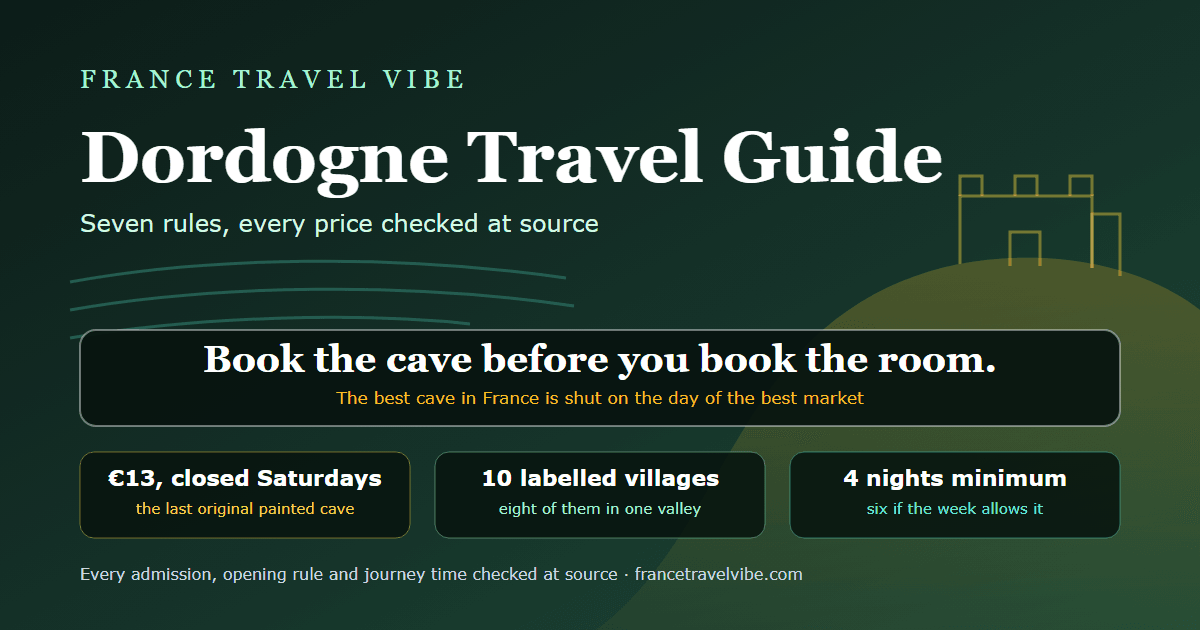
- Book the cave before you book the room. Font-de-Gaume is the last original polychrome cave in France open to the public, costs €13, must be booked online, and closes Saturdays (Prehistoric Sites of the Vézère Valley, 2026).
- Four nights is the floor, six is the right answer. Ten of France’s labelled most beautiful villages sit within about 40 km of Sarlat, and the roads between them are slow.
- Lascaux IV is a replica and it’s still worth €23, because the original has been shut since 1963.
- The caves are reachable by train, the villages are not. Les Eyzies has a station 700 m from the village; the châteaux need a car or a canoe.
- Autumn 2026 is unusually good value. July nights fell about 10 percent in the Sarlat area, but arrivals actually rose 7.4 percent. People came and left faster (Espace PRO Intense Périgord Noir, 2026).
Table of Contents
What Is the Dordogne, and How Many Days Do You Need?
Four nights is the floor and six is the right answer. The Dordogne is a department in southwest France, about two hours from Bordeaux by regional train, and the part everyone means is the Périgord Noir. The department holds 10 villages carrying the Plus Beaux Villages de France label, eight of them in that one corner (Dordogne Périgord Tourisme, 2026).
Locals divide the department into four colours: black, green, white and purple Périgord. You’ll see the scheme on every brochure. You can safely ignore it. What matters is that the caves, the castles and the labelled villages cluster in one valley system, and that valley is slower to drive than the map suggests.
Two things anchor the region’s reputation. UNESCO listed the Vézère valley in 1979 as a property of 15 prehistoric sites and 25 decorated caves, drawn from 147 Palaeolithic sites in all (UNESCO). And Sarlat, the base town, packs 66 listed monuments into 11 hectares, which its own council calls a national record for heritage density, with a population of 8,786 (Mairie de Sarlat).
One correction before you plan, because a surprising number of guides get it wrong. Rocamadour and the Gouffre de Padirac are not in the Dordogne. They’re in the Lot, the next department east. They’re a long and worthwhile day out, not a local stop, and budgeting them as one will wreck your schedule.
Our pillar puts the region in context against eleven others in where the Dordogne ranks among the best places to visit in France. Still shaping the wider trip? How many days France really needs covers the seven, ten and fourteen-day shapes.
How Do You Actually Get Tickets for the Original Caves?
Online, in advance, and before you book anything else. Font-de-Gaume is the last cave in France with original polychrome paintings still open to the public. Admission is €13, online booking is mandatory, the interior visit is capped at 30 minutes for conservation, and the site is closed on Saturdays all year (Prehistoric Sites of the Vézère Valley, 2026).
Read that last part twice. It applies to all three state-run sites here, plus 1 January, 1 May and 25 December.
Three sites share one booking system. Font-de-Gaume is the painted one. Les Combarelles is engraved rather than painted, several hundred figures cut into a narrow corridor, and it’s the connoisseur’s choice. The Abri du Cap-Blanc is neither: it’s a carved frieze of horses in high relief, at €9, and it’s far easier to get into.
Now the part nobody prints. The state publishes no daily capacity at all. Its page says only that the number admitted each day is limited and can change daily. Independent counts put Font-de-Gaume at about 78 places a day in groups of a dozen, Les Combarelles at 42 and Cap-Blanc at 210 (Hominides; Archaeology Travel, 2026). Treat those as the right order of magnitude rather than gospel. Either way, Les Combarelles is the scarcest ticket in the valley and almost nobody knows it.
Tickets go up a month at a time, and the July and August releases go fastest. Under-18s and EU residents aged 18 to 25 pay nothing, but still need a booking. Turn up fifteen minutes early: tickets are checked before the tour starts and the guides don’t wait.
Missed out? Take Cap-Blanc and don’t sulk. A frieze carved 15,000 years ago at eye level is not a consolation prize.
Lascaux sits at number 11 on my ranking of the experiences worth your time in France, the one car-required entry on a list where five of fifteen are free.
Is Lascaux IV Worth €23?
Yes, and it’s the rare facsimile that earns the word. Lascaux IV costs €23 for anyone 13 and over, €15 for a child aged 5 to 12, and it exists because nobody has been allowed inside the original since 1963 (Semitour Périgord, 2026). The site takes more than 400,000 visitors a year and passed 3.5 million in its first decade after opening in December 2016.
The naming defeats everyone, so here it is once. Lascaux I is the original, closed. Lascaux II is a partial replica beside it, opened in 1983. Lascaux III travels. Lascaux IV is the full-scale reproduction of the whole cave, with the museum attached. When people say “we did Lascaux”, they mean IV.
Why did the original close? Visitors brought in carbon dioxide, heat and fungal spores, and the paintings began suffering within twenty years of their discovery in 1940. Closing it was the only way to keep it.
The visit is timed and guided, and the replica is good enough that the temperature drop as you walk in does most of the work. Spreading it out costs less than you’d think: Lascaux IV plus Lascaux II is €29, and the Pass Vézère is €40.50.
Here’s my honest ordering, though. If you can get a Font-de-Gaume ticket, treat that as the priority and Lascaux as the thing that gives it scale. Standing in front of pigment that has been there since the Ice Age is a different experience from standing in front of an excellent copy, and the copy is the one that’s always available.
Which Castles and Villages Are Worth Paying For?
Castelnaud and Beynac, and do them on the same day, because they stare at each other across the river and spent the Hundred Years’ War on opposite sides of it. Castelnaud is €13.60 and Beynac is €12.50 (Château de Castelnaud; Château de Beynac, 2026).
They’re different visits. Castelnaud is the museum castle, with a serious collection of medieval siege weaponry. Beynac is the emptier, higher, more vertiginous one, and hands you a phone commentary at the gate rather than a fitted-out interior. Want only one? Castelnaud with kids, Beynac without.
The best-value ticket in the region isn’t either of them on its own. Castelnaud combined with the Jardins de Marqueyssac is €24.50, available 5 February to 11 November, against €25.50 bought separately. Marqueyssac alone is €11.90 from April to mid-November and €9.90 through the winter, and its clipped box terraces sit on the bluff that gives you the view both castles are in (Jardins de Marqueyssac, 2026). Want to sleep in a castle too? Two Dordogne château B&Bs cost about €165 for two on a July Saturday when I priced château hotels in France.
One parking note that saves a climb: Beynac has a car park at the château gate, a minute from the entrance. The village car park below is a fifteen-minute walk uphill. Both are signposted, and only one is obvious.
The ten labelled villages are La Roque-Gageac, Castelnaud-la-Chapelle, Domme, Beynac-et-Cazenac, Belvès, Monpazier, Saint-Léon-sur-Vézère, Saint-Jean-de-Côle, Limeuil and Coly Saint-Amand. Three earn a proper stop: La Roque-Gageac, built flat against its cliff, Monpazier, for the most complete bastide grid in France, and Domme, for the view. I’ll be honest about Domme. The panorama is worth the trip and the streets behind it are ordinary, so go for the terrace and don’t feel you’ve missed anything.
If châteaux are your thing more broadly, how the Loire’s châteaux compare on price and crowds covers the other great cluster.
Do You Need a Car in the Dordogne?
For the villages, yes. For the caves, no. That split is the single most useful thing in this guide. A car-free Dordogne genuinely exists, as long as you build the trip around the Vézère rather than the postcard stretch of river.
Start with the caves, because the transport works. Les Eyzies has a station 700 m from the village on the Périgueux to Agen line (SNCF Gares & Connexions, 2026). Font-de-Gaume, Les Combarelles and the National Prehistory Museum are all walkable from there. You can do the entire prehistoric half of this region without touching a steering wheel. Where these caves sit in the longer story, from the first painters to the Republic, is in my French history primer.
Sarlat is reachable too. Bordeaux to Sarlat runs about 2h14 at best over 173 km, roughly six trains a day, first out around 06:20 and last around 19:07, changing at Libourne or Bergerac (TER Nouvelle-Aquitaine, 2026). No direct train runs from Paris, so Bordeaux is the interchange, which makes the case for Bordeaux as your arrival city worth reading if you’re building a two-stop trip.
Where it breaks down is the castles. Beynac, Castelnaud, Marqueyssac and most of the ten villages sit on roads with a couple of buses a day at best. This matches what our guide to getting around France says about rural regions generally, and the Dordogne is the clearest example of it.
Which brings me to the mistake I made. I treated these villages as a driving loop, and they aren’t one. They’re strung along a single river, the road between them is slow, and by eleven in the morning it’s full of coaches.
The river is the better road. A canoe from Vitrac down past Castelnaud to Beynac runs about 16 km and three to four hours for roughly €24. Stop short at La Roque-Gageac and it’s 9 km, two and a half hours, about €20. The minibus back is included either way (Canoë Vacances, 2026). You’ll see four of the ten labelled villages from the water, from the angle they were built to be seen from, for less than one château ticket.
Flying in? Bergerac’s summer 2026 season runs 29 March to 24 October, and Ryanair came back after threatening to leave. It flies eight times a week to London Stansted, plus Liverpool, East Midlands, Bristol, Bournemouth and Edinburgh. British Airways, Jet2 and Transavia fill in the rest (Ville de Bergerac, 2026). Outside those dates, come through Bordeaux. Book the hire car early either way, because the desks at Sarlat and Bergerac are small and summer stock runs out.
Rural coverage matters here more than in most of France, and which French network your eSIM actually rides on is worth two minutes before you leave.
When Should You Visit the Dordogne?
Late May, June or September. July 2026 was the hottest month ever measured in France, and the Périgord Noir felt it: nights booked in the Sarlat area fell about 10 percent, from roughly 560,000 to 506,000 (ICI Périgord, 2026).
August is the month to skip, and heat is the reason rather than crowds. For the national picture, every month in France ranked and priced does the wider comparison, and what to pack for a French summer has the heat-specific list.
Winter is a genuinely different region, and underrated. Truffle markets run mid-November to mid-March, with controlled sales on Saturday mornings at 9am on rue Fénelon and the wholesale market on Wednesdays at 2.30pm outside the town hall (Mairie de Sarlat, 2026).
What Happened in 2026, and Why It Helps You
The Dordogne didn’t lose visitors this year. It lost nights. Arrivals in the Sarlat area rose 7.4 percent, from 161,000 to 173,000, while the average stay fell from 3.9 nights to 3.1 (Espace PRO Intense Périgord Noir, 2026). That gap is the whole story behind the headline decline.
Two things follow. Over the same board’s 2023 to 2026 window, the French to foreign split moved from 65/35 to 58/42. And across the full summer about five million nights were booked, down roughly 2 percent on 2024. The season was close to flat. July carried the damage.
More people, staying less time. What that means on the ground is that the crowd here is a midday crowd, and the fix is simple: stay the fourth night and get up early. Be at Beynac at nine and at the market at eight and you’re travelling off-season in high season.
The drought needs saying plainly too, because it was real and it did close rivers. On 11 July the prefecture had 44 basins under restriction, 20 of them at crisis level (Préfecture de la Dordogne, 2026).
But the restrictions govern water withdrawals and irrigation, not tourists, and they didn’t fall evenly. The tributaries took it. The Auvézère’s only canoe operator closed its main route from 8 July, the first time in 25 years it hadn’t run through the summer. On the Isle, paddlers spent August getting out to drag boats over gravel (ICI Périgord, 2026).
The main Dordogne is a different animal. It takes indirect low-water support from the big hydroelectric reservoirs upstream, which are obliged to maintain a guaranteed flow (EPIDOR). So the lower Dordogne sat at vigilance while twenty other basins were in crisis, and the castle stretch kept running all summer.
The Costs No Dordogne Travel Guide Prints
Less than any French region with this much on the ground. The seven headline sites in this Dordogne travel guide total about €96 a head at full adult price. They run from €9 at the Abri du Cap-Blanc to €23 at Lascaux IV (Prehistoric Sites of the Vézère Valley; Semitour Périgord, 2026). That’s four Paris museum tickets for a week of sites. Add a canoe afternoon at €20 to €24 and you have the whole cultural budget.
Accommodation splits sharply between Sarlat, which charges town-centre rates in season, and the gîtes ten minutes out, which don’t. That gap is wider here than the distance justifies, and it’s the easiest saving available. For a July week near Sarlat, a gîte came out €355 cheaper than a hotel for a family of four.
On the nightly tourist tax I’ll do something unusual and give you no number. The Sarlat area’s 2026 schedule exists only as a PDF I couldn’t verify. The versions circulating elsewhere are either the national statutory ranges or figures that would put a Dordogne B&B above a Paris palace. Rather than print something I can’t stand behind: our guide to French tourist taxes covers the rural formula, which applies to most gîtes here and works out to cents a night.
Zoom out and the region is doing well, whatever July looked like. Tourism brought in €1.3 billion in 2025, up 19 percent on 2019, and runs about a third of the local economy (Département de la Dordogne, 2026). For the wider picture, what a week in France actually costs has the daily figures.
What Every Dordogne Travel Guide Gets Wrong About Market Day
Arrive Tuesday. Market Wednesday. Caves Thursday. Castles and canoe Friday. That order exists for one reason. Sarlat’s big market runs Saturday, 8am to 1pm for food (Mairie de Sarlat, 2026). Font-de-Gaume is closed every Saturday of the year (Prehistoric Sites of the Vézère Valley, 2026). The two best things here are structurally in conflict.
Most guides tell you to do both and never notice they’ve written an impossible week. Here’s the thing, though: Wednesday’s market is the better one anyway. It runs 8am to 1pm through the old town, it’s smaller, and locals still shop it. Saturday’s version runs 8am to 1pm for food and until 6pm for everything else, and it’s the one the coaches are built around (Mairie de Sarlat, 2026).
| Day | Morning | Afternoon | Evening |
|---|---|---|---|
| Tuesday | Arrive, settle in | Sarlat old town on foot | Dinner in town |
| Wednesday | Sarlat market, 8am | Lascaux IV, timed entry | Montignac or back to base |
| Thursday | Font-de-Gaume, booked weeks ago | Les Eyzies and the museum | Quiet evening |
| Friday | Beynac at nine, before the coaches | Canoe Vitrac to Beynac | Castelnaud night show in season |
A fifth and sixth night buy you Monpazier’s bastide grid, Saint-Léon-sur-Vézère upstream, and the time to sit still, which is the actual point of coming here. If you want the wider route, our Provence itinerary covers the other great slow-travel region in the south, and the unwritten rules of visiting France covers the etiquette that markets in particular reward.
Frequently Asked Questions
How many days do you need in the Dordogne?
Four nights minimum, six to do it properly. In the Dordogne, France’s densest cluster of caves and châteaux, ten labelled villages sit within about 40 km of Sarlat, but the roads are slow and the caves run on timed entry. Average stays fell to 3.1 nights in July 2026, and that’s exactly the length that produces the rushed version.
Do you need a car in the Dordogne?
For the villages yes, for the caves no. Les Eyzies has a station 700 m from the village on the Périgueux to Agen line, and Font-de-Gaume, Les Combarelles and the National Prehistory Museum are all walkable from it. Sarlat is about 2h14 from Bordeaux on roughly six trains a day. The châteaux need wheels or a canoe.
How do you get tickets for Font-de-Gaume?
Only online at sites-les-eyzies.fr, and only in advance. Tickets are released about a month at a time, admission is €13, the cave closes on Saturdays, and interior visits are capped at 30 minutes for conservation. Under-18s and EU residents aged 18 to 25 go free but still need a booking.
Is Lascaux IV worth visiting if you’ve seen a real cave?
Yes, and the order matters. Lascaux IV is a full-scale facsimile at €23 for anyone 13 or over, built because the original has been closed since 1963. It takes more than 400,000 people a year on timed entry. If you can get a Font-de-Gaume ticket, do the original first and let Lascaux fill in the scale.
What’s the cheapest way to see the castles?
The combined Castelnaud and Marqueyssac ticket at €24.50, available 5 February to 11 November, or a canoe. The Vitrac to Beynac run costs about €24 with the shuttle back and passes below Castelnaud, Marqueyssac, La Roque-Gageac and Beynac in a single afternoon, which is better value than any château ticket.
The Bottom Line
- Book in this order: cave, room, car. Font-de-Gaume takes a few dozen people a day at €13, must be booked online, and closes Saturdays (Prehistoric Sites of the Vézère Valley, 2026).
- Give it four nights, and six if you can. Ten labelled villages and a UNESCO cave landscape don’t compress.
- Split the car question. The Vézère caves work by train from Les Eyzies; the châteaux don’t.
- Take the river. About €24 gets you past four labelled villages from the angle they were built for.
- Come in September. July 2026 nights fell 10 percent while arrivals rose 7.4 percent, so the crowd is a midday crowd and an early start beats it (Espace PRO Intense Périgord Noir, 2026).
If this Dordogne travel guide leaves you with one line, make it this one: the region isn’t crowded, it’s rushed. Almost everything that goes wrong here comes from treating a slow valley like a checklist, and almost everything that goes right comes from one extra night and an alarm set for seven. Book the cave first, and the rest of the week arranges itself around it.