
Last verified: October 19, 2026. I re-checked the train fares and times, Cannes’ municipal beach tariff and the airport taxi fares in this comparison on the date above, against TER Sud, SNCF Connect, the city of Cannes and Nice Côte d’Azur Airport. The TER fares had moved, to €7 for Antibes and €9.70 for Cannes. The other figures were checked against the body that sets them in August, and I re-check this page monthly.
Nice vs Cannes is a strange argument to watch, because the two towns are 40 minutes apart on a train that runs every 15 minutes. Add Antibes, sitting between them, and you’re choosing between three bases on one short stretch of coast. The internet answers with adjectives: authentic, glitzy, charming. Nobody prices anything.
Here’s what the adjectives hide. A sunbed on Cannes’ municipal beach costs €9 a day. A sunbed at a Croisette club a few minutes’ walk away starts around €70. A Cannes hotel can triple for a week in March for a reason printed a year in advance. Those numbers decide trips, and none of the comparison posts carry them.
So I ran five tests, each with a number attached, and scored all three towns.
Disclosure: Some links in this guide may earn us a commission, at no extra cost to you. It never changes what we recommend.
Key Takeaways
- Nice is the base for a first Riviera trip. It has the airport, the mainline station and the bus network, with Antibes about 25 minutes and Cannes under 40 minutes away on a line that runs 87 trains a day (SNCF Connect, 2026).
- Cannes has the Riviera’s cheapest sand, quietly. Its municipal beaches rent a lounger for €9 a full day beside private clubs starting around €70 (Ville de Cannes, 2026).
- Check the congress calendar before booking Cannes, any month. The Film Festival alone is worth about 20 percent of Cannes hoteliers’ annual revenue, and MIPIM, the Lions and MIPCOM fill the town in March, June and October (Ville de Cannes, 2025).
- Antibes is the value base. Free fine sand at La Gravette, a €6 Picasso museum in a seafront castle, and both neighbours on the same train line.
- The stakes are low, and that’s the honest headline. A “wrong” base here costs you about 30 minutes a day, not the holiday.
Table of Contents
Nice vs Cannes vs Antibes: Which Base Should You Pick?
Pick Nice for a first trip or any trip built on day trips. It logged 6.6 million hotel nights in 2025, up 7 percent, and its airport moved 15.23 million passengers, both from the tourist office’s own annual count (Explore Nice Côte d’Azur, Chiffres Clés 2025). Pick Cannes for a sand-first beach week outside congress dates. Pick Antibes for a slower week with both neighbours a short train ride away.
Four kinds of traveller, four answers. First Riviera trip? Nice, because the infrastructure argument ends the debate. Beach above everything? Cannes, with a caveat about dates I’ll get to. Travelling with kids who need sand and calm water? Antibes. Doing the Riviera as one leg of a longer France run? Nice again, because my pillar on the best places to visit in France treats it as the coast’s transport hub for a reason.
Keep the scale difference in mind, because it explains almost everything else. Nice is a working city of about 340,000 people that happens to have a famous seafront. Cannes counts roughly 74,700 residents, around 130 hotels and 8,000 rooms, and a convention centre that runs the town’s year (Ville de Cannes). Antibes sits between them in size and below both in noise.
And one honest admission before the tests start. These three towns are closer together than most readers assume. My rule after years of Riviera trips: you don’t choose a base by the town, you choose it by the train timetable, and this timetable is generous. The five tests are beach economics, getting around, the congress calendar, things to do, and the base budget. I’ll keep score.
What Does a Beach Day Actually Cost?
Cannes wins the beach test, and not for the reason its reputation suggests. The city’s two municipal beaches, Macé and Zamenhof, rent a lounger for €6.50 a half day or €9 a full day (Ville de Cannes, 2026). Parasols run €4.50 or €8, the season is June 15 to September 15, and you book online. The private Croisette clubs a few minutes away start around €70 for a front-row bed and run past €130 at the premium names in high season (Living on the Côte d’Azur, Beach Club Prices 2026).
Same bay, same sand, an eight-times price gap. That single fact does more for a beach budget than any hotel comparison, and I’ve never seen a ranking page print it.
Nice’s shore is a different animal: smooth pebbles along the whole Baie des Anges, with club loungers at roughly €32 a day. The full pebble story, and what to pack for it, lives in my Nice travel guide, so one sentence here does the job: bring water shoes or pay for the club.
Antibes quietly beats both on the only free metric. Plage de la Gravette sits under the old-town ramparts with fine sand, rare on this stretch of coast, shallow calm water, and no fee at all (Antibes Juan-les-Pins tourist office). If your beach day involves a bucket and spade rather than a bottle of rosé, Antibes is the answer and it costs nothing.
Two caveats, both worth planning around. Cannes’ municipal beds are summer-only: the season closes September 15, after which the free public stretches (Plage du Casino, the Plages du Midi) carry the shoulder season. And they sell out on summer mornings, so reserve online rather than strolling up at 11am.
Which Town Moves You Around the Riviera Best?
Nice, and it’s structural rather than a matter of taste. In 2026 the coastal TER puts Antibes about 25 minutes and €7 from Nice-Ville, and Cannes under 40 minutes and €9.70, at full fare (TER Sud, Nice–Antibes and Nice–Cannes route pages, 2026). With 87 trains a day on the line (SNCF Connect, 2026) you rarely wait more than 15 minutes, and tickets stay valid all day on the route. No other Riviera town pairs that with an international airport and a dense urban network.
The airport is where the asymmetry bites. From Nice Côte d’Azur’s terminal, a €1.70 tram takes you into Nice; the official fixed taxi fares run €72 to Antibes and €85 to Cannes. The full transfer table, and the €1.70 versus €2.50 bus-fare trick for towns beyond the Métropole, is in my Nice travel guide, which is the post to read if Nice wins your shortlist. The short version: land in Nice, and every base but Nice starts with a transfer decision.
Doing lots of hopping? The ZOU day pass covers unlimited TER in the department for €20, plus €5 per extra companion (ZOU, Région Sud fares). A couple doing Nice, Antibes and Cannes in one day pays €25 total, less than the €33.40 in singles it replaces. Coming down from Paris, the Paris to Provence route guide prices the TGV south. How the TER fits the national rail picture is Getting Around France’s territory.
Antibes earns its point here as the midpoint. From an Antibes base, both neighbours sit within about 25 minutes, which is the geometric argument for it, and the train frequency means you’ll never plan around a timetable. Cannes loses the test not because it’s hard to reach but because everything beyond Antibes requires passing through everything else first. Monaco, Menton, Èze and Villefranche, the eastern half of the day-trip menu, all sit on Nice’s side of the map.
Driving? Don’t. Parking is the Riviera’s real tax, and the train removes it entirely.
The Congress Calendar Sets Cannes Hotel Prices
Here’s the test no travel comparison runs, and it’s the most useful thing in this post. Cannes is a congress town first and a resort second: the Film Festival alone generates about 20 percent of its hoteliers’ annual revenue, roughly 80,000 nights, and supports 13,400 direct and indirect jobs (Ville de Cannes, 2025). When the Palais des Festivals fills, every hotel in town reprices, minimum stays appear, and the leisure traveller pays trade-fair rates for a beach holiday.
The rule that follows is simple and nobody states it: check the Palais des Festivals calendar before you book Cannes, in any month. The big four in 2026: MIPIM ran March 9 to 13 and Cannes Lions June 22 to 26 (Immosol, Cannes events calendar), and MIPCOM runs October 12 to 15 (Ville de Cannes agenda). The 80th Film Festival is already dated: May 11 to 22, 2027 (Screen Daily). The dates are public a year out. The surprise is optional.
I learned this the way most people do. Pricing a shoulder-season trip years ago, I found a Cannes quote nearly triple the same week in Nice and assumed an error, until I checked what was in the Palais that week. Nothing about the town explains it from the outside: same weather, same beach, a lanyard crowd where the tourists usually are. Nice has nothing on this scale; its rates follow the season in a smooth curve, which is one more argument for it as the default base.
The 2026 story also runs the other way, and it’s worth knowing. Cannes is actively shrinking its mass-cruise traffic. From 2026, disembarkations are capped at 6,000 passengers a day, and only one ship over 3,000 passengers may call per day. Large calls fall to 34 this year and 31 in 2027, and by 2030 the city wants nothing bigger than 1,300 passengers (Ville de Cannes; franceinfo, 2025). Between congresses, Cannes is getting deliberately quieter. Whether that’s the flaw or the whole point depends on what you came for.
Three Towns, Three Headline Acts
Nice by volume, Antibes by charm-per-euro, Cannes by boat. Nice backs its museums with a UNESCO listing: in 2021 the city was inscribed as Winter Resort Town of the Riviera, 522 hectares of it, the Promenade des Anglais included (UNESCO). The Musée Matisse charges €12, and Nice’s municipal-museums pass covers every city museum for €15 over 4 days (Musée Matisse), which makes a rainy-day plan almost free.
Antibes has the single best-value sight of the three. The Musée Picasso occupies Château Grimaldi on the seafront, where Picasso worked in 1946, and charges €6, free under 18, with a €15 pass covering four town museums over a week (Antibes tourist office). Add Port Vauban, Europe’s largest marina at about 1,500 berths (France Voyage), the ramparts walk and the Provençal market, and an Antibes day fills itself without a ticket queue in sight.
Cannes’ best sight leaves the shore. The Lérins islands sit 15 minutes offshore, and Horizon’s ferry to Île Sainte-Marguerite runs hourly, year round, at €19 return (Horizon, Compagnie Maritime). Fort Royal, the island’s pine woods and the quietest swimming in the bay make it the honest answer to “what do I do in Cannes that isn’t a beach or a boutique”. In town itself, the list runs short, and I’d rather say so than pad it.
What’s missing matters as much as what’s there. Cannes is thin on museums. Nice is thin on sand. Antibes is thin on nightlife. None of the three is thin on restaurants, and westward, the coast hands over to Provence: my Provence itinerary picks up where this shoreline ends.
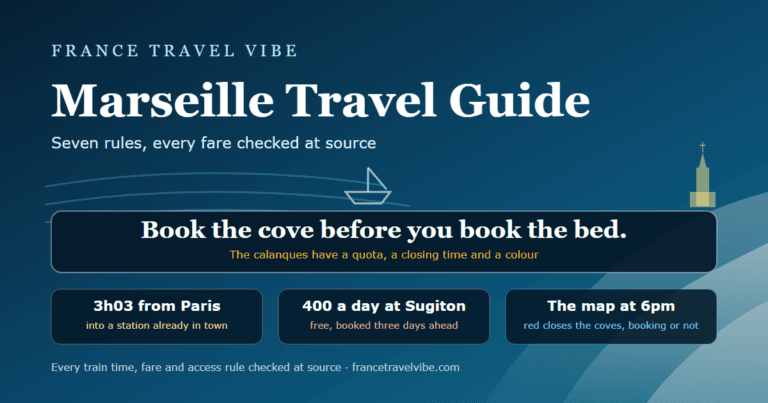
Further west, Marseille is the city France keeps getting wrong, and my Marseille travel guide covers its calanques rules and real costs.
Nice vs Cannes vs Antibes on Price: Which Base Is Cheapest?
Antibes, on the daily numbers a visitor actually pays. Its transit single is €1 on the app (Envibus), its best beach is free, its flagship museum is €6, and its 5-star tourist tax of €4.69 a night matches Nice’s (Antibes tourist office). Here is the whole scorecard, priced:
| Test | Nice | Cannes | Antibes | Winner |
|---|---|---|---|---|
| Transit single | €1.70 | €1.80 | €1.00 app | Antibes |
| Day on a sunbed | ≈€32 club | €9 municipal | Free sand | Antibes |
| Tourist tax, 5-star, per night | €4.69 | €4.42 | €4.69 | Cannes |
| Headline sight | Matisse €12 | Lérins ferry €19 | Picasso €6 | Antibes |
| Getting around the Riviera | Airport, hub station | End of the line | Midpoint | Nice |
| Hotel-rate behaviour | Smooth seasonal curve | Congress cliffs | Steady, smaller stock | Nice |
The tax row deserves one honest note: the three towns land within 27 cents of each other at the 5-star tier (Cannes publishes €4.42 net, Nice and Antibes €4.69), so it decides nothing. City-by-city rates across France live in my tourist tax guide, and the nightly figure belongs in your overall trip budget rather than in the base decision.
Lodging is where the shapes differ more than the prices. Nice runs the full range, hostel to palace, which is why budget travellers default there. Cannes’ budget beds mostly sit two to three kilometres inland from the Croisette, and its rates obey the calendar above. Antibes-Juan-les-Pins splits in two: old-town charm on the Antibes side, beach-strip resort at Juan-les-Pins. What kind of French lodging suits which trip is its own topic, and the honest week-length rule is this: under five days, base in Nice and day-trip; a sand-first week sits better in Antibes or Cannes.
What Happens When the Season Ends?
Nice stays a city, Cannes goes quiet, Antibes lands in between, and for shoulder-season trips this is the tiebreak. Nice’s tourism runs on 2.4-night city-break stays across the whole year, and the wider Côte d’Azur passed 12 million tourists in 2025 with more than half arriving from abroad (Côte d’Azur France Tourisme, Bilan 2025). The UNESCO listing says it plainly: Nice was built as a winter resort. Its museums, markets and trams don’t take the off-season off.
Cannes tells a different story in its own numbers. Hotel occupancy hit 84 percent in June 2025 and 97 percent in August (Ville de Cannes), which is a spectacular summer, and exactly what a seasonal resort looks like. Once the beach concessions fold and the last congress clears out, the Croisette in January is calm to the point of stillness. Some readers will read that as a flaw. The ones Cannes actually suits will read it as the point.
When should you actually come? September and early October are the sweet spot for all three: the sea is still warm, the crowds thin, and only MIPCOM week (October 12 to 15 in 2026) needs dodging in Cannes. For the national picture, month by month, my best time to visit France guide owns that answer. And if you’re weighing the summer heat the Riviera now runs, my honest safety guide covers heat and wildfire properly rather than in a caption.
However long you stay, 7, 10 or 14 days settles how much of it the Riviera deserves, and what to pack changes more by season here than by town.
Frequently Asked Questions
Is Nice or Cannes better to visit?
Nice for a first Riviera trip. It pairs an international airport (15.23 million passengers in 2025) with a mainline station and a dense bus network, and Cannes is under 40 minutes away by a €9.70 train that runs roughly every 15 minutes. For most itineraries, Nice is the base and Cannes is the day trip, not the reverse.
Is Cannes or Nice cheaper?
Nice across a whole trip, because its lodging runs from hostels to palaces and prices follow the season smoothly. On a single beach day, Cannes can be cheaper: its municipal sunbed is €9 a day against about €32 at a Nice club. But congress weeks multiply Cannes hotel rates, and that wipes out every daily saving.
Can you visit Cannes and Antibes as day trips from Nice?
Yes, easily. The coastal TER puts Antibes about 25 minutes and €7 from Nice-Ville, and Cannes under 40 minutes and €9.70, with tickets valid all day on the route. For a full day of hopping, the ZOU day pass covers unlimited TER in the department for €20, plus €5 per extra companion.
Which has better beaches, Nice or Cannes?
Cannes, for the beach itself: sand, calm water, free public stretches, and a €9 municipal sunbed option from June 15 to September 15. Nice’s shore is smooth pebbles along the whole Baie des Anges. Antibes quietly beats both for free sand, with Plage de la Gravette sitting under the old-town ramparts.
When should you avoid booking a Cannes hotel?
During the Palais des Festivals’ big four. MIPIM runs in March (March 9 to 13 in 2026) and the Film Festival in May (May 11 to 22 in 2027). Cannes Lions follows in June (June 22 to 26) and MIPCOM in October (October 12 to 15). The Festival alone is worth about 20 percent of hoteliers’ annual revenue, and rates move accordingly. The calendar is public a year ahead, so check it before fixing dates.
The Bottom Line
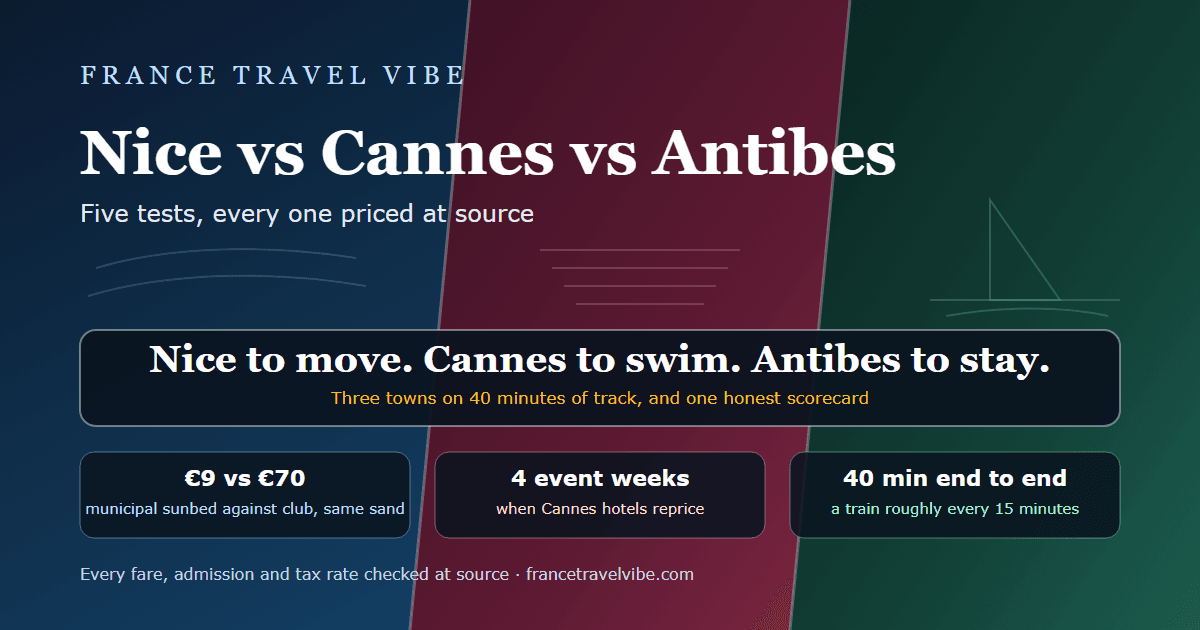
Nice to move, Cannes to swim, Antibes to stay. That’s the Nice vs Cannes argument settled the only way it can be: by test, not by town. The five split 3 to 1 to 1 rather than sweeping one way: Nice takes getting around, rate stability and the volume of things to do; Cannes takes the beach; Antibes takes the daily budget. And the test Nice loses, the beach, is the one plenty of readers care about most, so the scorecard is a starting point rather than a verdict.
Two rules survive whatever you choose. Check the Palais des Festivals calendar before booking Cannes in any month, because the dates are public and the price cliffs aren’t negotiable. And don’t agonise: these three towns share 40 minutes of track and a train every 15 minutes, so the base decision is worth an evening of thought, not a week of it.
Pick your dates against my month-by-month timing guide, then read my full Nice travel guide, because on these tests, that’s the base most first-timers should book.