
Last verified: October 19, 2026. I re-checked the museum prices and the Mont’s parking bands in this Normandy itinerary on the date above, against Mont-Saint-Michel’s public authority and each museum’s own page: Bayeux, the Mémorial de Caen, Utah Beach, the Airborne Museum and Arromanches all hold. The abbey is on its winter €13 rate until March 31, and I re-check this page monthly.
The most famous object in Normandy isn’t in Normandy. The Bayeux Tapestry came off its wall on September 1, 2025, the museum around it is being rebuilt until autumn 2027, and from September 10 this year the tapestry hangs in London instead (Bayeux Museum, 2026). For where 1066 sits in the longer story, my French history guide for travelers runs through it era by era.
Almost every Normandy itinerary online still builds a morning around it. That tells you how old most of this advice is. The same guides haven’t noticed that the landing beaches were made a World Heritage Site in July, that Pointe du Hoc is a building site, or that the American cemetery is about to start taking bookings.
Disclosure: Some links in this guide may earn us a commission, at no extra cost to you. It never changes what we recommend.
So here’s a Normandy itinerary built for what’s actually open: six days, two bases, every admission priced, and the four things that changed this year.
Key Takeaways
- A six-day Normandy itinerary works best as three nights in Bayeux, two heading west and south, and one for travel.
- The Bayeux Tapestry is at the British Museum from 10 September 2026 to 11 July 2027, and the Bayeux museum reopens in autumn 2027 (Bayeux Museum, 2026).
- The D-Day beaches joined the UNESCO World Heritage List on July 26, 2026 (France 24, 2026).
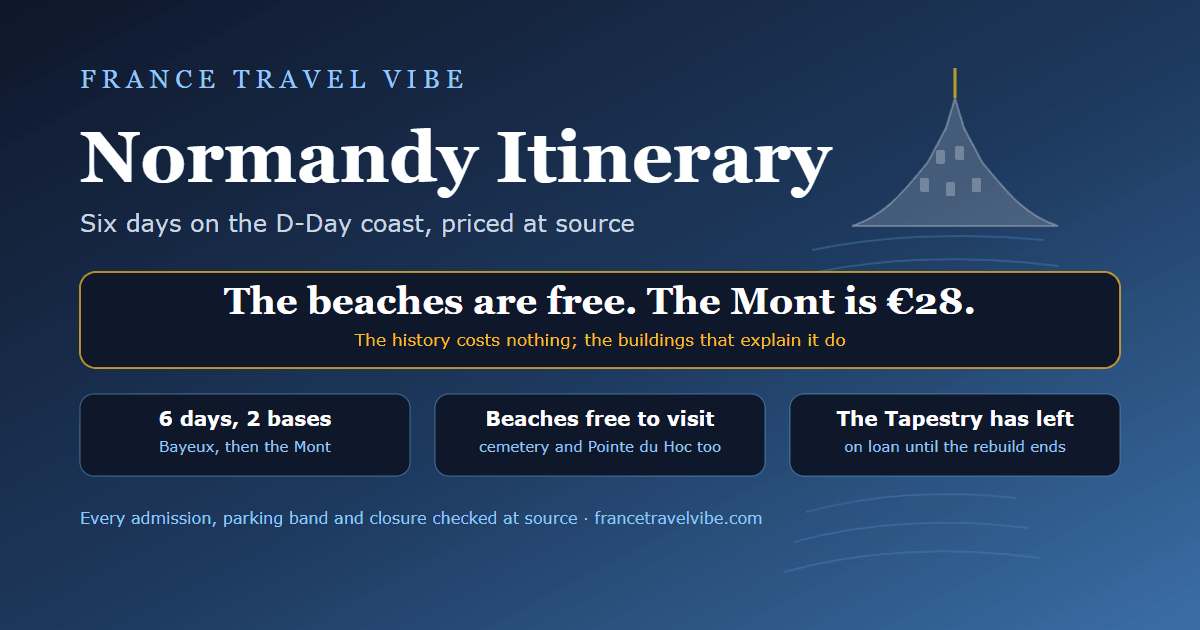
- The beaches, the cemetery and Pointe du Hoc are free. The Mont is not: €28 to park in high season, plus €16 for the abbey (Établissement Public du Mont-Saint-Michel, 2026).
- The American cemetery starts pre-registration for summer 2027 visits. Next of kin are exempt, and entry stays free.
Table of Contents
How Many Days Do You Need in Normandy?
Six, split two ways. Bayeux sits 2 hours 12 minutes from Paris Saint-Lazare on the fastest direct train, with around 13 services a day (SNCF Connect, 2026), so the region is an easy second stop. Three nights there covers the D-Day coast properly. Two more buy you Mont-Saint-Michel and cider country.
Four days is the floor, and it costs you one of those two. Under four, a Normandy itinerary stops being a trip and turns into a drive.
And no, it isn’t a day trip. People ask constantly, and the answer stays the same: Mont-Saint-Michel is four hours from Paris each way, and the landing sites are strung along 80 kilometres of coast that you cannot see between two trains. My guide to the best day trips from Paris by train rules both out for exactly this reason.
One more thing to settle early. There are two Normandies. This route covers the western half, Calvados and Manche, which is where the beaches, the Mont and the cider are. Rouen, Étretat and Le Havre sit in Seine-Maritime, on the far side of the region, and they are a separate trip. More on that at the end.
Where Normandy ranks against the other regions is in my list of the best places to visit in France, and if the whole trip length is still open, 7, 10 or 14 days settles it.
A Normandy itinerary needs six days and two bases, and it does not work as a day trip from Paris. Bayeux is 2 hours 12 minutes from Paris Saint-Lazare with about 13 trains a day, which makes it the practical base for the D-Day coast. Mont-Saint-Michel sits roughly four hours from Paris each way and belongs to the trip, not to a day out.
What Changed in Normandy for 2026
Four things, and every one of them changes a Normandy itinerary. Start with the one that empties a morning out of most itineraries: the Bayeux Tapestry is in London.
The museum closed on September 1, 2025 for a two-year rebuild and reopens in autumn 2027. The tapestry itself is at the British Museum from 10 September 2026 to 11 July 2027, and tickets for the first four months sold out before it even arrived. If you were planning to see it in Normandy on this trip, you can’t, and you should know that before you book anything.
Bayeux still works as a base. It just has a thinner day in it now. The Memorial Museum of the Battle of Normandy and the Baron Gérard museum are separate sites, both open, both €8.50 (Bayeux Museum, 2026). Worth knowing: tickets are sold at the desk only, with no advance or online purchase.
Second, on July 26, 2026, UNESCO inscribed “The D-Day Landing Beaches, Normandy, 1944” on the World Heritage List at its 48th session in Busan. The listing covers all five beaches plus Pointe du Hoc, the Longues-sur-Mer battery, the artificial harbour at Arromanches and the cemeteries, across roughly 80 kilometres of coast where more than 150,000 Allied troops came ashore (France 24, 2026). What does it change for you today? Nothing. What it changes next June is the number of people standing next to you.
Third, Pointe du Hoc is under restoration. An 18-month project began in February 2026 to hold the cliff against erosion. The site stays open, but the visitor centre closed in March 2026, access runs along one pathway, and on June 17 the Ranger dagger monument was lifted into storage until a new Memorial Plaza is ready (ABMC, 2026). Go anyway. It’s still the most legible piece of ground on the coast, and it’s still free.
Fourth, the Normandy American Cemetery is bringing in pre-registration. The American Battle Monuments Commission now expects the system to arrive at the end of 2026, taking bookings for visits from summer 2027. Everyone will need one, individuals, groups and tour operators alike, and the stated aim is to balance visitation against the site’s capacity. Two things stay true: entry remains free, and anyone with a next-of-kin buried there keeps the right to visit on the date and time they choose (American Battle Monuments Commission, 2026).
Do You Need a Car in Normandy?
For the cider route, yes, and there’s no honest way around it. For the D-Day coast, not necessarily. Bayeux is the one base in France where a half-day guided tour genuinely competes with a rental car, because the sites are spread over 80 kilometres and the interpretation is most of what you’re paying for.
Here’s the split I’d build a Normandy itinerary around. Take the train to Bayeux. Decide the coast separately, tour or car. Then pick up a car for the second half, because the Mont and the Pays d’Auge both need one.
The asymmetry catches people out. Every D-Day site on this route is free to enter, and the cemetery’s car park is free too. Then you reach Mont-Saint-Michel and the car costs €28 for 24 hours in July and August, before anyone has bought a ticket to anything.
Going car-free to the Mont? The Train du Mont-Saint-Michel runs from Paris Montparnasse to Pontorson with a connecting shuttle, daily from April to October and at weekends the rest of the year (Normandy Tourism, 2026). It works. It just doesn’t combine well with Bayeux in the same week. From the Breton side of the bay, my Brittany travel guide covers the €25 coach from Saint-Malo.
Two ways to pay less. Book the parking online before 10:00 or after 15:00 and it’s €2 cheaper. And outside July and August, parking between 18:30 and 03:00 is free (Établissement Public du Mont-Saint-Michel, 2026). Hold that thought, because it decides what time you should turn up.
The shuttle, incidentally, costs nothing. Le Passeur runs free all year, takes about 12 minutes, and runs until 01:00 in July and August.
My comparison of TGV, Ouigo and driving runs the rental maths route by route, and what a France trip costs per day puts it in a budget. For the coast itself, whether a guide beats a rental on the D-Day coast depends on how many of you are in the car.
The Six-Day Normandy Itinerary, Day by Day
Here’s the shape: three nights in Bayeux, one near the Mont, one in the Pays d’Auge, out through Honfleur. Around Bayeux, a chambre d’hôtes is the bed I’d book: breakfast is included by law, and for a July 2027 Saturday the ten houses I could book within 15 km cost a median of €87.50 for two. Collect the car on day 2 and drop it back where you found it, because one-way drops inside France usually cost extra.
| Day | Route | Anchor | Cut it if |
|---|---|---|---|
| 1 | Paris to Caen to Bayeux | Mémorial de Caen, then on to Bayeux | You’d rather have the afternoon in Bayeux |
| 2 | The western beaches | Utah Beach, Sainte-Mère-Église, Pointe du Hoc | You only have four days |
| 3 | The eastern beaches | American Cemetery, Omaha, Longues-sur-Mer, Arromanches | Never. This is the day. |
| 4 | Bayeux to Mont-Saint-Michel | The abbey, late | The Mont was never the draw |
| 5 | The Route du Cidre | Beuvron-en-Auge and Cambremer | You’re down to five days |
| 6 | Honfleur, then home | The old harbour | You have an early train |
Day 1 is the one most Normandy itinerary plans get wrong. Break the journey at Caen and do the Mémorial de Caen on the way in, at €20.80 for an adult (Mémorial de Caen, 2026). It gives you the why before you stand on the where, and doing it first makes everything on days 2 and 3 land harder. Then carry on to Bayeux, twenty minutes further down the line.
Day 2 runs west: the Utah Beach Museum at €10 (Utah Beach, 2026), Sainte-Mère-Église and its Airborne Museum at €11.50, then Pointe du Hoc, free, restricted, and still the stop that explains the most with the least.
Day 3 stays east and closer in. The cemetery in the morning, Omaha below it, the Longues-sur-Mer battery (free, always open, four casemates with their guns still in place), and Arromanches at €12.90 with the audioguide included. If you want a second museum, this is where it goes.
Day 4 is a two-hour drive southwest and a deliberately late arrival. More on the timing shortly.
Day 5 opens with a real cost: about two and a half hours from the Mont back east to the Pays d’Auge. I still think it’s worth it, but be honest with yourself about it. If that drive sounds like a waste of a morning, cut day 5, keep the Mont, and go home a day earlier.
Day 6 is Honfleur and a train from Le Havre or Caen.
At five days, drop the cider route. At four, keep Bayeux and the coast and nothing else.
How Do You Visit the D-Day Beaches Respectfully?
Start at the Normandy American Cemetery, take the free guided tour, and go to fewer museums than you think you should. The cemetery is free, its car park is free, it opens daily from 9am with last admission at 4:30pm, and staff run free tours of 45 to 60 minutes in English and French (Normandy Tourism, 2026). More than a million people came in 2024.
If you’re visiting a specific grave, say so when you arrive. Since July 28, 2026 the grave plots have been closed to general visitors under a drought water restriction, but staff will still locate a relative’s grave and take you there (ABMC, 2026). That service isn’t going anywhere: when pre-registration starts, next of kin keep the right to visit whenever they choose.
Now the part no tour operator will tell you. Two museums is the ceiling for this trip, not the minimum. Normandy is the one place I’ve seen people ruin a trip through sheer diligence. Four D-Day museums in two days, every one of them good, and by the fourth you’ve stopped feeling anything at all. The exhibits keep working. You’ve stopped.
So build the Normandy itinerary around two: the Mémorial de Caen for the why, one small site museum for the where, and the rest of your time on the ground, which costs nothing. The version of this trip that sees everything costs an adult €63.70 and gives you less.
And there’s a dissonance nobody writes down. Omaha Beach on a warm afternoon is a beach. Dogs, windbreaks, kids in the shallows, someone’s radio. The first ten minutes of that are genuinely difficult, and then it stops being difficult, because a coastline that went back to being ordinary is arguably the entire point. Don’t brace for a memorial. It’s a working seaside with a memorial on it.
The etiquette that actually matters is short. Quiet in the cemetery. Nothing leaves any site, ever. No metal detecting, which is illegal. And if you’re planning around early June, know that the commemorations close roads and fill every hotel for a week, so it’s a fine time to attend and a poor time to sightsee. For the war sites beyond this coast, from Verdun to Oradour, see my guide to WWI and WWII sites in France.
Visiting the D-Day beaches costs nothing. The Normandy American Cemetery, Pointe du Hoc, the Longues-sur-Mer battery and the beaches themselves are all free, and the cemetery runs free guided tours of 45 to 60 minutes in English. Only the museums charge, from €10 at Utah Beach to €20.80 at the Mémorial de Caen.
When Should You Go to Mont-Saint-Michel?
Late. The abbey alone ticketed 1,627,042 visitors in 2025 (Ministère de la Culture, Patrimostat 2026), and the island around it takes roughly 3 million a year, but almost all of them are there between 11am and 4pm, off a coach, for two hours. There’s no quota here and no entry fee for the island, so the arrival time in your Normandy itinerary is the only lever you have.
Turn up at four in the afternoon and three things happen at once. The coaches are leaving. Parking outside July and August becomes free from 18:30. And the village slowly empties around you while you’re still in it.
The abbey costs €16 from April 1 to September 30 and €13 from October 1 to March 31, with last admission an hour before closing (Centre des Monuments Nationaux, 2026). Check the free list before you queue: it’s free for under-18s, free for EU residents aged 18 to 25, and free for everyone on the first Sunday of the month from November to March.
Now the tides, minus the mysticism. A grande marée is just a tidal coefficient above 90. The water can reach the footbridge when the coefficient climbs past about 110, and that didn’t happen in 2026, whose highest was 105. The official calendar listed exactly two events for the year: August 14 at 21:28 and September 12 at 21:02 (Établissement Public du Mont-Saint-Michel, 2026).
If you’re timing a trip around one, the official advice is to arrive 1 to 2 hours before high tide to watch the water come in, and to expect a 1 to 1.5 hour wait afterwards before the passerelle is usable again. Note the hour on both of those 2026 dates. These are evening events, which is another argument for staying late.
Is a night on the Mont itself worth it? It’s expensive and the food is mediocre. It’s worth it for exactly one reason, which is being there after the last coach leaves. My month-by-month timing guide covers the wider Normandy season.
Is the Cider Route Worth a Day?
Yes, and it’s the day that stops a Normandy itinerary being entirely about 1944. The Route du Cidre is a signposted 40 kilometre loop through the Pays d’Auge linking around twenty producers, running between Beuvron-en-Auge, Cambremer, Bonnebosq and Beaufour-Druval (La Route du Cidre, 2026).
Look for the Cru de Cambremer signs. They mark producers working to the Pays d’Auge protected designation, which is the difference between a farm that makes cider and a shop that sells it. Camembert, Livarot and Pont-l’Évêque come from the same corner of Normandy, and my French food guide covers where to eat them.
Three drinks, one afternoon. Cider first. Then pommeau, which is apple juice stopped with Calvados before it ferments. Then Calvados itself. Normandy’s apples carry seven separate AOC labels, which tells you how seriously this is taken (Calvados Attractivité, 2026).
How a farm visit works: turn up, someone stops what they’re doing, you taste, you buy something. Many visits are free and that’s the unspoken deal. Don’t arrive at noon, when nobody is there, and don’t treat a working farmyard like a tasting room.
And here’s the tension nobody flags. This is a tasting route that requires a car. France’s limit is 0.5 g/L, and 0.2 g/L for anyone whose licence is under three years old, which catches out more visitors than you’d think. Calvados runs to 40 percent. Nominate a driver, or spit, or split the loop over two half-days. My guide to the unwritten rules covers the etiquette of a small French producer.
Camembert, Livarot and Pont-l’Évêque all come from the same few valleys, so the food half of the day looks after itself.
Rouen and Étretat Are a Different Trip
Leave them out. Étretat and Rouen sit in Seine-Maritime, on the opposite side of the region from Bayeux, and bolting them onto a D-Day week means four hours of driving to stand on a clifftop with everyone who had the same idea.
Étretat has a real crowding problem, and it prices accordingly. Parking is charged year round from 9am to 7pm, weekends and public holidays included. In the town centre that’s €3 for an hour and €15 for five. Even the outer car parks want €7.50 for a half day, and both zones jump to €50 if you overstay (Le Havre Étretat Tourisme, 2026). Access to the cliff-top plateaus and several of the named caves is prohibited outright, with an enforced setback from the edge. It’s worth a trip. It just isn’t worth this trip.
The second Normandy is its own three or four days from Paris: Rouen, Étretat, Le Havre, and Honfleur as the hinge between them. Honfleur is the one legitimate overlap, which is why it closes day 6 here. And Giverny, which people keep filing under Normandy, is really a Paris day trip.
Turning down four good places is what makes the rest of a six-day Normandy itinerary work. Most itineraries won’t do it, which is why they list nine stops and no sleep.
Frequently Asked Questions
How many days do you need in Normandy?
Six. A Normandy itinerary that size covers three nights in Bayeux for the D-Day coast, one at Mont-Saint-Michel, one in cider country and one for travel. Four days works if you accept the coast and nothing else. Bayeux is 2 hours 12 minutes from Paris Saint-Lazare.
Can you see the Bayeux Tapestry in 2026?
Not in Bayeux. The museum closed on September 1, 2025 for a rebuild and reopens in autumn 2027. The tapestry is at the British Museum in London from 10 September 2026 to 11 July 2027. Bayeux’s other two museums stay open at €8.50 each, tickets on the door only.
Do you need a car in Normandy?
For the cider route, yes. For the D-Day beaches, not necessarily: Bayeux is on a direct train from Paris and half-day guided tours leave from the town. Most people build a Normandy itinerary that rents for the second half only. You’ll want a car for Mont-Saint-Michel and the Pays d’Auge.
How much does it cost to park at Mont-Saint-Michel?
For a car, €14 for 24 hours in low season, €22 in medium season and €28 in July and August. The first 30 minutes are free all year, booking online before 10:00 or after 15:00 saves €2, and outside July and August parking is free from 18:30. The Passeur shuttle is free.
Are the D-Day beaches free to visit?
Yes. The beaches, the Normandy American Cemetery, Pointe du Hoc and the Longues-sur-Mer battery all cost nothing, and cemetery parking is free too. Only the museums charge, from €10 at Utah Beach to €20.80 at the Mémorial de Caen. From summer 2027 the cemetery will need a free booking.
The Bottom Line
- Six days, two bases. Three nights in Bayeux, one at the Mont, one in the Pays d’Auge, car for the second half.
- The tapestry has left. London until 11 July 2027, Bayeux museum reopening autumn 2027. Plan the town as a base, not a day.
- The beaches are World Heritage now, listed on July 26, 2026, which mostly means more company next June.
- The history is free and the museums are not. Two museums is the ceiling. Seven of them cost an adult €63.70 and give you less.
- Arrive at the Mont late. No quota, no entry fee, so timing is the only lever, and parking turns free at 18:30 outside high summer.
Build a Normandy itinerary around those five things and the region stops fighting you. Still choosing where to go? My ranking of the best places to visit in France puts Normandy against the other eleven. Fitting it into something longer is what 7, 10 or 14 days is for, and the complete France travel guide covers everything before you land. If the south is calling instead, a week in Provence is the warmer alternative.