
Last verified: October 15, 2026. Opening dates, closures and ticket prices at these sites change with renovation work and anniversaries. I re-check every price, the Oradour and Normandy cemetery access rules and the Paris drive times each quarter, and update the date above each time.
In 2025, the Normandy American Cemetery logged 1.4 million entries (Normandie Tourisme, Bilan 2025 du tourisme de mémoire, May 2026). In 2024, the paid sites of the whole Verdun battlefield took 316,546 between them (Mémorial de Verdun, Rapport d’activité 2024, March 2025). One free cemetery outdraws the battlefield’s paid sites four to one.
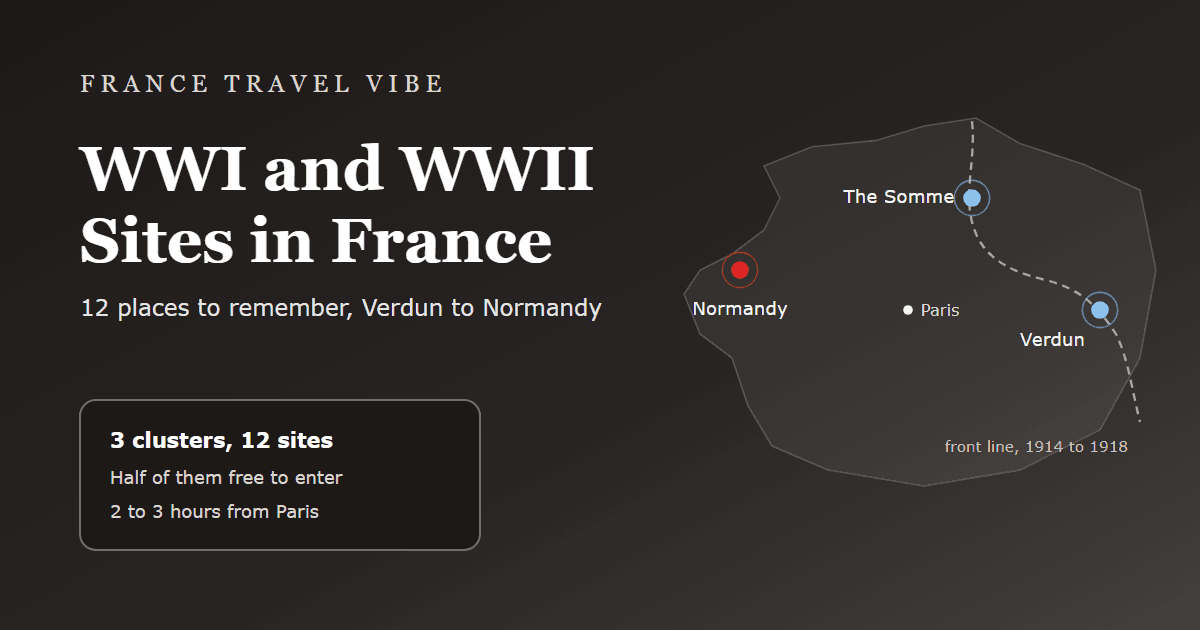
That’s the shape of the WWI and WWII sites in France. The crowds go to one coast, while the First World War front, two hours from Paris, stays quiet. And most of these places cost nothing. This guide picks 12 sites in three clusters, with 2026 prices, drive times from Paris and what’s shut until 2027. If you’ve ever wondered why every French village has a war memorial, my French culture guide explains it.
Disclosure: Some links in this guide may earn us a commission, at no extra cost to you. It never changes what we recommend.
Key Takeaways
- The best WWI and WWII sites in France sit in three clusters: Verdun and the Somme for 1914 to 1918, Normandy for 1944, and the occupation sites scattered from Alsace to Provence.
- Normandy takes the crowd: 5.9 million memory-site entries in 2025 (Normandie Tourisme).
- Half of these 12 sites are free to enter.
Table of Contents
WWI and WWII Sites in France at a Glance
Six of the 12 sites below cost nothing to enter, and the paid ones run from €6 to €20.80 for an adult in 2026. I read every price on the operator’s own page or price sheet on October 15, 2026. Drive times, from central Paris and between sites, are OSRM routes measured the same day with no traffic, so add a margin.
The Remembrance Ledger
| # | Site | War | 2026 adult price | By car from Paris | Time needed | Status for 2026 to 2027 |
|---|---|---|---|---|---|---|
| 1 | Verdun battlefield | WWI | Mémorial €14; full day €29 | 3h02 | Full day | Fort de Vaux reopened July 2026 |
| 2 | The Somme: Thiepval and the Historial | WWI | Thiepval free; Historial €10 | 2h10 | Full day | Historial shut Dec 6 to Jan 18 |
| 3 | Notre-Dame-de-Lorette and Vimy | WWI | Free | 2h23 | Half day | Open all year |
| 4 | Meuse-Argonne American Cemetery | WWI | Free | 3h02 | 1 to 2 hours | Open all year |
| 5 | Caverne du Dragon | WWI | €10 | 2h11 | 2 hours | Guided visits only |
| 6 | Normandy American Cemetery | WWII | Free | 3h22 | Half day | Free pre-registration from summer 2027 |
| 7 | Mémorial de Caen | WWII | €20.80 | 2h44 | Half day | New D-Day exhibition from May 2027 |
| 8 | La Cambe German War Cemetery | WWII | Free | 3h17 | 1 hour | Open all year |
| 9 | Oradour-sur-Glane | WWII | Free | 4h28 | 2 to 3 hours | Memory centre shut until June 2027 |
| 10 | Natzweiler-Struthof | WWII | €8 | 5h35 | Half day | Shut Dec 24, 2026 to Jan 31, 2027 |
| 11 | Paris memorials | WWII | Shoah memorial free | In Paris | Half day | Mont-Valérien: guided, book ahead |
| 12 | Mont Faron and the Rhône cemetery | WWII | €6; cemetery free | 9h09 | Half day | Can close on high fire-risk days |
Where Are France’s World War Sites, and How Do the Two Wars Differ?
The First World War in France is a line, and the Second is a scatter. In September 2023, UNESCO listed 139 First World War burial and memorial sites along that line, 96 of them in France and 43 in Belgium (Ministry of Culture, inscription press release, September 2023).
The Western Front ran from the Channel coast through Artois, the Somme and the Aisne, then east to Verdun and the Vosges. It barely moved for four years, so its cemeteries and craters sit in a band you can drive in a day. The Second World War left marks wherever something happened: the 1940 collapse, four years of occupation and deportation, and two landings in 1944.
On July 26, 2026, UNESCO added the Beaches of the D-Day Landings, Normandy, 1944, a property of six parts along the 1944 landing coast (UNESCO, decision 48 COM 8B.26, July 2026). So for the first time, both wars’ landscapes in France are World Heritage. If you want the national story around them, my French history guide for travelers puts the two wars in the long arc.
Why Does Normandy Get the Most Visitors?
Because 1944 happened on a holiday coast: the landing beaches, three nations’ cemeteries and the museums sit within an hour of each other, and the biggest draws are free. In 2025, Normandy’s memory sites logged 5.9 million entries across the 33 sites that answered the regional survey, and the American cemetery alone took 1.4 million (Normandie Tourisme, Bilan 2025, May 2026). In 2023, the region held 41.2% of all visits to war-memory sites in France (Ministry of Armed Forces, EcoDef Statistiques 255, December 2024).
The ranking holds one surprise. The German war cemetery at La Cambe drew 546,500 entries in 2025, more than the Mémorial de Caen with 440,000. And 62.4% of all Normandy memory-site entries were at free sites. Who goes? In the beaches zone in 2025, British visitors spent 736,200 nights and Americans 727,500, almost level (Normandie Tourisme, Bilan 2025).
Does Normandy deserve its crowd? Yes. The landings were vast, the American, British and Canadian cemeteries sit close together, and the coast went straight back to being a seaside. That makes it the obvious first trip. I won’t re-plan it here. My D-Day beaches tour comparison weighs a guide against driving yourself, and my Normandy itinerary fits the coast into a week. The point of the next sections is what lies beyond it.
The Best First World War Sites in France
The First World War sites in France are bigger, older and much quieter than Normandy. Today, the French state looks after 290 national necropolises holding about 770,000 bodies, more than 80% of them from 1914 to 1918 (Ministry of Armed Forces, Sépultures de guerre, 2026). The five picks below cover the French, British, Commonwealth and American memory of that war.
1. Verdun Battlefield: the Mémorial, Douaumont and the Forts
Verdun is France’s defining battle. It ran from February 21 to December 18, 1916 (Ministry of Armed Forces, Chemins de mémoire), and French memory still calls it “300 days and 300 nights”. About 300,000 men died on both sides, 163,000 French and 143,000 German (Mémorial de Verdun, Le bilan des batailles).
The Douaumont ossuary is the centre of it. Its vaults hold the remains of about 130,000 unidentified French and German soldiers (Grand Verdun tourist office). In front lies the national cemetery, and all around it the forest still holds the craters.
What stays with me is the row of low windows at the base of the ossuary. You bend down and look in, and you see bones, stacked. Nothing on the visit prepares you for it, and nothing needs to be said there.
For 2026, the Mémorial de Verdun is €14, Fort de Douaumont €8 and Fort de Vaux €8. A ticket for the Mémorial and both forts is €22, and the ossuary adds €7 with its film and tower (Mémorial de Verdun, 2026 prices; Ossuaire de Douaumont). Fort de Vaux reopened on July 4 and 5, 2026, after its first renovation since the 1920s (Mémorial de Verdun, press release, May 2026). The Mémorial closes in January. Give it a full day and sleep in Verdun.
2. The Somme: Thiepval, the Historial and Lochnagar
On July 1, 1916, the British Army suffered 57,470 casualties, 19,240 of them killed, its deadliest day (Imperial War Museums, The first day of the Somme). The battle ground on until November 18. In 2026, its 110th anniversary was marked at Thiepval and the Ulster Tower on July 1 (Northern Ireland Executive Office, July 2026).
The Thiepval Memorial carries the names of more than 72,000 British and South African soldiers with no known grave. Over 90% of them died between July and November 1916 (CWGC, Thiepval Memorial). You pay nothing for the memorial or the visitor centre.
The names on the arch are grouped by regiment, then by rank, then alphabetically. I found myself reading one family name over and over down a single panel, brothers or cousins, and lost track of time.
The Historial de la Grande Guerre costs €10 at Péronne and €6 at Thiepval, or €12 for both, valid for a year (Historial de la Grande Guerre, practical information). It closes from December 6 to January 18. Add the Lochnagar mine crater and the Beaumont-Hamel Newfoundland Memorial, both free. You need a car or a guide, since the memorials spread over about 30 km. Albert is the natural base.
3. Notre-Dame-de-Lorette, the Ring of Remembrance and Vimy
Notre-Dame-de-Lorette is France’s largest national necropolis: 25 hectares and about 43,000 bodies, about 20,000 of them in ossuaries (Ministry of Armed Forces, Sépultures de guerre). Entry costs nothing. Beside it, the Ring of Remembrance lists nearly 580,000 soldiers who fell in the Nord and Pas-de-Calais. They’re in alphabetical order, with no distinction of nationality, rank or religion (Mémorial 14-18 Notre-Dame-de-Lorette).
A short drive away, the Canadian National Vimy Memorial carries the names of 11,285 Canadians who died in France with no known grave (Veterans Affairs Canada). Its preserved trenches and shell-torn park cover about 107 hectares. Neither charges admission. Arras, 26 minutes from Vimy, makes a good base. Its Wellington Quarry tunnels add the story of the 1917 offensive underground.
4. Meuse-Argonne American Cemetery
The Meuse-Argonne American Cemetery holds 14,246 burials, the largest number of American war dead in Europe, and its walls list 954 missing (ABMC, Meuse-Argonne American Cemetery). It marks the Meuse-Argonne offensive, the largest American battle of the war, which ran from September 26, 1918 to the Armistice on November 11. The rows climb a gentle slope to a hilltop chapel, and the scale is hard to take in until you’re standing among them. There’s no fee, and it’s 45 minutes by car from the Mémorial de Verdun, so pair the two on the same trip.
5. Chemin des Dames and the Caverne du Dragon
The Chemin des Dames ridge saw the failed Nivelle offensive of April 1917 and the mutinies that followed. The Caverne du Dragon is a stone quarry 14 metres underground that both armies fought over and lived in. It’s guided visits only, about 75 minutes, at €10 for an adult (Caverne du Dragon, 2026 price leaflet). Bring a jumper, since it’s 12°C inside. At 138 km, it’s the closest of my five First World War picks to Paris.
Which Normandy Sites Matter Most?
With one day and no guide, I’d keep three: the American cemetery, the Mémorial de Caen and La Cambe. Why those three? The two cemeteries are among the four Normandy memory sites that drew more than 500,000 entries each in 2025. The other two are the cemetery’s visitor centre and Pointe du Hoc (Normandie Tourisme, Bilan 2025).
6. Normandy American Cemetery and Omaha Beach
The cemetery above Omaha Beach holds 9,389 American dead, with 1,557 names on the Walls of the Missing (ABMC, Normandy American Cemetery). Entry is free. From summer 2027, every visitor will need to pre-register, including people on tours. ABMC expects the system to be in place at the end of 2026, entry stays free, and next of kin are exempt (ABMC, Normandy pre-registration).
Nearby Pointe du Hoc is under an 18-month restoration that began on February 17, 2026, with the site open around temporary closures (Stars and Stripes, February 2026).
7. Mémorial de Caen
The Mémorial de Caen took 440,000 entries in 2025. It covers far more than D-Day, from 1918 through the occupation to the Cold War. An adult ticket is €20.80 in 2026, and €18.50 for ages 10 to 18 and over-65s (Mémorial de Caen, prices and tickets). A new D-Day beaches exhibition opens in May 2027 (France 3 Normandie, September 2026). It’s the best rainy-day half of a Normandy trip.
8. La Cambe German War Cemetery
La Cambe holds 21,245 German soldiers under flat grave stones, with small groups of five dark crosses among them and a burial mound at the centre (Volksbund, La Cambe). There’s no charge, and it’s 22 minutes from Bayeux.
I came straight from the white marble at Colleville, and the change hit me before anything else. The crowds thin, the colours darken, and it gets very quiet. It’s the visit that makes the Normandy coast make sense to me.
Where Did the Occupation Leave Its Hardest Marks?
On June 10, 1944, an SS unit killed 643 people at Oradour-sur-Glane and burned the village. The ruins still draw nearly 300,000 visitors a year (Ministry of Culture, Oradour-sur-Glane, June 2024). The occupation of 1940 to 1944 left fewer places built as memorials, and the ones it left are harder to stand in.
9. Oradour-sur-Glane
The village has been kept as it was left in 1944: roofless houses, the tram tracks, the burned cars, the church. A conservation plan running from 2024 to 2039, costing about €19 million, is shoring it up building by building (Ministry of Culture). The Centre de la mémoire is closed for renovation from September 2025 to June 2027. The village itself stays open and free, with a temporary welcome point in the car park (Destination Limoges).
I walked the main street slowly, past the rusted cars and the sewing machines left where they fell. Nobody spoke. The sign at the entrance says only “Souviens-toi”: remember.
It’s 23 minutes from Limoges. Allow two to three hours.
10. Natzweiler-Struthof
Natzweiler is the only concentration camp built on what is now French territory. The Nazis opened it on May 1, 1941, in Alsace, which the Third Reich had annexed in all but name (Ministry of Armed Forces, Centre européen du résistant déporté). About 52,000 prisoners of more than 30 nationalities passed through it from 1941 to 1945. About 17,000 died in the Natzweiler system, 3,000 of them at the main camp (Mémorial Natzweiler-Struthof, the KL Natzweiler).
The site took more than 236,000 visitors in 2024, and in 2025 it was renamed the Mémorial du camp de concentration de Natzweiler-Struthof (Mémorial Natzweiler-Struthof, renaming release, 2025).
Entry is €8, €4 reduced, and free under 10. It’s open Tuesday to Sunday and closes from December 24, 2026 to January 31, 2027 (Mémorial Natzweiler-Struthof, individual visitors). The camp sits at 800 metres in the Vosges, 50 minutes from Strasbourg. It’s cold up there in spring too, so dress for it.
Why was a Nazi camp built in France at all? Alsace’s long back-and-forth between France and Germany explains it, and my guide to French regional cultures tells that story. For a base, my Alsace wine route is the obvious one.
11. Paris: the Mémorial de la Shoah, Mont-Valérien and the Vel d’Hiv
In 2025, the Mémorial de la Shoah in the Marais took 346,000 visitors, up 17% (Mémorial de la Shoah, Rapport moral 2025, July 2026). It’s free, with no booking, Sunday to Friday (Mémorial de la Shoah).
On July 16 and 17, 1942, the French police arrested 13,152 Jews in Paris. Among them, 4,115 children were held at the Vélodrome d’Hiver (Ministry of Armed Forces, La rafle du Vel d’Hiv). A small memorial garden in the 15th arrondissement marks where the stadium stood, open around the clock (Paris.fr).
Mont-Valérien, just west of Paris in Suresnes, is where the Germans shot 1,008 resistance fighters and hostages. Visits are guided only, last 90 minutes, run in French, English, Spanish and German, and must be booked (Ministry of Armed Forces, Mémorial du Mont-Valérien). Add the Musée de la Libération de Paris at Denfert-Rochereau, whose permanent collection is free (Musée de la Libération de Paris). For where to stay and how the passes work, see my Paris travel guide.
Provence, August 1944: the Forgotten Landing
On August 15, 1944, Allied troops landed on the Provence coast in the second invasion of France. The Rhône American Cemetery at Draguignan holds 851 of the dead (ABMC, Rhône American Cemetery). It gets a fraction of D-Day’s attention. Why is the southern landing so forgotten? It came ten weeks after D-Day, and it worked fast.
12. Mont Faron and the Rhône American Cemetery
The Mémorial du débarquement et de la libération de Provence sits on Mont Faron above Toulon. In 2026, entry is €6, or €3 reduced (Provence-Alpes-Côte d’Azur tourism board). Free guided visits run at 2:30pm on Wednesdays and weekends (Ministry of Armed Forces, Mémorial du débarquement). The road and cable car can close on days of high summer fire risk, so check the same morning before you go up. The Draguignan cemetery is free and an hour away.
Near Aix, the Site-mémorial du Camp des Milles is a former tile factory used as an internment and deportation camp. It costs €14, €11 reduced, daily from 10am to 7pm (Camp des Milles). Base yourself with my Provence itinerary.
What Do France’s War Sites Cost in 2026?
Six of the 12 WWI and WWII sites in France on my list are free outright: the Meuse-Argonne, Colleville and La Cambe cemeteries, Lorette, Vimy and Oradour’s village. In Paris, the Mémorial de la Shoah and the Vel d’Hiv garden are free too. The paid museums run from €6 at Mont Faron to €20.80 at the Mémorial de Caen, read on each operator’s page on October 15, 2026. A full Verdun day with the Mémorial, both forts and the ossuary comes to €29 per adult.
Here’s what surprised me most. The visitor numbers run the opposite way to the scale of the wars. The French state maintains more than 3,400 burial sites holding about 1.2 million French soldiers, most of them from the First World War (Ministry of Armed Forces, Sépultures de guerre). Yet one 1944 cemetery outdraws the paid sites of the whole Verdun battlefield more than four to one. If you want to stand somewhere quiet and think, go east.
How Do You Plan a Route to Verdun, the Somme and Normandy From Paris?
Paris sits in the middle of the WWII sites in France and the old Western Front. By car, Thiepval is 2h10 north, the Mémorial de Caen 2h44 west and the Mémorial de Verdun 3h02 east (OSRM, measured October 15, 2026). Struthof (5h35) and Oradour (4h28) are trips of their own, and Toulon is nine hours, so fly or take the TGV.
Three routes work:
- First World War loop, 3 days. Arras, Lorette and Vimy on day one; the Somme on day two; Verdun and Meuse-Argonne on day three, then back to Paris.
- Both wars, 5 days. Two days in Normandy, back through Paris, one day on the Somme, two at Verdun.
- No car. Take the train to Caen for the Mémorial, which my D-Day beaches tour guide shows running as a day trip. Paris to Arras has 14 trains a day, the fastest 48 minutes (SNCF Connect, Paris to Arras). Paris Est to Verdun has 10, the fastest 1h40 (SNCF Connect, Paris to Verdun, October 2026). Book a local guide for the battlefield.
For renting a car and the toll roads, see my guide to getting around France. Want to fold one cluster into a longer trip? My France itinerary comparison shows how Paris plus one region splits a week. My day trips from Paris covers the shorter hops.
When should you go? April to June and September to October are calm and mild. Early June in Normandy and July 1 on the Somme bring the anniversary ceremonies, which are moving to attend but close roads and fill hotels. My month-by-month guide to the best time to visit France has the weather.
How Should You Behave at a War Cemetery?
Quietly. These are graves, and busy ones: in 2023, France’s war-memory sites took 13.0 million visits, 13.5% more than the year before (Ministry of Armed Forces, EcoDef Statistiques 255, December 2024). No picnics among the headstones, no drones, no climbing on monuments, and nothing leaves any site. Metal detecting on the old battlefields is illegal without a permit, and live shells still turn up in the fields.
Two dates fill these places. November 11 marks the 1918 Armistice and May 8 the 1945 victory, and both are public holidays with a ceremony at every war memorial in France. My guide to French public holidays lists what else closes on those days.
If you’re looking for a relative, four databases cover most of the dead:
- British and Commonwealth: the CWGC Find War Dead search.
- American: ABMC’s burials search.
- French: the Mémoire des hommes database of soldiers “Morts pour la France”.
- German: the Volksbund grave search.
Frequently Asked Questions
Are the First World War battlefields a UNESCO World Heritage Site?
Yes. In September 2023, UNESCO listed 139 First World War burial and memorial sites, 96 in France and 43 in Belgium, including Douaumont, Thiepval, Lorette and Vimy. On July 26, 2026, the D-Day beaches followed as a six-part property, so both wars’ main landscapes in France are now World Heritage.
Verdun or the Somme: which should I visit with only one day?
Verdun, if you want the French story and one concentrated battlefield, with the Mémorial at €14 and the ossuary at €7. The Somme, if your family’s history is British, Irish, South African or from Newfoundland: Thiepval’s more than 72,000 names are free, and the Historial at Péronne is €10.
Can I visit the WWI battlefields without a car?
Partly. Paris to Albert, the gateway to the Somme, has 27 trains a day, the fastest 1h25, and Verdun has 10. But the memorials sit in open country up to 30 km apart, so on arrival you’ll need a local guide, a taxi or a bike. Arras is easiest: Vimy is 26 minutes away by road.
Is Oradour-sur-Glane open to visitors?
Yes. The ruined village is open and free, with a temporary welcome point in the car park. The Centre de la mémoire, the museum at the entrance, is closed for renovation from September 2025 until June 2027. Nearly 300,000 people visit the village each year (Ministry of Culture).
How do I find a relative’s war grave in France?
Start with the database for the army they served in. The CWGC covers British and Commonwealth dead. ABMC covers Americans, including the 14,246 at Meuse-Argonne and 9,389 in Normandy. Mémoire des hommes covers French soldiers, and the Volksbund covers Germans. Each returns a cemetery and, where the grave is known, a plot and row. The missing are listed on a memorial panel instead.
The Bottom Line
The best WWI and WWII sites in France come down to three clusters and one choice of crowd:
- Normandy takes the visitors: 5.9 million memory-site entries in 2025, with the American cemetery at 1.4 million.
- The Western Front is the quiet half: 96 UNESCO sites in France, starting two hours from Paris.
- Half the sites cost nothing, and the dearest museum is €20.80.
- 2027 changes things: free cemetery pre-registration in Normandy, the Oradour centre reopening, and a new D-Day exhibition at Caen.
Whether you search for WW2 sites in France or the trenches of 1916, pick the cluster your family or your curiosity belongs to. For the beaches, start with my D-Day beaches tour comparison. For the history that connects them, read my French history guide for travelers. And for the memorial in every village square, my French culture guide explains what you’re looking at.