
Last verified: October 11, 2026. Every rule in this French dining etiquette guide marked “law” was checked against the DGCCRF and service-public.fr, and the prices against the Observatoire FIDUCIAL 2026. I re-check them each month and update the date above.
If a French restaurant refuses you a free carafe of tap water with your meal, the owner can be fined up to €3,000, or €15,000 if the restaurant is a company (DGCCRF, Transition écologique : quelles obligations pour les cafés et restaurateurs ?, October 2025). Most visitors never learn that. They learn that French dining is a test you can fail.
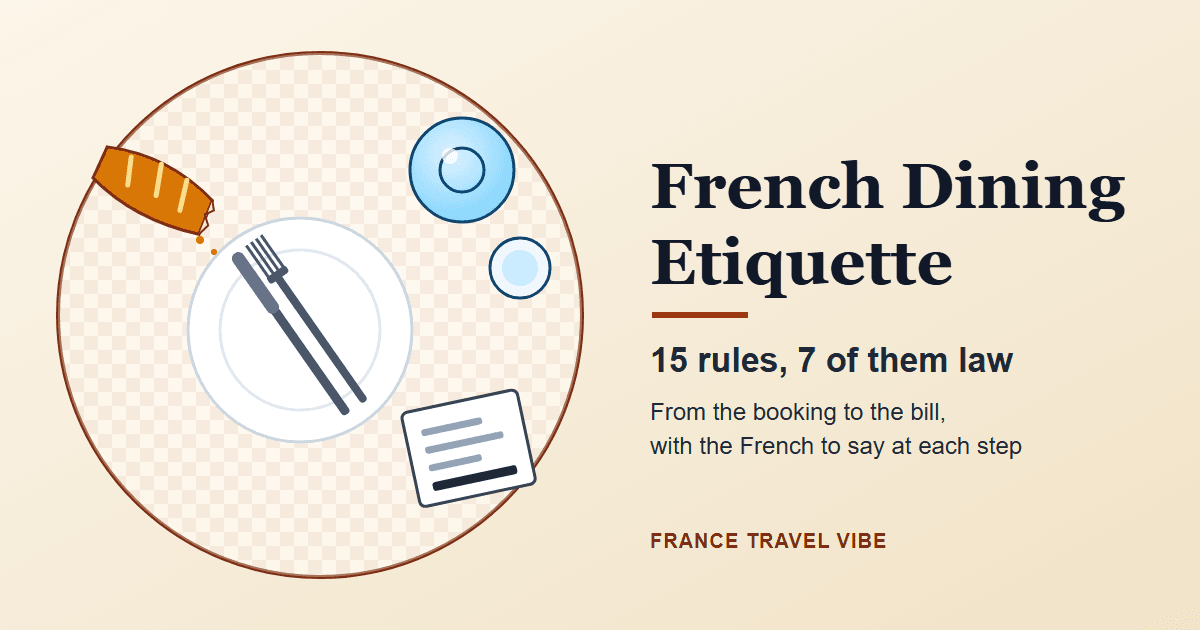
It isn’t. Half of French dining etiquette is custom, and you can relax about it. The other half is law, and it’s on your side. Below are fifteen rules in the order a meal happens, from the booking to the bill, each tagged custom or law, with the French to say at every step. For why the meal sits at the centre of the French day in the first place, start with my French culture guide.
Disclosure: Some links in this guide may earn us a commission, at no extra cost to you. It never changes what we recommend.
Key Takeaways
- Seven rules are law: free tap water with a meal, a doggy bag on request, the menu posted outside, service in the price, written allergens, an itemised bill and a table for one.
- Book weekend dinners for 20:00, and eat your big meal at lunch: the plat du jour averages €17.08 (Observatoire FIDUCIAL, 2026).
- Ask for the bill. Nobody will rush you.
Table of Contents
Which French Dining Etiquette Rules Are Actually Law?
Seven of them. In February 2025 the DGCCRF, France’s consumer protection authority, listed what a restaurant owes every customer (DGCCRF, Restaurants : droits et obligations des professionnels, February 2025). Prices posted outside, service included, free tap water, a doggy bag, an itemised bill and a table for one. Written allergen information makes seven.
That changes how you read a French dining room. The slow bill, the carafe nobody offers, the menu board out on the pavement: visitors take these for moods. They’re rules, and the table below is the whole set on one card.
| Rule | Your right | What to say | Where it’s written |
|---|---|---|---|
| 3 | A table even if you’re alone at a busy service | “Une table pour une personne, s’il vous plaît” | DGCCRF restaurant guidance |
| 4 | Prices posted outside, matching the menu inside | (read the board before you sit) | Arrêté du 27 mars 1987 |
| 7 | Allergen information in writing | “Vous avez la liste des allergènes ?” | Code de la consommation, R. 412-14 (via service-public.fr) |
| 10 | Free tap water with a meal | “Une carafe d’eau, s’il vous plaît” | Code de l’environnement, L. 541-15-10 |
| 12 | An itemised, dated bill | “L’addition, s’il vous plaît” | Arrêté n°25-361 of 8 June 1967 |
| 13 | Service already inside the price | (nothing; it’s on the menu as “prix service compris”) | Arrêté du 27 mars 1987 |
| 15 | A container for your leftovers | “Je peux emporter le reste ?” | Code de l’environnement, L. 541-15-7 |
Some of these rights carry fines, and so do the rules around them; the chart shows how far they climb. If a restaurant won’t budge, the government’s SignalConso site takes consumer complaints. You’ll almost never need it, and I never have. But once you know the rules exist, most “rude French service” stories turn out to be a different system, run partly to a written rulebook.
Do You Need a Reservation in France?
For dinner on a Friday or Saturday in a city or a resort town, yes. Since 1 October 2024 TheFork, the big booking platform, has deactivated accounts with more than four no-shows in twelve months (TheFork, SIRHA 2025 press kit, January 2025). For a weekday lunch in a village, you rarely need one. Most kitchens plan a table for one sitting, so a booking is a promise.
Rule 1 (custom): book weekend dinners, and book for 20:00. That’s when the room fills. About half of France sits down to lunch at 13:00, and dinner runs later than most visitors expect, as I explain in my French culture guide. Book for 18:30 and you’ll eat alone, if the kitchen is even open.
You can book by phone or through an app, and both are normal. On arrival, say “J’ai réservé au nom de…” and your name. TheFork says no-shows fell 10% in the first month of its crackdown, which is its own figure, not an audited one. High-end places may take a card imprint when you book. Read the cancellation terms before you give it.
On long stays I book far less than people expect. In a small town I close the laptop at 11:45, walk past the chalkboard while the kitchen is already smelling of garlic and browning butter, and come back at 12:15. That works for lunch almost everywhere. It doesn’t work for Saturday dinner in Lyon, and I’ve learned that one standing on the pavement.
What Do You Do When You Walk In?
You say “Bonjour”, or “Bonsoir” after about 18:00, and then you wait. The DGCCRF’s 2025 guidance is clear: a restaurant can’t turn you away for dining alone at a busy service. You just take the table you’re given (DGCCRF, February 2025).
Rule 2 (custom): greet first, then wait to be seated. The greeting comes before any request, every time. I explain why bonjour carries so much weight in my guide to French manners and meals. In a café you can usually take any free table. In a restaurant, wait for someone to seat you, then ask: “Une table pour deux, s’il vous plaît ?” Terrace or inside is your choice, if there’s room.
Rule 3 (law): you can eat alone, even at a busy service. Solo travellers sometimes feel unwelcome on a crowded evening, but a table for one is a right, not a favour. You can also refuse to leave your coat at the vestiaire. Dogs are at the owner’s discretion, but guide and assistance dogs must always be admitted.
How Do You Read a French Menu?
Start outside. Since 1987, French law has required the menu or the day’s carte to be posted outside for the whole service. It goes up by 11:30 for lunch and 18:00 for dinner, with the prices of five wines (DGCCRF, February 2025). The menu inside must match it.
Rule 4 (law): the board outside is the real menu. A QR code alone doesn’t meet the rule. If a menu is only served at certain hours, such as a cheaper lunch menu, the board has to say so. It must also say whether a drink is included. If a terrace shows no prices at all, treat it as a warning, the way I describe in my guide to France tourist scams.
Inside, three words trip almost everyone. Le menu is a fixed-price set of courses, and la carte is ordering dish by dish. L’entrée is the starter, not the main course.
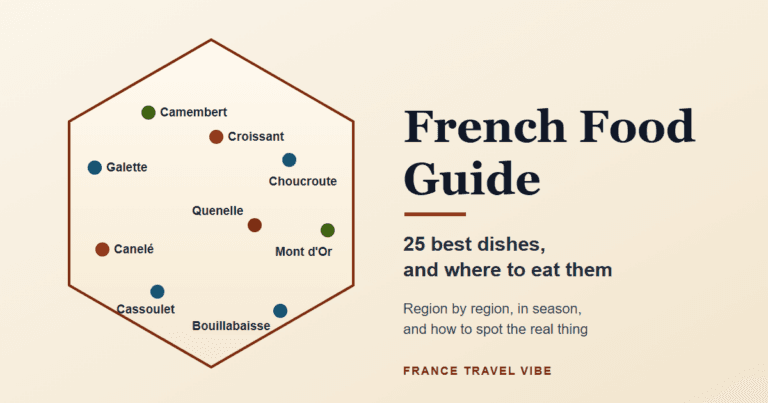
The menu must also name dishes exactly: a “bloc de foie gras” can’t be sold as “foie gras”. It must show, on the menu or a notice, where every meat comes from: beef, pork, lamb or poultry (service-public.fr, Réglementation dans un bar ou un restaurant, 2025). “Fait maison” beside a dish is its own label, explained in my French food guide.
| On the menu | What it means |
|---|---|
| Le menu / la formule | Fixed price, set courses; “entrée + plat” or “plat + dessert” |
| La carte | Order each dish separately |
| L’ardoise | The chalkboard of the day’s dishes |
| Plat du jour | Today’s main course, usually the best value |
| Entrée / plat / dessert | Starter / main / dessert |
| Boisson comprise | A drink is included in the price |
| Couvert | A cover charge; legal for a shared plate only if it’s printed |
| Pichet / demi / carafe | Jug of house wine / half-measure (often beer) / jug of water |
| Bleu, saignant, à point, bien cuit | Steak: barely seared, rare, medium, well done |
| Café gourmand | Espresso with three or four small desserts |
Why Does Lunch Matter More Than Dinner?
Because it’s the value meal. In 2026 the Observatoire FIDUCIAL put the average plat du jour at €17.08, across 400 restaurants whose 2025 accounts it analysed. The average bill in a traditional restaurant was €38 (Observatoire FIDUCIAL de la restauration, 2026). A single lunch dish costs less than half the average bill.
Rule 5 (custom): eat your big meal at lunch, and arrive by 12:30. The lunch formule, two courses at a fixed price, is how French workers eat well on a weekday. It’s how you should too. Kitchens close at about 14:00, and the room fills fast after 12:30.
If you miss the window, most places will only offer you a drink, a gap I chart in my first time in France tips. The money adds up: I price the lunch-versus-dinner gap across a whole trip in what a France trip actually costs.
The French also linger. OECD figures published in 2018 put French adults at 2 hours and 13 minutes a day eating and drinking, double the Americans’ 1 hour 2 minutes, the quickest eaters in the OECD (OECD Gender Data Portal, Balancing paid work, unpaid work and leisure, 2018).
A €17 plat du jour and a €38 average bill can share one dining room for a legal reason. The law lets a restaurant run a cheaper menu at set hours, as long as the board outside says which hours. The lunch formule is a different meal, priced for people who eat out every working day.
How Do You Order Without Getting It Wrong?
Order in courses, in order, and ask politely: “je voudrais” (I’d like) or “je vais prendre” (I’ll have). In 2025, service-public.fr confirmed that allergens must be shown on the menu or in a binder kept for customers (service-public.fr, 2025). So allergies are a right, and swaps are a favour.
Rule 6 (custom): order course by course, and call the server Monsieur or Madame. The waiter often takes drinks first, then food. Catch an eye and say “S’il vous plaît, Monsieur” (or “Madame”). Never say “garçon”. Steak arrives saignant, rare, unless you say otherwise; “à point” is the medium most visitors want. Substitutions are rare, because the dish is the kitchen’s work. If you just want the sauce on the side, ask nicely and accept a no.
Rule 7 (law): allergen information is yours, in writing. Spoken reassurance doesn’t replace it. Ask “Vous avez la liste des allergènes ?” and you should see it on the menu or in a binder.
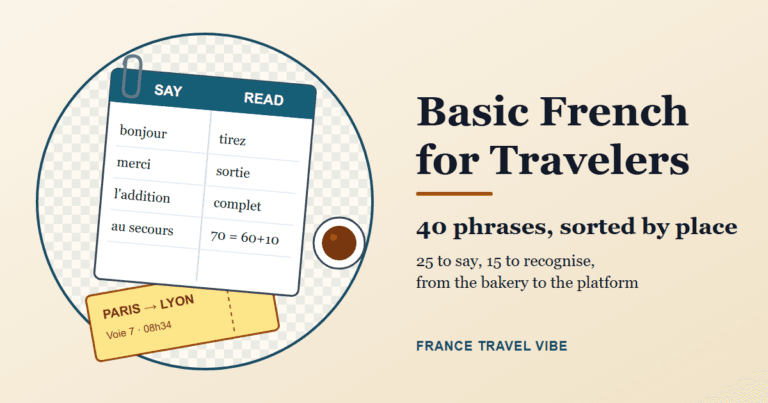
Two more rights are useful here. You can send back a dish that isn’t fresh or hot enough, though not one you just don’t like. And a restaurant may charge a couvert if you share one plate, but only if that charge is printed on the menu (DGCCRF, February 2025). For the rest of the French you’ll need, from the bakery to the platform, my basic French for travelers guide has forty phrases sorted by place.
The Table Manners That Actually Matter
Fewer than you’d think, and all of them custom: none of the DGCCRF’s restaurant rules says a word about your elbows (DGCCRF, February 2025). Hands on the table, bread on the cloth, and wait until everyone is served.
Rule 8 (custom): keep your hands on the table and your bread on the cloth. Both hands stay visible, wrists at the table’s edge, not in your lap. Bread goes straight on the tablecloth beside your plate, and you tear off a piece, never biting the whole chunk. It’s for the meal, not a starter with butter. A small piece on your fork to wipe up the sauce is normal in most places. Wait for “bon appétit” before you start.
Rule 9 (custom): put your knife and fork together when you’ve finished, and keep your phone away. Cutlery laid side by side on the plate tells the waiter you’re done; crossed or apart means you’re still eating. Ketchup won’t be on the table unless the dish calls for it. Keep your voice down, too. In my experience a French dining room runs at conversation level, not party level.
These manners matter most at a shared table. The evening table d’hôtes at a guesthouse is one sitting and one menu, and I describe how it runs in my guide to chambres d’hôtes. The first time, I copied my host: bread on the cloth, hands in sight, a piece of bread on my fork at the end. Nobody corrected me, and nobody would have.
What Should You Drink With a French Meal?
Wine or water, and the water is free. The DGCCRF says restaurants with table service must give diners free tap water, fresh or at room temperature, with glasses. Since 2022 they’ve also had to tell you so on the menu or a sign (DGCCRF, October 2025).
Rule 10 (law): tap water is free with a meal. Ask for “une carafe d’eau” and nobody will think you’re cheap. You do have to order something to eat or drink. The rule has teeth. In a case the DGCCRF announced in December 2025, a Val Thorens mountain restaurant at about 3,000 m was fined €8,000. Inspectors had found it offered only paid bottled water (The Local, French restaurant fined €8k for refusing to serve tap water, January 2026).
Rule 11 (custom): drink wine or water with the food, and take coffee after dessert. An apéritif comes before, a digestif after, and coffee after dessert, never with it. Soft drinks with a long dinner will get a polite look, nothing more, and ice is rare. Wine comes by the glass, the pichet or the bottle.
Three bits of law help here. A glass must be poured in front of you from a bottle you can see, and a bottle is opened at your table. The wine list must state how many centilitres you’re getting (service-public.fr, 2025).
Why does the wine line on the bill climb so fast? Partly tax. Food eaten in a restaurant carries 10% VAT, while alcohol carries the full 20% (BOFiP, TVA : ventes à consommer sur place, 2024). For a guide to the wine itself, start with wine tasting in France.
How Do You Get the Bill, Split It and Pay?
You ask. “L’addition, s’il vous plaît.” The restaurant must hand you a dated bill with its name and address and the price of each item, taxes included (DGCCRF, February 2025). It simply won’t bring it before you ask, because the table is yours for the meal.
Rule 12 (law): you’re owed an itemised bill, and asking is all it takes. So a slow bill is courtesy, French style. Catch an eye, mime a signature, say the phrase. Splitting is up to the house: try “On peut payer séparément ?” and accept “une seule addition” with good grace.
The card machine comes to your table. In 2024, for the first time, card overtook cash at French tills, 48% of payments to 43% (Banque de France, Bulletin 256, February 2025; split via La Finance pour tous).
Rule 13 (law): the price already includes service. Since 1987 every displayed restaurant price has been “service compris”. Rule 14 (custom): round up, don’t tip a percentage. For good service, leave a euro or two in cash on the table. Zero is normal, never an insult. My guide to French culture explains what the 1987 order actually says, and my first time in France tips cover tipping everywhere else.
Rule 15 (law): your leftovers can go home. Since 1 July 2021 a restaurant must give you a reusable or recyclable container if you ask. It may charge for it, and you can bring your own (DGCCRF, February 2025). All-you-can-eat menus are excluded. Say “Je peux emporter le reste ?” Some older guides still tell you not to ask. That advice is a few years out of date.
The first time I waited for a bill in France, I sat for twenty-five minutes before I worked out that nobody was coming. The waiter wasn’t ignoring me. He was leaving me alone, which was the point. Now I ask for it with the last of my coffee, and it arrives in two minutes.
How to Use This French Dining Etiquette Guide on the Night
Keep six moves in your head and you’ve covered most of French dining etiquette:
- Read the board outside before you sit; it’s the legal menu.
- Say bonjour, then wait to be seated.
- At lunch, order the formule by 12:30.
- Ask for a carafe of tap water.
- Eat course by course, hands on the table.
- Ask for the bill when you’re ready, and round up if it was good.
The best places to practise are the cities that take lunch seriously. My Paris travel guide covers the neighbourhood bistros, and Lyon vs Bordeaux makes the case for Lyon’s bouchons, where you’ll often share a table with strangers. If you’d rather learn from the other side of the pass, a cooking class in France takes you from the market to the plate.
Frequently Asked Questions
Is tap water free in French restaurants?
Yes, as long as you order something. Restaurants with table service must serve free tap water, fresh or at room temperature, and must tell you so on the menu or a sign. Refusing it can cost an individual operator up to €3,000, according to the DGCCRF. Ask for “une carafe d’eau, s’il vous plaît”.
Can you ask for a doggy bag in France?
Yes. Since 1 July 2021 French restaurants must give you a reusable or recyclable container for your leftovers if you ask. They may charge for the container, and you can bring your own. The DGCCRF excludes all-you-can-eat offers. Ask “Je peux emporter le reste ?” at the end of the meal.
Do you need a reservation for restaurants in France?
For Friday and Saturday dinners in cities and resort towns, yes, and book for 20:00. For a weekday lunch in a small town, usually not: arrive by 12:30. Keep the booking, too: since October 2024 TheFork has deactivated accounts with more than four no-shows in a year.
Why won’t the waiter bring the bill in France?
Because in France the table is yours until you ask, and bringing the bill early would feel like rushing you out. The DGCCRF says the restaurant must hand you a dated, itemised bill at the end of the meal. Say “l’addition, s’il vous plaît” and it usually comes in minutes.
What is the difference between a menu and à la carte in France?
Le menu, or la formule, is a fixed price for set courses, such as starter and main or main and dessert, often cheapest at lunch. À la carte means ordering each dish separately. The average plat du jour cost €17.08 in Fiducial’s 2026 study, so the lunch menu is usually the best value.
The Bottom Line
French dining etiquette has two halves, and once you see which is which, the room gets easier to read:
- Relax about the custom. Bonjour, courses in order, hands on the table, coffee after dessert. Get one wrong and nobody minds.
- Rely on the law. Free tap water, a doggy bag, the menu posted outside, written allergens and an itemised bill whenever you ask for it.
- Eat at lunch. A €17 plat du jour against a €38 average bill is the bargain of the French table.
Now put it to work. Pick the dishes worth booking a table for in my French food guide. For why the French table runs the way it does, go back to my French culture guide.