
Last verified: October 19, 2026. I re-checked the admission prices and fares on this page against the operators’ own websites on the date above: the Louvre, the Eiffel Tower, the Paris Museum Pass and Île-de-France Mobilités. The Eiffel Tower has already published new fares for visits from January 11, 2027, so I re-check this page monthly.
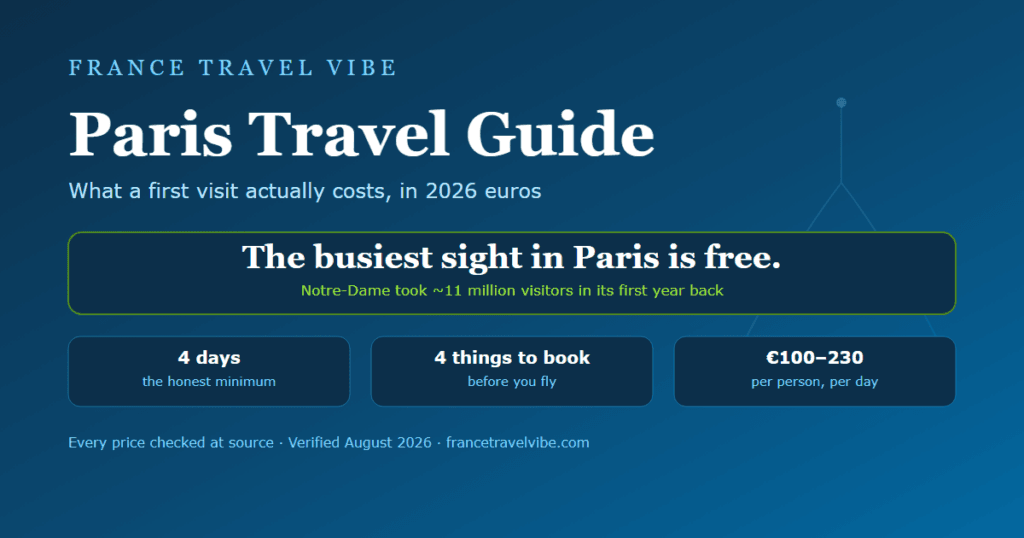
Notre-Dame took about 11 million visitors in its first year after reopening (AFP via Malay Mail, 2025). That is more than the Louvre managed in 2025, and walking into the nave still costs nothing.
Disclosure: Some links in this guide may earn us a commission, at no extra cost to you. It never changes what we recommend.
Almost every Paris travel guide on the internet opens with the Louvre and the Eiffel Tower. They are working from an order of things that stopped being true. And most of them will tell you what to see without telling you what any of it costs, which is the part you actually need two weeks before a flight.
So this Paris travel guide does the other half. What to book and when. What everything costs in 2026 euros, checked against the ticket offices themselves. How to move around for less than the fare most visitors pay. And the three mistakes that cost first-timers the most.
Key Takeaways
- Notre-Dame drew roughly 11 million visitors in its first year back, ahead of the Louvre’s 9.0 million (franceinfo, 2026). Entry to the nave is free.
- You cannot book Notre-Dame days ahead. Slots open a few hours before, and trying from abroad can get you temporarily blocked.
- Four days. Four things to book before you fly. Everything else can wait.
- A metro ride is €2.55, but Navigo Liberté+ charges from €1.64 for the same trip.
- Climbing the Eiffel Tower’s stairs to the second floor costs €14.80 against €36.70 for the summit lift.
What’s in This Paris Travel Guide
How Many Days Do You Need in Paris?
Four full days. That covers the four headline sights, two proper neighbourhood walks and one long lunch. Any less and the trip becomes a queue with pauses. Most Paris travel guides answer this with a number and no reasoning. Three works if you accept one museum a day. Five is where Versailles or a day trip out of Paris stops costing you Paris itself.
Arrival day isn’t a day. You’ll land, find your bed, walk somewhere near it and eat. Plan nothing you’ve paid for. The same goes for the morning you fly home. I’ve watched people burn a Louvre slot on the afternoon they landed, and nobody enjoys the Louvre on four hours’ sleep.
Here is the shape that works. Day one: the Louvre in the morning, Île de la Cité and Notre-Dame in the afternoon. Day two: Musée d’Orsay, then the Left Bank on foot. Day three: Montmartre early, before the coach parties, then somewhere flat in the afternoon. Day four: whatever you have been circling: the Eiffel Tower, Sainte-Chapelle, a market, the Marais. Book that day-one slot first: my guide to Louvre tickets covers what it costs and how to buy it.
Two rules make that shape work. Put the ticketed thing first each morning, because queues at the Louvre and the Eiffel Tower build through the day and never recover. And keep one afternoon completely unplanned, because the thing you remember from Paris is rarely the thing you booked.
The Paris region drew 49.1 million visitors in 2025, including a record 23 million international ones (Visit Paris Region, 2025 annual review, 2026). You are never going to have the place to yourself. You can, however, decide which hour you meet the crowd, and that is mostly what a good Paris plan is.
Deciding whether Paris is one stop or the whole trip? My guide to the best places to visit in France ranks twelve regions by crowds and train time. My comparison of 7, 10 and 14-day France itineraries shows what each length actually buys.
What Should You Book Before You Fly?
Four things: the Louvre, the Eiffel Tower, Notre-Dame’s bell towers, and any Versailles day. That is the whole list. Everything else in central Paris can be decided the morning of, and most of it should be, which is the opposite of what a Paris travel guide usually implies.
Nobody publishes these side by side, so here they are in one table, every figure checked against the operator’s own site on August 19, 2026.
| Sight | 2026 adult price | Museum Pass? | Book ahead? | Closed |
|---|---|---|---|---|
| Notre-Dame, nave | Free | n/a | You can’t: slots open hours ahead | Open daily |
| Notre-Dame, bell towers | €16 | Yes | Yes, well ahead | n/a |
| Louvre | €22 EEA / €32 non-EEA | Yes | Yes, timed slot | Tuesdays |
| Eiffel Tower, 2nd floor by stairs | €14.80 | No | Rarely needed | n/a |
| Eiffel Tower, 2nd floor by lift | €23.50 | No | Yes | n/a |
| Eiffel Tower, summit by lift | €36.70 | No | Yes, as early as possible | n/a |
| Versailles, high-season Passport | €32 EEA / €35 non-EEA | Partly | Yes | Mondays |
| Paris Museum Pass, 2 days | €85 | n/a | Optional | n/a |
The Louvre is the one with a hard rule attached. It opens daily except Tuesdays, 9am to 6pm, until 9pm on Wednesdays and Fridays, with last entry an hour before closing (Musée du Louvre, 2026). Admission is €22 for European Economic Area residents and €32 for everyone else, and it is free for under-18s and for EEA residents under 26.
Notre-Dame works in a way almost every guide gets wrong. Entry is free, every day of the year, and booking is optional. But you cannot book days in advance. Slots open only a few hours before your visit, and they are aimed at people already in the city. The cathedral warns that booking too early, too often or from too far away can temporarily block your access for security reasons (Notre-Dame de Paris, 2026). So plan to queue, or book from your hotel over breakfast. Either works; what doesn’t work is arriving with a reservation you made from home, because you won’t have one.
Is the Paris Museum Pass worth it? It costs €85 for two days, €105 for four and €125 for six, and covers more than 50 museums and monuments (Paris Museum Pass, 2026). With the Louvre at €32 and Notre-Dame’s towers at €16, two paid sights a day clears the two-day pass. One a day does not. The Musée national de la Marine joined the pass for 2026, and the Eiffel Tower never has been on it.
One warning, and it comes from the operators themselves rather than from me. The Museum Pass warns that a growing number of malicious websites imitate official ticketing to sell fake tickets. Some platforms, it adds, simply charge inflated prices. Notre-Dame is blunter still: entry is 100% free, bookings exist only on its own site, and no third-party platform is authorised to sell tickets. Buy from the sight’s own domain or don’t buy. My guide to France’s common tourist scams covers the rest of the pattern.
What Does a Paris Trip Cost in 2026?
Between €100 and €230 per person per day, before flights. The two lines most Paris travel guides leave out are the tourist tax and January’s museum increases.
Accommodation is the swing factor, and it swings harder than any Paris travel guide tends to admit. Paris hotels averaged a record €514.05 a night in June 2025 at 86.3% occupancy, against €239 across the year as a whole (CoStar/STR via Hospitality Net, 2025; In Extenso, 2026). Same city, same rooms, more than double the price, for the sake of a few weeks in the calendar.
Then the line nobody quotes you. Paris tourist tax reaches €15.93 per person per night at the top band and €11.70 in five-star hotels, charged on top of your room rate at checkout. A couple staying four nights in a well-placed four-star pays roughly €45 in tax alone before anyone has bought a museum ticket.
Food is where Paris is kinder than its reputation. A bakery lunch runs €6–9, a formule at a neighbourhood place €18–24, and a serious dinner starts around €40. Eat your big meal at lunch and the same restaurant costs about a third less. It’s the single easiest saving in the city, and it’s how Parisians eat anyway. For a lunch you cook yourself, a Paris cooking class priced for 2026 runs €80 to €239. Before you order, my French food guide covers what to eat and my guide to French dining etiquette covers how the meal itself runs.
Put those together and a four-day first visit looks like this, per person, two people sharing a room, before flights. The admissions line assumes the Louvre, Notre-Dame’s towers and the Eiffel Tower stairs, the exact tickets priced earlier on this page.
| Line (per person, 4 days) | Careful | Comfortable |
|---|---|---|
| Bed (sharing a double) | €210 | €400 |
| Food | €140 | €260 |
| Transport (Liberté+, 16 trips) | €26 | €26 |
| Admissions | €63 | €63 |
| Tourist tax | €22 | €48 |
| Total | €461 | €797 |
Both columns land inside the €100–230 a day band, which is the point: the band is not a guess, it is what these lines add up to. Book the same trip for June and the bed line roughly doubles on its own.
For the whole-country picture, my France trip cost breakdown prices a ten-day trip line by line, and my guide to the best day trips from Paris prices the eight easiest escapes from the city.
How Do You Get Around Paris?
On the metro, and almost certainly not on the ticket most visitors buy, which is the one thing a Paris travel guide can save you real money on. A single Metro-Train-RER journey costs €2.55 and a bus or tram ride €2.05, but Navigo Liberté+ charges from €1.64 for the same metro trip (Île-de-France Mobilités, 2026).
Run the arithmetic on a normal four-day visit, call it four journeys a day and sixteen in total, and the ranking is not the one the tourist-pass marketing suggests.
Above roughly twenty journeys, the €32.40 weekly pass overtakes Liberté+ and becomes the cheapest option outright. Below that, Liberté+ wins. Single tickets only make sense if you’re in Paris for a day and a half. So which do you want? On a four-day trip, Liberté+. It is the option almost nobody at the airport counter offers you.
Two practical notes. The cardboard ticket is finished. The old t+ is no longer sold, and existing cardboard tickets work until December 15, 2026. After that they can be exchanged onto a Navigo Easy card at RATP and SNCF offices until January 14, 2027. And airport journeys are charged separately, at €14 a trip to or from Orly and Charles de Gaulle.
Getting to Charles de Gaulle deserved its own paragraph in summer 2026, when engineering work pushed some journeys to as much as 90 minutes from central Paris, with airport RER B trains every 15 minutes in the daytime and the last service before 23:00 (Connexion France, 2026). Check before an early flight, and add an hour to whatever the app says.
Between cities, the calculation is different again. My guide to getting around France by TGV, Ouigo or car has that math.
Where to Stay: One Base, Not Three
One central base, for the whole trip. Every Paris travel guide says stay central; almost none says why one base beats three. The 1st through 7th arrondissements and the 11th put nearly everything on this page within a walk or two metro stops. A 3-star double had a median of €250 in the Marais and €221.50 in the Latin Quarter for a November 2026 night when I checked Booking.com in September, and a bed at HI Paris started at €30.60.
If you want a shorthand, take it district by district. The 5th and 6th for a first visit that leans historic and walkable. The 3rd and 4th for the Marais and the best evening streets. The 11th for lower prices and the food Parisians actually queue for. The 7th if the Eiffel Tower is genuinely why you came. What all four share is that you can walk home from dinner. That matters more on a short trip than any single sight does. It’s the same one-base rule behind my France-wide guide on where to stay.
The mistake I see most often, and made myself early on, is booking three neighbourhoods across five nights because each looked good in isolation. What it actually buys is two mornings spent packing and two check-ins during the best light of the day. Then a running tax of twenty minutes, every time you want something left in the other room. Paris is small. Pick one bed and let the city come to you. On my longer stays I’ve never once regretted staying put, and I’ve regretted moving every single time.
The arrondissement-by-arrondissement version, with hotel counts and 3-star prices for each area, is in my guide to where to stay in Paris. If you would rather rent a flat, my guide to the Airbnb Paris rules covers registration and the checks to run before you book.
What’s New in Paris for 2026?
You can swim in the Seine, the one genuinely new line any Paris travel guide can offer this year. Three supervised river sites run free, with no reservation, daily from July 4 to August 30, 2026 (Ville de Paris, updated June 2026). They are the same three as 2025. A cleanup costing more than €1 billion ended a swimming ban of roughly a century. If you’d rather stay dry, a Seine river cruise after dark covers the same stretch from a boat.
They aren’t interchangeable, and the hours are the part people get caught by. Bras Marie, in the centre between the Louis-Philippe and Marie bridges, faces Île Saint-Louis and opens 8am to 6pm. Bras de Grenelle, in the 15th opposite the Île aux Cygnes, is now the size of an Olympic pool and runs 10am to 5:30pm on weekdays. Bercy, in the 12th under the Simone-de-Beauvoir footbridge, has two pools and the longest hours: 11am to 9pm, every day.
Read the rules before you pack a towel. Swimmers must be at least 1.20 m tall, under-14s need an adult, and a life jacket is loaned to you and has to be worn. There are no ID checks, but your height may be measured. Sites close on strong currents, bad weather or a failed daily water test. Closures go up on paris.fr the same day, not in advance. Canal Saint-Martin and the Bassin de la Villette also offer free swimming if the river is shut.
The other headline is the one in this page’s opening. Notre-Dame passed 6 million visitors in its first six months back (Vatican News, 2025). It reached roughly 11 million across the first year, and projects 14 to 15 million annually. The Louvre took 9.0 million in 2025, up 3.5% on 2024, still short of its 10.2 million record in 2018, after which it capped entry at 30,000 people a day (franceinfo, 2026).
Smaller changes are worth knowing too. The Musée national de la Marine, fully renovated, joined the Museum Pass for 2026. Notre-Dame’s bell towers have been open again since September 2025, at €16 for a 387-step climb to a terrace 69 metres above the Seine, the best view in central Paris that does not involve a queue at the Eiffel Tower. For the eight centuries the cathedral has stood through, my French history guide for travelers takes them era by era.
Further out, the Louvre’s new Seine entrance and the dedicated room for the Mona Lisa are real but distant. The plan runs to 2031, so neither changes anything about your trip this year.
September Beats June Now
September, then May. June belonged on that list without qualification until recently, and every Paris travel guide said so. It doesn’t any more, on price or on temperature.
The price case is in the chart above: a record €514.05 a night in June 2025 against €239 across the year. The temperature case arrived the following summer. Paris set an all-time June record of 40.9°C in 2026. At the July peak, Météo-France held 37 departments on red alert at once, and the month closed as the hottest July France has ever recorded (franceinfo, 2026). Paris has little shade and a great deal of stone.
August is quieter than its reputation for tourists and worse than its reputation for everything else. Neighbourhood restaurants close for two or three weeks, and the city you came to see is partly away. Is it ruined? No, but you’ll eat worse than you would in September, for more money.
That leaves a wider good window than most people expect. Late April through May, and the whole stretch from early September to the end of October, cover roughly five workable months. December has the markets and a genuinely festive centre. January and February have the lowest rates of the year and the shortest museum queues, at the price of a 4:30pm sunset and a fair amount of grey.
My month-by-month guide to timing a France trip scores all twelve months on weather, crowds and room rates.
Three Mistakes Most Paris Travel Guides Skip
Buying tickets from the wrong website. This is the expensive one, and it is now common enough that the sights warn about it themselves. No Paris travel guide should send you anywhere but the official domain. Notre-Dame states plainly that entry is free, and that no third-party platform is authorised to sell tickets. The Museum Pass warns separately that malicious sites imitate official ticketing, and that some platforms simply charge inflated prices. If a site is selling you a Notre-Dame ticket, it is selling you something that does not exist.
Treating pickpocketing as someone else’s problem. Three things work. A bag that closes and sits in front of you on the metro. A phone that never rides in a back pocket. And real attention in exactly three places: station escalators, monument queues and the Champs-Élysées. My guides to staying safe in France and the scams that target visitors go further.
Skipping bonjour. It takes a second and it changes the temperature of every interaction in the city. Say it before the question, not after. Fifteen more of these unwritten rules are worth ten minutes before you fly.
Frequently Asked Questions
How many days do you need in Paris?
Four full days for a first visit, which is the figure this Paris travel guide is built around. Three covers the headline sights at roughly one museum a day, and five lets you add Versailles or a day trip without losing Paris itself. Arrival and departure days should not be counted, since you will spend both in transit.
Is the Paris Museum Pass worth it?
It costs €85 for two days, €105 for four and €125 for six, covering 50+ museums and monuments (Paris Museum Pass, 2026). With the Louvre at €32 for non-EEA visitors and Notre-Dame’s towers at €16, two paid sights a day clears the two-day pass. The Eiffel Tower is not included.
Do you need to book Notre-Dame in advance?
You can’t. Entry is free and booking is optional, but slots open only a few hours before your visit and cannot be reserved days ahead (Notre-Dame de Paris, 2026). The cathedral warns that booking too early, too often or from too far away can temporarily block your access, and that no third-party platform is authorised to sell tickets.
How much does a trip to Paris cost?
Roughly €100–230 per person per day before flights, plus tourist tax of up to €15.93 per person per night. June is the outlier: hotels averaged a record €514.05 a night in June 2025 against €239 across the year (CoStar/STR, 2025).
What is the cheapest way to get around Paris?
Navigo Liberté+, which charges from €1.64 a trip against €2.55 for a single Metro-Train-RER ticket (Île-de-France Mobilités, 2026). Above about twenty journeys, the €32.40 weekly pass is cheaper still. Airport trips cost €14 either way and are not included.
The Bottom Line
Four days, four bookings, one bed, and a Liberté+ card. That’s a first Paris trip organised.
I first checked every figure in this Paris travel guide against the operator’s own website in August 2026, and re-checked the prices and fares in October. I re-check the page monthly, because Paris moved several of these prices in January and will move more.
- Book four things before you fly: the Louvre, the Eiffel Tower, Notre-Dame’s towers, Versailles. Not Notre-Dame’s nave, which cannot be booked.
- €100–230 per person per day, plus up to €15.93 a night in tourist tax.
- Liberté+ from €1.64 a trip beats €2.55 singles; the €32.40 weekly beats both above twenty journeys.
- Stairs, not the lift: €14.80 to the Eiffel Tower’s second floor against €36.70 for the summit.
- September, then May. June now prices and feels like high summer.
The city that 23 million international visitors reached last year is not going to feel empty whenever you go. But the difference between a good first Paris trip and a frustrating one is mostly made before you land, in about an hour of booking. This year, it also comes down to knowing that the busiest thing in Paris is free, and that you cannot reserve it from home.
Next decision: how long the whole France trip runs, and whether Paris is one stop or the anchor.
Continue planning
Once this Paris travel guide has your city days settled, the rest follows in order. The Paris to Provence route is the classic next leg, a 2h33 train south. My complete France travel guide covers entry rules and national costs, the best places to visit in France shows where Paris sits among twelve regions ranked by crowds and train time, and 7, 10 or 14 days settles the length. For the money and the movement, see what a France trip actually costs per day and TGV vs Ouigo vs driving.