
Last verified: October 17, 2026. Airfare, hotel rates and museum prices move constantly, and several French travel costs changed in 2026. I re-check this page monthly against official and industry sources and update the date above each time.
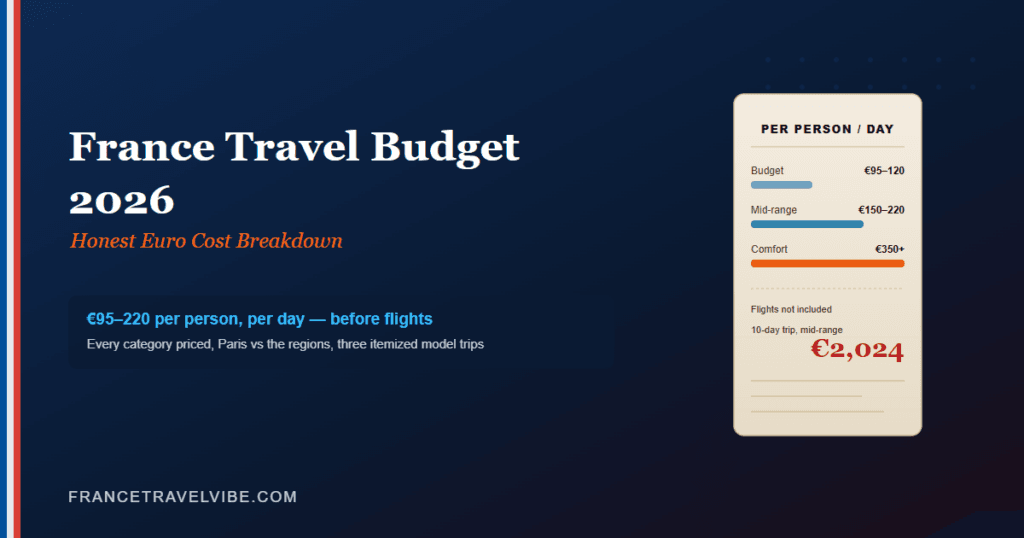
A France trip cost lands somewhere between €95 and €220 per person, per day in 2026, depending on how you travel. That’s before you’ve bought a single flight, and it comes from the itemised ten-day model further down this page, which prices every line from the operators themselves.
Most cost guides stop there. They give you one blended daily figure, quote prices from two years ago, and quietly leave out the flight, the tourist tax, and the increases that hit French travel costs this year. You build a budget that’s a few hundred euros short before you land.
So this page builds the France trip cost from the ground up: every category priced in euros, Paris measured against the regions, three fully itemized model trips you can audit line by line, and the specific 2026 changes that moved the total.
Disclosure: Some links in this guide may earn us a commission, at no extra cost to you. It never changes what we recommend.
Key Takeaways
- Your France trip cost runs €95-120 per person per day on a budget, €150-220 mid-range, and €350+ at the top, all excluding international flights, based on my itemised model below.
- A Paris hotel night averaged €239 in 2025 against €133 nationally, so each night outside the capital saves about €50 per person sharing at the same standard.
- A US round trip averages about $820 to Paris, but January costs roughly half of August.
- Two 2026 increases, the Louvre’s non-EU ticket and the Paris tourist tax surcharge, add about €31 per person to a Paris-heavy trip. ETIAS is not one of them: it slipped past 2026.
Table of Contents
What Is the Average France Trip Cost Per Day?
Budget travelers spend €95-120 per person per day in France, mid-range travelers €150-220, and the top end starts around €350, all excluding international flights. Those bands are what my itemised ten-day model, four nights in Paris and six in Provence, adds up to: €106, €202 and €428 a day, built from 2025 hotel averages, Ouigo and TGV fares, the Louvre’s 2026 ticket and the Paris tourist tax sheet, each cited in its own section below. For scale, the average international visitor spent €760 per stay in France in 2025, up 7% in a year (Atout France, bilan touristique 2025, 2026).
What does each band actually buy? At €95-120 you’re in a hostel bed or a two-star room, eating one bakery meal and one cheap sit-down meal, using public transport, and paying for maybe one attraction a day. At €150-220 you’re in a central three or four-star hotel with a private bathroom, eating a proper lunch menu and a restaurant dinner, and not thinking hard about a taxi. Above €350, you’ve stopped counting.
Those three bands are the backbone of any France trip cost estimate. But the bigger variable isn’t your travel style. It’s your postcode.
Costs are only one of the decisions a first trip turns on. My complete France travel guide covers the rest: entry rules, timing, where to go and how to move around once you’re there.
What Does Accommodation Cost in France in 2026?
Accommodation is the largest single line in a France trip cost, and the one that swings most. A comfortable, central three or four-star room runs €140-230 a night in France in 2026. Across 2025 as a whole, the average French hotel room cost €133 a night and the average Paris room €239 (In Extenso, via Voyages d’Affaires, 2026). Chambres d’hôtes, the French B&B, include breakfast in the room price by law, which narrows the gap with a hotel that charges for it separately (service-public.fr, 2026). In my October 2026 search, two people paid a median of €95 a night with breakfast for a July 2027 Saturday (what a chambre d’hôtes stay is like). Outside the cities, a self-catering gîte is the other big lever: in my gîte vs hotel comparison it beat 2-3 star hotels for a full week in all 12 tests I ran. In the cities, the cheapest chain, hotelF1, cost a median of €42.50 for two in October 2026 (budget hotels in France, priced side by side).
That annual average hides the thing that actually wrecks Paris budgets: event weeks. In 2026, Paris hotels set a March record at €351.64 average daily rate, then a May record at €401.43 during the French Open. The all-time monthly high still belongs to June 2025, when concerts and Fashion Week pushed the average to €514.05 (CoStar/STR, 2026; Hospitality Net, 2025).
Read that again: that June’s citywide average was more than twice the annual one. Nothing about your trip changed except the dates.
So is France genuinely expensive, or does it just feel that way? Less than its reputation. Eurostat puts French restaurant and accommodation prices 16% above the EU average, dearer than Italy or Germany but cheaper than the Netherlands, Denmark or Switzerland (Eurostat price level indices, 2025 data). The real premium is Paris, where the average room costs about 80% more than the national €133. Food and rail are competitive with the rest of Western Europe. Paris rooms aren’t.
One habit worth stealing from slow travel: check whether your Paris dates collide with a trade fair or a Roland-Garros week before you book anything else. I’ve watched the same category of room double between two consecutive weeks in June, and no amount of comparison-shopping recovers that. Moving the trip by seven days is the only lever that works.
One more thing about room rates. Whatever you’re quoted, the tourist tax gets added at checkout on top, up to €15.93 per person per night in Paris in 2026 (service-public.gouv.fr, 2026).
How much that adds depends entirely on where you sleep, which I break down in France’s tourist tax, city by city.
What Do Food and Drink Cost in France?
Food is the second-largest slice of a typical France trip cost. Budget about €12 for a bakery or café lunch and €28-55 for a restaurant dinner in France in 2026. The anchor is Fiducial’s analysis of 400 restaurants’ 2025 accounts: a plat du jour averages about €17 and the average bill in a traditional restaurant is €38, with Paris and the Riviera above that (Observatoire FIDUCIAL de la restauration, 2026). Breakfast from a boulangerie runs €4-8. Those three numbers, repeated across ten days, are where most France budgets quietly go wrong.
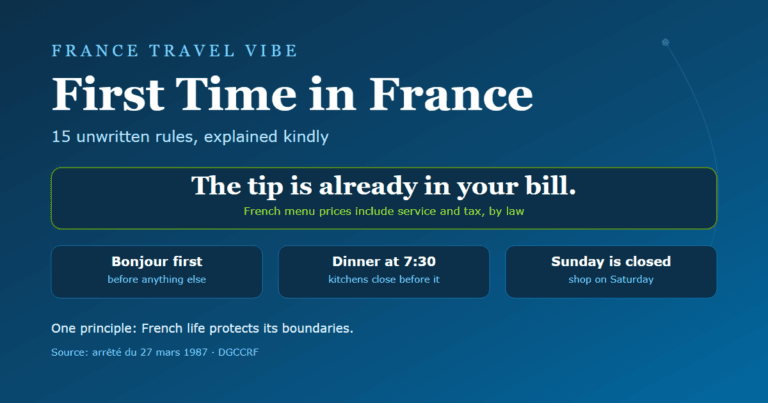
Here’s the arithmetic that matters. A €12 bakery lunch versus a €28 restaurant lunch is a €16 daily gap. Across a ten-day trip, that’s €160 per person, roughly one extra night in a decent regional hotel. Same trip, same country, different lunch habit. One more thing the bill won’t tell you: service is already included, so read my guide to tipping in France before adding anything on top.
The French lunch menu is the lever. Most restaurants run a formule at midday: two or three courses for €18-24, which costs less than ordering the same dishes à la carte at dinner. Eating your main meal at lunch and keeping dinner light is the single biggest saving available that doesn’t involve eating worse. It’s also just how a lot of France eats. How to order it, and what the words on the menu mean, is in my French dining etiquette guide.
Prices aren’t running away, at least. French consumer prices rose 1.8% year on year in June 2026, after 2.4% in May, with accommodation and transport services leading the services increase (Insee, Informations rapides 162, 2026). Compared with 2022-23, that’s stable enough that a 2025 menu price is still a fair guide.
And tipping? Service is included by law. A euro or two rounded up for good service is normal; 15-20% is not expected and marks you out instantly.
How Much Are Flights to France?
Airfare sits outside every France trip cost figure quoted so far, and it is usually the largest single payment. A round trip from the US to Paris averages about $820 into Charles de Gaulle and $770 to Paris overall (KAYAK, 2026). January is the cheapest month at roughly $616, and booking about 50 days ahead averages near $650 (KAYAK, 2026).
The seasonal spread is brutal, and it’s larger than every other decision in this article combined. A typical New York to Paris round trip runs €380-450 in January and February, against €850-1,200 from late June through August (Paris Tourism, Cheapest Time to Fly, 2026). That’s a swing of up to €800 per person on the same route.
What does an €800 swing actually buy you back? Put it next to the daily numbers: flying in shoulder season instead of peak summer covers more than a week of mid-range spending on the ground.
Airfare is only the loudest part of the seasonal swing. For what each season costs once you are on the ground, see the best time to visit France, month by month.
What Does Getting Around France Cost?
Ground transport is the most controllable part of a France trip cost. A Paris metro ticket costs €2.55 as of January 1, 2026, and a digital carnet of ten runs €17.35, about 19% cheaper than buying singles. Bus and tram tickets are €2.05 (European Traveler, Paris Transport Tickets & Prices 2026, 2026).
Long-distance travel splits sharply by how far ahead you book. Ouigo, the low-cost TGV, sells Paris-Marseille from €16 and Paris-Nice from €19, with children at €8 (OUIGO, 2026). Standard TGV InOui starts around €29 in second class booked in advance (Seat61, Paris to Nice by train, 2026). Walk up on the day and you’ll pay several times either figure.
What about driving? Car hire from a Europcar station in Avignon came to about $28 a day for a week’s economy car in my October 2026 search, before insurance, and airport desks and July or August dates run well above that (Europcar, 2026). Petrol was about €2.14 a litre for SP95-E10 in mid-October 2026 (prix-carburants.gouv.fr, 2026). Motorway tolls run about €0.09-0.10 per kilometre on the main routes: the operators’ 2026 grids put Paris to Lyon at €41.30 for a car and Paris to Marseille at €69.40 (APRR and VINCI Autoroutes, 2026).
Run those two options against each other on one route. Paris to Marseille costs €16 on Ouigo booked ahead. Driving the same 775 kilometres solo costs about €69 in tolls plus roughly €111 in petrol, assuming 6.7 litres per 100km at €2.14. That’s near €180 before you’ve paid for the car itself. A car earns its cost once you’re moving between villages in Provence or the Dordogne. Between major cities, it loses badly to rail, every time. The full TGV vs Ouigo vs driving comparison runs this math for every major route.
What Do Sights and Museums Cost After the 2026 Price Rise?
Sights make up a smaller share of a France trip cost than most people assume, but 2026 moved the headline number. The Louvre raised its ticket for most non-EU and non-EEA visitors by 45%, from €22 to €32, on January 14, 2026 (Artforum, 2026). Visitors from the EEA, including Norway, Iceland and Liechtenstein, still pay €22 (AFAR, 2026). Knowing the real price matters: discounted “skip-the-line” offers are among the commonest fake ticket resale sites. My guide to Louvre tickets shows what the new museum pricing means in practice.
That makes 2026 the first year a French museum ticket depends on which passport you carry. Four other national sites, among them the Château de Versailles and the Château de Chambord, announced their own non-EU increases (Artforum, 2026).
Why now? The Louvre needs to raise €1.1 billion for its renovation while the French culture ministry absorbs €216 million in cuts, €58 million of which comes from museum and heritage budgets. The ticket increase is expected to bring in an extra €17.5 million a year (Artforum, 2026).
Everything else has held steadier. Typical monument entry runs €15-25, and a half-day cooking class in France €143 to €239 with lunch. A Seine sightseeing boat is €15 to €18 online, and what a Seine cruise costs by format runs from there to €219 for dinner. The Paris Museum Pass costs €85 for two days, €105 for four and €125 for six (Louvre Museum Guide, 2026). Some vendors quote €90, €109 and €139 for the same passes (The Paris Museum Pass, 2026). Check the official site before you buy. Either way, the pass now breaks even faster for non-EU visitors than it did in 2025, because the single ticket it replaces got more expensive while the pass didn’t.
The 2026 Costs Almost Nobody Budgets For
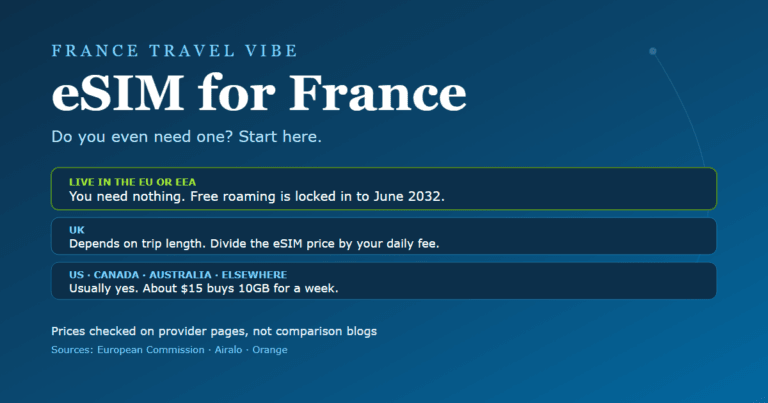
Two charges that didn’t cost this much in 2025 now add roughly €31 per person to a France trip with four Paris nights and one Louvre visit. Both sit outside the daily budget figures quoted earlier, and neither shows up in a standard France trip cost breakdown. One line you may be able to delete entirely: check whether you need an eSIM before budgeting for one.
Here’s the arithmetic, which is worth showing because nobody totals these up. The Louvre increase adds €10 for non-EU visitors. And Paris’s Île-de-France Mobilités surcharge is worth 200% of the base tourist tax, so on a four-star room that’s €5.20 extra per person, per night. It takes the nightly total from what would have been €3.25 to the published €8.45 (derived from service-public.gouv.fr 2026 rates). Four nights of that is €20.80.
€10 plus €20.80 is €30.80 per person, or €61.60 for a couple, on a trip that looked identical last year.
What about ETIAS, the €20 authorization you’ve probably read about? Not yet, and probably not this year. In July 2026, eu-LISA, the EU agency building it, told the Financial Times that a 2026 launch “was no longer feasible.” That pushes the realistic start into 2027 (Euronews, “ETIAS: After EES chaos, will Europe’s new €20 travel authorisation system be delayed?”, 2026). Plenty of sites still tell you to budget €20 for it this autumn. Don’t. When it does land, it’ll cost €20 for travelers aged 18 to 70, free for under-18s and over-70s.
Three more items belong on the list. The EES biometric border system went fully live on April 10, 2026 (France Diplomatie, 2026). It costs nothing, but it costs time at the border, so build in a longer connection. And the exchange rate quietly moves every dollar total: the euro averaged $1.1627 in 2026, peaking at $1.2019 (Exchange-Rates.org, 2026). A €3,000 trip is closer to $3,490 than the $3,000 most people mentally convert at parity.
Travel insurance is the third, and it sits on top of your France trip cost rather than inside it. Most people leave it out entirely. Policies covering European destinations averaged $341 in the year to August 2026, against $317 for international trips generally (Squaremouth, International Travel Insurance Cost Report, 2026). That figure comes from policies actually sold, not quoted. As a rule of thumb, budget 4% to 10% of your prepaid, non-refundable costs.
Two things move that number more than the destination does. Trip length is the first: a 4-to-7-day policy averages $157, an 8-to-14-day policy $307. Age is the second, and it’s steeper. Travelers aged 35 to 49 average $180, while the 60-to-69 band averages $376 (Squaremouth, 2026). If you’re travelling with parents, price their policy separately rather than assuming a group rate.
So is it required for France? Legally, no, not if you’re visa-exempt. The €30,000 medical minimum applies to Schengen visa applicants, not to US, UK, Canadian or Australian passport holders on a short stay (AXA Schengen, 2026). British travelers also get a free GHIC, which covers state healthcare in France on the same terms a French resident gets (Post Office, Travel Insurance for France, 2026). What a GHIC doesn’t cover is repatriation, and that’s the bill that turns a bad trip into a bad year.
On the EES point specifically: I’ve stopped booking connections under two hours through a Schengen entry airport since the scanning went live. It’s not that the kiosks are slow, it’s that the queue in front of them is unpredictable in a way it never used to be. A missed connection costs more than every fee in this section combined.
For the full picture on what you need at the border, see my complete France entry requirements guide.
What Does a Full France Trip Cost? Three Model Budgets
A seven-day France trip runs about €740 per person on a budget and €1,415 mid-range on my model’s mixed Paris-and-Provence route, before flights; a comfortable week based entirely in Paris lands nearer €1,650 once the €239 average Paris room replaces the regional nights. Here is what a real France trip cost looks like line by line. Below is the same ten-day route, four nights in Paris and six in Provence, priced three ways, with every line shown.
| Line item (per person, 10 days) | Budget | Mid-range | Comfort |
|---|---|---|---|
| Bed (sharing a double) | €490 | €840 | €1,740 |
| Food and drink | €360 | €650 | €1,400 |
| Local transport | €75 | €225 | €450 |
| Paris ↔ Provence rail | €54 | €130 | €220 |
| Sights and museums | €55 | €130 | €400 |
| Tourist tax | €22 | €49 | €71 |
| Total, excluding flights | €1,056 | €2,024 | €4,281 |
| Per day | €106 | €202 | €428 |
Notice what happened? Each France trip cost column lands inside the daily bands at the top of this page. The bands aren’t guesses. They’re what you get when you add up real prices. Add your own airfare on top, and the tourist tax line will shift with the cities you pick.
One caveat those totals hide: they assume two people sharing a double room. Travel solo and the same France trip cost rises by roughly 45-50% per person. A single room rarely costs half a double, and there’s nobody to split the car hire with. Run the mid-range model solo and the bed line goes from €840 to €1,680, transport from €225 to €350, and the ten-day total from €2,024 to about €2,990. Almost the entire gap is accommodation, which is why solo travelers get more out of chambres d’hôtes and small guesthouses than out of chain hotels.
Your France trip cost scales with nights, though not quite linearly. Longer trips spread the fixed costs, like one set of airport transfers, across more days. Insurance works the other way and sits on top of every column: reckon on 4% to 10% of whatever you’ve prepaid.
| Trip length | Budget | Mid-range | Comfort |
|---|---|---|---|
| 7 days | ~€740 | ~€1,415 | ~€3,000 |
| 10 days | €1,056 | €2,024 | €4,281 |
| 14 days | ~€1,480 | ~€2,830 | ~€5,990 |
Frequently Asked Questions
How much does a trip to France cost per day?
A France trip cost runs €95-120 per person per day on a budget, €150-220 mid-range, and €350+ at the top, excluding international flights, based on my itemised ten-day model (€106, €202 and €428 a day). Paris costs more mainly through the room: the average Paris hotel night was €239 in 2025 against €133 across France (In Extenso, via Voyages d’Affaires, 2026).
How much money do I need for a week in France?
Budget a France trip cost of roughly €740 per person for seven days on a tight budget and about €1,415 mid-range, rising to about €1,650 for a comfortable week based entirely in Paris, before airfare, using my itemised model and In Extenso’s 2025 room averages. Add your flight and the per-night tourist tax on top.
Is France expensive compared to other European countries?
Somewhat. Eurostat puts French restaurant and accommodation prices 16% above the EU average for 2025, above Italy and Germany but below the Netherlands, Denmark and Switzerland (Eurostat, 2026). Food, rail and museums sit close to the Western European average. The cost is concentrated in accommodation, and mostly in Paris.
How much does a trip to Paris cost for two people?
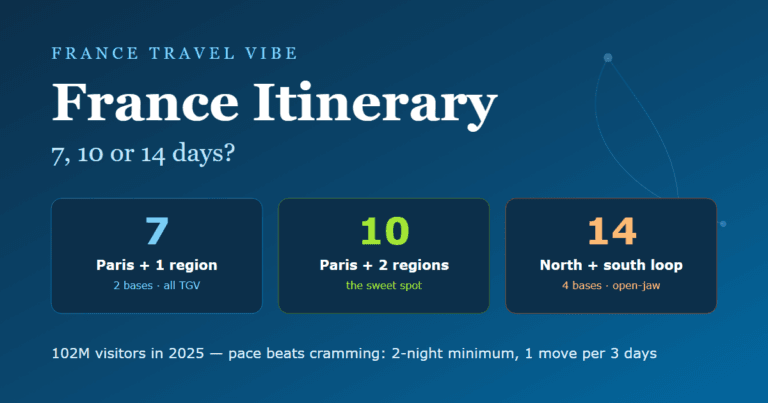
Using the itemized model above, ten days for two costs about €2,112 on a budget and €4,048 mid-range, excluding flights; my France itinerary comparison prices 7, 10 and 14 days side by side. A Paris-only version costs more, since the average Paris room ran €239 a night in 2025 against €133 nationally, about €53 more per person sharing (In Extenso, 2026).
Does a France trip cost more if you travel solo?
Yes, by roughly 45-50% per person. A solo traveler pays the whole room rate rather than half, and loses the shared car hire. On the ten-day mid-range model that takes the per-person total from €2,024 to about €2,990, almost all of it in the accommodation line.
Do I need travel insurance for France, and what does it cost?
Not legally, if you hold a US, UK, Canadian or Australian passport on a short stay. The €30,000 Schengen medical minimum applies to visa applicants only. Policies covering Europe averaged $341 in the year to August 2026, or 4-10% of prepaid costs (Squaremouth, 2026).
Do Americans need to pay anything extra to enter France in 2026?
No. ETIAS slipped past 2026 after eu-LISA confirmed in July 2026 that a launch this year wasn’t feasible, with 2027 now likely (Euronews, 2026). Budget €20 for it from 2027. EES biometric registration, live since April 10, 2026, is free but adds time at the border.
The Bottom Line
A France trip cost comes down to five decisions, and only one of them is about how fancy you’re willing to be.
- Your France trip cost runs €95-120 per person per day, €150-220 mid-range, €350+ at the top, flights excluded.
- Your dates move the flight by up to €800, more than any other single choice on the trip.
- Nights outside Paris cost about €50 less per person at 2025 average hotel rates.
- Travelling solo adds 45-50% per person, almost all of it in the room rate.
- Lunch format and rail booking window are the two levers that actually shift the on-the-ground total.
- Add about €31 per person for 2026’s increases before you compare against an older budget. ETIAS isn’t among them yet.
- Budget 4-10% on top for insurance, more if anyone in the party is over 60.
France drew a record 102 million international visitors and €77.5 billion in tourism revenue in 2025 (Atout France, bilan touristique 2025, 2026). Prices reflect that. But the country still rewards travelers who eat lunch properly, book rail early, and spend a few of their nights somewhere other than the capital.
Working out the rest of the trip? Start with my complete France travel guide for the full planning picture, then add France’s tourist tax, city by city to get the accommodation line exactly right, and check what you actually need at the border before you book. For the rest of the budget, see what each month costs, the rail-versus-driving comparison, how long to actually stay and where to stay, from hotels to gîtes.