
Last verified: October 17, 2026. Prices and rules on this page were checked against official French government, museum, and transport sources on the date above. France changed several traveler-facing prices in January 2026, so I re-check this France travel guide monthly and update the date each time.
In 2025, France pulled in 102 million international visitors and €77.5 billion in tourism revenue, a 9% jump on the year before (Atout France, bilan touristique 2025, 2026). Then, in January 2026, it started charging non-Europeans more to walk into its biggest attractions.
That’s the part nobody planning a first trip has heard yet. Most France travel guides still quote 2024 prices, still say ETIAS is coming this autumn, and still skip the tourist tax entirely. You end up budgeting a trip that no longer exists.
So this France travel guide walks the decisions in the order you actually hit them: what you need to get in, when to go, what it costs, where to go, how long to stay, how to move around, where to sleep, and what to know before you land. Each one links to a deeper guide when you’re ready to go further.
Disclosure: Some links in this guide may earn us a commission, at no extra cost to you. It never changes what we recommend.
Key Takeaways
- France hosted a record 102 million visitors in 2025 (Atout France, 2026), and 2026 is the year it began pricing entry by passport: the Louvre went from €22 to €32 for non-EU visitors on January 14.
- Budget €95–265 per person per day, before flights and before tourist tax.
- Give a first trip 10 days: Paris plus one region, not a national circuit.
- Go in September, May, April or October. Paris rooms hit a record €514.05 a night in June 2025, against about €239 across the whole year (CoStar/STR, 2025; In Extenso, 2026), so late June now prices like peak season.
What’s in This France Travel Guide
What Do You Need to Enter France in 2026?
A valid passport. That’s it, for US, UK, Canadian, Australian and roughly 56 other visa-exempt nationalities. As of August 2026, no ETIAS, no visa, and no pre-registration are required to enter France for a short stay.
Two systems confuse people here, and they’re at completely different stages. The Entry/Exit System (EES) is the EU’s automated border register: it records your face, fingerprints and every entry and exit electronically instead of stamping your passport. It has been fully operational at French borders since April 10, 2026 (France Diplomatie, “EES: the new European border Entry/Exit System”, 2026). You don’t apply for it or pay for it. You just get scanned.
ETIAS is something else: a €20 pre-travel authorization you apply for online, closer to the US ESTA than to a visa. Half the internet says it arrives this autumn. In July 2026, eu-LISA, the EU agency building it, told the Financial Times that a 2026 launch “was no longer feasible,” pushing the realistic start into 2027 (Euronews, “ETIAS: After EES chaos, will Europe’s new €20 travel authorisation system be delayed?”, 2026). Anyone selling you one right now is selling you nothing.
Your passport does have to meet the actual standard: issued within the last 10 years, and valid at least three months past the day you plan to leave the Schengen Area. My complete guide to France entry requirements walks through the EES kiosk, the ETIAS timeline and the passport rules in full. Once you’re in, the 90/180 rule applies: 90 days inside any rolling 180-day window, counted across all 29 Schengen countries, not per country.
When Is the Best Time to Visit France?
September first, then May, with April and October close behind. June used to make that list without qualification. It doesn’t any more. In June 2025 Paris hotels posted their highest monthly rate ever, €514.05 a night at 86.3% occupancy, against about €239 across the year (CoStar/STR, via Hospitality Net, 2025; In Extenso, 2026). Then on June 24, 2026 France recorded its hottest day in history, with the national thermal indicator at 30.0°C (Météo-France, bilan climatique juin 2026, 2026). Early June is still one of the best fortnights of the year. The back half now prices and feels like July.
The volume backs that up. Between May and August 2025, France logged 257.8 million overnight stays, up 3.7% year on year, with international stays climbing 6.8% (INSEE, Insee Focus n° 363, 2025). Those four months absorb most of the year’s pressure.
Two dates deserve their own planning note. Bastille Day falls on July 14, and in 2026 the Tour de France finishes on the Champs-Élysées on July 26. Both are worth seeing. Both also push Paris hotel rates to their annual ceiling, so book them deliberately rather than stumbling into them.
What about winter? Cities hold up beautifully. Paris, Lyon and Strasbourg in December cost a fraction of July, and Alsace’s Christmas markets are the one December draw that genuinely justifies the crowds. Provence in January, on the other hand, is a lot of closed shutters and cold wind. For the capital specifically, my Paris travel guide prices a four-day first visit in 2026 euros.
That is the short version. My month-by-month guide to timing a France trip scores all twelve months on weather, crowd volume and room rates, and explains why late June no longer counts as shoulder season.
How Much Does a Trip to France Cost in 2026?
Budget €95–120 per person per day, mid-range €150–220, and €350+ if you’re not counting. Those bands come from the itemised ten-day model in my France trip cost breakdown, linked below, which prices every line from the operators themselves and lands at €106, €202 and €428 a day, and they exclude flights.
Where you are matters as much as how you travel. The average Paris hotel room cost €239 a night across 2025 against €133 nationally, about €53 more per person sharing (In Extenso, via Voyages d’Affaires, 2026). Shifting two nights out of Paris and into Normandy or the Dordogne saves about €100 a head without downgrading anything. I have since priced the whole trip out line by line in a full euro-by-euro France budget breakdown.
Now the line item almost nobody quotes. The taxe de séjour is France’s tourist tax: a fixed charge per adult, per night, set by each town and added to your bill on top of the room rate. Paris raised its rates on January 1, 2026. The top band reaches €15.93 a night, a 5-star hotel is €11.70, and a 3-star is €5.53 (Paris tourist tax office, 2026 rates, 2026). Those figures already fold in the departmental surcharge and the 200% Île-de-France Mobilités transport surcharge. See my full city-by-city tourist tax breakdown for what Nice, Lyon and Marseille charge instead.
Run the math on a couple spending a week in a 4-star: that’s roughly €75 in tax alone, arriving as a surprise at checkout. It won’t break a trip. It will annoy you if nobody warned you.
What Changed for Travelers in 2026?
France now prices its headline attractions by passport. On January 14, 2026, the Louvre raised admission for most non-EU visitors from €22 to €32, a 45% increase the museum expects to generate an extra €17.5 million a year (CNN, “Louvre museum to hike entrance fee by 45% for non-European visitors”, 2025). I have since taken that apart in detail in my guide to Louvre tickets.
It didn’t stop at the Louvre, and no France travel guide has put the full picture in one place. So I did. Here’s every traveler-facing price I could verify that moved this year:
| What you’re paying for | European (EU/EEA) rate | Non-EU rate in 2026 | What changed |
|---|---|---|---|
| Louvre admission | €22 | €32 | +45% for non-EU visitors, from Jan 14, 2026 |
| Versailles Passport, high season | €32 | €35 | €3 EEA discount introduced Jan 14, 2026 |
| Château de Chambord | €21 | €31 | +€10 for non-Europeans, from Jan 14, 2026 |
| Paris tourist tax, 5-star hotel | €11.70 per person per night | same | Raised Jan 1, 2026, including a 200% transport surcharge |
| Paris metro single ticket | €2.55 | same | New fare Jan 1, 2026; paper tickets withdrawn Nov 2025 |
| TGV Inoui fares | +1% | same | Below the 1.3% inflation forecast for 2026 |
Read those as one story rather than six. France’s culture ministry is absorbing €216 million in cuts in 2026, €58 million of it from museums and heritage bodies (Artforum, 2025). Institutions responded by charging the visitors least likely to vote in France. Chambord’s director was blunt about the arithmetic: the increase touches about 10% of a million annual visitors, North Americans most of all, and is expected to raise €600,000 toward a royal wing in serious trouble. That wing is the François Ier range, entirely closed to visitors since 2023, and its full restoration is now costed at €37 million, €12 million of it emergency securing work (Domaine national de Chambord, 2026). My guide to which Loire Valley châteaux are worth the tickets works through what that does to a shortlist (France 3 Centre-Val de Loire, 2025).
What does that mean for you, practically? On a museum-heavy Paris week, two adults now pay roughly €20–40 more than the same itinerary cost in 2025. Not a trip-killer. Worth building into the number before you book.
Where Should You Go on a First Trip to France?
Paris plus one region. Nearly every France travel guide says so, and this is the rare piece of received wisdom that holds up. The most common first-trip mistake is Paris, the Riviera and the Alps in seven days, which buys you train windows instead of places. If the Riviera is that one region, my Nice travel guide makes the case for staying put and riding out from there. Weighing which region? My guide to the best places to visit in France ranks twelve of them by crowd pressure and travel time. And for what to do once you are there, my ranking of the best things to do in France prices fifteen experiences and flags the four you have to book before you fly.
Four pairings work reliably, and they suit different people:
- Paris + Normandy: D-Day beaches, Mont-Saint-Michel, cider country. Best for history-first travelers, who should start with my French history primer. Works nearly year-round.
- Paris + Loire Valley: châteaux at a gentle pace, easy trains, good cycling. Best for a first trip with mixed ages.
- Paris + Provence: markets, hill villages, lavender from late June through mid-July. Best in May, June or September.
- Paris + Alsace: Colmar, Strasbourg, the wine route. Best in autumn, or December for the markets.
France holds more than 50 UNESCO World Heritage sites (UNESCO, 2026), which sounds like an invitation to build a checklist. Use them as anchors instead: pick one or two that genuinely interest you, then let the region around them fill the days.
Does Paris have to be in the plan at all? Not really. If you’ve already done the big-capital thing elsewhere, a first France trip built on Lyon or Bordeaux works better than most people expect. Both have direct TGV links, real food cultures, and half the queueing. Lyon puts you two hours from the Alps and inside France’s densest concentration of bouchons. Bordeaux puts you inside a wine region with trams instead of tour buses, and which French wine region to taste in is a question I’ve answered separately. If only one of them fits the trip, seven tests separate Lyon from Bordeaux.
Season should also steer the choice, not just the calendar. Provence needs late spring or September, because July heat and August crowds land at the same time. Normandy and Brittany hold up from April to October and get moody rather than unpleasant in winter. Alsace peaks twice, in autumn colour and December markets. The Loire is the safest all-round bet if your dates are locked and you’d rather not gamble.
What I’d do differently: I plan France in bases now, not stops. On my early trips I moved every second night and spent a third of the trip packing, queueing and finding the next set of keys. Four nights in one place buys you the second visit to the market, the café where they recognise you, the walk you only find on day three. The photos from those days are the ones I kept.
How Many Days Do You Need in France?
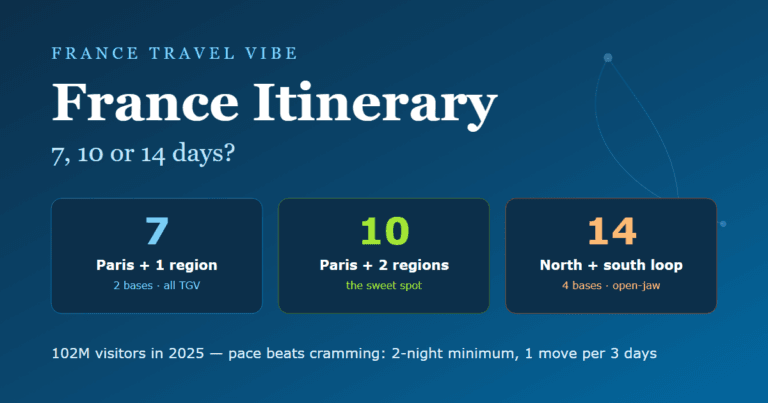
Ten days. That’s the honest floor for Paris plus one region without a rushed feeling. Seven works if you accept one region only, and fourteen is the point where a second region stops costing you the first.
The reason is travel days. A Paris-to-Provence move eats half a day once you count checkout, the trip to the station, the ride and finding your next place. Two moves in a week means a full day gone before anyone’s seen anything. My France itinerary comparison prices 7, 10 and 14 days side by side and maps what each unlocks.
One planning change helps here. SNCF is testing a six-month booking window on direct southeast TGV routes out of Paris-Gare de Lyon, covering Lyon, Marseille, Nice, Grenoble, Annecy, Toulon, Perpignan and Toulouse (SNCF Voyageurs, via RailwayPro, 2026). If your dates are fixed, you can now lock the expensive legs half a year out.
How Do You Get Around France?
Trains between cities, a rental car only for countryside. In 2026, SNCF is raising TGV Inoui fares by just 1%, below the 1.3% inflation forecast, and says more than 50 million TGV Inoui and Ouigo seats will sell for under €30 this year (SNCF Connect, 2026).
Booking early is where the savings actually live. Reserving second-class tickets three to four months ahead brings an average discount of around 35%, because French rail fares climb as seats sell rather than dropping at the last minute. Ouigo, the low-cost service, starts at €10 for adults and €5 for children. The trade-off is out-of-centre stations and strict baggage rules. My full getting around France comparison prices TGV, Ouigo, driving and flying route by route.
When is a car worth it? The Dordogne, inland Provence, Alsace’s wine villages and Brittany’s coast all reward one. But check the Crit’Air question before you book. A Crit’Air sticker is a windscreen vignette rating your car’s emissions from 1 (cleanest) to 5, and it’s what lets you drive into a French low-emission zone. France has 25 of those zones in force in 2026, and entering one without the right sticker carries a €68 flat fine for a car, up to €450 if contested and lost (service-public.fr, vignette Crit’Air, 2026).
Most rentals are already compliant, so ask the rental company outright. If you’re bringing your own car from abroad, the official sticker costs €3.85 including postage at certificat-air.gouv.fr (service-public.fr, 2026) and takes two to three weeks to arrive. Ignore the resellers charging €40 for the same thing.
In Paris, the metro is still the cheapest thing in the city. A single metro or RER ticket costs €2.55 as of January 1, 2026, buses and trams are €2.05, and the whole Île-de-France region is now one fare zone, except airport stations at €14 (European Traveler, Paris transport tickets and prices 2026, 2026). Paper tickets were withdrawn in November 2025, so load a €2 Navigo Easy card or use your phone.
Where Should You Stay in France?
France has four lodging categories, and picking the right one shapes a trip more than picking the right hotel does. Hotels are the default. The other three are where the country gets interesting.
- Gîtes are self-catering rural houses, usually rented by the week. Best value for families and slow trips.
- Chambres d’hôtes are French B&Bs, often with a shared dinner table. Best for meeting people, if your French can survive it.
- Château hotels are exactly what they sound like, and off-season rates are lower than most people assume. I list the 12 best château stays under €200, with dated prices from €102 a night.
- Municipal campsites are a French institution: town-run, cheap, and rated on the same star system as hotels. Glamping sites sit at the comfortable end of the same category. My guide to camping in France has real pitch prices.
In Paris, a 3-star double had a median of €250 in Le Marais and €221.50 in the Latin Quarter for a November 2026 night when I checked Booking.com in September, and a bed at HI Paris started at €30.60. Which arrondissement matters more than the star rating, and that deserves its own guide.
Speaking of stars: French hotel ratings are set by a national body against a checklist of facilities, not by how nice the place feels. A 2-star can be spotless and well-run. A 4-star might just mean a lift, air conditioning and a bigger reception desk. Read recent reviews and look at the location before you read the rating. Remember too that the star band decides your tourist tax, so a 5-star adds €11.70 per person per night in Paris before you’ve bought a coffee.
Room size is the other adjustment. French hotel rooms, especially in older Paris buildings, run small by North American standards, and a “double” often means one bed that two people fit in rather than two beds. If you need twin beds, say so at booking rather than at check-in.
One booking note: for July and August in Provence, the Riviera or Brittany, the good places go four to six months ahead. Shoulder season is far more forgiving. I’ve matched each base to the right kind of bed in where to stay in France, base by base.
What Should You Know Before You Land?
Two things separate a smooth first trip from a rough one. The first: pickpocketing and phone theft are the most common crimes against visitors, concentrated in crowded transport, stations and monument queues (US State Department, France Travel Advisory, 2025). The second: “bonjour” isn’t politeness, it’s the entry fee.
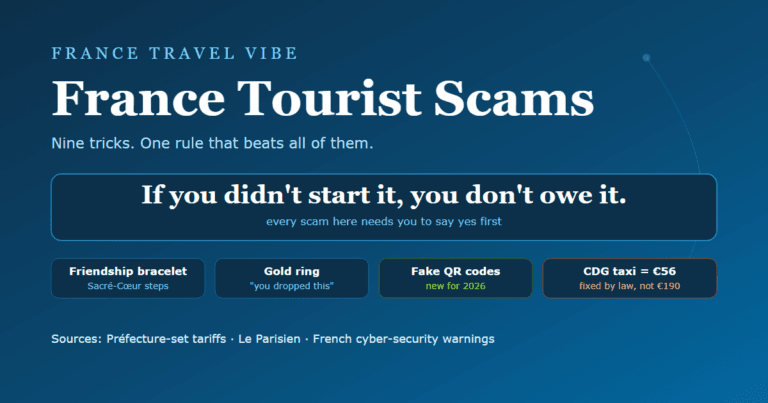
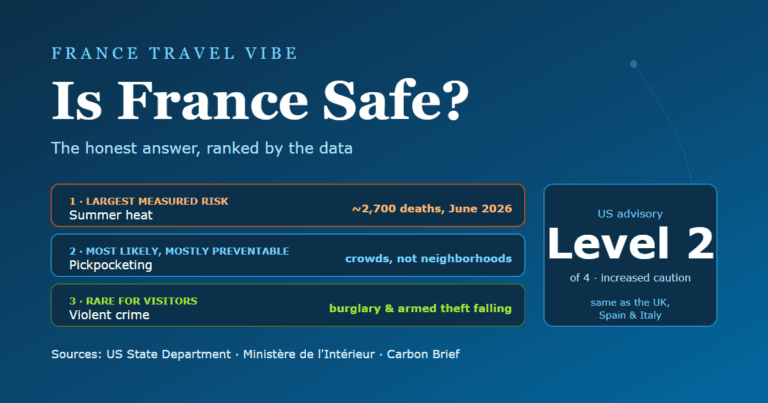
On the theft side, three habits cover most of it. Keep your phone off the café table, carry your bag in front of you on the metro, and treat anyone who approaches you with a clipboard, a friendship bracelet or a “gold ring” they just found as a distraction rather than a person. Violent crime against tourists stays rare. Petty theft is a daily working industry around the big sights. My honest answer to whether France is safe ranks the real risks, and my guide to France tourist scams breaks down each staged trick.
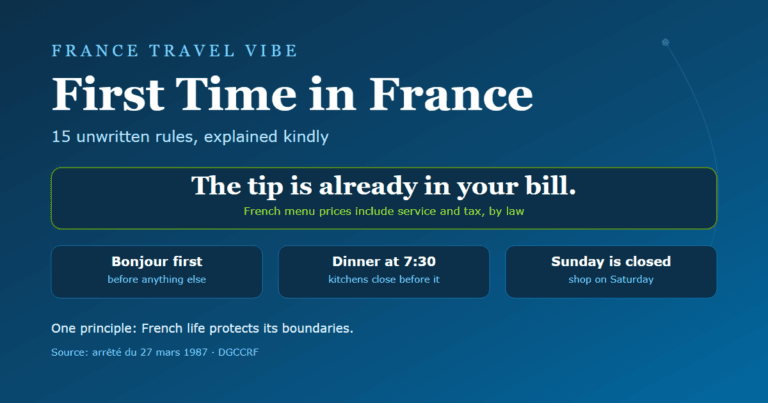
On the language side, say “bonjour” when you walk into any shop, bakery or restaurant before you say anything else. Say “au revoir” on the way out. Skipping it reads as walking into someone’s house without knocking, and it explains most stories about rude French service. The reasons behind the rule, and the eleven others like it, are in my French culture guide. Your accent doesn’t matter. The greeting does. It’s the first of the first time in France tips that decide how your trip actually feels.
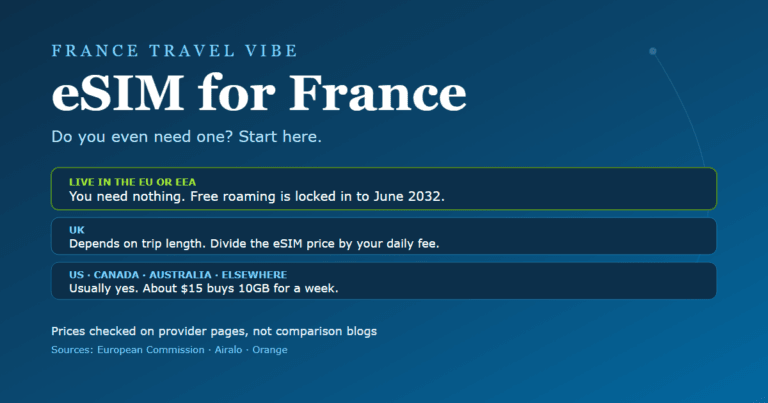
One more thing to settle before you land: whether you need an eSIM for France. If you live in the EU or EEA, you don’t.
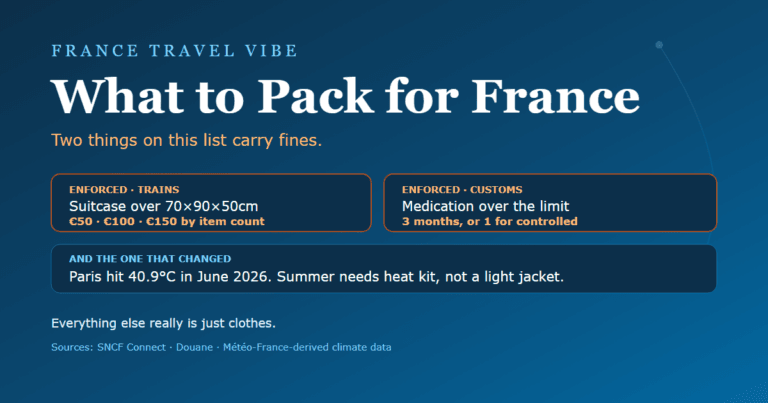
Two of those checks carry fines, and both are covered in what to pack for France: train luggage limits and customs rules on medication.
A few more things catch first-timers out:
- Meal times are fixed. Lunch service runs roughly noon to 2pm, and dinner rarely starts before 7:30pm. Turn up at 5pm and you’ll find a closed kitchen.
- Sundays are quiet. Many smaller shops close Sunday, and plenty close Monday too.
- Tipping is optional. Service is already included by law; rounding up for good service is plenty.
- Sort connectivity before you fly. An eSIM activated at home beats hunting for a SIM counter at arrivals.
Frequently Asked Questions
Do I need a visa or ETIAS to visit France in 2026?
No. Visa-exempt travelers need only a valid passport, issued within 10 years and valid three months past departure. ETIAS slipped past 2026 after eu-LISA confirmed in July 2026 that this year’s launch wasn’t feasible (Euronews, 2026), with 2027 now the likely date.
How much does a week in France cost?
Roughly €665–840 per person for a budget week and €1,050–1,540 mid-range, based on the daily bands from the itemised model in my France trip cost breakdown. Neither figure includes international flights or the tourist tax your accommodation adds per person, per night.
How many days do you need in France?
Ten days for Paris plus one region. Seven is enough for a single region, and fourteen makes a second region worth adding. Budget one full day for transit between regions and another for arrival and departure. Two of your ten days never belong to a destination.
Is France expensive in 2026?
More than in 2025 if you’re not a European resident. The Louvre raised non-EU admission 45% to €32 on January 14, 2026 (CNN, 2025), Paris tourist tax now reaches €15.93 per person per night, and metro singles went to €2.55.
What’s the cheapest month to visit France?
November through March, outside the Christmas market and ski windows. The swing shows up hardest on airfare: a New York–Paris return runs €380–450 in January and February against €850–1,200 from late June through August (Paris Tourism, 2026). Moving a trip from August to late September cuts the biggest line item on the trip.
The Bottom Line
Plan a first France trip in this order: dates, region, days, transport, beds. Everything else follows. That is this France travel guide in one line.
- Getting in is simple right now: a valid passport, no ETIAS, EES scanning at the border.
- Ten days, Paris plus one region. Two of those days go to travel, so plan eight.
- September, May, April or October: the same country, at a fraction of June’s room rates.
- €95–265 per person per day, plus tourist tax, plus 2026’s non-EU museum pricing.
- Trains between cities, a car for countryside, booked three to four months out.
France is aiming for €100 billion in annual tourism revenue by 2030, up from €77.5 billion in 2025 (Atout France, 2026). Prices and rules will keep moving in that direction, which is why every figure on this page carries a date and gets re-checked monthly.
Working through the details next? Start with when to go, then what it costs, because those two decisions constrain everything else.
Continue planning
The rest of this France travel guide breaks into its own pages as they publish. Start with what you need to enter France right now, the one decision with a deadline attached. Guides to timing, budget, tourist taxes, itineraries, transport and packing follow, and each one links back to this page.