
Last verified: October 19, 2026. I re-checked the admission prices for Chambord, Chenonceau, Amboise and the Clos Lucé against each château’s own tariff page on the date above, and all four hold. The other prices, parking bands and shuttle fares were checked the same way in August, and I re-check this page monthly.
Two châteaux, sixty kilometres apart. One charges me €31 to walk in and €8 to leave the car. The other charges €19, the same as it charges everybody, and has a railway station 400 metres from the gate.
Beauty isn’t what separates them. Almost every guide to the Loire Valley chateaux ranks ten buildings by how they photograph, then assumes you’ll rent a car and see as many as daylight allows. That advice was thin in 2019. In 2026 it’s actively expensive.
Disclosure: Some links in this guide may earn us a commission, at no extra cost to you. It never changes what we recommend.
So here’s the version with the numbers in it: five châteaux worth your days, what each one costs this year, which ones you can reach on a train, and the two that most lists include and I’d skip.
Key Takeaways
- Pick three châteaux across two or three days, not ten across four. Chenonceau, Villandry and one of Chambord or Cheverny is the shortlist that works for most people.
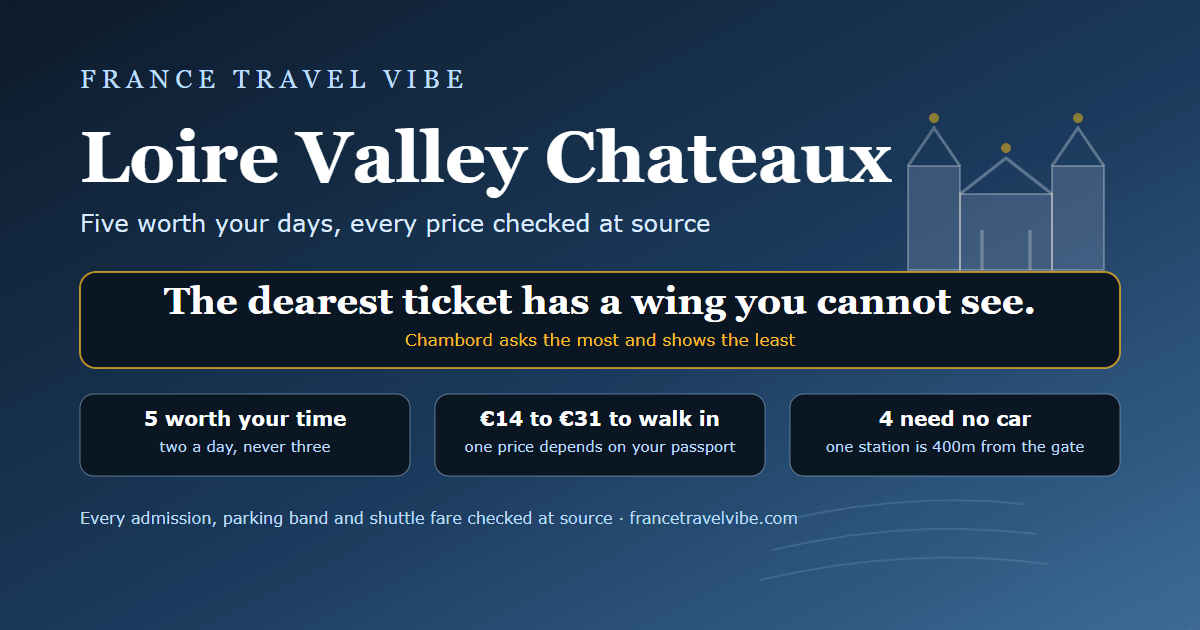
- Admission across that shortlist runs €14 to €31. Chambord charges €21 to EEA nationals and residents and €31 to everyone else since 14 January 2026, plus €8 to park (Domaine national de Chambord, 2026).
- Chambord’s François Ier wing has been entirely closed to visitors since 2023, and works run from 2026 with public access expected back by 2032 (Domaine national de Chambord, 2026).
- Four of the five need no car. Chenonceau has its own station 400 m from the door, 25 minutes from Tours.
- Go April to June or September. Two châteaux a day, with a long lunch in between.
Table of Contents
Which Loire Valley Chateaux Should You Actually Pick?
Three, over two or three days. Chenonceau, Villandry, and one of Chambord or Cheverny, with Amboise or Blois added free if you’re staying in either town. The UNESCO listing covers 280 km of river from Sully-sur-Loire to Chalonnes-sur-Loire, inscribed in 2000 and the largest site France has on the list (UNESCO World Heritage Centre, 2000). You are not going to see it. Nobody sees it.
That’s the whole difficulty here, and the lists make it worse. “The densest concentration of châteaux in Europe” reads like a selling point. It’s really a warning about pacing.
So I judge the Loire Valley chateaux on three things, and I use the same three all the way down this page. What it costs. How hard it is to reach. How long it actually holds you. Not architecture. Architecture is why you came; it isn’t how you choose.
Here’s the shortlist, in one line each.
- Chenonceau. The one built across a river. Fully open, €19 for everyone, and a train station 400 m away.
- Villandry. The gardens, not the house. Cheapest of the five and genuinely different from the rest.
- Chambord. The biggest, the grandest, the most expensive, and the one with a wing behind hoardings.
- Cheverny. Lived-in, intact interiors, half Chambord’s price, twenty minutes from it.
- Amboise or Blois. Whichever town you sleep in. Both are royal, both are a walk from your room.
And the two I’d cut? Azay-le-Rideau, lovely and small, but it eats a half day of transport for 45 minutes of building unless you’re already in that corner. And Chaumont-sur-Loire outside the garden festival, when €16 buys a château that isn’t the reason anyone goes there.
Where the Loire ranks against the other regions is in my list of the best places to visit in France. If the overall trip length is still open, 7, 10 or 14 days settles it.
Three châteaux over two or three days is the honest ceiling in the Loire Valley, not ten. The UNESCO site covers 280 km of river between Sully-sur-Loire and Chalonnes-sur-Loire and is the largest French property on the World Heritage List. Choose on price, access and time on site rather than architecture, because the buildings are more alike than the logistics are.
What Every Loire Chateau Costs in 2026
Admission at the Loire Valley chateaux starts at €14, at Villandry (Château de Villandry, 2026). It tops out at €31, at Chambord, for a visitor who isn’t European (Domaine national de Chambord, 2026). That’s before parking. That’s a 121 percent spread across buildings the guidebooks treat as interchangeable. Not one competing guide prints it.
The table below is the version I’d actually travel with. Everything in it comes from the château that charges it, never from a resale site.
| Château | 2026 adult | Nearest station, and the last bit | Verdict |
|---|---|---|---|
| Chenonceau | €19 (€24 with audioguide) | Chenonceaux, 400 m walk, ~25 min from Tours | The one to book first |
| Villandry | €14, gardens only €8.50 | Tours bus line 32, stop 280 m away, no Sunday service | Go for the gardens, allow 2.5 hours |
| Chambord | €21 EEA / €31 non-EEA, plus €8 parking | Blois-Chambord, then Rémi line 2, €3.30, ~25 min | Grand, costly, one wing shut |
| Cheverny | €15.50 (€20.50 with Moulinsart) | Blois, seasonal shuttle Apr to Nov | The value pick, 20 min from Chambord |
| Amboise, royal | €17.30 | Amboise, walk from the platform | Free if you sleep in town |
| Clos Lucé | €20 (€25 during the June to Sept exhibition) | Amboise, walk | Leonardo’s last house, good with kids |
| Blois, royal | €16 | Blois-Chambord, in town | Four architectures in one courtyard |
| Chaumont-sur-Loire | €21 festival, €16 outside it | Onzain-Chaumont, then the river bridge | Worth it only for the gardens |
| Azay-le-Rideau | €16 Apr to Sep, €13 Oct to Mar, park €4 | Azay-le-Rideau, a real walk | Skip unless you’re nearby |
Two things fall out of that table straight away.
The first is that the price mostly doesn’t track the château. Cheverny at €15.50 has better-preserved interiors than places charging €20. Villandry at €14 is the most distinctive thing in the valley. You aren’t paying for quality; you’re paying for fame and for who owns the building.
The second is the row that behaves differently from all the others. Chambord is the only one of the Loire Valley chateaux where what you pay depends on your passport. It’s one of five French cultural sites that introduced a non-European rate in January 2026, alongside the Louvre, Versailles, the Sainte-Chapelle and the Opéra de Paris (Le Journal des Arts, 2026). I’ve covered why all five did it in my complete France travel guide; the short version is a culture budget under pressure.
The wording matters, because it’s narrower than “non-EU”. The €21 rate goes to nationals or residents of a European Economic Area country, on proof. Hold a British passport and you’re now on the €31 side of that line, which surprises a lot of readers. My guide to France entry requirements covers what EEA status does and doesn’t get you. And what a France trip costs per day sets admissions against the rest of the budget.
And then there’s parking, which nobody counts. Chambord charges €8 a day for a car. Add it to two adult tickets and a non-European couple arriving by car is at €70 before lunch, at one château. The same couple does Villandry and Cheverny in a day for €59, with both gardens, and drives between them in half an hour.
Loire Valley chateaux admission in 2026 runs from €14 at Villandry to €31 at Chambord for a visitor who is neither a national nor a resident of the European Economic Area. Chambord is the only château in the valley with a two-tier price and the only one charging separately for parking, at €8 a day. Price does not track architectural quality.
Chambord Charges the Most and Shows You the Least
Chambord’s François Ier wing has been entirely closed to visitors since 2023, and the emergency works to hold it up start in 2026 and run alongside a wider restoration that isn’t expected to give the public that wing back until around 2032 (Domaine national de Chambord, 2026). You’re paying the valley’s highest admission for its least complete building.
I want to be fair about this, because it isn’t neglect. The wing has foundation and roof instability, cracking made worse by a cycle of flooding and severe drought that’s been hard on the floors. Access was cut back progressively, then stopped. The numbers are large and public. The full restoration is costed at €37 million, with €12 million for the emergency securing phase alone. The domaine funds €6 million of that itself. The remaining €31 million has to come from patrons and donations.
Now put that next to who walks through the door.
Chambord set a fourth consecutive attendance record in 2025 with 1,218,055 visitors, up 2.63 percent, and revenue up 13.3 percent to €24.34 million (Tourmag, 2026). Of those, 68.3 percent were French, 4.7 percent American and 3.15 percent British. And 19.7 percent were Europeans under 26, who get in free.
Read the chart and the pricing together and the logic is plain. Nearly one visitor in five pays nothing, two thirds pay the domestic rate, and the shortfall on a €37 million repair bill gets asked of the small slice least able to object.
So should you still go? Yes, if it’s your first time in the valley. The double-helix staircase is worth the ticket on its own, the roof terraces are unlike anything else in France, and the walled estate runs to 5,440 hectares. Chambord isn’t a disappointment. It’s just no longer the automatic first pick among the Loire Valley chateaux.
Here’s the swap I’d actually make. If the €31 rate lands on your household and you’re travelling as a family, Cheverny is twenty minutes away at half the price, with its interiors fully intact. Two adults save €31 and lose very little. That trade doesn’t appear in a single guide I’ve read, because the guides rank on grandeur and grandeur isn’t the thing that’s changed this year.
Chambord charges the highest admission of any château in the Loire Valley. Its François Ier wing has been entirely closed to visitors since 2023, with works running from 2026 and public access expected back by 2032. The restoration is costed at €37 million, of which €12 million is emergency securing. In 2025 Chambord drew 1,218,055 visitors, 68.3 percent of them French.
Can You Visit the Loire Valley Chateaux Without a Car?
For four of the five on my shortlist, yes, and this is where the standard advice is most out of date. Chenonceau has its own SNCF station about 400 metres from the entrance, roughly 25 minutes from Tours on the line towards Vierzon (Château de Chenonceau, 2026). You walk out of the station and you’re there.
Villandry is the next surprise. It sits 280 metres from the “Villandry Centre” stop on Tours bus line 32, which connects with tram A at Fac 2 Lions (Château de Villandry, 2026). One caveat, and it’s the kind most guides skip: line 32 runs Monday to Saturday and not on Sundays (Commune de Villandry, 2026). The commune doesn’t publish a frequency I could verify, so check your actual date rather than trusting a headway you read somewhere.
Blois and Amboise are simpler still. Both royal châteaux are a walk from their own platforms, and Amboise puts three châteaux within strolling distance of the town.
Which leaves Chambord, the one everyone assumes needs a car. It doesn’t. Rémi line 2 runs year round from Blois-Chambord station to Chambord, about 25 minutes for €3.30 single, €6.60 return. It’s timed to connect with trains from Orléans and Paris Austerlitz, and it carries bikes (Domaine national de Chambord, 2026).
Be careful with the other one, because the coverage muddles them constantly. The Azalys “navette châteaux” is a different service, running 4 April to 1 November 2026, and it serves Chaumont, Beauregard and Cheverny, not Chambord (Azalys, 2026). If you’re planning Cheverny in February, that shuttle isn’t running.
There’s a wrinkle in that chart worth saying out loud. Parking is charged per car and the shuttle per person, so at Chambord driving is marginally cheaper for two, and the shuttle wins the moment you’re alone. Most transport advice assumes the opposite.
One more thing, and I’m being careful here on purpose. Chambord publishes a reduced €18.50 rate instead of €21 for holders of a same-day train ticket. Its French tariff page also shows the reduced tier for non-EEA visitors at €28.50, so the €10 surcharge follows you into the discount. What the château doesn’t publish anywhere I could find is what a non-European traveller arriving by train actually pays. Ask at the desk, and don’t count on €18.50.
Still deciding whether to rent at all? My guide to getting around France does that maths nationally, and the day trips from Paris guide explains why the Loire is worth a night rather than a day.
Cycling gets a paragraph and no more, because it has its own guide to cycling the Loire Valley. La Loire à Vélo runs 900 km from Cuffy to Saint-Brevin-les-Pins as part of EuroVelo 6, several châteaux carry the Accueil Vélo label, and the Rémi shuttle takes bikes. An afternoon on a bike between two of the Loire Valley chateaux is the best hour I’ve had here, better than either building.
Four of the five main Loire Valley chateaux need no car. Chenonceau has its own railway station 400 metres from the entrance, about 25 minutes from Tours. Villandry is 280 metres from a Tours city bus stop on line 32, which runs Monday to Saturday only. Chambord is reached by Rémi line 2 from Blois-Chambord station year round for €3.30 single.
Tours, Amboise or Blois: Which Base Wins?
Amboise for a first Loire trip, Tours if you want a city in the evening, Blois if Chambord and Cheverny are the point. The fastest Paris trains reach St-Pierre-des-Corps on the edge of Tours in about 1 hour 2 minutes. That’s the shortest hop of the twelve regions in my best places to visit in France rail table (2026). No single base reaches all the Loire Valley chateaux. Picking as though one does is the most common mistake here.
Amboise is the one I’d send most people to. The royal château, Clos Lucé and Château Gaillard are all walkable, so day one costs you no transport at all, and Chenonceau is a short train ride east. Small town, early nights, good for mixed ages.
Tours buys you the TGV station, the TER hub that reaches Chenonceau and Villandry, and actual restaurants after eight o’clock. Travelling without a car and want more than one dinner option? This is the pragmatic choice.
Blois is the specialist. Its royal château sits in the middle of town with four architectural styles stacked in one courtyard for €16, and the station is where both shuttle networks start. If Chambord and Cheverny are your two, base here and skip the car. The four styles read in order, and my French history guide for travelers puts each one in its era.
Whichever you choose, the nightly tourist tax gets added to the room rate, and my guide to French tourist taxes breaks it down by band. If sleeping in a château is the fantasy, I priced 112 of them in my guide to château hotels in France. If it isn’t, a chambre d’hôtes in one of the river villages puts breakfast in the price.
How Many Chateaux Can You See in One Day?
Two of the Loire Valley chateaux, properly, with a long lunch in between. Villandry alone advises two and a half hours, an hour for the château and ninety minutes for the gardens (Château de Villandry, 2026). Two of those fill a day. The coach tours sell three anyway.
Here’s the arithmetic that makes three hard rather than merely tiring. Chambord with its estate is a comfortable half day on its own. Add half an hour of driving between sites, a queue at each ticket desk, and lunch. Your third château becomes a 4pm walk-through of somewhere you’ve stopped looking at.
I’ve broken this rule more than once and it always goes the same way. The first château is a discovery. The second is a comparison, which is genuinely the good part, because you start noticing what makes them different. The third is a corridor with furniture in it. My rule now is two a day, and if I’m tempted by a third, I go and sit by the river instead.
Crowds bend this too. Chambord took 1,218,055 visitors in 2025, and it’s the second most visited château in France. In July and August, add queueing to every estimate above.
One booking detail worth knowing, since it catches people out: Chenonceau’s audioguide must be reserved in advance and isn’t available at all in July and August (Château de Chenonceau, 2026). It’s €5 on top of the €19. If you want the commentary, sort it before you arrive.
When Should You Go, and What Changed in 2026?
April to June, or September. Two things moved this year, and both are at Chambord. The two-tier ticket took effect on 14 January 2026 (Domaine national de Chambord, 2026). The emergency works on the François Ier wing began.
The quiet advantage the Loire Valley chateaux have over the rest of France is that they hold up in a hot summer better than Provence and in shoulder season better than the coast. Gardens are the reason. Villandry and Chaumont are at their best exactly when the Riviera is unbearable, and the valley stays green when the south has gone brown. My month-by-month timing guide puts the Loire at its best from May to June and again in September, and I’d hold to that.
August is the month I’d avoid, and it’s a comfort question rather than a safety one. The châteaux are busy and the interiors are warm. Worse, the gardens that make this region worth the trip are exactly what you’ll be standing in at two in the afternoon, in full sun.
Opening dates catch people out more than weather does, because they vary by château and nobody expects that.
Three dates to put in your planning. Chaumont’s Festival International des Jardins runs 22 April to 1 November 2026, and outside it the entry drops from €21 to €16, which is also roughly when it stops being worth the trip. Villandry’s château is open 7 February to 11 November and again 28 November to 3 January, though its gardens stay open all year bar Christmas Day. And Clos Lucé charges €25 rather than €20 during its temporary exhibition, 6 June to 13 September.
For what to bring, my France packing list covers the shoulder seasons. And if you’re pairing the Loire with somewhere else at the same time of year, the Alsace wine route peaks in exactly the same weeks.
The 3-Day Loire Chateaux Route, Day by Day
Day one Amboise on foot, day two Chenonceau plus Villandry, day three Chambord and Cheverny from Blois. Two châteaux a day, one long lunch, and no rental car unless you want one.
| Day | Base | The two | Getting there | Roughly |
|---|---|---|---|---|
| 1 | Amboise | Royal château, Clos Lucé | On foot from your room | €37.30 |
| 2 | Amboise or Tours | Chenonceau, Villandry | TER and bus line 32 | €33 |
| 3 | Blois | Chambord, Cheverny | Rémi line 2 and the seasonal shuttle | €36.50 EEA, €46.50 otherwise |
A few notes on making it work.
Day two is the one to check first. Villandry’s bus doesn’t run on Sundays, so if your day two is a Sunday, flip it with day three or swap Villandry for Chaumont, which is on the railway.
Day three is season-dependent. The Cheverny shuttle only runs 4 April to 1 November. Outside those dates, Chambord still works by Rémi line 2 year round, but Cheverny needs a car or a taxi.
If you only have two days, cut day one. Amboise’s châteaux are the pleasant extras; Chenonceau and Chambord are the ones you came for.
And give one afternoon to a bike instead of a third château. My cycling guide prices five château rides, bike and ticket included.
If the Loire is one half of a longer trip, my itinerary comparison shows how it fits with Paris, and Normandy or Provence make the obvious second regions.
Frequently Asked Questions
Which Loire Valley chateaux are worth visiting?
Chenonceau, Villandry and one of Chambord or Cheverny, plus Amboise or Blois if you’re sleeping in either town. Three across two or three days is the honest ceiling. The Loire Valley chateaux differ by more than €17 in admission and by a great deal more in how easily you reach them.
Is Chambord or Chenonceau better?
Chenonceau, for most visitors in 2026. It’s €19 for everyone, it’s fully open, and its railway station is 400 metres from the gate. Chambord is grander, but charges €31 to non-EEA visitors plus €8 to park, and its François Ier wing has been entirely closed since 2023.
Can you visit the Loire Valley chateaux without a car?
Four of the main five, yes. Chenonceau is about 25 minutes from Tours with the station 400 metres away, Villandry is 280 metres from a Tours bus stop, and Blois and Amboise are walkable from their platforms. Chambord needs the Rémi shuttle from Blois, at €3.30 each way.
How many châteaux can you see in a day?
Two, done properly. Villandry alone advises two and a half hours for the château and gardens, and Chambord with its estate is a half day. The third is where the day stops being enjoyable, and it’s the one nobody remembers afterwards.
Where should you stay to visit the Loire Valley chateaux?
Amboise for a first trip, because three châteaux are walkable from the town. Tours if you want a city in the evening and a TGV station about an hour from Paris. Blois if Chambord and Cheverny are the priority, since both shuttle networks start from its station.
The Bottom Line
- Three châteaux, two per day. Chenonceau, Villandry, and Chambord or Cheverny.
- €14 to €31 is the real spread, and Chambord is the outlier on price and on what’s closed.
- Four of the five need no car. Chenonceau’s station is 400 metres from the door.
- Amboise is the best first base. Tours for city evenings, Blois for Chambord and Cheverny.
- April to June, or September. Check Sunday buses and seasonal shuttles against your actual dates.
Pick on price and access rather than on grandeur and the Loire Valley chateaux stop being a list to get through. They become three good days.
Still choosing a region? Where the Loire ranks against the other eleven is the place to start. Already committed and fitting it into a longer trip? Seven, ten or fourteen days settles how many nights the valley gets.