
Last verified: October 17, 2026. Weather normals, hotel rates and event dates on this page were checked against Météo-France-derived climate data, Insee tourism statistics, CoStar/STR hotel benchmarks and official event calendars on the date above. Seasonal advice shifts as the climate does, so I re-check this page monthly and update the date each time.
The best time to visit France is September, then May. That’s the short answer, and it’s a slightly different answer than the one most guides give you. It holds on the coast too, where September on the Riviera brings the warmest sea of the year and none of the August crush. Which town to base in is its own question, and Nice vs Cannes vs Antibes answers it with five priced tests.
For years the standard answer to the best time to visit France has been four months: May, June, September, October. Two things happened in 2026 that broke one of those four. France recorded its hottest day in history in late June, and Paris hotels posted their highest-ever monthly room rate in the same month. June is now peak season in everything except the school calendar.
So this page rebuilds the best time to visit France from the data up. Every month scored on weather, crowd volume and room rates, the regional exceptions that override the national answer, and the specific 2026–27 dates worth booking around.

Disclosure: Some links in this guide may earn us a commission, at no extra cost to you. It never changes what we recommend.
Key Takeaways
- September is the strongest single month: Paris averages 21.5°C on 45mm of rain against May’s 69mm, French schools are back, and Nice still averages a 24.8°C high.
- June has left the shoulder season. France’s national temperature indicator hit a record 30.0°C on June 24, 2026 (Météo-France, bilan climatique juin 2026, 2026), and Paris hotels had already set a record €514.05 a night the June before (CoStar/STR, 2025).
- Hotel demand peaks hard in Q3: 69.2 million hotel nights against 43.1 million in Q1 (Insee, 2025–26).
- Winter is genuinely cheap: a New York–Paris return runs €380–450 in January against €850–1,200 in August.
- Judged on weather, crowds and price together, the best time to visit France is a four-week window opening the day French schools go back.
Table of Contents
When Is the Best Time to Visit France?
September is the best time to visit France, followed by May, with October and April close behind. In September, Paris averages a 21.5°C daily high on 45mm of rain across about 8 rainy days, the driest of the four shoulder months in the 1991-2020 normals (Météo-France, fiche climatologique Paris-Montsouris, 2025). French schools return on September 1, which empties the coast and the campsites in a single week.
May is the runner-up for best time to visit France rather than the winner, and the reason is counterintuitive. May is Paris’s wettest month by volume, 69mm against December’s 62mm, spread across 9 rainy days. It’s warm, it’s beautiful, and it rains on you more than the brochures suggest.
October holds up better than its reputation. Paris still averages 16.5°C, Nice 21°C, and the crowds have gone. April is the gamble: 16.6°C on average, but the variance between a warm April and a cold wet one is the widest of any month. The low season pays off outside the cities too: from November the Versailles Passport drops to €25 and its gardens are free, one reason day trips from Paris are cheaper off-peak.
So where does that leave the old four-month answer to the best time to visit France? Three of the four still stand. The fourth needs a rethink.
Timing is one of five decisions a first trip turns on. My complete France travel guide covers the other four: entry rules, real costs, where to go, and how to move around once you’re there.
Why June Has Stopped Being Shoulder Season
June used to be the insider’s pick for the best time to visit France: summer weather, spring prices, schools still in session. In 2026 both halves of that trade collapsed. France’s national thermal indicator reached 29.8°C on June 23 and 30.0°C on June 24, the highest nationally averaged temperature in French recorded history (Météo-France, bilan climatique juin 2026, 2026).
The numbers underneath that average are worse than the average. Pissos, in the Landes, hit 44.3°C on June 23. Bordeaux reached 42.1°C. Paris set an all-time June record of 40.9°C. By June 25, 72 of metropolitan France’s 96 departments were under Météo-France’s red alert, and 845 schools closed outright.
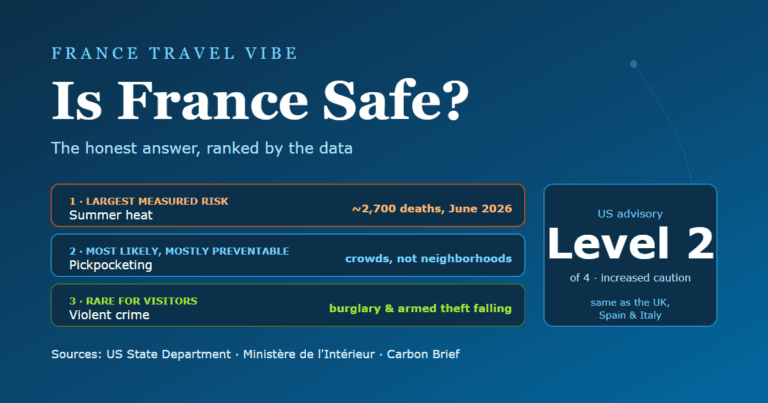
For a traveler, the practical consequence arrived a few weeks later: the Louvre and the Eiffel Tower both curtailed their opening hours in mid-July because of the heat. You can book the ticket and still lose the afternoon. Heat is also the largest measured risk in a French summer, which is why it leads my guide to heat safety and whether France is safe.
Prices point the same direction. Paris hotels set their all-time monthly record in June 2025, €514.05 a night, up 7.3% year on year, with occupancy at 86.3% and a single-night peak of €595.33 on June 16 (CoStar/STR, via Hospitality Net, 2025). Set that against the €239 Paris average for the whole of 2025 (In Extenso, via Voyages d’Affaires, 2026) and June ran at more than twice the year’s normal rate.
I’ve been shifting my own French summers later for three years now, and 2026 settled it. The habit worth stealing is simple: treat the second half of June as July. Book it with July expectations on price, July expectations on crowds, and a plan for what you do between 1pm and 5pm when it’s 38°C and the shade is taken.
Does that mean June is never the best time to visit France? No. Early June is still one of the best fortnights of the year: the first two weeks, before the events calendar and the heat both arrive. It’s the back half that’s changed.
How Crowded Does France Actually Get in Summer?
Crowd volume is the second axis in any honest best time to visit France answer, and it’s steep. French hotels logged 69.2 million overnight stays in Q3 2025 against 43.1 million in Q1 2026. That’s a 61% swing between the country’s busiest and quietest quarters (Insee, Informations rapides 286, 2025; Insee, Informations rapides 120, 2026). Non-resident hotel nights alone rose 11.4% in Q3.
Is that the whole picture? Not close. Hotels understate the swing badly. Add campsites and Q3 2025 reaches 210.9 million overnight stays across all collective accommodation. Insee doesn’t even report campsite figures for the first quarter, because most of them are shut. That’s the cleanest statistical summary of French seasonality you’ll find: an entire accommodation category that only exists for half the year.
Who’s driving the surge? Not the French. Resident hotel nights actually slipped 0.2% in Q3 2025 while non-resident nights climbed 11.4%, led by Asia-Oceania at +30.2%, the United States at +14.7% and Germany at +10.2%. The high-range hotels absorbed most of it, up 9.9%. So the summer crush you’ll queue in is substantially an international one, and it lands hardest on exactly the properties and sights foreign visitors book.
Attraction numbers say the same thing from the other end. The Eiffel Tower took 6.75 million paid visitors in 2025, roughly 450,000 more than 2024, and the Louvre drew 9.0 million. France as a whole hosted 102 million international visitors and earned €77.5 billion (Atout France, bilan touristique 2025, 2026). Those people aren’t spread evenly across twelve months.
When Is France Cheapest to Visit?
If price alone decides the best time to visit France, the answer is November through March, excluding the Christmas market and ski weeks. The gap is largest on airfare: a New York–Paris return runs €380–450 in January and February against €850–1,200 from late June through August (Paris Tourism, Cheapest Time to Fly, 2026). That’s up to €800 per person, decided entirely by which week you pick.
Why does the airfare gap matter more than the hotel gap? Because you pay it once, in full, before anything else is booked. Rooms follow the same curve with sharper spikes. Paris hotels averaged €351.64 in March 2026, a March record, at 73.9% occupancy, and the all-time monthly high is €514.05, set in June 2025. Against a €239 annual average, the shoulder months are the only stretch where the published average and the rate you actually pay are close to each other.
One cost doesn’t move with the season: the tourist tax. Paris charges up to €15.93 per person per night regardless of month, so it’s a flat addition to a cheap January trip and a rounding error on an expensive June one. I break the rates down city by city in France’s tourist tax guide.
For what the rest of the trip costs in each band, see my honest France trip cost breakdown: €95–120 a day on a budget, €150–220 mid-range, before flights.
Does the Best Time to Visit France Change by Region?
Yes, and in the Alps it inverts the national answer entirely. France spans oceanic, continental, Mediterranean and alpine climates across roughly 1,000 kilometres, so a single “best month” is an average that fits almost nowhere exactly. September illustrates why the best time to visit France is a regional question: Paris sits at a 21.5°C high while Nice holds 24.8°C, and Val Thorens is nine weeks from opening its lifts on November 21 (Mountain Marker, 2026/27 ski season calendar, 2026). Provence needs late spring or September; the Alps need December through March or high summer; Alsace peaks twice, in autumn and in Advent. Season and destination travel together, so it helps to know where to go in France before you fix the month.
One region deserves its own note. September on the Riviera is the clearest win on the whole chart. Nice averages a 24.8°C high in September, and while its 81mm of rain is more than Paris gets, it falls on about five days, often as short storms. October still averages a 21°C high, but rainfall jumps to 128mm across eight days (Météo-France, fiche climatologique Nice, 2025). So the swimmable, uncrowded window on the Côte d’Azur is roughly four weeks long, and it starts the day French schools go back.
Provence works differently again. What sets the calendar there isn’t the weather at all, it’s the lavender. The Valensole plateau usually peaks between late June and the first week of July, with harvest starting around mid-July. In a hot dry year some fields are cut by about July 25. The higher Pays de Sault, above 800 metres, blooms later and holds into August, with a fraction of the crowds. If lavender is the reason you’re going, your window is narrower than your holiday. My Provence week built around the markets works out where that fits.
Which Dates Should You Book Around?
Four categories of date move French prices and crowds independently of the season: school holidays, public holidays with bridge weekends, events, and the August shutdown. A week of concerts and trade fairs took one Paris night to €595.33 in June 2025 (CoStar/STR, via Hospitality Net, 2025). Get these wrong and the month you picked as the best time to visit France stops mattering.
French school holidays. The 2026–27 year starts September 1, 2026. All Saints runs Saturday October 17 to Monday November 2, 2026, and the Christmas break runs December 19, 2026 to January 4, 2027, both nationwide. February and April holidays are staggered across three zones, which spreads ski and spring demand across roughly five weeks rather than two. Zone C includes Paris, Créteil, Versailles, Montpellier and Toulouse; Zone A covers Lyon, Bordeaux, Grenoble and others; Zone B takes Marseille, Lille, Nice, Nantes, Rennes and Strasbourg.
Public holidays and ponts. May 2026 was the month of bridges. Labour Day and Victory Day both fell on Fridays, Ascension landed on Thursday May 14 with the obvious Friday bridge, and Whit Monday closed the month on May 25. Four long weekends inside five weeks. 2027 is quieter: May 1 and May 8 fall on Saturdays, which leaves Ascension on Thursday May 6, with schools shut on Friday May 7, and Whit Monday on May 17. My guide to French public holidays has every date and what closes on each. Domestic travel spikes on every one of them, so a May trip should either book well ahead or route around them.
Events. The 2026 Tour de France ran July 4–26 and finished on the Champs-Élysées after a Montmartre stage, with Alpe d’Huez on stage 20. The Tour de France Femmes followed from August 1–9. Bastille Day is fixed at July 14 and Assumption at August 15. In Paris, the reliable rate-spikers are Fashion Week, the French Open, the big concerts and the trade fairs. Together they pushed a single night in June 2025 to €595.33.
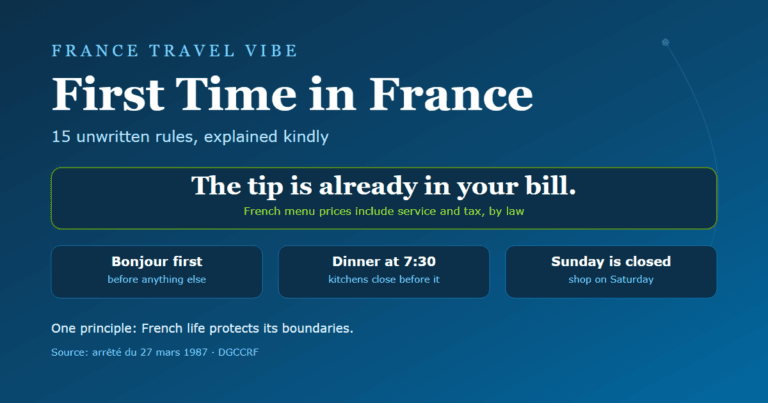
The August shutdown. This one surprises first-timers. Small French businesses close for fermeture annuelle, with restaurant closures clustering roughly August 3–23. Neighbourhood restaurants in residential arrondissements shut for two to four weeks, along with plenty of bakeries, boutiques and pharmacies. Major attractions, department stores and tourist-district cafés stay open throughout. So August Paris isn’t closed, exactly. It’s just that the version of Paris most people want to eat in has gone to the coast. My first time in France tips explain why those closures are the culture working as intended.
Slow travel makes this manageable in a way a one-week trip can’t. When I’m somewhere for a month, an August closure is an inconvenience; when you’ve got six dinners and three are shuttered, it’s the trip. If your dates land in mid-August, check your shortlist restaurants’ social accounts before you build an itinerary around them. The closure notice usually goes up there weeks before it goes on the door.
Is Summer Ever the Right Answer?
Sometimes, and it’s worth saying plainly rather than pretending July and August are never the best time to visit France. Campsites alone logged 107.0 million overnight stays in Q3 2025 (Insee, Informations rapides 286, 2025), and a lot of those people are having a better holiday than the ones queueing at the Louvre. Three trips genuinely need high summer: alpine hiking, which depends on the passes being snow-free; the Atlantic and Breton coasts, where the sea only turns tolerable in late summer; and any trip locked to family school holidays.
Alpine hiking is the strongest case. Chamonix, the Vanoise and the Écrins are at their best from July through early September, and the alternative isn’t “go in May”, it’s “don’t go.” Mountain refuges and lifts run on a short season.
So what do you do if the dates aren’t yours to choose? Two levers still work: geography and altitude. Move north and up: Brittany, Normandy, Alsace and the mountains all sit well below the Mediterranean’s peak crowd density, and every 300 metres of elevation buys back roughly 2°C. Book accommodation four to six months ahead for Provence, the Riviera or Brittany, as I note in the main France travel guide. Normandy is the easiest of those to shift into the shoulder season, and my six-day Normandy itinerary is built around the tides and the crowds rather than the calendar.
And what about winter? Cities hold up beautifully and cost a fraction of summer. Colmar’s Christmas market runs November 23 to December 29, 2026, and Strasbourg sets its dates each autumn; in 2025 it ran November 26 to December 24. I’ve put ten towns’ dates and the quiet days in my guide to the Alsace Christmas markets. The vineyard road between the two cities is a separate three-day trip, and it is emptiest in May and October. Ski resorts open earlier than most people plan for: Val Thorens and Orelle launch the 2026–27 season on November 21, 2026, with Courchevel following December 4 and Méribel and Les Menuires December 5. Which one you pick is mostly a budget question, and I have ranked twelve resorts by what they actually cost. Provence in January, on the other hand, is closed shutters and cold wind. Paris’s river boats run all winter, but a flood can halt them, so check when the Seine boats stop running before booking a January dinner cruise.
The Month-by-Month Verdict
Here is the best time to visit France scored month by month on four axes at once, combining the Paris climate normals, the Insee demand series and the 2026 rate records above. September tops it on all four simultaneously, which no other month manages. Temperatures are Paris daily highs from the 1991-2020 normals (Météo-France, 2025); the verdict is national.
| Month | Paris high | Rain (mm / days) | Crowds | Prices | Verdict |
|---|---|---|---|---|---|
| January | 7.6°C | 48 / 10 | Lowest | Lowest | Cities and skiing only. Flights from €380. |
| February | 8.8°C | 42 / 9 | Low | Low | Driest month. Ski zones stagger demand. |
| March | 12.8°C | 45 / 10 | Rising | Rising fast | Paris hit a €351.64 record in 2026. Events, not weather. |
| April | 16.6°C | 46 / 9 | Moderate | Moderate | Highest variance of any month. The Loire châteaux and Paris are safe bets. |
| May | 20.2°C | 69 / 9 | Moderate | Moderate | Runner-up. Wettest month by volume, and four long weekends. |
| June (early) | 23.4°C | 51 / 8 | Moderate | Rising | The best fortnight of the year. |
| June (late) | 23.4°C | 51 / 8 | High | Peak | Now peak. Record heat in 2026, on top of the €514 room record set in June 2025. |
| July | 25.7°C | 59 / 7 | Peak | Peak | Alps and lavender only. Bastille Day and the Tour. |
| August | 25.6°C | 58 / 8 | Peak | Peak | Coasts full, cities half-shut, prices at the ceiling. |
| September | 21.5°C | 45 / 8 | Falling fast | Falling | Best month. Driest shoulder month, Nice still 24.8°C. |
| October | 16.5°C | 55 / 10 | Low | Low | Underrated. Alsace colour, harvest, empty châteaux. |
| November | 11.1°C | 54 / 10 | Lowest | Lowest | Grey, cheap, and the Christmas markets open in the last week. |
| December | 8.0°C | 62 / 11 | Split | Split | Markets and ski weeks expensive; everything else isn’t. |
Notice the pattern in the two highlighted rows? September and May differ by 1.5°C in average high and 15mm in rainfall. What separates them isn’t weather at all. It’s that one sits after the school year and the other sits inside a month with four public holidays.
Frequently Asked Questions
What is the best month to visit France?
September is the best time to visit France. Paris averages a 21.5°C high on 45mm of rain across about 8 days, the driest of the four shoulder months, French schools return on September 1, and Nice still averages a 24.8°C high (Météo-France, 2025). May is the runner-up, though it’s Paris’s wettest month by volume.
What is the cheapest time to visit France?
November through March, outside the Christmas market and ski weeks. A New York–Paris return runs €380–450 in January and February against €850–1,200 in peak summer (Paris Tourism, 2026). Paris room rates in those months sit much nearer the €239 annual average than the June record of €514.05.
Is June still a good time to visit France?
Early June, yes; late June is no longer the best time to visit France. Late June has become peak. France’s national temperature indicator hit a record 30.0°C on June 24, 2026, with 72 of 96 departments under red alert, and Paris hotels had set their €514.05 record the June before (CoStar/STR, 2025). Book the second half of June with July expectations.
Should I avoid France in August?
Only if you want cities. Restaurant closures for fermeture annuelle cluster around August 3–23, and neighbourhood restaurants shut for two to four weeks. Major attractions and tourist-district cafés stay open. The Alps, Brittany and Normandy handle August far better than Provence or the Riviera do.
When is the best time to see lavender in Provence?
Late June to the first week of July on the Valensole plateau, at 590 metres, where the harvest starts from mid-July and ran about two weeks early in 2026. The higher Pays de Sault blooms later and holds through July. My Provence lavender fields guide has the week-by-week calendar and five routes.
How crowded is France in summer compared to winter?
French hotels logged 69.2 million overnight stays in Q3 2025 against 43.1 million in Q1 2026, a 61% swing (Insee, 2025). Campsites add 107.0 million more Q3 nights and aren’t reported in Q1 at all, because most are closed.
When do the Alsace Christmas markets open in 2026?
Colmar’s market runs November 23 to December 29, 2026. Strasbourg sets its dates each autumn and had not announced 2026 by late September; in 2025 it ran November 26 to December 24. Both are the main reason late November and December beat the rest of winter in eastern France, and both push regional room rates well above the November baseline.
The Bottom Line
The best time to visit France comes down to four decisions, and only one of them is about weather.
- September is the best month, on rainfall, temperature, crowd volume and price simultaneously.
- May is the runner-up, with the caveat that it’s Paris’s wettest month and carries four long weekends.
- Late June has moved into peak season: record heat in 2026, and a €514.05 record for Paris rooms in June 2025 against a €239 annual average.
- The regional answer overrides the national one. Provence wants May or September; the Alps want winter or high summer; Alsace peaks twice.
- Winter is genuinely cheap, with airfare swinging up to €800 per person between January and August.
- Book around the calendar, not just the season: school holidays, May’s four ponts, the Tour, and the August shutdown.
France drew 102 million international visitors in 2025 and they did not arrive evenly, which is why the best time to visit France is a scheduling question before it’s a weather one. Moving a trip by four weeks is the cheapest upgrade available to you. It costs nothing, and it buys back the room rate, the queue and the afternoon heat all at once.
Planning the rest of it? Start with my complete France travel guide, price the trip with the honest France trip cost breakdown, add the tourist tax for your cities, and check what you need at the border before you book. Then sort out getting around France, because high-season trains and rental cars both punish late bookers. My 7, 10 or 14 day itinerary comparison settles how many days you actually need, and my guide to what to pack for each season turns the month you pick into a packing list. For the days that shut museums and banks, see my guide to French public holidays.