
Last verified: October 13, 2026. Figures checked against the five regional language surveys, service-public.fr and the Conseil constitutionnel.
France’s Ministry of Culture counts 75 languages of France, yet Article 2 of the Constitution says “the language of the Republic is French” (Ministry of Culture, Langues régionales, 2026). Both are true, and that tension is the story of French regional cultures in one line.
Most travel writing turns those cultures into costumes and crêpes. The official map makes it worse, because none of them lines up with a region. This guide compares five on the same points. Where does each sit on the map? Who still speaks the language? What does the law do differently, and what does each change for your trip? For why France was never one culture to begin with, start with my French culture guide.
Disclosure: Some links in this guide may earn us a commission, at no extra cost to you. It never changes what we recommend.
Key Takeaways
- Five French regional cultures stand out for a visitor: Breton, Basque, Alsatian, Corsican and Provençal. None matches an official region.
- Speaker shares range from 46% to 2.7%. 46% of Alsatians say they speak the dialect well; 2.7% in Brittany say the same of Breton (regional surveys, 2022 and 2024).
- Alsace and Moselle even have two extra public holidays. Learn the local hello. See the Five-Culture Card.
Table of Contents
Why Doesn’t the Map of France Show Its Regional Cultures?
Because the map was drawn for administration, not identity. Since 1 January 2016, mainland France has had 13 regions, 18 with the overseas ones, after the law of 16 January 2015 merged the old 22 into larger blocks (INSEE, Tableaux de l’économie française 2017). Not one of the five cultures in this guide matches one of them.
Brittany is the closest, and it still misses. The Brittany region leaves out Nantes, the old capital of the Breton dukes, which sits in Pays de la Loire. Alsace was folded into the Grand Est region in 2016, then given its own Collectivité européenne d’Alsace in 2021. The French Basque Country has no region at all. Its nearest thing to an institution is an agglomeration community of 158 communes created on 1 January 2017 inside Nouvelle-Aquitaine (Communauté d’agglomération Pays Basque, data.gouv.fr). Provence is roughly half of Provence-Alpes-Côte d’Azur. Only Corsica is its own territory.
So when you plan a trip around French regional cultures, look past the region name on the map. Someone from Strasbourg will call themselves Alsatian long before they say “Grand Est”. If you’re still choosing where to go, my ranking of the best places to visit in France sorts twelve of them by crowds and cost.
What Are the Five French Regional Cultures Worth Knowing?
The five French regional cultures a visitor will actually notice are Breton, Basque, Alsatian, Corsican and Provençal. Each has a living language, a visible identity and a tourist area attached. Since 2008, Article 75-1 of the Constitution has said that “regional languages belong to the heritage of France” (Conseil constitutionnel, Constitution of 4 October 1958). Heritage, note, not rights.
They aren’t the only ones. Flemish survives in the far north, Catalan around Perpignan, and Savoyard and Gascon in the mountains and the south-west. The overseas territories have dozens more languages of their own. I’ve kept to five because these are the ones that change what you see, hear and eat on a mainland trip.
The Five-Culture Card
| Culture | Where it is | Language today | Say hello | Eat | Festival to time a trip for |
|---|---|---|---|---|---|
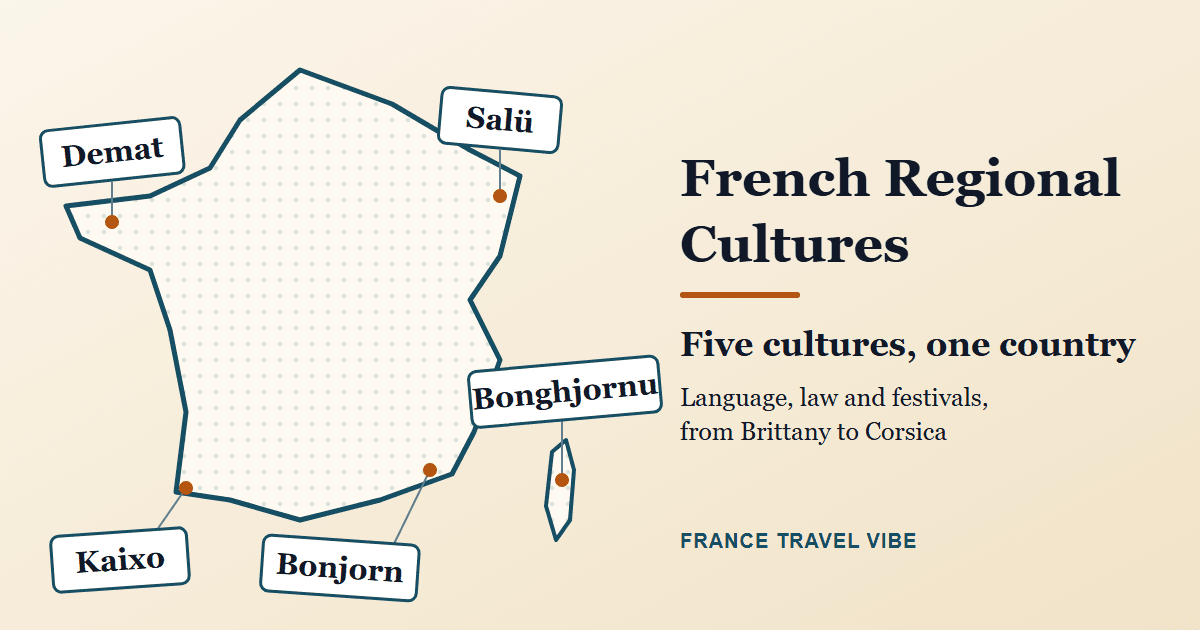
| Breton | Brittany region plus Nantes (Loire-Atlantique) | 2.7% speak Breton well (2024) | Demat | Galette and cider | Interceltique, Lorient, 30 Jul to 8 Aug 2027 |
| Basque | Labourd, Basse-Navarre and Soule, in the south-west corner | 20.1% speak Basque well (2021) | Kaixo | Gâteau basque, piperade | Fêtes de Bayonne, 14 to 18 Jul 2027 |
| Alsatian | Bas-Rhin and Haut-Rhin, inside Grand Est | 46% speak Alsatian well (2022) | Salü | Choucroute, tarte flambée | Strasbourg Christmas market, late Nov to 24 Dec |
| Corsican | The island of Corsica | About 43% speak Corsican well (2021) | Bonghjornu | Brocciu cheese, figatellu | Santa di u Niolu, around 8 Sep |
| Provençal | Western Provence-Alpes-Côte d’Azur | Not measured | Bonjorn | Aïoli, bouillabaisse | Transhumance, Saint-Rémy, 17 May 2027 |
The dishes get the full treatment, with where to eat each one, in my French food guide.
How Many People Still Speak France’s Regional Languages?
It depends enormously on the language. In the latest regional surveys, 46% of adults in Alsace say they speak Alsatian “fairly or very well”. Only 2.7% of people in historic Brittany say the same of Breton (Collectivité européenne d’Alsace, Étude sociolinguistique 2022, via Erhart, OpenEdition; Région Bretagne, Enquête sociolinguistique 2024).
Language is the clearest test of how alive French regional cultures still are. Treat these figures as five separate measurements, not one league table. Each survey was run by a different body, in a different year, with its own age floor. No national count has been made since INSEE’s 1999 family survey, so these regional surveys are all there is.
Speaking isn’t the same as using, either. In Corsica’s 2021 survey, about 43% said they speak Corsican well, but only 2% said it’s the language they use most in daily life (Collectivité de Corse 2021, cited in Urteaga, Oñati Socio-Legal Series, 2025).
The age picture matters more than the headline. In Alsace, the 46% falls to 9% among 18 to 24 year-olds, and only 4% of adults speak Alsatian with their children. Occitan drops from 7% overall to 2% among 15 to 29 year-olds (OPLO, Enquête sociolinguistique occitane 2020). Basque runs the other way.
Here’s what the numbers mean on the ground. The loudest branding and the most spoken language rarely coincide. Brittany and Provence sell their identity hardest, with flags, stickers and cicadas on every tea towel. Yet Breton has the lowest measured share of the five, and Provençal hasn’t been measured at all. If you want to hear a regional language in a bakery queue, go to Corsica, the inland Basque valleys or a village in rural Alsace.
What Makes Brittany Different, Beyond the Crêpes?
A Celtic language, a music scene that’s still social, and a border the official map ignores. In 2024, about 107,000 people spoke Breton well, 2.7% of residents aged 15 and over in the five departments of historic Brittany. That’s half the Région’s 2018 estimate of 214,000 (Région Bretagne, Enquête sociolinguistique 2024).
And yet the speakers are getting younger. Their average age fell from 70 in 2018 to 58.5 in 2024. Older native speakers are dying, and the newer speakers are younger and mostly learned it at school. Breton is far stronger in the west, at 5.5% in Basse-Bretagne against 0.9% in the east. The east has a second regional language almost nobody outside Brittany mentions: Gallo, a Romance language with about 132,000 speakers, more than Breton.
What you’ll notice is bilingual. Station names, road signs and town halls carry the Breton name under the French one. Nantes, though outside the Brittany region, still has the castle of the Breton dukes. The music is the clearest sign: the fest-noz, a night of circle and chain dances, is held all over the region. The biggest gathering is the Festival Interceltique in Lorient, which runs from 30 July to 8 August 2027 (Festival Interceltique de Lorient).
The first fest-noz I went to had no start and no finish that I could find. A line of dancers simply grew past my table, someone took my hand, and I was in it for twenty minutes without learning the steps. Nobody minded.
Coast, islands and the Breton difference all get their own space in my Brittany travel guide.
Is the French Basque Country Different From the Spanish Side?
It’s the same language and culture on both sides of the border. On the French side, though, Basque has no region and no official status, and the map inside it varies hugely. In 2021, 20.1% of people aged 16 and over in the French Basque Country spoke Basque well or fairly well, about 51,500 people (OPLB, VIIe enquête sociolinguistique, synthèse, 2023).
That average hides a steep slope from coast to mountains. In the Bayonne, Anglet and Biarritz conurbation, only 8.4% speak Basque. In the rest of Labourd it’s 22.9%. In the inland valleys of Basse-Navarre and Soule it’s 47.5%, nearly one person in two. The coast you’re most likely to stay on is the least Basque-speaking part of it.
The other surprise is age. Young adults now speak Basque more than the middle-aged do: 21.5% of 16 to 24 year-olds against 15.1% of 35 to 49 year-olds. The likely reason is Basque-medium schooling. No other regional language in this guide shows a pattern like it.
Basque, or Euskara, is unrelated to any other living language in Europe. You’ll see it on every sign, alongside a sport played against a wall: pelota, on the fronton that most villages keep beside the church. The biggest party is the Fêtes de Bayonne, where the town dresses in white with a red scarf. The prefecture counted about 1.3 million people over five days in 2023 (Préfecture des Pyrénées-Atlantiques, bilan des Fêtes de Bayonne 2023). In 2027 it runs from 14 to 18 July.
In a village bakery up the Nive valley, I said bonjour and got “Kaixo” back, with a smile that said I could pick either. I picked Kaixo the next morning. It got a bigger smile.
My guide to where to stay in France prices the Basque coast against the other summer bases.
Is Alsace French or German?
French, with a Germanic dialect, a German-era legal system and a history of changing hands four times between 1871 and 1945. In a 2022 survey of 4,001 people, 46% of adults in Alsace said they speak Alsatian fairly or very well. Among 18 to 24 year-olds, it was 9% (Collectivité européenne d’Alsace, via Erhart, OpenEdition, 2022).
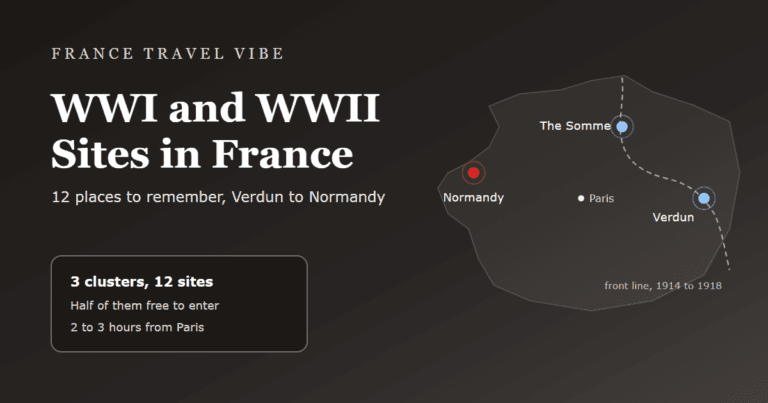
Germany annexed Alsace and part of Lorraine in 1871. France took them back in 1918, Nazi Germany annexed them again in 1940, and France returned in 1944 and 1945. The dialect and the half-timbered towns are far older, from Alsace’s centuries in the Holy Roman Empire. The back-and-forth explains why the question still gets asked. For where those annexations sit in the national story, see my French history primer. The Struthof camp in the Vosges, the only concentration camp built on what is now French territory, is in my guide to WWI and WWII sites in France.
It also explains something few visitors know: Alsace and Moselle have their own law. When France separated church and state in 1905, the region was German, so the old arrangements stayed. The state still pays clergy there, and the region keeps extra public holidays.
| Holiday | Rest of France | Alsace and Moselle |
|---|---|---|
| Good Friday, 26 March 2027 | Normal working day | Holiday in communes with a Protestant or mixed church |
| 26 December (Saturday in 2026, Sunday in 2027) | Normal working day | Holiday everywhere in the three departments |
Source: service-public.fr, Jours fériés, 2026 and 2027 calendars.
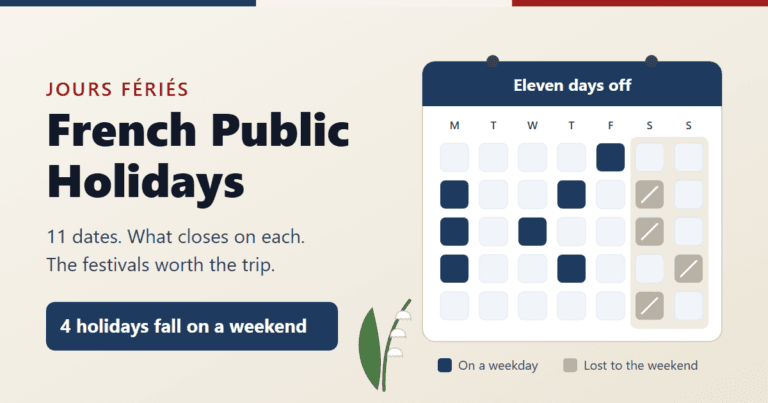
This is the one regional difference that can change your itinerary. On Good Friday, shops and offices in much of Alsace close while Paris works normally, so plan a market morning or a bank errand for another day. The 26th falls on a weekend in both 2026 and 2027, so it bites again from 2028. The full national calendar, with what closes on each date, is in my guide to French public holidays.
I learned the 26 December rule the hard way, in a previous year when it fell midweek. I’d saved a day in Strasbourg for shopping and found the shutters down, while a friend in Lyon was texting me photos of the sales.
The villages and wine are covered in my Alsace wine route guide, and December in my guide to Alsace Christmas markets. Strasbourg’s market ends on 24 December; that guide has the closing days for the village markets.
Why Does Corsica Feel Like a Different Country?
It has its own elected assembly and executive, its own language and, since June 2026, an autonomy bill moving through Parliament. On 23 June 2026, the Assemblée nationale voted 271 to 202 for a constitutional bill giving Corsica “a status of autonomy within the Republic” (Assemblée nationale, projet de loi constitutionnelle pour une Corse autonome, 2026).
As of October 13, 2026, the Senate is due to debate it on 26 October (Sénat, dossier législatif). Both chambers must pass the same text, and then three-fifths of both together, sitting as a Congress. None of it changes your trip: the entry rules and the currency are the same as on the mainland.
Corsica became French in 1768, when Genoa ceded it. Since 2018 a single Collectivité de Corse has run it, in place of two departments. Its language, Corsican, is close to Tuscan Italian. In the Collectivité’s 2021 survey, 30% said they were fully bilingual in Corsican and French. Another 13.2% spoke it fairly well, and only 8.9% didn’t understand it at all (Collectivité de Corse 2021, cited in Urteaga, Oñati Socio-Legal Series, 2025).
You’ll see the politics before you hear the language. Road signs carry the Corsican name, and on some the French one has been painted out. The Moor’s head flag flies from balconies. The sound to listen for is polyphony. Cantu in paghjella, three-voice male singing, has been on UNESCO’s urgent-safeguarding list since 2009 (UNESCO, Cantu in paghjella). A good place to hear it is the Santa di u Niolu fair at Casamaccioli. It’s held each year around 8 September, the feast of the Nativity of the Virgin (Visit Corsica, Les foires de septembre en Corse).
On my first drive inland from Ajaccio, several signs had their French names blacked out. It looked hostile. It wasn’t: the woman who rented me a room laughed, poured coffee and explained the village name in Corsican before I’d asked.
Is Provence’s Culture Just Lavender and Markets?
No. Provence has the most famous literary revival of the five, and the least measured language. In 1904, the Provençal poet Frédéric Mistral shared the Nobel Prize in Literature for work written in Provençal (Nobel Prize, Frédéric Mistral facts). In 1854 he had founded the Félibrige, a literary society, to preserve the language.
Provençal is a dialect of Occitan, the language of the whole southern third of France. The best data on Occitan is a 2020 survey of 8,000 people. 7% speak it, and only 2% of 15 to 29 year-olds; speakers average 66 years old (OPLO, Enquête sociolinguistique occitane 2020). But that survey covers Occitanie and Nouvelle-Aquitaine only. Nobody has measured Provence itself, so anyone quoting a Provençal speaker figure is guessing.
You’ll meet the culture anyway. Street names in Avignon and Arles carry a second, Provençal name. Christmas means santons, clay figures of village trades added to the crib. The perfume craft of the Pays de Grasse went onto UNESCO’s list in 2018. And on Whit Monday, 17 May 2027, Saint-Rémy-de-Provence hosts the Fête de la Transhumance. Thousands of sheep walk through the town centre, at a festival held since 1985.
The villages and markets are in my Provence itinerary, the flowers in my lavender fields guide, and the big city in my Marseille travel guide.
Why France Keeps Regional Languages Out of Official Life
Article 2 of the Constitution makes French the language of the Republic, and the Constitutional Council reads it strictly. In May 2021, it struck out two articles of a new regional languages law. One allowed immersion teaching in schools; the other allowed regional spellings in civil records (Conseil constitutionnel, décision n° 2021-818 DC, 21 May 2021).
The ruling held that regional-language teaching in state schools “can only be optional”, so full immersion schooling in Breton or Basque was unconstitutional in that form. It also blocked spellings that French doesn’t use, like the tilde in the Breton first name Fañch, in birth registers. Funding for bilingual private schools, the third disputed article, survived.
France also signed the European Charter for Regional or Minority Languages on 7 May 1999 and has never ratified it (Council of Europe, Promoting ratification in France). The same Article 2 is the obstacle.
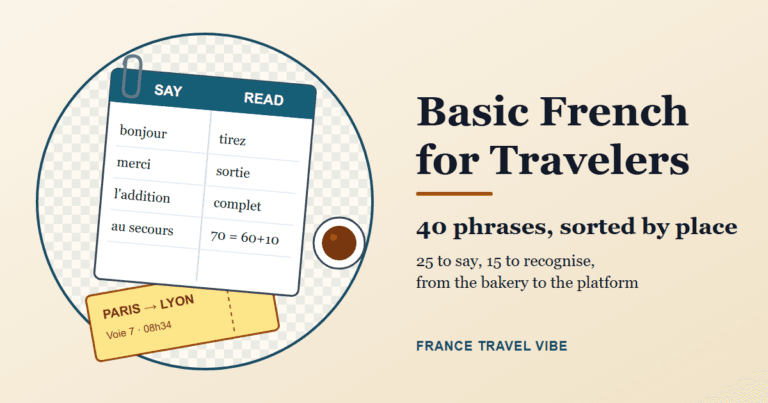
For a visitor, the visible result is simple: French regional cultures live on signs, in schools and in song rather than in official paperwork. Bilingual signs are allowed, but French always comes first. My basic French guide has the forty phrases you’ll actually need, none of them in a regional language.
How to Show Respect for a Regional Culture as a Visitor
Respecting French regional cultures takes very little: learn one word, eat the local dish, and never tell anyone their region is “basically” somewhere else. In Alsace, where 46% of adults still speak the dialect well (CeA, 2022), a “Salü” at the market costs nothing and lands well. In the Basque valleys, where nearly one person in two speaks Basque, “Kaixo” does the same.
Five things not to say:
- In Brittany: that Mont-Saint-Michel is Breton. It’s in Normandy, just on the Norman side of the Couesnon, and Bretons have opinions about that. Some will tell you the river moved.
- In Alsace: that it’s “basically German”. Four changes of flag in 75 years left people very clear about which side they’re on.
- In Corsica: that it’s “basically Italian”. The language is close to Tuscan; the identity is Corsican.
- In the Basque Country: that it’s the Spanish bit of France. Basque predates both countries.
- In Provence: that it’s the Riviera. Nice was part of Savoy until 1860 and keeps a dialect of its own.
Timing is the other form of respect. Arrive for the week a culture shows itself, and you’ll see it on its own terms rather than as a backdrop. My month-by-month guide to the best time to visit France sets these dates against crowds and prices.
Which Regional Culture Should You Visit First?
Match the culture to the trip. Of the five French regional cultures, Alsace is the easiest first look. It has a direct high-speed line from Paris, and nearly half of adults say they speak the dialect. The Basque Country is best for food and for hearing a language young people actually speak. Corsica gives the strongest sense of a different place.
Brittany is for music and coast, and for a culture that’s rebuilding itself in schools. Provence is the market-and-village version, with the language hiding in street names. If one trip has room for two, pair Alsace with Burgundy’s vineyards or the Basque coast with Bordeaux.
My ranking of the best places to visit in France puts all of these against the rest of the country. For the table manners that apply in all five, see my French dining etiquette guide.
Frequently Asked Questions
How many regions does France have?
France has 13 regions in mainland France and Corsica since 1 January 2016, and 18 including the five overseas regions. French regional cultures are older than these regions and don’t follow their borders. The Basque Country has no region of its own, and Nantes, once Brittany’s capital, sits in Pays de la Loire.
What regional languages are spoken in France?
The Ministry of Culture lists 75 languages of France, most of them overseas. In mainland France the main ones are Alsatian, Occitan (including Provençal), Breton, Basque, Corsican, Catalan, Flemish and Gallo. Their share of speakers ranges from 46% for Alsatian in Alsace to 2.7% for Breton in Brittany.
Is Alsace French or German?
Alsace is French. It changed hands four times between 1871 and 1945 and has been French since the end of the Second World War. In a 2022 survey, 46% of adults said they speak the Germanic Alsatian dialect well, and Alsace and Moselle keep local laws, including two extra public holidays.
Do people in the French Basque Country speak Basque?
About one in five do. In 2021, 20.1% of people aged 16 and over spoke Basque well or fairly well, but only 8.4% around Bayonne and Biarritz against 47.5% in the inland valleys of Basse-Navarre and Soule. Young adults speak it more than the middle-aged.
Does Corsica’s autonomy bill affect tourists?
No. Entry rules and the euro are the same as on the mainland, and the bill changes neither. The constitutional bill passed the Assemblée nationale 271 to 202 on 23 June 2026. As of October 13, 2026, it still needed the Senate and a three-fifths vote of Parliament sitting as a Congress.
The Bottom Line
French regional cultures hide behind the official map, but they show up in a bakery queue, a road sign or a holiday calendar:
- The map won’t show you the cultures. Brittany leaves out Nantes, and the Basque Country has no region at all.
- The languages range from 46% to 2.7%. Alsatian is widely spoken but fading among the young; only Basque is stronger among young adults than on average.
- Alsace’s law can close the shops on Good Friday and 26 December.
Pick one culture from the card for your next trip, and learn its hello before you go. Then go back to my French culture guide for the rules that hold everywhere, and to my French food guide for what to order when you get there.