
Last verified: October 7, 2026. Culture moves slowly, but the dated facts here (the 2025 smoking decree, the 2026 DARES, Ifop and Ined releases) are re-read before each update.
At 13:00, half of France is at lunch. That is not a figure of speech. In 2010, the latest year INSEE has published, 48% of French adults were eating at one o’clock (INSEE, Le temps de l’alimentation en France, Insee Première n°1417, October 2012). Once you know that, the closed shop, the slow waiter and the empty street all make sense, and that one number is where this French culture guide starts.
Most tips lists tell you what to do in France and never why. This guide does the opposite. It explains the twelve systems the manners come from, with the law or the number behind each, and then points you to the deeper guide on each topic. It’s the culture chapter of my complete France travel guide, and it’s built so you can read it once and stop guessing.
Disclosure: Some links in this guide may earn us a commission, at no extra cost to you. It never changes what we recommend.
Key Takeaways
- France runs on a shared clock. Half the country eats at 13:00 (INSEE, 2010), and the French spend 133 minutes a day eating and drinking, twice the American figure (OECD).
- Four “unwritten” rules are law: service in the price, Sunday rest, French-first signs, and where you may smoke.
- The twelve rules below are systems, not tips: the clock, the greeting, the register, the table, the price, the week, the year, the language, the secular state, the café, protest and the regions. Learn the system and the tip follows.
Table of Contents
What Makes French Culture Different for a Visitor?
In 2010, the French spent 2 hours 22 minutes a day eating, 13 minutes more than in 1986, and the time clustered around three shared meals (INSEE, Insee Première n°1417, October 2012). The OECD’s time-use figures put France first among its member countries at 133 minutes a day eating and drinking, against 62 in the United States (OECD Time Use database, via The Local, August 2023). That’s a different survey with a different age band, which is why the two French figures sit nine minutes apart, but on either measure France sits at the top. The difference isn’t that France is slow. It’s that France is synchronised.
Rule 1: France does the same things at the same time. That is the whole secret, and almost nobody says it plainly. INSEE’s own researchers pointed to the synchronisation of meals and noted that Eurostat had singled France out for it as far back as 2004. Everyone eats at once, so everything else closes at once. The bakery queue at 12:15, the dead street at 13:00 and the “fermé” sign on the pharmacy are the system working as designed.
I learned this the slow way, on long stays in small towns. The first week, I kept arriving at shops at 12:40 and finding the lights off. By the third week I’d stopped fighting it, ate when the town ate, and found the afternoon opened up. Once you move with the clock instead of against it, France gets easy.
Here is the French day as the data describes it. INSEE measured who’s eating when; the shop and kitchen hours are what you’ll meet in practice, and the Sunday rule is written into the labour code.
| Time | What France is doing | Source or status |
|---|---|---|
| 07:00 to 09:00 | Breakfast, peak around 08:00 on weekdays; 82% eat something before 11:00 | INSEE time-use survey, 2010 |
| 09:00 to 12:00 | Shops, markets and offices open; errands happen now | Typical practice |
| 12:00 to 14:00 | Lunch: 92% eat between 11:00 and 15:00, averaging 55 minutes; 48% are eating at 13:00 | INSEE, 2010 |
| 12:00 to 14:00 | Restaurant kitchens serve; many small shops and offices close | Typical practice |
| Around 12:30 | The average working lunch break lasts 46 minutes; 91% of employees take one | Ifop for Edenred, March 2026 |
| 14:30 to 15:30 | Shops reopen, later in the south | Typical practice |
| 16:30 | The goûter, the children’s snack; 21% of adults eat something between 15:00 and 18:00 | INSEE, 2010 |
| 18:00 to 20:00 | The apéritif, the drink before dinner | Custom; written into the UNESCO listing of the French meal |
| 19:30 to 22:00 | Dinner service; the peak has moved to about 20:15, from just before 20:00 in 1986 | INSEE, 2010 |
| Sunday | Food shops may trade until 13:00; other retail is closed unless a derogation applies: one of the mayor’s 12 Sundays a year, a tourist zone or a sector exemption | Code du travail L3132-13; economie.gouv.fr |
The INSEE survey is old, and I say so because the next one is already in the field. INSEE’s 2025 to 2026 time-use survey collects until September 2026 and publishes about a year later (INSEE, Enquête Emploi du temps 2025-2026). When it lands, I’ll update the table.
Why Is Bonjour the Whole Transaction?
In October 2021, 65% of French people were greeting close friends and colleagues with la bise again (Ifop poll of October 2021, as reported by Le Bonbon, October 25, 2021). Before the first lockdown the figure was 91%. In March 2021 it had fallen to 39%. The pandemic bent the greeting rituals, and within seven months they had recovered half the lost ground. In France the greeting is the contract that opens every exchange.
Rule 2: say bonjour before you say anything else. Walk into a bakery, a pharmacy, a train compartment, a small shop, and the first word is “bonjour”, or “bonsoir” from about six in the evening. Skipping it reads as walking into someone’s home without knocking. The reply you get after a bonjour is a different reply. Most stories about rude French service begin with a tourist who went straight to the question.
Rule 3: “vous” is the default, and formality is respect, not distance. France keeps two words for “you”. “Vous” is for strangers, shopkeepers, anyone older, anyone serving you. “Tu” is for friends, family and children, and you wait to be offered it. “Bonjour Madame” and “Bonjour Monsieur” are normal, not stiff. An unsmiling shop assistant isn’t being cold. Professional reserve is the courtesy here, and the warmth arrives once the form has been observed.
On one long stay I rented a room above a street of small shops. By the second week the woman at the newsagent greeted me by sight, the baker asked about my day, and the café waiter had my order half poured. None of that happened because my French improved. It happened because I’d said bonjour and au revoir, every time, for two weeks.
La bise is the kiss on the cheek, and it’s for people you know. Nobody expects it from a visitor, and you never offer it to a waiter, a shopkeeper or a hotel receptionist. Among friends, the count changes by region, usually two, sometimes more in the south, sometimes one in Brittany, and the French argue about it themselves. In an office, a handshake is correct. For the fifteen practical first-trip rules that follow from all this, read my first-time-in-France tips.
Why Does Half of France Eat Lunch at 13:00?
Forty-eight percent of French adults were eating at 13:00 in 2010, down from 51% in 1986 (INSEE, Insee Première n°1417, October 2012). In March 2026, Ifop found that 91% of employed French people take a lunch break, and 79% take one every working day (Ifop for Edenred, Grande enquête sur la pause déjeuner des Français, fieldwork March 10 to 18, 2026, 2,500 respondents). The break lasts 46 minutes on average. Lunch isn’t a gap in the French day. It’s one of its load-bearing walls.
Rule 4: eat when France eats, or plan to wait. A restaurant kitchen runs two services. Lunch is served from about noon to two, dinner from about half past seven, and the hours between belong to the staff. Walk in at 15:00 and you’ll be offered a drink and an apology. Outside the brasseries that serve all day, the cook has gone home and will be back at half past seven.
The same Ifop study found that 88% of workers call the lunch break necessary or indispensable. 65% eat it with other people: 51% with colleagues or clients, 14% with family or friends. And 74% give it as much time as they used to, or more. Lunch also “follows the sun”, in Ifop’s phrase: it’s taken earlier in the east of France and later in the west. If you’re planning a day around a table, that detail matters.
Dinner is late by Anglo-American standards and getting later. INSEE found the evening peak had moved from just before 20:00 in 1986 to about 20:15 in 2010, with 92% of adults eating something between 18:00 and midnight, for an average of an hour. Book for 20:00 and you’ll eat with the French. Book for 18:30 and you’ll eat alone, if the kitchen is open at all.
Why so much ceremony around a meal? Because France decided, formally, that the meal is culture. In 2010, UNESCO inscribed the “gastronomic meal of the French” on its intangible heritage list (UNESCO, Gastronomic meal of the French, 2010). The listing defines it as a shared festive meal with an apéritif, at least four courses (a starter, fish or meat with vegetables, cheese, dessert) and a digestif to close. You won’t eat four courses every day. But the shape of that meal is the shape every French menu is built around.
At a chambre d’hôtes, the evening table d’hôtes is the clearest version of this: one sitting, one menu, everyone together. I describe how that works in my guide to chambres d’hôtes. For how to order, what the menu words mean and why the bill waits until you ask, my French dining etiquette guide goes from booking to bill.
Service Compris: What the 1987 Order Actually Says
Since the arrêté du 27 mars 1987, every price a French café or restaurant shows the public must be a “prix service compris”, a price with service included (Légifrance, Arrêté du 27 mars 1987 relatif à l’affichage des prix). The rate the house applies to pay its staff must be printed in brackets beside it. The displayed price is the whole price. That is the law, and it has been for nearly forty years.
Rule 5: the price is the price, so a tip is a gesture, not a wage. No percentage is fixed in law, whatever a tipping guide tells you about “15% by law since 1985”. What’s guaranteed is the principle. Your waiter is salaried, with the same social cover as any other employee, and nobody is depending on your coins to make rent.
So what do you actually do? Round up, or leave a euro or two in cash on the saucer when the service was good. Leaving nothing is normal, not an insult. Adding 20% to the bill doesn’t read as generous so much as confused, because you’re paying twice for the same service. The fifteen practical first-trip rules cover the amounts for taxis, guides and hotels, so I won’t repeat them here.
This is the first of four “unwritten” rules in this guide that turn out to be written. Tipping, Sunday closing, French-first signage and where you may smoke all sit in a decree or a code. Visitors read them as quirks of temperament. They’re legislation, which is why they don’t bend when you’re the only customer.
Why Is France Closed on Sunday, and in August?
Under the Code du travail, food shops may give their staff Sunday rest from 13:00, which is why your bakery is open in the morning and shut by lunch (Code du travail, article L3132-13). For everything else, Sunday is the legal rest day. A mayor can authorise up to 12 shopping Sundays a year, and designated tourist zones get wider exceptions (economie.gouv.fr, Commerçants, êtes-vous autorisés à ouvrir le dimanche).
Rule 6: Sunday belongs to the household, by law. This is the second written rule. In the big cities and the resort towns you’ll find plenty open, because they sit inside the tourist-zone exceptions. In a provincial town, Sunday afternoon means a walk, a long lunch and closed shutters. Buy your bread before one, and treat the quiet as the point rather than the problem.
Rule 7: August empties the cities and fills the coast. In 2025, 63% of French people aged 15 to 69 went on holiday at least once, and 37% didn’t (Crédoc, via the Observatoire des inégalités, June 2026). The split is sharply social: 81% of people on more than €2,550 a month went away, against 49% of those on under €1,190, and 78% of senior managers against 54% of manual workers. Paris in August is a city of visitors, Parisians who couldn’t leave, and “fermeture annuelle” signs on the restaurants that could.
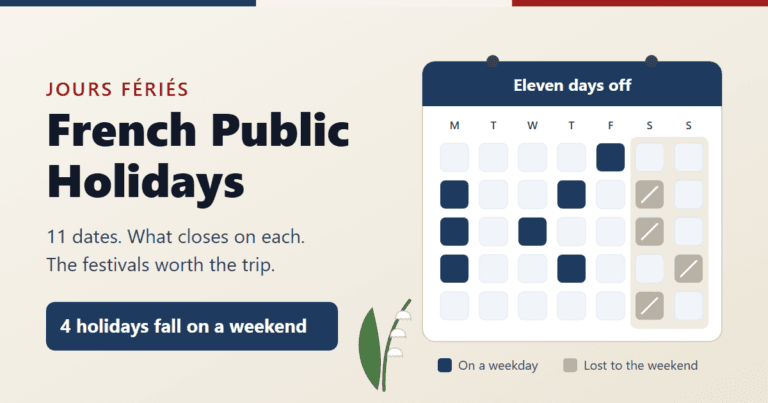
The year has eleven fixed points as well. France keeps 11 national public holidays, and only May 1 is a compulsory day off for employees (service-public.gouv.fr, public holidays and bridges). When one falls on a Thursday, the Friday usually becomes a “pont”, a bridge, and the long weekend takes the country with it. May is the worst month for this and the best for an empty office. The dated calendar to the end of 2027, and what closes on each day, is in my guide to French public holidays.
Alsace and Moselle add two more, Good Friday (in communes with a Protestant temple or a mixed church) and December 26, under the local law regime the three departments kept after their years under German rule (Code du travail, article L3134-13). It’s one of several ways the east of France runs on slightly different rules, and I’ll come back to it under laïcité below.
For which months are busy, hot or shut, read my month-by-month guide to the best time to visit France.
Do You Need to Speak French?
No, but you need to start in French. In 2025, France ranked 38th of 123 countries on the EF English Proficiency Index, with a score of 539 (EF, English Proficiency Index 2025, 2025). That was up 15 points on the year, but still in the “moderate” band and among the lowest in the European Union, alongside Italy. Plenty of people you meet will speak English. Plenty won’t, and the ones who do will still prefer to be asked.
Rule 8: French first, then switch. Open with “Bonjour, parlez-vous anglais ?” and most conversations go smoothly from there, in whichever language works. Open in English and you’ve skipped the greeting and assumed the answer in one move. The six words that carry a whole trip are bonjour, bonsoir, s’il vous plaît, merci, au revoir and excusez-moi. You can learn them on the plane.
This is the third written rule. The loi Toubon of August 4, 1994 makes French compulsory in the description, labelling and advertising of goods and services, in contracts and in public services (Ministry of Culture, Garantir l’emploi du français). Menus, signs and notices are French-first because they have to be. An English translation may sit beside the French. It can’t replace it.
My own French is functional and heavily accented. The turning point on every long stay has been the same: the day a shopkeeper answered my clumsy French in French, rather than switching to English to rescue me. It means you’ve been accepted as someone making the effort. From then on the town treats you as a regular rather than a visitor. For the forty phrases that actually get used, with the pronunciation that matters, start with my basic French for travelers guide.
What Is Laïcité, and Does It Affect Visitors?
Half of people aged 18 to 59 in metropolitan France, 51%, said they had no religion when INSEE and Ined surveyed them in 2019 and 2020 (INSEE and Ined, Trajectoires et Origines 2, La diversité religieuse en France, March 2023). Another 29% said Catholic, 10% Muslim and 9% another Christian denomination. Only 8% of Catholics attend a place of worship at least once a month. France is secular in law and, increasingly, in practice.
Rule 9: the state has no religion, and the calendar still does. Laïcité comes from the law of December 9, 1905, which separated the churches from the state (Légifrance, Loi du 9 décembre 1905). In daily life it means no new religious symbols on public buildings, no religion taught in state schools, and a strong instinct that belief is private. It also means the Republic’s rituals, the mairie wedding, the July 14 parade, carry the ceremony that church once did.
And yet six of the eleven public holidays are Christian feasts, from Easter Monday to All Saints. The calendar kept the shape of the old religion while the state let go of its content. Ined’s 2026 chapter on the same survey adds that 27% of Catholics say religion is important in their lives, against 76% of Muslims and 66% of Jews (Ined, Religion in France, online September 2026). The country has stopped assuming faith without turning against it.
For a visitor, the practical effects are small and courteous. Churches are open, free and treated as heritage as much as worship, so cover your shoulders, lower your voice and skip the flash during a service. Don’t ask people about their religion, their salary or how they vote; all three sit in the private zone.
Expect the east to be different: Alsace and Moselle were German when the 1905 law passed, so it never applied there. The three departments still run a local regime under which the 1801 Concordat and its companion laws remain in force, with those two extra holidays and the clergy of four recognised faiths paid by the state (Public Sénat, Concordat en Alsace-Moselle : faut-il le supprimer ?). My Alsace wine route guide is where you’ll see the difference on the ground.
Why Is the Café the Centre of Everything?
A written question in the National Assembly in September 2025 put the count at 200,000 cafés and bistrots in 1968 and about 30,000 today, a fall of 85% (Assemblée nationale, question écrite n° 9575, published September 9, 2025). It said their closure deprives “more than ten million French people” of a place to meet. The café is shrinking. It’s still the public living room, and a second question in January 2026 asked the culture ministry to seek heritage recognition for it, UNESCO included (Assemblée nationale, question écrite n° 12469, published January 27, 2026).
Rule 10: the café is a room you’re welcome in, at the counter’s pace. Coffee at the bar usually costs less than coffee at a table, and both prices must be on the board, under the same 1987 order. Nobody will hurry you. Nobody will bring the bill until you ask for it, because clearing a table before you’ve asked is the rude thing here. From about 18:00 the terrace becomes the apéro, the drink that opens the evening, and a glass of something with olives and saucisson is the most French hour of the day.
The fourth written rule lives on that terrace. A decree of June 27, 2025 banned smoking on beaches in season, in public parks and gardens, at bus shelters and within 10 metres of schools, libraries and sports grounds (info.gouv.fr, L’interdiction de fumer à la plage ou autour des écoles entre en vigueur, June 2025). The fine is €135. Café and restaurant terraces aren’t on the list, unless they sit inside a park, on a beach or beside a school gate (GHR, Interdiction de fumer dans certains espaces extérieurs, July 2025). So the ban stops at the terrace rail, and you’ll notice.
The café sits inside a wider food culture that France has written down as heritage. In 2022, UNESCO inscribed the “artisanal know-how and culture of baguette bread”, four ingredients and a daily ritual (UNESCO, Artisanal know-how and culture of baguette bread, 2022). The dairy industry counts more than 1,200 cheeses, 46 of them protected by an AOP designation (CNIEL and CNAOL, dairy industry press room, 2025). The weekly market is where you’ll meet both, and where the bonjour rule matters most.
If you’d rather cook than watch, my guide to cooking classes in France prices the options. For the regions behind the glass on the table, start with wine tasting in France. And for what’s on the plate, my French food guide goes region by region.
Why Do the French Protest, and Will It Touch Your Trip?
Strike days in French private firms fell 64% in 2024, to 62 days per 1,000 employees, after two years of pension-reform mobilisation (DARES, Les grèves en 2024, published February 5, 2026). Only 1.6% of companies with ten or more staff saw any strike at all. Transport and storage stayed the exposed sector at 403 days per 1,000, down from 894 in 2023. The reputation is louder than the record.
Rule 11: protest is a civic ritual, not a crisis. A manifestation is announced, routed, marshalled and policed. In public services, unions must file strike notice five days ahead, and in public transport each striker must declare 48 hours in advance, which is how the rail operator knows which trains it can run. Private firms need no notice at all, which is partly why their strikes are shorter and rarer. France strikes in waves tied to national arguments: 171 days per 1,000 in 2023, when the retirement age rose, and 161 in 2019, against 58 in 2021 (DARES, Les grèves en 2023 and earlier editions, January 2025). Between the waves, strikes are rarer than the reputation suggests.
A strike day on the ground is undramatic. The rail operator posts a reduced timetable the afternoon before. The trains that run are full, and the ones that don’t simply vanish from the departure board. City metros run a partial service on some lines, and the buses are usually the least affected. Shops and restaurants open as normal, and so do most museums, though the biggest Paris museums have closed rooms or whole sites on the biggest strike days. The demonstration itself follows a published route on a published afternoon, with police at both ends, and closes a few streets for a few hours.
What it means for you is mostly logistics. If you have a train booked, check the operator’s app the evening before and again in the morning. If you don’t, you’ll notice very little. Stay out of the middle of a march, as you would anywhere, and keep your distance from the police line. For how a strike day actually works on the trains, read my guide to getting around France.
Is There One French Culture or Many?
In 2024, about 107,000 people spoke Breton, and their average age had fallen from 70 in 2018 to 58.5, the first fall the survey series has recorded (Région Bretagne, Enquête sociolinguistique 2024, 2025). France is one Republic. It has never been one culture, and the regions will tell you so themselves.
Rule 12: respect the region you’re standing in. Paris centralised the country for four centuries and still calls everything else “la province”, but the provinces kept their languages, their dishes and their calendars. The word cuts both ways: people outside Paris use “Paris” as shorthand for distance, cost and hurry. As a visitor you’ll be forgiven for not knowing the local history. You won’t be forgiven for treating the local version of France as a lesser copy of the Paris one. Nobody in Marseille wants to hear that the city is Paris on the sea, and anyone in Lyon will tell you that the food is better at home, and mean it.
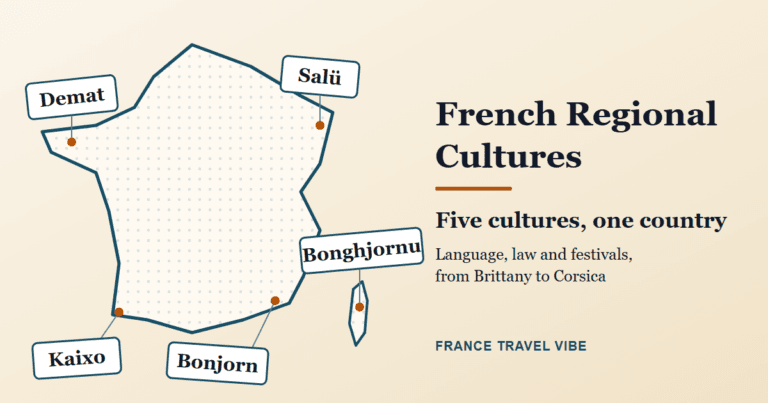
Brittany is Celtic, with its own music and a fest-noz on a Saturday night, while the Basque country next to Spain speaks a language unrelated to any other in Europe and plays a sport against a wall. Alsace keeps an Alemannic dialect, a Germanic kitchen and its own body of local law. Corsica sings in parts. Its polyphonic tradition silences a room, and its language is its own. Provence runs on Occitan place names, weekly markets and a wind with a name of its own, the mistral. How the five compare, from who still speaks the language to which one keeps its own public holidays, is in my guide to French regional cultures.
The quickest way I’ve found to earn goodwill in any of them is to notice. Order the local dish rather than the national one. Learn the local word for hello where there is one. Ask what’s in season. On one long stay in the west I was told, gently, that the cake I’d just praised was “not French, it’s Breton”. The distinction mattered to the person saying it, so it mattered to me.
Which region suits which trip is the job of my guide to the best places to visit in France. The Breton case gets its own treatment in my Brittany travel guide, including why the islands now cap visitors.
Where the History Shows Up on a Trip
On more buildings than you’d expect. In 2020, the Ministry of Culture counted 45,415 buildings protected as historic monuments in France, and 45% of them were privately owned (Ministry of Culture, Chiffres clés 2022, Monuments historiques). But the history that explains the manners is smaller and closer than the châteaux.
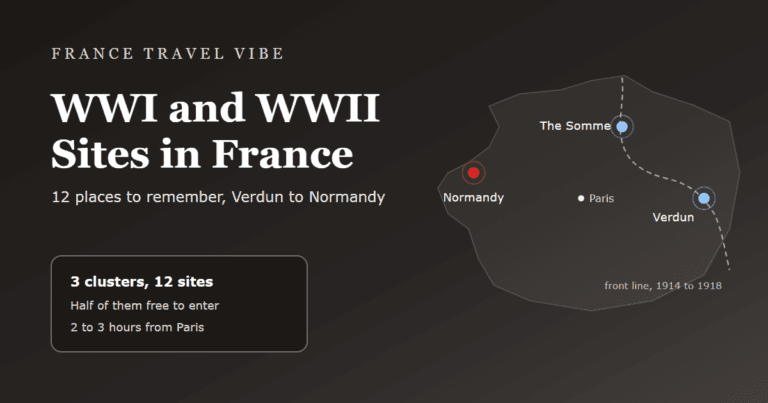
Look at the town hall. The letters “RF” over the door, the bust of Marianne inside and the tricolour outside are the Revolution, still on duty. Three of the eleven public holidays are national-memory days: July 14 for the Revolution, November 11 for the 1918 armistice, May 8 for the 1945 victory. And almost every commune in France, down to the smallest, keeps a war memorial with the names of its dead from 1914 to 1918. Stand in front of one in a village of 300 people and count. The battlefields behind those names are in my guide to WWI and WWII sites in France. It explains a great deal about why the French guard their quiet Sundays and their long lunches.
The Revolution also left its vocabulary. “Citoyen” is still the Republic’s word for its members: it is what new nationals are called at the citizenship ceremony, and what every young French person is for a day at the Journée défense et citoyenneté. “Égalité” and “fraternité” are working legal principles rather than slogans.
Laïcité as a word came a century later, but its root is the 1789 Declaration’s line that no one may be troubled for their opinions, “even religious”, which is why a state school can’t hang a crucifix and a mairie wedding is the only one the state recognises. Even the metric system and the départements, the hundred or so administrative units whose numbers you’ll see on car number plates, are inventions of the 1790s.
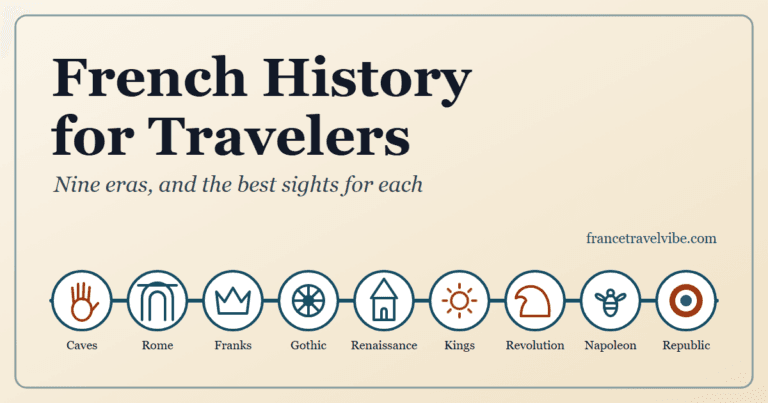
The deeper story, from the kings to the Republic, is a separate guide. So are the battlefields. For the Normandy coast specifically, my D-Day beaches tour comparison and my Normandy itinerary cover the ground, and my guide to Louvre tickets handles the museum that holds the rest.
How to Use This French Culture Guide
This French culture guide is the hub of a cluster, and the twelve rules above are the map. Each one has a deeper post behind it, and together they carry the 2 hours 22 minutes a day INSEE measured at the table (INSEE, Insee Première n°1417, 2012). Read the rules here, then go where your next worry is.
If your worry is the restaurant, the dining etiquette guide takes you from reservation to bill. If it’s the language, the phrasebook has the forty phrases that actually get used, and nothing you’ll never say. If it’s the food itself, the food guide names the twenty-five dishes worth knowing and the region each one belongs to.
If it’s dates, the holidays and festivals guide tells you what’s shut and what’s worth planning around. If it’s the regions, the regional cultures guide compares five of them. If it’s the past, the history primer and the war-sites guide explain what you’re looking at. And if you’ve got a trip booked for next month and just need the fifteen practical rules, the first-trip tips are the place to start.
For the experiences themselves, the markets, the tastings, the walks, the museums, my guide to the best things to do in France is the other hub this one talks to.
Frequently Asked Questions
What are the core values of French culture?
Liberté, égalité, fraternité is carved on the public buildings. In daily life the values look like formality in greetings, privacy about money, religion and politics, a strict line between work and the rest of life, and shared meal times. In 2010, INSEE found 48% of French adults eating at 13:00, the clearest measure of that shared rhythm.
How many kisses for la bise in France?
Usually two, one on each cheek, though parts of the south do three and parts of Brittany one. La bise is for friends and family, never for shopkeepers, waiters or hotel staff, and a handshake is right at work. In October 2021, Ifop found 65% of French people had gone back to it with close friends, against 91% before the pandemic.
Is France a religious country?
In law, no: the 1905 act separated church and state. In practice, less and less: in 2019 and 2020, 51% of people aged 18 to 59 told INSEE and Ined they had no religion, and only 8% of Catholics attend at least monthly. Churches are open and visited as heritage. Dress modestly and keep your voice down inside.
Why does everything in France close at lunch?
Because half the country is eating. INSEE’s time-use survey found 48% of French adults at the table at 13:00 and 92% eating between 11:00 and 15:00, for an average of 55 minutes. Shop and office staff are among them. Run errands in the morning or after 14:30, and expect a 15:00 reopening in the south.
Will strikes affect my trip to France?
Probably not. In 2024, DARES counted 62 strike days per 1,000 employees in private firms, down 64% on 2023, and only 1.6% of companies saw a strike. Transport is the exposed sector, and the rail operator publishes which trains will run the day before; my guide to getting around France explains how. Check the evening before a long journey.
The Bottom Line
France isn’t slow, rude or closed. It’s synchronised, formal and written down, and once you’ve seen the system the manners stop looking like a test. Three of the twelve rules do most of the work on day one:
- Move with the clock. Lunch at one, dinner at eight, errands in the morning, bread before the Sunday one o’clock close.
- Bonjour first, vous by default. The greeting opens the exchange, and the formality is the courtesy.
- The price is the price. Service is in it by law; a tip is rounding up, not a wage.
For the fifteen practical first-trip rules, read what I wish I’d known on my first trip. Keep this French culture guide as the map for the cluster. For everything else, my complete France travel guide is where it plugs into the rest of the site.