
Last verified: October 19, 2026. I re-checked the Riquewihr parking bands, the Kut’zig fare and the train times on this Alsace wine route guide on the date above, against the commune, the operator and SNCF’s own pages. The other fares and admissions were checked against the body that sets them in August, and I re-check this page monthly.
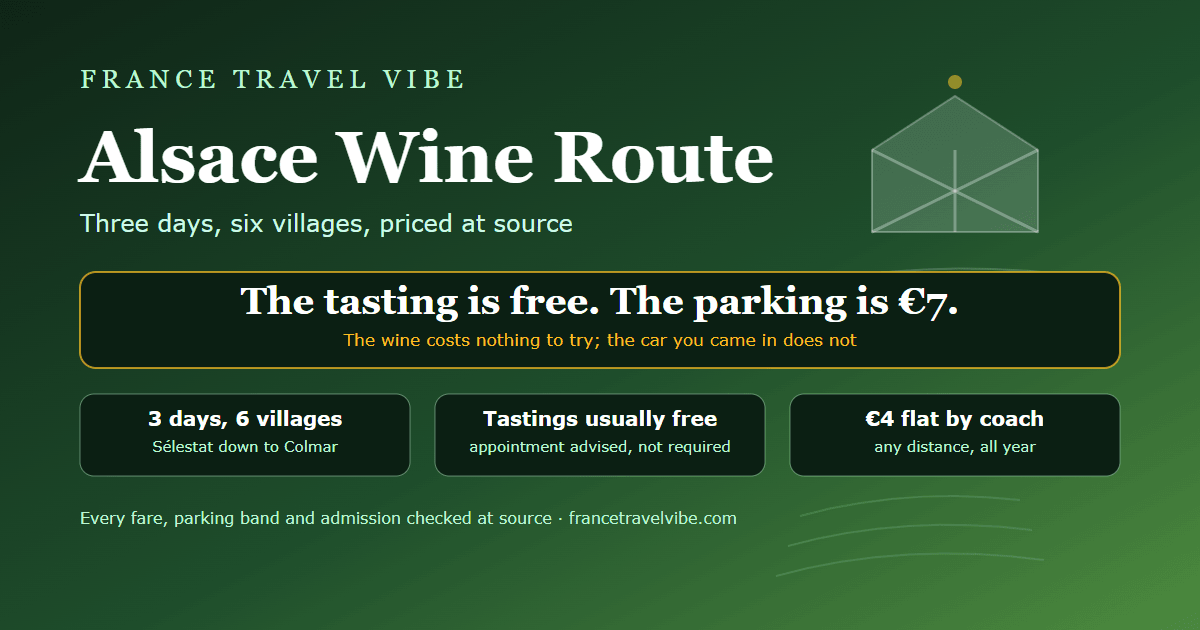
A regional coach through the Alsace vineyard costs a flat four euros this year. Any distance, one price (TER Grand Est, 2026). Four hours of parking in Riquewihr costs seven (Commune de Riquewihr, 2026).
Hold those two numbers next to each other, because almost every Alsace wine route guide hands you eight villages and a rental car without mentioning either one. Nor do they mention the thing that makes Alsace different from Bordeaux or Champagne: here, the tasting is usually free. For the three big-name regions compared, where nothing is, there’s a separate guide.
Disclosure: Some links in this guide may earn us a commission, at no extra cost to you. It never changes what we recommend.
So here’s a three-day Alsace wine route built around what things actually cost, which villages a bus can reach, and the harvest that quietly moved to August.
Key Takeaways
- Three days and six villages is the honest shape of the Alsace wine route. The road runs more than 170 km through nearly 119 wine communes, and driving all of it is a mistake (Route des Vins d’Alsace, 2026).
- Cellar tastings here are usually free, with an appointment recommended rather than required (Pays de Ribeauvillé et Riquewihr, 2026).
- This is the one French wine region you can do properly without a car. A Fluo coach is €4 flat, and the Kut’zig open-top bus links six wine villages from Colmar for €32 a day.
- That matters more than money: France’s drink-drive limit is 0.5 g/L, and 0.2 g/L for anyone licensed under three years (Service Public, 2026).
- The 2026 harvest opened 18 August, the third year running that picking has started in August (Association des Viticulteurs d’Alsace, 2026).
Table of Contents
How Many Days Do You Need for the Alsace Wine Route?
Three. One for a city, two for the vineyard. The full Alsace wine route runs more than 170 km from Marlenheim to Thann through nearly 119 wine-growing communes, past 51 grands crus and more than 720 producers, and it has been an official tourist route since 1953 (Route des Vins d’Alsace, 2026). Driving the whole thing is a way to see a road.
The stretch that earns your time is much shorter. Roughly 40 km between Sélestat and Colmar holds the villages everyone comes for, and it is also the part with the best transport. Everything north of Barr is a different, quieter trip, and everything south of Rouffach is mostly for people who live there.
Six villages is my ceiling. I’ve tried seven, and the seventh is always the one that turns a good day into a blur of half-timbering. Two villages a day, three if one of them is a walk-through, is the pace that lets you actually sit down in a cellar.
Getting here is the easy part. Strasbourg is 1 hour 45 minutes from Paris on the fastest TGV (SNCF Connect, 2026), the best ratio of travel time to genuine difference anywhere in France, which is why it lands sixth in my ranking of the best places to visit in France. Colmar is another 32 minutes down the line (TER Grand Est, 2026). How different, in language and law as well as food, is the subject of my comparison of French regional cultures.
Fitting three days into a longer trip? My France itinerary comparison covers how a second region changes a ten-day plan, and the complete France travel guide has the broader planning frame.
Can You Do the Alsace Wine Route Without a Car?
Yes, and this is the only major French wine region where that’s genuinely true. A Fluo regional coach costs a flat €4 whatever the distance, and the ticket stays valid four hours after you buy it (TER Grand Est, 2026). One ticket covers the Fluo networks of nine departments, Haut-Rhin among them, which is where this trip spends its time. An annual Fluo card, which also halves TER fares, costs €30, or €10 under 26 (Fluo Grand Est, 2026).
Here’s the part that surprised me. In Alsace the railway runs through the vineyard, not past it. From Strasbourg the line stops at Molsheim, Rosheim, Obernai and Barr before Sélestat, and from Sélestat it reaches Dambach-la-Ville. Colmar connects to Turckheim, and a tram-train runs Mulhouse to Thann (Alsace Wine Route, 2026). Those are wine villages with platforms in them.
Then there’s the Kut’zig, an open-top bus that exists purely to solve this problem. It runs from 3 April to 11 October 2026, Friday to Sunday and public holidays in April, May, June and October, then Tuesday to Sunday in July, August and September. Six departures leave Colmar Gare at 8:30, 10:15, 12:00, 13:45, 15:30 and 17:15, roughly 1h45 apart, and a hop-on hop-off day costs from €32 with reservation required (Kut’zig, 2026).
Now the caveat, because a section like this is worthless without one. Fluo lines 68R016 (Colmar to Riquewihr to Ribeauvillé) and 68R017 (Colmar to Ribeauvillé to Saint-Hippolyte) both serve the villages, but a line that exists is not a line that runs usefully. Pull the actual timetable sheet for your date before you build a day around one, and check Sunday and holiday service specifically. I couldn’t verify the frequencies sheet by sheet, so I won’t tell you they’re convenient.
My guide to getting around France covers the national picture, and what a France trip costs per day puts these fares in context.
What Does It Cost to Park in an Alsace Wine Village?
In Riquewihr, €4 for the first hour and €7 for four, charged seven days a week from 9am to 7pm at the Parking du Vignoble. Seven hours costs €9, and failing to pay triggers a €40 post-parking charge (Commune de Riquewihr, 2026). Camping-cars pay €10 overnight and €20 in the daytime.
Why so structured? Riquewihr is a walled village of roughly a thousand residents absorbing national-monument volumes of visitors, and the centre is closed to traffic. The car park is the valve.
Now put the same day side by side. Take Haut-Koenigsbourg, the castle above Sélestat that most itineraries bolt on. By car you pay €12 to get in and you park. By bus you pay €3 each way on line 500 from Sélestat station, and that ticket earns you the reduced €6 admission (Château du Haut-Koenigsbourg, 2026). Six euros of bus plus six of entry is the same €12 the driver pays for admission alone.
One more thing about the car, and it’s specific to where you rent it. Strasbourg runs a low-emission zone, and it survived the attempt to scrap it: parliament voted to abolish France’s ZFEs on 15 April 2026, and the Conseil constitutionnel annulled that vote on 21 May on procedural grounds (Connexion France, 2026). Strasbourg, Schiltigheim, Ostwald and Holtzheim intend to ban Crit’Air 2 vehicles from 2028 (Strasbourg.eu, 2026). Colmar has no such zone, which is one more reason to collect a car there instead.
Six Villages, and How Long Each One Holds You
The Kut’zig picks the six for you, and its route is a better Alsace wine route shortlist than most published ones: Ribeauvillé, Hunawihr, Riquewihr, Kaysersberg, Turckheim and Eguisheim, all within 90 minutes of Colmar Gare (Kut’zig, 2026). Every one is reachable without a car, which is not true of any other shortlist you’ll find.
The route really splits in two. North of Sélestat the villages have their own railway platforms; south of it they don’t, and the bus takes over. Here’s the whole thing in one table, which is the version I wish someone had handed me.
| Village | Own railway station | Kut’zig from Colmar | How long it holds you |
|---|---|---|---|
| Obernai | Yes, Strasbourg line | Not served | Half a day |
| Barr | Yes, Strasbourg line | Not served | 2 hours |
| Dambach-la-Ville | Yes, Sélestat line | Not served | 2 hours |
| Ribeauvillé | No, Sélestat then bus | 35 min | Half a day |
| Hunawihr | No | Between Ribeauvillé and Riquewihr | 20 minutes |
| Riquewihr | No | 55 min | Half a day |
| Kaysersberg | No | 70 min | Half a day |
| Turckheim | Yes, from Colmar | 80 min | 2 hours |
| Eguisheim | No | 90 min | 2 hours |
Rail stops and journey times come from the route’s own transport pages and the Kut’zig timetable (Alsace Wine Route and Kut’zig, 2026). The last column is my judgment, not theirs.
Eguisheim is built in concentric rings, so you walk it in circles rather than up and down one street. Give it two hours. Riquewihr is the one everyone means when they picture Alsace, and it is also the one that punishes a late arrival. I go before nine or after five. In the middle of a July day its main street is a corridor of people.
Kaysersberg has a ruined castle on the hill above it and, more usefully, it is still a working town rather than a display case. Half a day if you walk up. Ribeauvillé is the practical one, with actual shops and services, which makes it the best base if you want to sleep on the route instead of in a city.
Turckheim sits on a train line from Colmar, which makes it the easiest evening trip of the six. Hunawihr is small enough to be a stop rather than a visit, twenty minutes for the fortified church and the view across the vines, and that’s fine. Not every village needs half a day.
Two a day, three at a push. That’s the honest pace, and it holds whether you drive or ride. For when to come, my month-by-month guide to the best time to visit France covers the national picture.
Strasbourg or Colmar: Which Base Wins?
Colmar, for a three-day trip. It sits in the middle of the half of the route worth your time, it’s where the coaches and the Kut’zig start, and it has no low-emission zone to think about. The two cities are 32 minutes apart with 34 return trips a day (TER Grand Est, 2026), so the choice costs you very little either way.
Strasbourg wins if you want a city first and a vineyard second. It’s the bigger place, it has the cathedral and the European institutions, and it’s the one with the direct 1h45 run from Paris. But you’ll spend an hour of each day getting to the villages and back.
The split option works too: two nights in Colmar and one in Strasbourg, moving on your last morning. Whichever you pick, budget for the nightly tourist tax on your room, which every French commune sets for itself. My guide to France’s tourist taxes explains how the bands work.
December is the exception that breaks all of this. Colmar’s Christmas market runs 23 November to 29 December 2026, and Strasbourg sets its dates each autumn; in 2025 it ran 26 November to 24 December. Both cities sell out months ahead, and the whole calculation changes. That trip has its own guide to the Alsace Christmas markets.
The Tasting Is Free. The Driving Is the Problem.
Here’s the thing no tour-selling page will tell you: in Alsace, cellar tastings are “la plupart du temps gratuites”, most of the time free, with an appointment recommended rather than required (Pays de Ribeauvillé et Riquewihr, 2026). Walk into a family domaine on a weekday morning and someone will open bottles for you. A representative estate keeps its tasting room open Monday to Saturday, 9 to 12 and 14 to 18, and only asks you to book for groups of eight or more.
Compare that with the paid cellar visits sold online for Eguisheim, and you can see why the tour sellers are so keen for you to book something.
There’s one time of year when “just drop in” fails, and I learned it the hard way. During the harvest the family is in the vineyard, not the tasting room. The tourist office says it plainly: vignerons are “moins disponibles dans leurs caves” when picking starts. I once walked a village full of cellar signs at three on a Tuesday afternoon and found every door shut. Call ahead in late August and September, or accept that the day is about the vines rather than the wine.
Now the part that actually constrains this trip. The route is built around a car, the product is alcohol, and a proper visit runs thirty minutes to an hour across several wines. France’s limit is 0.5 g/L of blood, and 0.2 g/L for anyone who has held a licence for under three years. Between 0.5 and 0.8 it’s a €135 fine and six points; above 0.8 it becomes a criminal offence carrying up to €4,500 and two years (Service Public, 2026).
Read that limit again and the €4 coach stops looking like the budget option. It’s the option that lets you drink the wine you came for. If you do drive, the spit bucket is not rude here, it’s what professionals do all day. My honest France safety guide covers roadside checks and driving rules in more detail.
What about the wine itself? Alsace labels by grape rather than by château, which makes it the easiest French region to read. Riesling, Pinot Gris and Gewurztraminer are the three you’ll be offered most. Above them sit 51 grands crus, and a new Premier Cru tier is working its way through the INAO, with seven applications underway and yields capped at 57 hectolitres per hectare instead of 68 (Decanter, 2026). Labels will look different within a few years.
Comparing regions before you book? That’s a bigger question, and it gets its own guide.
The Harvest Moved to August. So When Should You Go?
The Alsace wine route is at its best in May, June, September and early October. And the harvest is no longer where the guidebooks put it. The Association des Viticulteurs d’Alsace announced the ban on 17 August 2026 and opened picking on 18 August for crémant, still wines and grands crus alike (ICI Alsace, 2026).
One day earlier than 2025 isn’t the story. The pattern is. Alsace has now started picking in the third week of August three years running, against a historic norm of mid-September into October. Book late September expecting to see the harvest and you’ll arrive after most of it. The 2026 crop is expected at about 804,000 hectolitres, the second smallest on record after 785,000 in 2021, and the third short year in a row.
So what does a working harvest mean for a visitor? Tractors in the lanes, tasting rooms with the shutter half down, and villages busy with work rather than with tourism. Some people love it. Just know which one you booked.
May and June give you full vines, open cellars and the Kut’zig running weekends. Early October gives you colour and the calm after picking. What to bring is another question, and my seasonal packing list for France has the layers this valley needs.
The 3-Day Alsace Wine Route, Day by Day
Day one, Colmar and Eguisheim on foot. Day two, the central villages. Day three, north to the castle, or on to Strasbourg. That order works whether or not you rent anything, and it hangs on one number: the first Kut’zig leaves Colmar Gare at 8:30, and the next isn’t until 10:15 (Kut’zig, 2026). Miss it and you’ve lost the quiet hour.
Day one. Colmar in the morning, then Eguisheim in the afternoon: it’s the closest of the six and the easiest to reach. Anchor: the old town. Alternative if it rains: Colmar’s museums. If you only have two days, this is the day to compress.
Day two. Riquewihr early, Ribeauvillé after lunch, Hunawihr in between if the timing works. Driving, that’s €7 to park in Riquewihr and another band in Ribeauvillé. On the Kut’zig, it’s one €32 ticket and a schedule to respect. Take the 8:30 from Colmar Gare and you’re in Riquewihr before the coaches.
Day three. Sélestat by train, then the line 500 shuttle up to Haut-Koenigsbourg, €3 each way with the reduced €6 admission attached. Or carry on north to Strasbourg. Cut this day first if you’re short, because the castle is the one part that isn’t about wine.
Prefer two wheels to four? The Véloroute du Vignoble d’Alsace runs 131.5 km from Marlenheim to Thann as the Alsace leg of EuroVelo 5 (France Vélo Tourisme, 2026). Three days is a comfortable pace for it.
Pairing Alsace with somewhere else? My Normandy itinerary and Provence itinerary are the two other regions that work as a short second stop, and my Paris guide covers the city most people put first. Weighing France’s two big wine cities instead? Lyon vs Bordeaux is that comparison.
Frequently Asked Questions
How many days do you need for the Alsace wine route?
Three. One for Colmar or Strasbourg, two for the villages. The full route runs more than 170 km through nearly 119 wine communes. The stretch worth your time is roughly 40 km between Sélestat and Colmar, and six villages is the honest ceiling before they blur together.
Can you do the Alsace wine route without a car?
Yes, and it’s the only French wine region where that’s genuinely true. A Fluo regional coach is a flat €4 in 2026. The railway from Strasbourg stops at Obernai, Barr and Dambach-la-Ville, and the Kut’zig open-top bus links six villages from Colmar for €32 a day between April and October.
What does it cost to park in an Alsace wine village?
In Riquewihr, €4 for one hour and €7 for four, charged 9am to 7pm every day at the Parking du Vignoble. Seven hours costs €9, and an unpaid stay becomes a €40 post-parking charge. Three villages in a day runs to about €20 in parking before you’ve tasted anything.
Are wine tastings free in Alsace?
Usually, yes, and it’s the biggest cost difference between the Alsace wine route and Bordeaux or Champagne. The Pays de Ribeauvillé et Riquewihr tourist office says cellar tastings are free most of the time, with an appointment recommended rather than required. Booking is normally only needed for groups of eight or more. During the harvest, call ahead, because the family will be out picking.
When is the grape harvest in Alsace?
Earlier than it used to be. The 2026 harvest opened on 18 August for crémant, still wines and grands crus, one day ahead of 2025’s record. That’s three years running that picking has started in August, against a historic norm of mid-September, so a late-September trip may arrive after it.
The Bottom Line
- The Alsace wine route works best as three days and six villages, two a day. The seventh village is the one that ruins the trip.
- The tasting is usually free. The paid prices you’ll see quoted come from people selling tours.
- €4 flat on a regional coach against €7 for four hours of parking, and a €6 shuttle ticket that halves the castle admission.
- Decide who is driving before the first pour. The limit is 0.5 g/L, and 0.2 g/L in your first three years of licence.
- The harvest now opens in August. Book late September for the vendanges and you’ll miss them.
Still choosing a region? My ranking of the best places to visit in France puts Alsace against eleven alternatives on crowds, cost and travel time. Already committed and fitting it into a longer trip? Start with the France itinerary comparison instead.