
Last verified: October 14, 2026. Figures checked against the Ministry of Culture’s monument register, its Patrimostat 2026 report and the Conseil constitutionnel.
In October 2026, France’s register of protected historic monuments held 46,761 records, and 5,119 of them began in the 12th century. That’s more than the whole 19th century, with 3,766 (Ministry of Culture, Immeubles protégés au titre des Monuments Historiques, data.gouv.fr, October 2026). Your trip to France is more medieval than anything else, even when the postcards say Versailles.
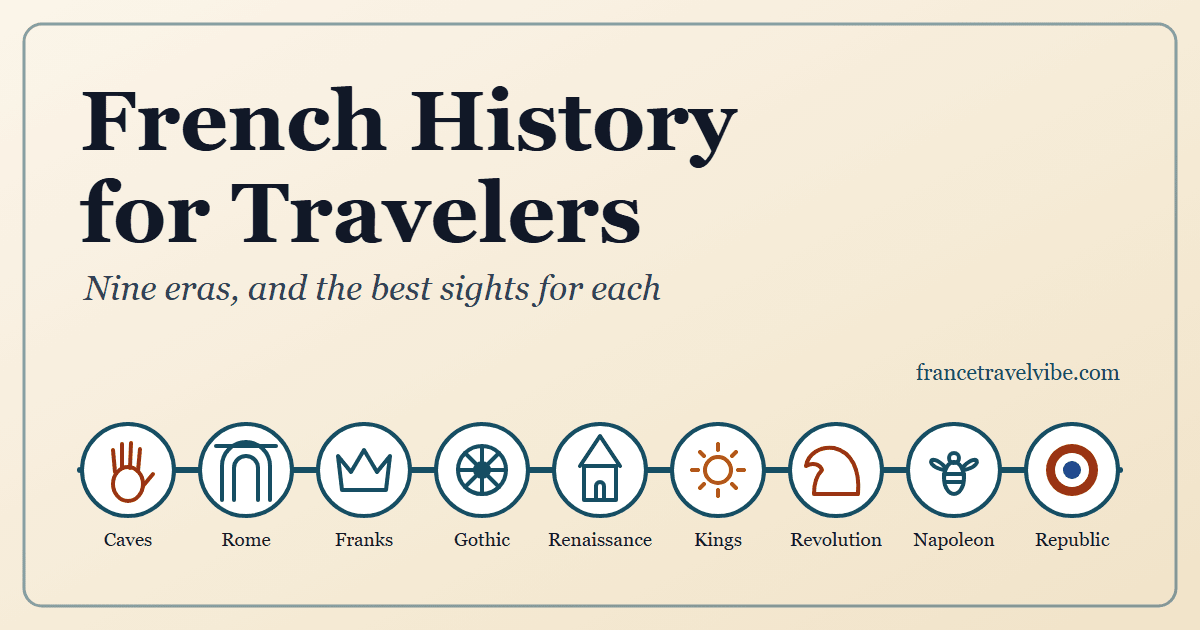
This is French history for travelers, and it doesn’t need a textbook. Most history books give you dates with no places, and most sightseeing lists give you places with no dates. So the Conciergerie, the Arc de Triomphe and the Panthéon blur into “old and grand”. This guide gives you nine eras, the one name to know in each, where to see it, and a one-day Paris walk that runs roughly in date order. For why the history explains the manners, start with my French culture guide.
Disclosure: Some links in this guide may earn us a commission, at no extra cost to you. It never changes what we recommend.
Key Takeaways
- You need nine eras, not a textbook. The Era Card has them on one screen.
- More of what you’ll visit is medieval than from any other era. The Middle Ages account for 38.9% of France’s dated protected monuments (Ministry of Culture register, 2026).
- The Revolution and Napoleon live mostly in Paris, where one walk covers 2,000 years.
Table of Contents
French History for Travelers in One Table
Three eras cover more than three-quarters of what you’ll see. In the Ministry of Culture’s register, the Middle Ages hold 38.9% of dated protected monuments, the 17th and 18th-century kings 25.0% and the Renaissance 13.5% (Ministry of Culture, Mérimée register, data.gouv.fr, October 2026). Learn those three well and the rest slots in around them.
The table below is French history for travelers at its most compact. Each row gives you the story in a line, the one name worth remembering, and three places to see it. The start and end years are conventions, not walls. Kings didn’t vanish in 1789, and Roman towns didn’t empty in 476.
The Era Card
| Era | Dates | The story in a line | Name to know | Where to see it |
|---|---|---|---|---|
| Prehistory | to about 800 BC | Cave painters, then farmers who raised standing stones | The Chauvet painters | Dordogne caves, Chauvet 2 replica, Carnac |
| Gaul and Rome | 52 BC to AD 476 | Caesar beats the Gauls, Rome builds cities | Vercingétorix | Pont du Gard, Nîmes, Arles |
| The Franks | 481 to 987 | A Germanic people take over and give France its name | Clovis | Saint-Denis basilica, Reims cathedral |
| Middle Ages | 987 to 1494 | Cathedrals, castles and a hundred years of war with England | Joan of Arc | Notre-Dame, Mont-Saint-Michel, Carcassonne |
| Renaissance | 1494 to 1598 | Kings bring Italy home and build on the Loire | François I | Chambord, Chenonceau, Fontainebleau |
| The Kings | 1598 to 1789 | Absolute monarchy, run from Versailles | Louis XIV | Versailles, the Invalides, Place Vendôme |
| The Revolution | 1789 to 1799 | The monarchy falls and the Republic is born | Robespierre | Conciergerie, Place de la Concorde, Panthéon |
| Napoleon | 1799 to 1815 | A general crowns himself and rewrites the law | Napoleon Bonaparte | Arc de Triomphe, Invalides tomb, Fontainebleau |
| Kings, emperors, republics | 1815 to 1958 | Regime after regime, a rebuilt Paris and two world wars | Charles de Gaulle | Haussmann’s boulevards, Eiffel Tower, Normandy beaches |
I pulled the full register to see where the weight falls, and the answer surprised me. Grouped by the century each record’s main building campaign began, the 16th century is the largest single column at 5,364 records. But the 12th century, at 5,119, beats the entire 19th, and the medieval stretch as a whole outweighs any later era.
A note on the method, because it matters. The register counts records, not buildings. A church begun in the 12th century and rebuilt in the 15th counts once, under the 12th. Some records are bridges, crosses or standing stones, and 7,060 have no century at all, so I’ve left them out.
What Did the Cave Painters and the Gauls Leave Behind?
The oldest art in France, and a defeat that made the country Roman. The paintings in the Chauvet cave are about 36,000 years old, “18,000 years older than Lascaux”, according to France’s Ministry of Culture (Ministry of Culture, Grotte Chauvet : retour sur la découverte). Then came the Gauls, whose chief Vercingétorix lost to Julius Caesar at Alésia in 52 BC.
You can’t enter Chauvet. The original was sealed to protect it, and visitors see a full-scale replica nearby in the Ardèche. Lascaux is the same story. Font-de-Gaume in the Dordogne is the last cave with original polychrome paintings you can still walk into, and the tickets are scarce, so plan with my Dordogne travel guide.
The register’s 1,825 prehistoric records are mostly something else: Neolithic dolmens and menhirs, thousands of years younger than the caves. The great field of them is in Brittany. In 2025, the megaliths of Carnac and the shores of Morbihan joined UNESCO’s World Heritage List, one of France’s 56 properties in 2026 (Ministry of Culture, Les biens français inscrits sur la Liste du patrimoine mondial).
For the Gauls themselves, the MuséoParc Alésia in Burgundy stands on the battlefield. Go knowing one thing: “our ancestors the Gauls” is mostly a 19th-century school story. Modern France owes far more to Rome.
Where Can You See Roman France?
In the south, and less often than you’d think. Only 1.8% of France’s dated protected monuments are Roman, about 700 records out of 39,701 (Ministry of Culture, Mérimée register, October 2026). The ones that survive are spectacular, though. The Pont du Gard, the arenas of Arles and Nîmes, and Orange’s theatre are among the best Roman buildings outside Italy.
Rome called this coast simply “the Province”, and the name stuck as Provence. Nîmes is the place to see the most in one walk: the arena, still used for events, and the Maison Carrée, a temple so complete it looks unreal. It joined the World Heritage List in 2023. My Provence itinerary strings Nîmes, Arles and the Pont du Gard into one loop.
Further north, Lyon was Lugdunum, capital of the Three Gauls. Its two theatres still sit on the Fourvière hill above the old town, which is one reason it wins the history round in my Lyon vs Bordeaux comparison.
Why does so little Roman building survive? Later builders reused the stone for churches and town walls. Paris was Lutetia, a modest town on the Left Bank. Two pieces of it survive. The Arènes de Lutèce, a 1st-century arena, is now a public garden. The baths under the Musée de Cluny date from around AD 200.
The first time I found the Arènes de Lutèce, a group of old men was playing pétanque in the middle of the arena floor. Nobody looked up. A Roman stage, a game of boules and a dog asleep in the stands: that’s Paris history, used rather than displayed.
Why Is France Named After the Franks?
Because the Franks, a Germanic people, took over Roman Gaul as the empire collapsed in the 5th century. Their king Clovis was baptised at Reims around 500, traditionally in 496, though many historians prefer 498 or 499 (Encyclopædia Universalis, Clovis Ier). His kingdom was Francia, and Francia became France.
The rest of the era is a chain of three names. Charlemagne was crowned emperor in 800. His grandsons split the empire at Verdun in 843, and the western third is the seed of France. Then, in 987, Hugh Capet became king and started a line that, through its Valois and Bourbon branches, ruled until 1848.
So what’s left to see? Very little. Only 215 dated records in the register come from the 6th to 10th centuries. The places to go are two churches. The basilica of Saint-Denis, on métro line 13, holds the tombs of the kings and is where Gothic architecture began in the 1140s. Reims cathedral is where most French kings were crowned.
Why Is France Covered in Medieval Churches and Castles?
Because between about 1000 and 1500, France built in stone on a scale nobody had seen since Rome. In October 2026, 15,446 of the register’s dated records began in the Middle Ages, 38.9%, more than any other era (Ministry of Culture, Mérimée register, October 2026). Every village church you photograph is part of that number.
The style shifted from thick-walled Romanesque to Gothic, with its pointed arches and tall windows. Notre-Dame was begun in 1163. The Sainte-Chapelle, built by Louis IX to hold relics, was consecrated in 1248. Chartres, Amiens and Reims are the other great cathedrals, and Mont-Saint-Michel puts an abbey on a rock in the sea, covered in my Normandy itinerary.
It was also an age of war. The Hundred Years’ War with England ran from 1337 to 1453. Joan of Arc broke the siege of Orléans in 1429 and was burned at Rouen in 1431. In the south, the kings crushed the Cathars and fortified the frontier. In 2026, UNESCO inscribed the royal Capetian fortresses of Languedoc, joining Carcassonne, listed since 1997. The popes, meanwhile, lived in Avignon from 1309 to 1377.
Notre-Dame is the medieval building most visitors will see. It reopened in December 2024 after the 2019 fire and received about 11 million visitors in its first year, according to the cathedral (The Local, via AFP, December 2025). Entry is free. For Chartres and the walled town of Provins, see my day trips from Paris.
I saw the Sainte-Chapelle’s upper chapel for the first time on a flat grey morning, and I’d braced to be disappointed. I wasn’t. Even with no sun, the windows hold the room in blue and red light. Go anyway on a dull day.
Why Did the Renaissance Kings Build on the Loire?
Because that’s where the court lived. In the register, 5,364 records begin in the 16th century, the largest single century of all (Ministry of Culture, Mérimée register, October 2026). The kings who fought in Italy from 1494 came home with Italian ideas, and in 1516 François I brought Leonardo da Vinci home too.
Leonardo spent his last three years at the Clos Lucé manor in Amboise and died there in 1519. That same year, work began on Chambord, the king’s enormous hunting château with its double spiral staircase. Chenonceau, built across the river Cher, was run for decades by two rival women, Diane de Poitiers and Catherine de’ Medici.
Why the Loire and not Paris? The valley was rich, central and good hunting country, and the kings trusted it. Paris had been in English hands during the Hundred Years’ War and stayed volatile. Fontainebleau, south of Paris, is the Renaissance palace you can reach by train.
The century ended in blood. The Wars of Religion set Catholics against Protestants, with the St Bartholomew’s Day massacre in Paris in 1572. The Edict of Nantes brought a fragile peace in 1598. For which châteaux to pick, and what they cost, use my Loire Valley châteaux guide. To sleep in one, try my château hotels guide.
How Did Louis XIV Turn Versailles Into a Government?
He moved the court and the government there in 1682 and kept the nobility under his eye. It still works on crowds: Versailles drew 8.4 million visitors in 2025, 6.3 million of them to the palace and the Trianon estate (News Tank Culture, citing the Château de Versailles, January 2026). A quarter of the dated records in the register, 9,944, began in the 17th or 18th century.
Why leave Paris at all? Louis XIV, the Sun King, had seen the city rise against the crown in his childhood, and he reigned for 72 years without forgetting it. He turned a hunting lodge into a palace where a duke’s status depended on who handed the king his shirt. The idea was absolute monarchy: one king, no rival power. Versailles was its stage set.
In Paris, the same era built the Invalides for wounded soldiers in the 1670s, and the grand squares of Place Vendôme and Place des Victoires. The 18th century then gave the city its Enlightenment cafés, where writers argued about reason, rights and kings. The Procope, open since 1686, still serves dinner.
The kings also left the Louvre. It began as Philippe Auguste’s fortress around 1190, became a palace, and was abandoned when the court left for Versailles. The Revolution opened it as a public museum in 1793. My Louvre tickets guide handles what it costs today, and my day trips from Paris covers getting to Versailles.
Where Can You Still Trace the French Revolution in Paris?
Mostly in places, not buildings. The Bastille was torn down from 1789, the guillotine stood on today’s Place de la Concorde, and Marie-Antoinette’s last prison, the Conciergerie, drew 775,000 visitors in 2025, up 27% (Ministry of Culture, Patrimostat 2026, p. 48). A reconstruction of her cell is part of the visit.
The crowd stormed the Bastille on 14 July 1789, and it’s now a traffic circle. What’s left is easy to miss. On the line 5 platform at Bastille métro, toward Bobigny, a stretch of the moat’s outer wall is exposed, and a steel strip in the floor traces where it ran (RATP, Histoire de la station Bastille). A few courses of one tower, found in 1899, were rebuilt in Square Henri-Galli nearby. What closes on 14 July today is in my guide to French public holidays.
Louis XVI was guillotined on what was then Place de la Révolution on 21 January 1793. I once stood there at dusk trying to picture the scaffold, and couldn’t: six lanes of traffic circle the obelisk on the same spot. The Panthéon, a church turned into a temple for the nation’s great figures, drew 1.1 million visitors, up 23%, in 2025 (Patrimostat 2026, p. 48).
Here’s what surprised me most: the Revolution destroyed far more than it built. It knocked down the Bastille, sold off abbeys for their stone and stripped churches of their statues. So you won’t find a “Revolution building” the way you find a Gothic cathedral. You find a square, a prison and a line in the floor of a métro station.
What the Revolution did leave on every town hall, from the tricolour to the word “citoyen”, is covered in my French culture guide.
The busiest CMN monuments, by era
| Monument | Era it shows | 2025 visitors | Change vs 2024 |
|---|---|---|---|
| Arc de Triomphe | Napoleon | 1.9 million | +5% |
| Mont-Saint-Michel abbey | Middle Ages | 1.6 million | +11% |
| Sainte-Chapelle | Middle Ages | 1.3 million | +12% |
| Panthéon | Kings and Revolution | 1.1 million | +23% |
| Conciergerie | Middle Ages and Revolution | 775,000 | +27% |
Source: Ministry of Culture, Patrimostat 2026, p. 48. These are the Centre des monuments nationaux’s sites only. Versailles, the Louvre and Notre-Dame are run separately.
What Did Napoleon Leave Behind?
A tomb, an arch and a legal system. He seized power in 1799, crowned himself emperor in Notre-Dame on 2 December 1804, and issued the Civil Code that still underpins French civil law. His Arc de Triomphe was the busiest of the Centre des monuments nationaux’s sites in 2025, with 1.9 million visitors, up 5% (Ministry of Culture, Patrimostat 2026, p. 48).
He ordered the Arc de Triomphe in 1806 to honour his armies, and it wasn’t finished until 1836, long after his fall. The Unknown Soldier of the First World War lies beneath it. Climb to the roof for the best view of Haussmann’s star of avenues.
His body came back from exile on St Helena in 1840. Since 1861 it has lain in a red stone tomb under the gilded dome of the Invalides, inside the Musée de l’Armée. At Fontainebleau, you can stand in the courtyard where he said goodbye to his guard in 1814. Waterloo, where it ended in 1815, is in Belgium.
The surprise with Napoleon is where you meet him: in the law as much as in marble. The Civil Code of 1804 set out property, contracts and family law for the whole country. It has been amended many times since, but it’s still the Code civil, the backbone of French private law.
For the rest of Napoleon’s Paris, and the passes that cover it, see my Paris travel guide.
Why Has France Had Five Republics?
Because between 1789 and 1958 France kept trying new systems and kept throwing them out. The Conseil constitutionnel lists 15 constitutional texts from 1791 to 1958, swinging between kings, two emperors and five republics (Conseil constitutionnel, Les Constitutions de la France). That’s why one Paris walk passes a royal palace, a revolutionary prison, an imperial arch and a republican Panthéon.
After Napoleon, the Bourbons came back in 1814, lost the throne in 1830, and Louis-Philippe’s July Monarchy fell in 1848. The Second Republic lasted four years before Napoleon’s nephew made himself Napoleon III. His Second Empire gave you the Paris you walk today: Baron Haussmann tore down medieval streets from 1853 for the boulevards and cream stone buildings.
Defeat by Prussia in 1870 ended the empire. Alsace and part of Lorraine were German until 1918, the story my French regional cultures guide tells for Alsace. In 1871, the Paris Commune rose and was crushed, and the Sacré-Cœur went up on Montmartre afterwards. The Third Republic built the Eiffel Tower for the 1889 World’s Fair and separated church and state in 1905.
The Third Republic collapsed in 1940 under German invasion, and Marshal Pétain’s Vichy regime governed until the Liberation. After a provisional government, the Fourth Republic lasted from 1946 to 1958. Then Charles de Gaulle returned, and the Fifth Republic’s constitution was promulgated on 4 October 1958. It’s still in force, and after 68 years it trails only the Third Republic’s 70 as France’s longest-lasting regime since the Revolution.
How Do the World Wars Show Up on a Trip?
Everywhere, quietly, and in three landscapes you can visit. UNESCO listed the First World War funerary and memorial sites of the Western Front in 2023 and the D-Day beaches in July 2026 (Ministry of Culture, Les biens français inscrits sur la Liste du patrimoine mondial). Verdun and the Somme are the first war. Normandy is the second.
Between them sits the occupation of 1940 to 1944, which left fewer monuments and more plaques. Look up at Paris walls and you’ll see small marble plates naming people shot during the Liberation in August 1944. My guide to WWI and WWII sites in France takes Verdun, the Somme and Normandy site by site.
For the beaches, my D-Day beaches tour comparison weighs guided tours against driving yourself, and my Normandy itinerary fits them into a week.
On a side street in the Latin Quarter, I once noticed the stone around a window was pocked with small craters. It took me a moment to realise they were bullet marks from 1944, left unrepaired on purpose. The plaque below gave a name and an age: nineteen.
How Do You Walk 2,000 Years of Paris in One Day?
Go roughly in date order, east to west along the Seine. My route covers about 9 km on foot and ten stops, from a 1st-century arena to the Eiffel Tower, then one métro ride to the Arc de Triomphe. Think of it as French history for travelers at walking pace. Four of the five busiest CMN monuments in the table above are on it, and Notre-Dame, the stop that drew about 11 million people in its first reopened year, is free.
Start early at the Arènes de Lutèce (stop 1) and walk to the Panthéon (2), then the Cluny baths (3). Geography beats chronology in a few places (here, at the Louvre, the Invalides and the Arc), but the walk still runs from Rome to the Republic. Cross to the Île de la Cité for Notre-Dame (4) and the Sainte-Chapelle and Conciergerie (5), which stand side by side in the old royal palace. Then follow the river to the Louvre’s Cour Carrée (6). Walk the courtyard to see the palace; save the museum for another day.
From there, the Tuileries lead to Place de la Concorde (7). Cross the Pont Alexandre III to the Invalides (8) for Napoleon’s tomb. Finish at the Eiffel Tower (9) at dusk, and ride métro line 6 from Bir-Hakeim to Charles de Gaulle–Étoile for the Arc de Triomphe (10).
Is it too much for one day? For most people, yes, if you go inside everything. Pick three interiors at most, usually Notre-Dame, the Sainte-Chapelle and one of the Panthéon or the Invalides, and see the rest from outside. Several of these sites close one day a week, so check before you set out.
Base yourself on the Left Bank and the walk starts at your door: my guide to where to stay in Paris recommends the 5th or 6th for exactly this. If your legs give out, my Seine river cruise guide is the sit-down version of the same 2,000 years.
Which Region Shows Which Era Best?
Match the era to the trip. Provence for Rome, the Dordogne for prehistory, Normandy and Burgundy for the Middle Ages, the Loire for the Renaissance, and Paris and Versailles for the kings, the Revolution and Napoleon. Even a theme park counts: Puy du Fou, a history park in the Vendée, passed 3 million visitors in 2025 for the first time (France 24, via AFP, October 2025).
For Rome, base in Nîmes or Arles, with my Provence itinerary. For prehistory, the Vézère valley in the Dordogne is unmatched. For the Middle Ages, Normandy has Mont-Saint-Michel and Rouen, and Burgundy has the abbeys. For the Renaissance, nothing beats the Loire. For the kings, the Revolution and Napoleon, stay in Paris and add Versailles and Fontainebleau. For the world wars, it’s Normandy, Verdun and the Somme.
If you want the regions ranked as trips rather than eras, my best places to visit in France does that, and my guide to things to do in France covers Puy du Fou alongside the big museums.
Frequently Asked Questions
What are the main periods of French history?
French history for travelers comes down to nine periods: prehistory, Gaul and Rome, the Franks, the Middle Ages, the Renaissance, the kings of the 17th and 18th centuries, the Revolution, Napoleon, and the kings, emperors and republics from 1815 to 1958. The Middle Ages matter most on the ground, with 38.9% of France’s dated protected monuments.
Why is France called France?
France is named after the Franks, a Germanic people who took over Roman Gaul in the 5th century. Their king Clovis ruled most of it by around 500, and his kingdom was called Francia. Hugh Capet, crowned in 987, started the royal line that ruled France, through its branches, until 1848.
How many republics has France had?
Five. The current Fifth Republic dates from the constitution of 4 October 1958, which Charles de Gaulle shaped. The Conseil constitutionnel lists 15 constitutional texts between 1791 and 1958, as France switched between monarchy, empire and republic. The 1793 constitution was approved but never applied.
What is the oldest site you can visit in France?
The decorated caves. Chauvet’s paintings, in the Ardèche, are about 36,000 years old, but the original cave is closed, so visitors see a full-scale replica. In the Dordogne, Font-de-Gaume still lets small groups into an original painted cave, and my Dordogne travel guide explains how to get tickets.
Is there anything left of the Bastille?
Very little. On the line 5 platform at Bastille métro, part of the moat’s outer wall is exposed, with a steel strip in the floor tracing its line. A few courses of a tower, found in 1899, were rebuilt in Square Henri-Galli. The July Column on the square commemorates the 1830 revolution, not 1789.
The Bottom Line
French history for travelers comes down to knowing which era you’re standing in:
- Nine eras cover everything you’ll see, and the Era Card puts them on one screen.
- Your trip leans medieval. The 12th century alone holds more protected monuments than the whole 19th.
- The Revolution is places, not buildings: a square, a prison, a line in a métro station.
- Paris, roughly in date order, fits in a day, if you pick three interiors and walk past the rest.
Pick the era you’re most curious about and build your trip around its region. Then go back to my French culture guide for how that history shapes daily life, and to my French regional cultures guide for the places where it took a different turn.