
Last verified: October 11, 2026. Figures checked against Eurostat, the European Commission, service-public.fr and EF’s 2025 France fact sheet.
French is now the fourth most-spoken language in the world, with 396 million speakers on the 2026 count (French foreign ministry, March 2026). France had 102 million international visitors in 2025 (Atout France, Bilan 2025, February 2026). Hardly any of them needed more than forty phrases of it.
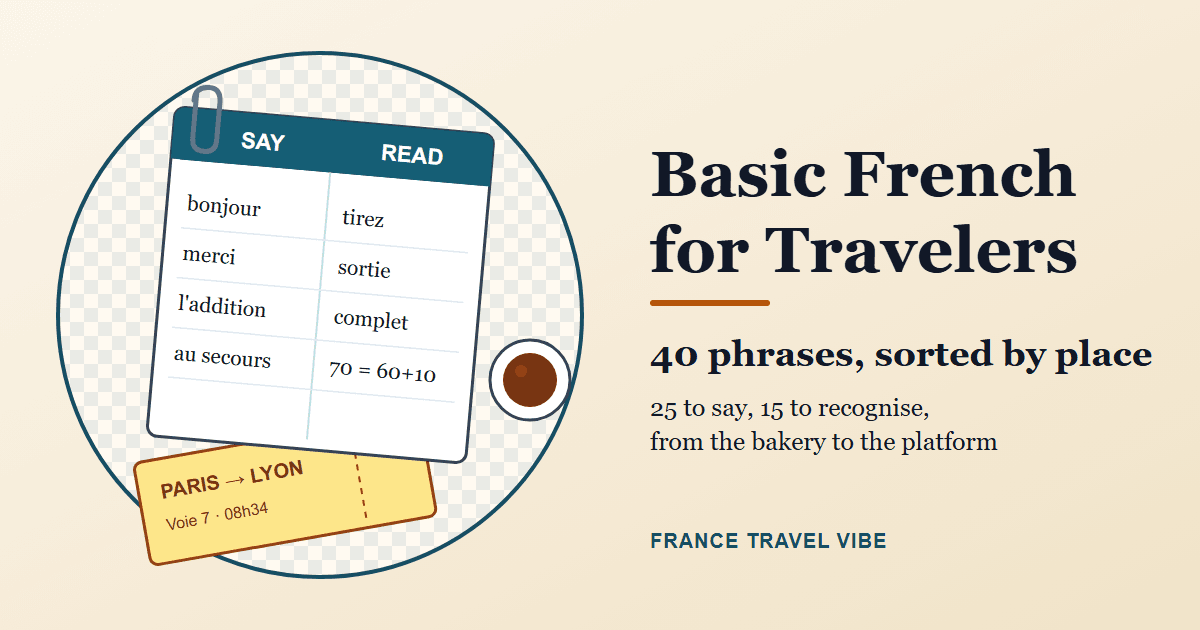
Most phrase lists run from a dozen to over a hundred entries, sorted by grammar. This basic French for travelers guide is sorted by place instead: the bakery, the train, the pharmacy, the emergency. It splits the forty into 25 phrases to say and 15 to recognise, because you’ll hear far more French than you’ll ever speak. For why starting in French matters more than speaking it well, read my French culture guide first.
Disclosure: Some links in this guide may earn us a commission, at no extra cost to you. It never changes what we recommend.
Key Takeaways
- Basic French for travelers means 25 phrases to say and 15 to recognise, not fluent French. The full list is in the 40 Card at the end.
- French test-takers read English far better than they speak it: 555 for reading, 456 for speaking (EF English Proficiency Index 2025, an online test rather than a population survey). If words fail, show your screen.
- Learn the numbers 70 to 99, the door signs and two emergency phrases.
Table of Contents
Do People in France Speak English?
Many do, but unevenly. In the European Commission’s 2024 survey, 40% of people in France said they could hold a conversation in English, against 47% across the EU (European Commission, Special Eurobarometer 540, Europeans and their languages, France factsheet, 2024). So expect English in hotels and big museums. Don’t count on it at a village bakery.
Eurostat’s adult survey tells the same story from another angle. In 2022, 22.6% of French adults aged 25 to 64 knew no foreign language at all. That’s a little better than the EU average of 25.3%, and far behind Germany and the Netherlands (Eurostat, Adult Education Survey, edat_aes_l22, 2022).
Age matters a lot. Only 13.1% of French 18 to 24 year olds know no foreign language, against 32.4% of 55 to 64 year olds (Eurostat, 2022). The student at the museum desk will switch to English happily. The owner of the village épicerie may not be able to.
Knowing a language is also a low bar. Of the French adults who know one, half (50.5%) rate themselves only “basic” in their best foreign language, against 40.5% across the EU (Eurostat, edat_aes_l31, 2022). That gap is where your forty phrases come in.
Why Should You Show Your Screen Instead of Repeating Yourself?
Because French adults read English much better than they speak it. On EF’s 2025 France fact sheet, French test-takers scored 555 in reading, 524 in listening, 500 in writing and only 456 in speaking, the one skill in EF’s “low” band (EF, English Proficiency Index 2025, France fact sheet, 2025). EF’s sample is people who chose to take its online test, so treat it as a pattern, not a population rate.
So speaking is the weak skill on both sides of the counter. Your French is shaky, and the spoken part of their English is the shakiest part of it. Both of you read better than you talk. That’s why pointing, writing a number on paper and turning your phone round work so well in France.
My routine is simple. I try the phrase once. If it lands, great. If I get a blank look, I type the sentence into a translation app and show the screen. When the answer is a number or an address, I ask “Vous pouvez l’écrire ?” (phrase 25, can you write it down?). Download the offline French pack before you fly, because the signal drops on trains and in old stone buildings. My eSIM guide for France covers the data side.
The 8 Phrases That Open and Close Every Conversation
Eight phrases do most of the work on any trip, and you’ll use the first and fifth in every single shop. Start with these, and add Monsieur or Madame after the first one: “Bonjour, Madame” sounds warmer than bonjour alone.
| # | French | Say it like | When |
|---|---|---|---|
| 1 | Bonjour | bohn-ZHOOR | Walking into any shop, café, bakery or lift |
| 2 | Bonsoir | bohn-SWAHR | The same, once it’s dark |
| 3 | S’il vous plaît | seel voo PLAY | After every request |
| 4 | Merci | mair-SEE | Every time someone hands you anything |
| 5 | Au revoir | oh ruh-VWAHR | Leaving, always |
| 6 | Excusez-moi | ex-kew-zay-MWAH | To get someone’s attention |
| 7 | Pardon | par-DOHN | To get past, or “sorry?” |
| 8 | Parlez-vous anglais ? | par-lay voo zahn-GLAY | Only after bonjour |
Bonjour becomes bonsoir at no fixed hour. Phrase books say 5pm, 6pm or nightfall, and no rule sets one. I switch once it’s dark or around dinner time, and nobody has ever minded a late bonjour. The greeting itself is the rule that matters, and my first-time-in-France tips explain why it changes the whole exchange.
Excusez-moi and pardon aren’t interchangeable. Use excusez-moi to stop a passer-by and ask directions. Use pardon to squeeze past on the Métro, or as a one-word “sorry, what?” when you didn’t catch something.
How Do You Buy Something in a Shop or Bakery?
Greet, name the thing, add s’il vous plaît, then listen for four questions. In 2024, card overtook cash at French tills for the first time (Banque de France, Bulletin 256, February 2025), so paying is rarely the problem. Understanding the cashier is.
Four phrases to say:
- 9. Je voudrais… (zhuh voo-DRAY), I’d like. “Je voudrais une baguette, s’il vous plaît.”
- 10. C’est combien ? (say kohm-BYAN), how much is it?
- 11. Je regarde, merci (zhuh ruh-gard mair-SEE), I’m just looking. It ends the “can I help you?” politely.
- 12. Je peux payer par carte ? (zhuh puh pay-YAY par KART), can I pay by card?
Four questions to recognise:
- 26. Et avec ceci ? (ay ah-vek suh-SEE), anything else? Answer “c’est tout, merci”.
- 27. Ce sera tout ? (suh suh-rah TOO), will that be all?
- 28. Sans contact ? (sahn kohn-TAKT), contactless? Just nod and tap.
- 29. Vous avez la carte ? (voo za-VAY la KART), do you have our loyalty card? It means the store’s own card, and “Non, merci” is the answer.
The loyalty-card question caught me for years. I’d hear “la carte”, produce my bank card, and get a patient smile from the cashier. In supermarkets and chain stores it almost always means the store card.
How Do You Understand Prices and Numbers in French?
Learn one to twenty, the tens, and three odd numbers. Seventy is soixante-dix, “sixty-ten”. Eighty is quatre-vingts, “four twenties”. Ninety is quatre-vingt-dix, “four twenties and ten”. Add cent (100) and that covers almost every price you’ll hear in France. Belgium and Switzerland say septante and nonante, but you won’t hear those in France.
The three to recognise:
- 30. Soixante-dix (swa-sahnt-DEESS), 70
- 31. Quatre-vingts (kat-ruh-VAN), 80
- 32. Quatre-vingt-dix (kat-ruh-van-DEESS), 90
At a market stall I once heard “quatre euros soixante-dix” for a wedge of cheese, stopped listening at “soixante” and counted out €4.60. The stallholder smiled and wrote 4,70 on the paper wrap, which is the screen trick in reverse.
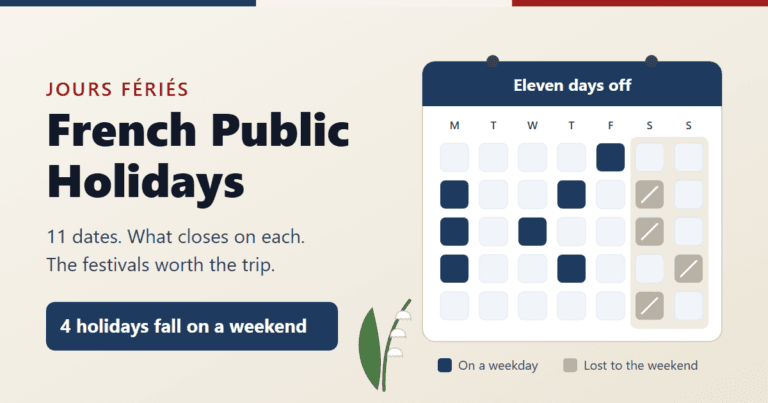
Two more habits help. Prices are written with a comma and the euro sign after: 12,50 € is “douze euros cinquante”. Times run on the 24-hour clock, so a sign reading “fermé de 12h30 à 14h” means the shop closes at 12:30 and reopens at 2pm. Listen hard for deux (2, “duh”) against douze (12, “dooz”): only douze ends in a z sound. A door reading “fermé les jours fériés” means closed on public holidays, and my guide to French public holidays lists which days those are.
What Do You Need at a Café or Restaurant?
Three phrases cover a café table, and a fourth comes from the shop list. French law requires restaurants with table service to serve free tap water with a meal (DGCCRF, Transition écologique, October 2025). Asking for a carafe is a perfectly normal request.
- 13. Une table pour deux, s’il vous plaît (ewn tah-bluh poor DUH), a table for two.
- 14. Une carafe d’eau, s’il vous plaît (ewn ka-RAHF DOH), a jug of tap water.
- 15. L’addition, s’il vous plaît (la-dee-SYOHN), the bill. It won’t come until you ask.
Order with “je voudrais” (phrase 9) and you’re set. Ordering course by course, steak doneness, allergies and the bill all have their own rules, and my French dining etiquette guide walks through them in the order a meal happens. For what’s actually on the board outside, my French food guide names the dishes worth ordering.
Which French Phrases Get You Around on Trains and Streets?
Three phrases and a handful of signs will get you through any station. France’s 1994 loi Toubon requires French on any sign in a public place or on public transport, and public bodies that translate must offer at least two languages (Légifrance, loi n° 94-665, articles 3 and 4, 1994). The French is always there. The English sometimes is. My French culture guide explains what else the loi Toubon covers.
- 16. Où est… ? (oo AY), where is…? “Où est la gare ?” Add “à gauche” (left), “à droite” (right) and “tout droit” (straight on) to follow the answer.
- 17. Un billet pour…, s’il vous plaît (uhn bee-YAY poor), a ticket to…
- 18. C’est quel quai ? (say kel KAY), which platform?
The signs below are the read-only half of the trip. I put this decoder together from the words that have actually stopped me in stations, car parks and doorways.
| # | Sign | Say it like | Means | Where you’ll see it |
|---|---|---|---|---|
| 33 | Tirez / Poussez | tee-RAY / poo-SAY | Pull / Push | Every shop and café door |
| 34 | Sortie | sor-TEE | Exit | Stations, motorways, museums |
| 35 | Fermé / Ouvert | fair-MAY / oo-VAIR | Closed / Open | Shop doors, with the hours below |
| 36 | Complet | kohm-PLAY | Full, sold out | Hotels, car parks, trains |
| 37 | Interdit | an-tair-DEE | Forbidden | “Accès interdit”, “interdit de fumer” |
| 38 | Quai / Voie | KAY / VWAH | Platform / Track | Departure boards |
| 39 | Retard / Supprimé | ruh-TAR / sew-pree-MAY | Delayed / Cancelled | Departure boards |
| 40 | Toilettes | twa-LET | Toilets (also “WC”) | Everywhere; cafés keep them for customers |
Supprimé is the one to learn before you travel. It means the train isn’t coming, and it’s usually your cue to find the next one on the board. For the trains themselves, the passes and the driving, my guide to getting around France has the logistics.
What Do You Say at a Hotel or Pharmacy?
At the hotel desk you need one sentence, and at the pharmacy two. Pharmacies are where a lot of travellers’ French gets tested, because you have to describe what’s wrong with you. Point anyway. French pharmacists give health advice as part of the job, and pointing at the problem is a perfectly good start.
- 19. J’ai une réservation au nom de… (zhay ewn ray-zair-va-syohn oh NOHM duh), I have a booking under the name…
- 20. J’ai mal à la tête (zhay mal ah la TET), I have a headache. Swap the end: “à la gorge” (throat), “au ventre” (stomach), “au dos” (back).
- 21. Je suis allergique à… (zhuh swee za-lair-ZHEEK ah), I’m allergic to…
The first time I needed a pharmacy in France, I pointed at my throat and said “j’ai mal à la gorge” with an accent thick enough to stand a spoon in. The pharmacist answered in fast French, saw my face, and wrote the dose on the box in big numbers: “3 x / jour”. It’s the most useful note anyone has given me abroad.
Look for the green cross outside. If you’re staying somewhere small, like a chambre d’hôtes, ask your host for the nearest pharmacie de garde, the one on night and Sunday duty.
What Should You Say in an Emergency in France?
Call 112, and have two French phrases ready: one to shout, one to say where you are. The EU says 112 operators answer in the country’s own language. English is offered only “in some countries”, and “there is no standard or minimum range of languages” (European Union, Your Europe, emergency number FAQ, checked June 2026). In France, plan for French first.
| Number | Service | Who should call it |
|---|---|---|
| 112 | All emergencies, EU-wide, free from any phone | Visitors, first choice |
| 15 | SAMU, medical emergencies | Medical |
| 17 | Police | Crime, danger |
| 18 | Pompiers, fire and rescue | Fire, accidents |
| 114 | SMS, chat or video, in French and French Sign Language | Deaf, hard-of-hearing and aphasic people |
Service-public.fr lists all five (service-public.fr, Numéros d’urgence, F33954, checked August 2026). The 114 is a text service built for people who can’t speak on the phone, and it works in French. If you’re a visitor who can speak, call 112.
- 22. Au secours ! (oh suh-KOOR), help! Shout it to the people around you.
- 23. Je suis à… (zhuh swee-ZAH), I’m at… Follow it with the address. Before a street number it becomes au: “Je suis au 12, rue…”.
Save your hotel’s full address in your phone, written in French, the day you arrive, so you can read it out to the operator. My guide to whether France is safe covers the rest: pickpockets, the police report, and what to do if your phone goes.
Where You’ll Need More French in France
Outside Paris and the big student cities. On EF’s 2025 France fact sheet, Grenoble scored 600 and Paris 583, while Marseille scored 532, below the national 539 (EF English Proficiency Index 2025). By region, Île-de-France led at 558 and Corsica scored 489. The further you get from the big cities, the more the say-list earns its keep.
That matches my own experience. In Paris I rarely get past phrase 8 before someone switches to English. In Marseille, at village markets and at small family-run places, the conversation stays in French, and the shop questions (26 to 29) do most of the work. My Marseille travel guide has the rest of the city.
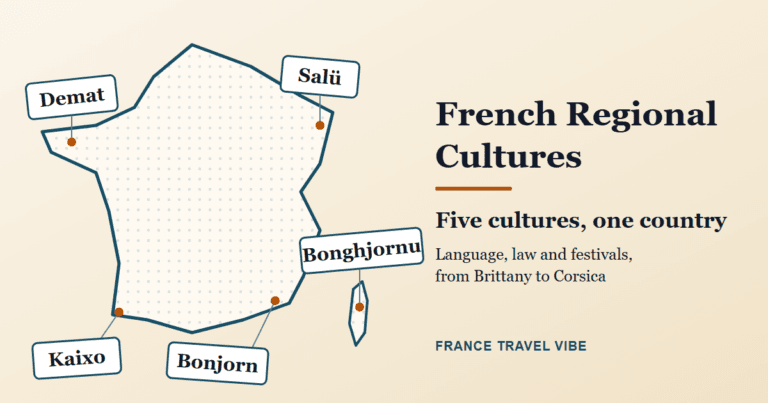
You’ll also see Breton, Alsatian, Occitan and Basque on road signs and station names. They’re part of the local identity, but nobody expects a visitor to speak them. The cultures behind those bilingual signs are compared in my guide to French regional cultures.
How to Use This Basic French for Travelers Cheat Sheet
Learn the eight openers on the plane, the numbers on the way in from the airport, and the rest on the day you need them. In the European Commission’s 2024 survey, three in five Europeans said they could hold a conversation in a language other than their mother tongue (European Commission, Special Eurobarometer 540, 2024). Plenty of the French people you meet have struggled in someone else’s language too, so a little effort goes a long way.
Two last phrases belong on every card. 24. Je ne comprends pas (zhuh nuh kohm-prahn PAH), I don’t understand. Pair it with 25. Vous pouvez l’écrire ? from the screen section above. Together they turn any conversation that’s going wrong into one written down on paper or a screen.
The 40 Card
| # | French | Say it like | English | Place | Say / Read |
|---|---|---|---|---|---|
| 1 | Bonjour | bohn-ZHOOR | Hello | Everywhere | Say |
| 2 | Bonsoir | bohn-SWAHR | Good evening | Everywhere | Say |
| 3 | S’il vous plaît | seel voo PLAY | Please | Everywhere | Say |
| 4 | Merci | mair-SEE | Thank you | Everywhere | Say |
| 5 | Au revoir | oh ruh-VWAHR | Goodbye | Everywhere | Say |
| 6 | Excusez-moi | ex-kew-zay-MWAH | Excuse me | Street | Say |
| 7 | Pardon | par-DOHN | Sorry / sorry? | Street, Métro | Say |
| 8 | Parlez-vous anglais ? | par-lay voo zahn-GLAY | Do you speak English? | Everywhere | Say |
| 9 | Je voudrais… | zhuh voo-DRAY | I’d like… | Shop, café | Say |
| 10 | C’est combien ? | say kohm-BYAN | How much is it? | Shop | Say |
| 11 | Je regarde, merci | zhuh ruh-gard mair-SEE | I’m just looking | Shop | Say |
| 12 | Je peux payer par carte ? | zhuh puh pay-YAY par KART | Can I pay by card? | Shop | Say |
| 13 | Une table pour deux | ewn tah-bluh poor DUH | A table for two | Café | Say |
| 14 | Une carafe d’eau | ewn ka-RAHF DOH | A jug of tap water | Café | Say |
| 15 | L’addition | la-dee-SYOHN | The bill | Café | Say |
| 16 | Où est… ? | oo AY | Where is…? | Street | Say |
| 17 | Un billet pour… | uhn bee-YAY poor | A ticket to… | Station | Say |
| 18 | C’est quel quai ? | say kel KAY | Which platform? | Station | Say |
| 19 | J’ai une réservation au nom de… | zhay ewn ray-zair-va-syohn oh NOHM duh | I have a booking under… | Hotel | Say |
| 20 | J’ai mal à la tête | zhay mal ah la TET | I have a headache | Pharmacy | Say |
| 21 | Je suis allergique à… | zhuh swee za-lair-ZHEEK ah | I’m allergic to… | Pharmacy, café | Say |
| 22 | Au secours ! | oh suh-KOOR | Help! | Emergency | Say |
| 23 | Je suis à… | zhuh swee-ZAH | I’m at… | Emergency | Say |
| 24 | Je ne comprends pas | zhuh nuh kohm-prahn PAH | I don’t understand | Everywhere | Say |
| 25 | Vous pouvez l’écrire ? | voo poo-VAY lay-KREER | Can you write it down? | Everywhere | Say |
| 26 | Et avec ceci ? | ay ah-vek suh-SEE | Anything else? | Shop | Read |
| 27 | Ce sera tout ? | suh suh-rah TOO | Will that be all? | Shop | Read |
| 28 | Sans contact ? | sahn kohn-TAKT | Contactless? | Shop | Read |
| 29 | Vous avez la carte ? | voo za-VAY la KART | Loyalty card? | Shop | Read |
| 30 | Soixante-dix | swa-sahnt-DEESS | 70 | Prices | Read |
| 31 | Quatre-vingts | kat-ruh-VAN | 80 | Prices | Read |
| 32 | Quatre-vingt-dix | kat-ruh-van-DEESS | 90 | Prices | Read |
| 33 | Tirez / Poussez | tee-RAY / poo-SAY | Pull / Push | Doors | Read |
| 34 | Sortie | sor-TEE | Exit | Stations, roads | Read |
| 35 | Fermé / Ouvert | fair-MAY / oo-VAIR | Closed / Open | Shops | Read |
| 36 | Complet | kohm-PLAY | Full | Hotels, car parks | Read |
| 37 | Interdit | an-tair-DEE | Forbidden | Everywhere | Read |
| 38 | Quai / Voie | KAY / VWAH | Platform / Track | Stations | Read |
| 39 | Retard / Supprimé | ruh-TAR / sew-pree-MAY | Delayed / Cancelled | Stations | Read |
| 40 | Toilettes | twa-LET | Toilets | Everywhere | Read |
A “Read” phrase is one you need to recognise when someone says it or you see it written, without having to produce it on the spot.
Frequently Asked Questions
Do people in France speak English?
Many do, unevenly. In the European Commission’s 2024 survey, 40% of people in France said they could hold a conversation in English, against 47% across the EU. Younger people and big cities are your best bet. In villages and markets, start in French and switch only if they offer.
How much French do you need to visit France?
For basic French for travelers, about 25 phrases to say and 15 to recognise is enough. In 2022, 22.6% of French adults aged 25 to 64 knew no foreign language at all (Eurostat), so the basics matter outside hotels and museums. The greeting matters more than the grammar, and numbers matter more than vocabulary.
When do you say bonsoir instead of bonjour?
Once it’s dark, or around dinner time. No rule fixes an hour, and phrase books give anything from 5pm to nightfall. A bonjour at 7pm in July is perfectly normal, since it’s still daylight. Bonsoir in the morning is the only real mistake.
What number do you call in an emergency in France, and will they speak English?
Call 112, free from any phone. The EU’s Your Europe service says operators answer in the country’s language and English is offered only in some countries, so learn “Je suis à…” (I’m at…) and keep your address saved in French to read out. The 114 text line is for deaf and hard-of-hearing people, in French.
Can I just use a translation app in France?
Yes, and showing the screen often works better than speaking it aloud. On EF’s 2025 France fact sheet, reading scored 555 against 456 for speaking, so a typed sentence is easier to understand than a spoken one. Download the offline French pack before you fly, because signal drops on trains.
The Bottom Line
Basic French for travelers comes down to three habits:
- Say 25, recognise 15. The openers, the shop, café and station phrases, and the two emergency ones are yours to say. The cashier’s questions, the prices and the signs only need recognising.
- Show the screen when speech fails. On EF’s test, French adults read English far better than they speak it, so write it down.
- Learn the numbers. Soixante-dix and quatre-vingts trip up more visitors than any grammar.
Print the 40 Card, then take it to the table with my French dining etiquette guide. For why starting in French changes the whole trip, go back to my French culture guide.