
Last verified: September 16, 2026. Every price, group size and language rule in this guide was read on the school’s own page on the date above, or on the tourist office or marketplace listing where the school prints none (Saint-Rémy, Lyon), and every market day on the city’s or tourist office’s page. Schools reprice each season and reprint their calendars each spring, so I re-check this page and update the date each time.
Le Cordon Bleu Paris scheduled five public market-tour workshops for the whole of 2026. When I checked on September 16, every one was gone, and the page had switched to a waiting list (Le Cordon Bleu Paris, From Market to Plate, 2026). That’s the cooking class in France most people picture. It’s also the one you can’t book.
Meanwhile the booking sites show 86 cooking classes for Paris alone, priced in dollars from $46 to $253 (GetYourGuide, Paris cooking classes, September 2026). Nothing on the card separates a demonstration from a market morning, or an English class from a translated one. The price is on the button. The rules that decide whether it’s a good morning aren’t.
So I pulled every price here from the schools’ own pages on one day. Then I set out the six decisions in the order you’ll meet them: format, city, day of the week, language, lead time, and what comes home. A class like this belongs inside the experiences worth your time in France, and it starts with the weekday the booking sites ignore.
Disclosure: Some links in this guide may earn us a commission, at no extra cost to you. It never changes what we recommend.
Key Takeaways
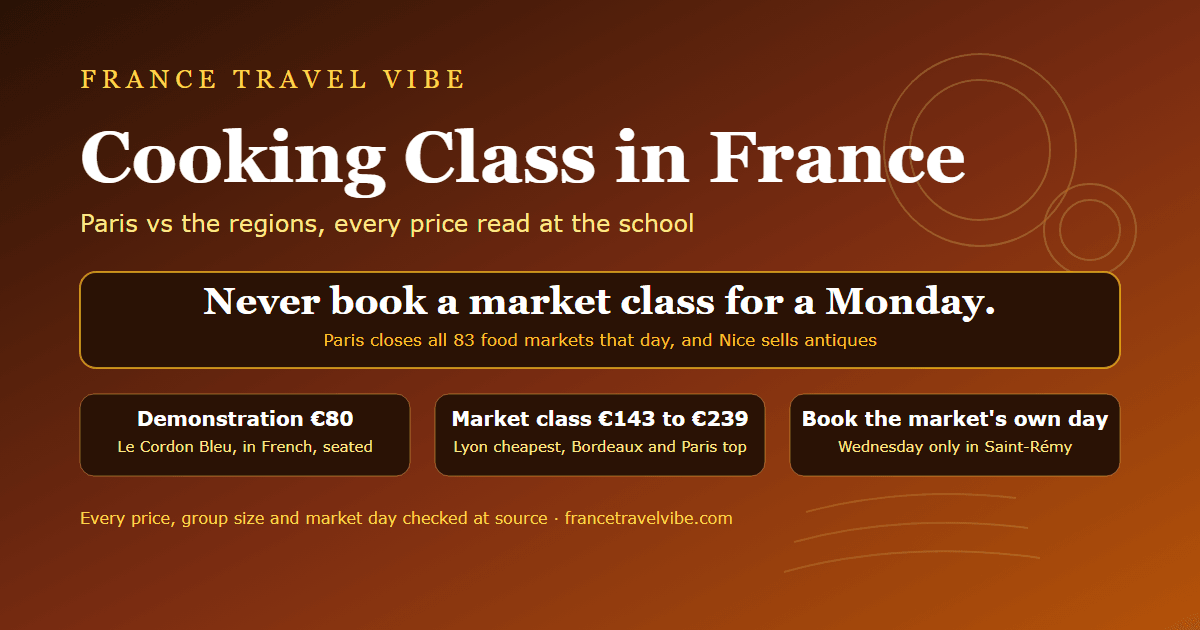
- Paris runs €80 to €239 for anything up to a half day, before the full-day and multi-day tiers. Le Cordon Bleu’s demonstration is €80 for 2h30; Le Foodist’s evening market class is €239 for 5h30 (schools’ own pages, September 16, 2026).
- The regions aren’t automatically cheaper. A market morning is €143 in Lyon, €150 in Uzès in season, €195 in Saint-Rémy, €199 to €229 in Paris, €210 in Nice and €228 in Bordeaux.
- Never book a market class for a Monday. Paris’s 83 food markets close that day (Ville de Paris, 2026), and Nice’s Cours Saleya sells antiques.
- Check the language line. Le Cordon Bleu and the Ritz teach in French with a translator; the visitor schools teach in English.
- Book the small rooms weeks out. La Cuisine Paris showed one to three places left one to three days out, and Le Cordon Bleu’s five market dates were gone by September.
Table of Contents
Cooking Classes in France at a Glance
In 2026 a hands-on half day with a market visit costs €143 to €239 across the schools below (Eatwith; Le Foodist, 2026). A three-hour technique class costs €110 to €180. Every figure was read on the school’s own page on September 16, except where the table says otherwise. The table is the whole guide in one place. The sections after it argue the rows.
| School (city) | Class | 2026 price | Hours | Max group | Language | Market day rule |
|---|---|---|---|---|---|---|
| La Cuisine Paris (Paris) | Market tour and cooking class, Maubert or Monge | €199 | 4 | not printed | English | Maubert Tue, Thu, Sat; Monge Wed, Fri, Sun |
| La Cuisine Paris (Paris) | Croissant and breakfast pastries | €129 | 3 | not printed | English | no market |
| Le Foodist (Paris) | Morning market class, lunch, wine | €209 to €229 | 6 | not printed | English | Tue to Sun |
| Le Foodist (Paris) | Evening market class, dinner, wine | €209 to €239 | 5.5 | not printed | English | Tue to Sat |
| Cook’n With Class (Paris) | French Market class, four courses, wine | €215 | 5 to 6 | 8 | English | market mornings, see calendar |
| Cook’n With Class (Paris) | Croissant, macaron, éclair or bread | €135 | 3 | 6 to 10 | English | no market |
| Cook’n With Class (Paris) | Express croissant or macaron | €110 | 2 | 6 to 10 | English | no market |
| Le Cordon Bleu (Paris) | Demonstration, The Art of Cooking like a Chef | €80 | 2.5 | not printed | French, translated | no market |
| Le Cordon Bleu (Paris) | Signature workshop: choux, tarts or confectionery | €180 | 3 | 16 | French, translated | no market |
| Le Cordon Bleu (Paris) | From Market to Plate | waitlist | 5.5 | 16 | French, translated | five dates a year, all gone |
| École Ducasse Paris Studio (Paris) | Cooking with ingredients from the market | €319 | 8 | not printed | French; paid translation | Tue to Sat |
| Joëlle’s rooftop (Lyon), via Eatwith | Croix-Rousse market, class, four-course lunch | €143 | 3.5 | 6 | English, per the listing | market mornings |
| Les Petits Farcis (Nice) | Cours Saleya market, class, lunch | €210 and up | 5.5 | 10, studio built for 8 | English | Tue to Sun |
| Les Petits Farcis (Nice) | Macaron or choux workshop | €110 and up | not printed | 8 | English | no market |
| La Cuisine Provençale (Saint-Rémy), tourist office listing | Market tour, class, four-course meal | €195 | 4 | 12 | not printed | Wednesday market |
| La Cuisine Provençale (Saint-Rémy), tourist office listing | Class and four-course meal | €95 | 4 | not printed | not printed | Wed to Fri, no market |
| Le Pistou (Uzès) | Market, class, lunch | €190 | 5.5 | not printed, min 6 | English | Wed and Sat markets |
| Peta Mathias (Uzès) | Market, class, lunch, late May to late September | €150 | 5 | 8 | English | Wed and Sat markets |
| The Gastronome (Bordeaux) | A Day in Bordeaux: Capucins market, class, lunch | €228 | 5 | 6 | English | Tue to Fri |
| The Gastronome (Bordeaux) | Canelé atelier | €96 | 2.5 | not printed | English | Saturday, no market |
Read across a row and the sticker price stops meaning much. Divide each price by the hours the school prints and the order flips: the Riviera’s “expensive” market day costs less per hour than a Paris pastry class.
The per-hour view isn’t a trick. A market morning includes an hour at the stalls and a sit-down meal, and both are the point. What it shows is that the cheapest-looking option, the demonstration, is cheap because you’re watching, and the dearest, the three-hour choux workshop, is dear because sixteen of you get a station each.
How Much Does a Cooking Class in France Cost?
One Paris school covers the whole 2026 range on its own. Le Cordon Bleu’s public list runs from €80 for a 2h30 demonstration to €995 for four days of bread and pastry (Le Cordon Bleu Paris, short courses, 2026). Between those ends sit five bands, and the band matters more than the school.
The short band is €80 to €110: the Cordon Bleu demonstration, Cook’n With Class’s two-hour express croissant or macaron session at €110, and The Gastronome’s 2h30 canelé atelier in Bordeaux at €96 (Cook’n With Class, all classes; The Gastronome, 2026). You bake one thing, or you watch a chef cook three.
The technique band is a three-hour hands-on class at €110 to €180. Les Petits Farcis in Nice starts its macaron and choux workshops at €110 (hours not printed), and La Cuisine Paris charges €129 for croissants and breakfast pastries (Les Petits Farcis; La Cuisine Paris, 2026). Cook’n With Class asks €135 for any of its pastry classes, and Le Cordon Bleu €180 for a signature workshop.
The market band is the half day, three and a half to six hours, at €143 to €239. That’s Lyon’s rooftop class at the bottom and Le Foodist’s evening market class with dinner at the top (Eatwith, Croix-Rousse market and rooftop class; Le Foodist, Paris cooking classes, 2026).
Above the half day sits a full-day band: Le Cordon Bleu’s 5h30 to six-hour workshops at €240 to €295 and École Ducasse’s eight-hour market day at €319 (École Ducasse Paris Studio, 2026). Then the multi-day tier. Cook’n With Class charges €400 for three days of bread, Le Cordon Bleu €510 to €545 for two days, École Ducasse €859 for its three-day immersion and Les Petits Farcis €1,080 for a four-day fish camp (schools’ own pages, 2026).
What’s inside the market price? A meal, and usually wine. Le Foodist’s morning class ends in a three-course lunch with red and white; Cook’n With Class serves four courses, cheeses and wine; the Lyon class finishes with four courses on a roof. So compare a €215 market class with a €199 one only after you’ve priced the lunch you’d otherwise buy.
Two traps on the booking sites. Viator’s France cooking-class page advertised “prices from $4” when I looked, which isn’t a cooking class (Viator, 2026). And the marketplaces price in dollars with a “from”, so the euro figure on the school’s own page is the one to plan with. For where a €199 morning sits in a day’s spending, see what a France trip costs in 2026.
Which Format Should You Book: Market Morning, Technique Class or Demo?
Of the 15 public workshops on the first page of Le Cordon Bleu’s 2026 list, exactly one is a demonstration. Four are three-hour workshops, six run 5h30 to six hours, and four span two to four days (Le Cordon Bleu Paris, short courses, 2026). The oldest name in the business has voted: hands-on and half a day is the product.
Book the market morning if you have one class in you. It’s the only format you can’t repeat at home, because the hour at the stalls is the lesson. La Cuisine Paris’s version runs 9:00 to 13:00 from the Maubert or Monge markets; Le Foodist’s runs 9:00 to 15:00 and includes a 2h30 hands-on session before lunch (Le Foodist, 2026).
What does a chef do at a market that you can’t? Ask the right question. On my own market mornings in France I ask for a good cheese; the chef asks the cheesemonger which one will be right on Thursday, for a dinner, and gets a different answer. Then the same at the fishmonger. That’s the hour, and it’s why I’d never swap it for thirty more minutes at the stove.
Book the technique class if you’ve done a market morning before, or if you want the skill more than the meal. Croissants, macarons, choux, bread: three hours, one thing, done properly, and it travels home in your hands. At €129 to €135 at the visitor schools in Paris it’s also the format with the most dates, because it doesn’t depend on a market being open.
Book the demonstration only for the name. Le Cordon Bleu’s €80 session is 2h30 of watching a chef cook, and it’s the cheapest way to sit in that building. Book the multi-day tier if you came to France for this and nothing else. Two age rules travel with the format. Le Cordon Bleu takes nobody under 18 (Le Cordon Bleu Paris, 2026). Cook’n With Class runs its market class from age 15 with an adult and its family classes from age 6 (Cook’n With Class, French Market class, 2026).
Paris or the Regions: Where Is a Cooking Class Worth It?
In 2026 a market morning costs €143 in Lyon, €150 in Uzès in season, €195 in Saint-Rémy, €199 to €229 in Paris, €210 in Nice and €228 in Bordeaux (Eatwith; Peta Mathias; Alpilles en Provence tourist office; Les Petits Farcis; The Gastronome, 2026). So the regions aren’t automatically cheaper. The format sets the price; the city takes off €56 in Lyon or adds €29 in Bordeaux.
I’ll own a correction here. My list of the best things to do in France said the regional versions are cheaper. Lyon and the Gard bear that out; Nice and Bordeaux don’t, so I’ve narrowed it to a Lyon and Gard rule. What the regions do change is the market itself, and the size of the room.
Lyon is the bargain and the smallest room. Joëlle’s class walks the Croix-Rousse market, cooks in a chef’s apartment and eats four courses on a rooftop, 3h30 for up to six people at €143 (Eatwith; Viator, 2026). It’s the only class here with no website of its own, so the marketplace price is the price. For why Lyon’s cheap restaurants are protected, the city comparison has the argument.
Nice has the market with a book behind it. Rosa Jackson’s Les Petits Farcis starts at 9:30 on the Cours Saleya, cooks in her studio, and finishes lunch around 15:00. It’s from €210 with rosé, up to ten people in a studio built for eight, and the Libération farmers’ market version is €230 for two to seven (Les Petits Farcis, 2026). The rest of Cours Saleya and the Riviera is in the Nice guide.
Provence and the Gard split in two. In Saint-Rémy, La Cuisine Provençale’s market tour and class is €195, for a minimum of four and a maximum of twelve. The class alone, four courses included, is €95 for a minimum of two, Wednesday to Friday from 10:00 (Alpilles en Provence tourist office, 2026).
In Uzès, Le Pistou charges €190 for a 9:30 market start, 3h30 of cooking and a two-hour lunch, 5h30 in all, minimum six (Le Pistou, 2026). Peta Mathias runs €150 market-day classes for up to eight, 9:00 at the stalls to lunch at 14:00, from late May to late September (Peta Mathias, 2026). Saint-Rémy’s Wednesday market and the villages around it sit in the Provence itinerary.
Bordeaux is the dearest of the regions and the most tightly scheduled. The Gastronome’s A Day in Bordeaux tours the Capucins market, cooks and serves lunch: five hours from 9:30, Tuesday to Friday, in English, at €228 (The Gastronome, 2026). Its canelé atelier is €96 on Saturday afternoons. Lyon, Nice and Bordeaux are each a direct train from Paris; Saint-Rémy and Uzès need a car or a bus from Avignon or Nîmes, and the train versus driving question has its own guide.
Which Day Should You Book a Market Class?
Not Monday. Paris runs 83 food markets, 74 open-air and 9 covered, and the city’s own page says all of them close on Monday (Ville de Paris, les marchés parisiens, June 2026). In Nice, the Cours Saleya sells flowers and food Tuesday to Sunday and hands the square to about 180 antiques dealers on Monday, 07:00 to 18:00 (Nice Côte d’Azur tourist office, 2026).
The schools know this, and their own pages say so if you read the class name. La Cuisine Paris names its market classes after the Maubert and Monge markets. The city’s data has Maubert on Tuesday, Thursday and Saturday and Monge on Wednesday, Friday and Sunday, 07:00 to 13:30 on weekdays and 14:30 at the weekend (Paris Open Data, marchés découverts, 2026). Le Foodist runs its morning market class Tuesday to Sunday and its evening one Tuesday to Saturday. Its only Monday class is a vegetarian technique session with no market in it (Le Foodist, 2026).
So what is a Monday “market tour” on a booking site? Ask which market. In Paris the city’s answer is none.
In Bordeaux the Capucins market runs Tuesday to Saturday 6:00 to 13:30 and Sunday to 13:00, closed Monday (Marché des Capucins, 2026), and The Gastronome runs Tuesday to Friday. In Saint-Rémy the big market is Wednesday, 8:00 to 13:00 (Alpilles en Provence tourist office, 2026), which is why the school there opens Wednesday. Uzès trades on the Place aux Herbes on Saturday, 07:30 to 13:30 with 200 stalls, and both schools there build their classes around the Wednesday and Saturday market days (Uzès Pont du Gard tourist office; Peta Mathias, 2026).
| Market | Days it trades | Hours | School that uses it |
|---|---|---|---|
| Paris food markets (all 83) | Tuesday to Sunday | morning markets 07:00 to 13:30 weekdays, 14:30 weekends; covered markets keep their own hours | Le Foodist, Cook’n With Class, Le Cordon Bleu |
| Marché Maubert, Paris 5e | Tue, Thu, Sat | 07:00 to 13:30, Sat to 14:30 | La Cuisine Paris |
| Marché Monge, Paris 5e | Wed, Fri, Sun | 07:00 to 13:30, Sun to 14:30 | La Cuisine Paris |
| Cours Saleya, Nice | Tuesday to Sunday; antiques on Monday | mornings, see the Nice guide | Les Petits Farcis |
| Saint-Rémy-de-Provence | Wednesday | 08:00 to 13:00 | La Cuisine Provençale |
| Uzès, Place aux Herbes | Wednesday and Saturday | Sat 07:30 to 13:30; Wednesday per the schools | Le Pistou, Peta Mathias |
| Marché des Capucins, Bordeaux | Tuesday to Sunday | 06:00 to 13:30, Sun to 13:00 | The Gastronome |
Monday is dead everywhere on this list, and a technique class is the honest thing to book that day. In Paris, Nice and Bordeaux any other day has a market, though The Gastronome only runs Tuesday to Friday. In Saint-Rémy it’s Wednesday only and in Uzès Wednesday or Saturday, so match the class to its market’s day. For the full village market calendar across Provence, the Provence itinerary has the table.
Will the Class Be in English?
At the visitor schools, yes. Seven of the ten schools with pages of their own print English on them, the Lyon class says so on its listing, and two of the remaining three are the famous names. La Cuisine Paris writes that its classes are taught in English, and Cook’n With Class has taught in English since 2007 (La Cuisine Paris; Cook’n With Class, 2026). Le Foodist says all its classes are in English and hands-on, and Les Petits Farcis is bilingual with English classes (Le Foodist; Les Petits Farcis, 2026).
At the famous names, no. Le Cordon Bleu’s own note says every short course is taught in French and consecutively translated into English by a translator (Le Cordon Bleu Paris, 2026). The École Ritz Escoffier describes its classes the same way: conducted in French and consecutively interpreted into English (Ritz Paris, École Ritz Escoffier, 2026).
École Ducasse’s Paris Studio teaches most courses in French, offers translation for a fee, and keeps a separate category of classes in English (École Ducasse Paris Studio, 2026). Ferrandi’s two-hour amateur classes at Galeries Lafayette run in French or English by session (Ferrandi Paris, 2026).
Does consecutive translation matter? At a demonstration, not much: you’re seated, and the translator speaks between steps. At a stove it costs you one step. The chef says fold, the room folds, the translator says fold, and you fold late. I’ve cooked in translated classes and enjoyed them, but I went in knowing that the €80 seat and the €180 station buy the name first and the instruction second.
None of this is a mark against the French schools. It’s their language and their kitchen, and the translation is honest and printed. It’s a mark against booking the most famous name for a first class without reading that line. If the kitchen is the point, book English; if the building is the point, book the demonstration and enjoy it for what it is. Either way, the unwritten rules of a French table will apply at lunch.
How Far Ahead Do You Need to Book?
Weeks for a small market class, months for a dated workshop at a famous school. On September 16, 2026, La Cuisine Paris showed one place left for the next evening’s Marais tour and cooking class, three for Friday’s Monge morning and two for Saturday’s Maubert morning (La Cuisine Paris, 2026). The croissant class still had five or more. One to three days out, the tour and market classes were nearly full and the technique class wasn’t.
The famous name is the other extreme. Le Cordon Bleu listed five market workshops for all of 2026, on May 30, June 20, July 11, August 22 and September 12, and by mid-September the page offered a waiting list (Le Cordon Bleu Paris, 2026). Cook’n With Class, which has welcomed more than 30,000 students since 2007, tells you plainly on its calendar page that classes fill up quickly and to book direct for the best rate (Cook’n With Class, 2026).
The market classes go first because the rooms are small. The Lyon rooftop and The Gastronome in Bordeaux cap at six, and Cook’n With Class’s market class and Les Petits Farcis’s studio at eight. Le Cordon Bleu allows sixteen per practical room (Le Cordon Bleu Paris, 2026). On the marketplaces the range widens: a Galeries Lafayette macaron class shares the room with four to eighteen people (GetYourGuide, 2026).
The rule that catches solo travellers runs the other way. Some schools print a minimum. Les Petits Farcis needs two for a cooking class, four for pastry or a street-food tour and six for a wine tasting (Les Petits Farcis, 2026). Le Pistou in Uzès needs six and builds its dates around requests (Le Pistou, 2026). Saint-Rémy needs two for the class and four for the market tour. Book alone on a quiet October Tuesday and the school, not you, may be the one who cancels. Where no minimum is printed, ask.
Two calendar notes. École Ducasse’s studio shut from August 2 to 18 in 2026, and it opens Tuesday to Saturday only (École Ducasse Paris Studio, 2026). The other schools thin their calendars in August too, for the same reason every French calendar does.
Read the school’s own cancellation page before you pay, because the marketplace’s 24-hour line isn’t always the school’s. The other Paris experience that lives by a slot rule is a timed Louvre ticket, and the same habit serves both.
What You Actually Take Home
A structure, more than a recipe. On November 16, 2010, the gastronomic meal of the French went onto UNESCO’s Representative List (UNESCO, gastronomic meal of the French, 2010). UNESCO defines it as a fixed sequence: an apéritif, at least four courses of starter, fish or meat with vegetables, cheese and dessert, then liqueurs. Most market classes in the table cook three or four courses of it. The sequence is what you can repeat without a French market.
Then the paper and the kit. Every school hands over the recipes. Le Cordon Bleu adds an apron, a tea towel, a cooler bag and 10% off its shop that day, and Le Pistou sends you home with checklists and tasting notes (Le Cordon Bleu Paris; Le Pistou, 2026). The technique classes send you home with the one thing you made, which is why the croissant class is the one people repeat.
A sense of scale, too. The 2026 Michelin Guide lists 668 starred restaurants across France and Monaco, 31 of them with three stars (Michelin Guide France and Monaco 2026, March 2026). Four hours won’t get you near that, and the good schools don’t pretend otherwise. What they teach is the everyday version of the thing that, by Atout France’s count, a third of tourists name among their reasons for choosing France at all (Atout France, œnotourisme, 2026).
Pair it well. A market morning ends by 13:00 or 15:00, which leaves the afternoon for a wine tasting to go with what you cooked. If the evening is still free, a dinner cruise on the Seine is one meal you won’t have to cook. In December, the Alsace Christmas markets are the winter market experience without a stove. Before you shop, my French food guide names the 25 dishes worth knowing and the town to eat each one.
Frequently Asked Questions
How much does a cooking class in France cost?
In 2026, €80 for Le Cordon Bleu’s 2h30 demonstration, €110 to €180 for a three-hour technique class, and €143 to €239 for a half day with a market visit and a meal. That range holds in Paris, Lyon, Nice, Bordeaux and the Provence and Gard villages. Full-day workshops run €240 to €319 and multi-day courses €400 to €1,080. Every figure is from the school’s own page on September 16, 2026, or from Eatwith and the Alpilles tourist office for Lyon and Saint-Rémy.
Are cooking classes in France taught in English?
At the visitor schools, yes: La Cuisine Paris, Cook’n With Class, Le Foodist and Les Petits Farcis all teach in English. Le Cordon Bleu’s short courses and the École Ritz Escoffier’s classes are taught in French and consecutively translated, and École Ducasse charges for translation. Read the language line before you book a famous name.
Can I take a market tour cooking class on a Monday?
Not a real one. The Ville de Paris closes all 83 of its food markets on Monday, Nice’s Cours Saleya becomes an antiques market that day, and Bordeaux’s Capucins market is shut. Le Foodist’s own Monday class is a technique session with no market. Book Tuesday to Saturday in Paris or Nice, Tuesday to Friday for Bordeaux’s market class, and the market’s own day in the villages: Wednesday in Saint-Rémy, Wednesday or Saturday in Uzès.
How far ahead should I book a cooking class in Paris?
Weeks for a small-group market class and months for a dated workshop at a famous school. On September 16, 2026, La Cuisine Paris had one to three places left in each market class one to three days out. Le Cordon Bleu’s five 2026 market workshops were all gone, with the page on a waiting list.
Is Le Cordon Bleu Paris open to tourists?
Yes, through public short courses at 13-15 Quai André Citroën: an €80 demonstration, €180 three-hour workshops, €240 to €295 for 5h30 to six hours, and multi-day courses to €995, with 16 people per practical room. Two rules apply to everyone: participants must be 18 or over, and every course is taught in French with consecutive English translation.
The Bottom Line
A cooking class in France is priced by its format, not its city, and the format is a choice you can make before you open a booking site.
- One class in you: the market morning, on the market’s own day, at €143 to €229, or €239 for the Paris evening class. The hour at the stalls is the lesson.
- A second visit, or a skill to keep: the three-hour technique class at €110 to €180, any day, croissants or macarons or choux.
- The famous name: the €80 demonstration at Le Cordon Bleu, knowing it’s in French with a translator and you’re seated.
- To save money: Lyon or the Gard. Nice and Bordeaux cost what Paris costs.
- Travelling alone: check the printed minimum, then book the small rooms weeks out.
For the rest of the trip, what four days in Paris cost covers the city most of these classes sit in. And the experiences worth your time in France ranks this one against the other fourteen.