
Last verified: October 17, 2026. Etiquette moves slowly, so unlike my price and rules guides these first time in France tips won’t change much month to month. The August closure dates and price figures below come from my continuously verified France guides, checked on the date above.
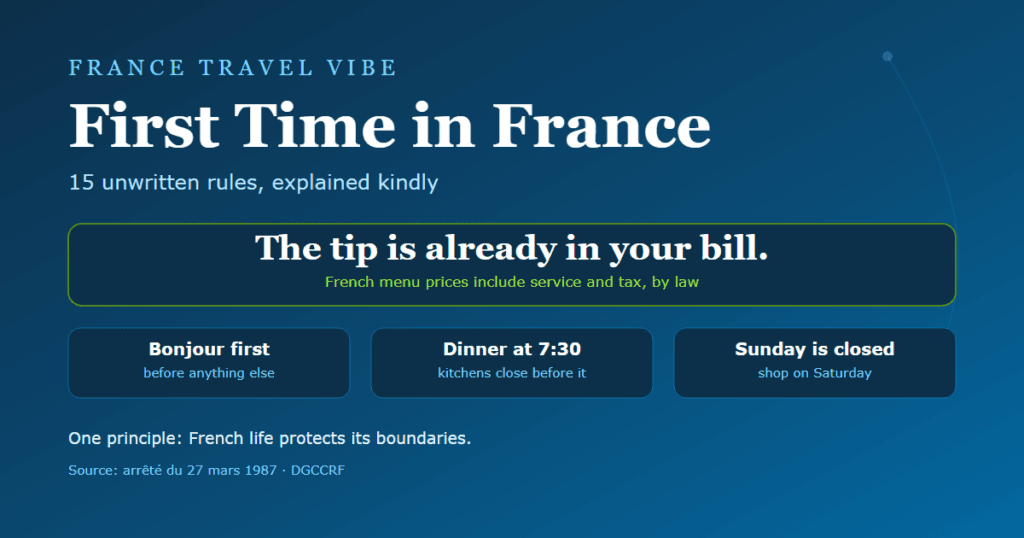
Here’s the single most relaxing fact a first-timer can learn: the tip is already in your bill. Under French price-display rules, the number on the menu includes service and taxes, so the price you read is the price you owe (arrêté du 27 mars 1987, via L’Hôtellerie Restauration). Half of what people worry about before a first trip to France is already handled like that, quietly, by the system.
The other half is fifteen unwritten rules. My other guides cover the systems: borders, budgets, trains, fines. These first time in France tips cover the social contract instead, meaning how to greet, eat, pay and move through a French day without friction. None of them takes more than ten minutes to learn.
Disclosure: Some links in this guide may earn us a commission, at no extra cost to you. It never changes what we recommend.
Key Takeaways
- The first of all first time in France tips: say bonjour before anything else, everywhere. It’s the rule that explains most “rude French service” stories.
- Lunch runs noon to 2pm and dinner starts around 7:30pm. Kitchens genuinely close between.
- Don’t stress about tipping: French price-display rules require the menu price to include service and taxes (arrêté du 27 mars 1987). Rounding up is generous; zero is normal.
- Sundays and August closures are the culture working as intended, not an inconvenience to defeat.
Table of Contents
What’s the One Rule That Changes Everything?
Say bonjour first, transact second. Before the question, before the order, before pointing at a croissant: bonjour. My complete France travel guide calls it the entry fee, and it’s tip 1 for a reason. It reframes every interaction that follows.
Here’s the pattern underneath it, and underneath most first time in France tips. French daily life protects boundaries. A greeting marks the boundary between strangers and a transaction. Meal times mark the boundary between eating and working. Sunday marks the boundary between the week and rest. Learn that one principle and the other fourteen rules stop being trivia. You can predict them. Those boundaries hold wherever you go, though how heavily a place is visited changes how they feel in practice. It is worth a look at the best places to visit in France before you pick your first-trip regions.
The practice is small. Bonjour when you enter any shop, bakery, café or pharmacy, before you say anything else. Merci, au revoir on the way out. In an elevator or a small waiting room, a murmured bonjour to the people already there. Your accent is irrelevant, and the forty French phrases worth learning come after it. The greeting is the whole test, and most “rude waiter” stories begin with a visitor who skipped it and became, in local terms, someone who walked into a home without knocking.
When Do the French Actually Eat?
On a schedule, and the schedule wins. Of all the first time in France tips here, this is the one that most often derails a first day. Lunch service runs roughly noon to 2pm, dinner rarely starts before 7:30pm, and between the two most kitchens genuinely close. Turn up hungry at 5pm and you’ll find cafés serving drinks, not meals. That’s tip 2: eat when France eats, or plan a bakery fallback.
Tip 3 is where the schedule pays you. The lunchtime formule or menu du jour is the best-value restaurant meal in France, because the same kitchens charge far more at dinner. My France trip cost breakdown prices the gap at €16 a day between a €12 bakery lunch and a €28 restaurant lunch, which compounds to €160 over ten days. A proper sit-down formule sits between those two and beats both on satisfaction per euro.
Tip 4: coffee has a vocabulary. Order “un café” and an espresso arrives. That’s not a mistake, it’s the default. Want milk, ask for a café crème; want it large, un grand crème. And tip 5: the bill will not come until you ask for it, and my French dining etiquette guide explains why. Say “l’addition, s’il vous plaît” or catch an eye and mime a signature. Nobody forgot you. In France the table is yours for the evening, and rushing you out would be the actual rudeness.
Do You Tip in France?
You don’t have to, and among first time in France tips this is the answer travelers can never find stated plainly. Under the arrêté du 27 mars 1987 on consumer price information, French restaurant prices shown to the public are inclusive of service and taxes, and the DGCCRF enforces it (L’Hôtellerie Restauration; DGCCRF, restaurants: droits et obligations). The price you read is the price you owe. Service isn’t a tip you’re expected to add; it’s already inside the number. That’s tip 6, and it’s the flagship of these first time in France tips.
One precision most guides get wrong, in both directions. You’ll see “15%” quoted everywhere as a legally required rate. No percentage is set in law. Where an establishment pays staff on a service percentage, it must display the rate it uses, and 15% is simply the conventional figure. What’s guaranteed isn’t a number, it’s the principle: the displayed price is the whole price.
Tip 7 is what to actually do. For good café or restaurant service, round up or leave €1–2 in cash on the table. Cash is preferred even when you pay by card. For a taxi, round up. For a tour guide who was excellent, a few euros. For hotel staff in ordinary hotels, nothing is expected. Leaving zero anywhere is normal, not an insult; no server is depending on your tip to make rent, because the wage system doesn’t work that way.
Tip 8: don’t import percentages. Adding 20% to a French bill doesn’t read as generous so much as confused, and no one will stop you, but you’re tipping on top of service you already paid for. Round up when it was good. Smile and say merci. Done.
Why Is Everything Closed?
Because the boundary is the point, and it’s why closures belong in any honest list of first time in France tips. Sunday closures, the mid-afternoon shutter in smaller towns, and the great August pause aren’t gaps in service. They’re the same principle as the meal schedule, applied to the calendar. Plan around them and France gets dramatically easier.
Tip 9: shop for food on Saturday. Most supermarkets and nearly all small shops close Sunday afternoon if not all day, with one delicious exception: bakeries commonly open Sunday morning, because Sunday lunch needs bread. Tip 10: in smaller towns, expect shops to close from roughly 12:30 to 2:30 even on weekdays. It’s not a siesta cliché; it’s lunch, taken seriously.
Tip 11 is the August one. Independent restaurants and shops take their annual closure, the fermeture annuelle, clustered around August 3–23, when much of France itself goes on holiday. My month-by-month guide tracks this alongside the heat data: tourist districts and major attractions stay open, but that beloved neighborhood bistro from a blog post may simply be shut for three weeks. Check before you cross town for it.
The Quiet Rules: Volume, “Non,” and the Green Cross
Three more first time in France tips, and the first is the one nobody warns you about. Tip 12: speak more quietly than feels natural. In a French restaurant or train carriage, the ambient volume is genuinely lower, and a loud table reads as tourist from across the room far faster than any outfit does. My packing guide already debunked the dress-code myth; volume is the tell that’s real.
Tip 13: recalibrate directness. “Non” delivered flatly isn’t hostility, and neither is an unsmiling shop assistant. French service culture treats professional reserve as respect, not coldness. The warmth arrives after the bonjour, and it compounds across repeat visits. Don’t take the baseline personally, and don’t perform extra cheerfulness to fix it; it doesn’t need fixing.
Tip 14: learn the green cross. The lit green cross marks a pharmacy, and French pharmacists are trained to advise directly; one on Rue de Rivoli talked me out of a clinic visit for a wasp sting in about ninety seconds. For blisters, sunburn, stomach trouble, insect bites and half of travel’s small miseries, the pharmacy is the first stop, not a clinic. It pairs with the two fixes worth knowing from my France safety guide: 112 for emergencies, and a carafe d’eau, free tap water by custom at any restaurant, for everything the heat throws at you.
What Should You Do on Day One?
Nothing ambitious, and that’s tip 15, the quietest of these first time in France tips. Arrive, say your first bonjour, eat one unhurried meal, walk one neighborhood. Every guide on this site that handles the systems agrees on the same first day: my entry requirements guide covers the EES border queue, getting around France covers the transfer in, my scams guide covers the one taxi rule that matters at the airport, and the eSIM decision is best made before you fly. The systems are handled. Day one is for the social contract.
There’s a deeper layer to all of this: the history and regional cultures that make the rules make sense. My French culture guide covers it: the twelve systems behind the rules, with the law or the number behind each. For a first trip, the fifteen rules above are enough.
Frequently Asked Questions
Do you tip in France?
No obligation exists. Under the arrêté du 27 mars 1987, French restaurant prices displayed to the public are inclusive of service and taxes, so the menu figure is the whole amount owed (L’Hôtellerie Restauration). Round up or leave €1–2 in cash for good service; leaving nothing is normal.
What time is dinner in France?
Dinner service starts around 7:30pm and runs to roughly 10pm, and most kitchens close entirely between lunch (noon–2pm) and dinner. Arrive at 5pm hungry and your realistic options are a bakery or waiting. Tourist districts stretch the windows somewhat.
Is it rude not to speak French in France?
No, but skipping the greeting is. Bonjour, merci and “parlez-vous anglais?” cover a whole trip, and effort is what registers. With a record 102 million visitors in 2025 (Campus France, 2026), France is thoroughly used to imperfect French; it’s the missing bonjour that changes the temperature.
Why are shops closed on Sundays in France?
Because French life protects the boundary between the week and rest, the same way it protects meal times. Most shops close Sunday afternoon or all day; bakeries commonly open Sunday morning. Shop Saturday, enjoy the quiet, and know many independents also close around August 3–23.
What should you not do in France?
Five things cover most of it, and they’re the inverse of the first time in France tips above: don’t skip bonjour, don’t expect dinner before 7:30pm, don’t tip American percentages onto a service-included bill, don’t plan Sunday errands, and don’t take professional reserve personally. Every one is a boundary, not a rejection.
The Bottom Line: One Principle, Fifteen Rules
The best first time in France tips all decode the same way: French daily life protects its boundaries: between greeting and transaction, meals and work, Sunday and the week. A visitor who respects the boundaries gets the warm version of France in return.
- Bonjour first. Of all the first time in France tips, it’s the entry fee and the whole test.
- Eat on the schedule, and let the lunchtime formule save you real money.
- The tip is already in the bill, because displayed prices include service by law. Round up when it’s good; owe nothing.
- Saturday is shopping day. Sunday belongs to the bakery and the walk.
- Day one is for arriving, not achieving.
The systems side of the trip lives in my complete France travel guide, and if you’re still choosing dates, the month-by-month ranking will tell you what the calendar does to crowds, prices and those August shutters.