
Last verified: October 17, 2026. The fares, official guidance and reports of France tourist scams on this page were checked against Préfecture-set taxi tariffs, French cyber-security warnings and 2026 press investigations on the date above. Scam tactics change faster than most travel advice, so I re-check this page monthly and update the date each time.
A taxi from Charles-de-Gaulle to the Right Bank of Paris costs €56. That price is set by prefectural order, applies at every hour of every day, and a licensed driver has no legal right to charge more. This August, a Le Parisien investigation found fake drivers still taking tourists for as much as €190 on that exact ride (The Local, €190 fare: how fake taxi drivers target tourists, 2026). My Paris travel guide lists the official ticketing domains worth trusting.
That gap between the legal price and the charged price is what most advice never gives you: a number to check against. Below are the nine France tourist scams actually running right now. Two of them didn’t exist when most guides were written. And one rule defeats all nine.
Disclosure: Some links in this guide may earn us a commission, at no extra cost to you. It never changes what we recommend.
Key Takeaways
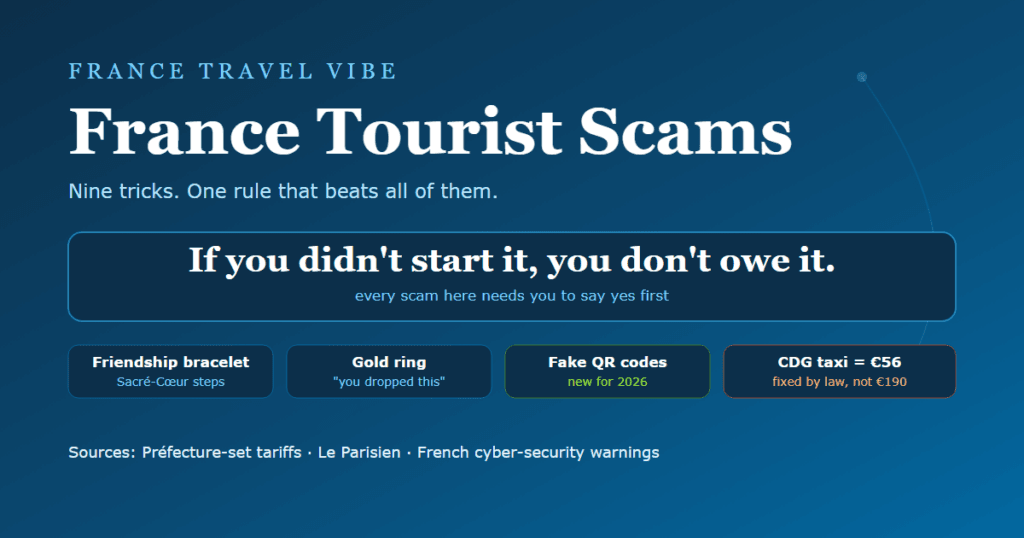
- Every one of the France tourist scams below needs you to accept something you didn’t ask for. If you didn’t start it, you don’t owe it.
- The CDG taxi forfait is €56 to the Right Bank and €65 to the Left Bank, fixed by prefectural order. Fake drivers were charging up to €190 in August 2026 (The Local, 2026).
- Fake QR codes pasted over real ones are France’s fastest-growing traveler fraud, and French cyber authorities spent 2026 warning about them (The Local, 2026).
- At any card terminal, always choose to be charged in euros.
Table of Contents
What Do All France Tourist Scams Have in Common?
They need your participation. That’s the whole pattern, and it’s why nine separate tricks collapse into one rule: if you didn’t start it, you don’t owe it.
Look at what each one actually requires. The bracelet needs your wrist. The ring needs your open hand. The petition needs your signature. The fake QR code needs your scan. The unlicensed taxi needs you to walk to a car you didn’t choose. Not one works if you decline the transaction. Competing guides teach nine unrelated countermeasures, which is nine things to remember while jet-lagged and holding a suitcase. One rule is easier to carry.
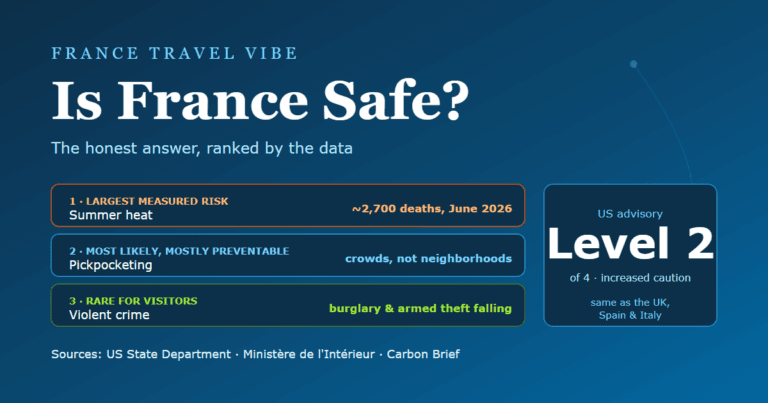
This is also what separates France tourist scams from theft, and the distinction matters. Pickpocketing happens to you whether you cooperate or not. It’s defeated by how you carry your bag, not by what you say. That side of the story lives in my guide to whether France is safe, which covers the crowd geography and the crime data. This page is about the ones that need you to say yes.
Getting the small stuff right is part of a bigger plan. My complete France travel guide covers entry rules, budget, timing and transport.
Which Street Scams Are Most Common in France?
Four of them dominate: the friendship bracelet, the gold ring, the petition and the shell game. All four cluster in the same handful of places: the Sacré-Cœur approach steps, the Eiffel Tower lawns and the Louvre forecourt. All four follow one three-beat structure: a setup, a tell, and a fix that takes one second.
The friendship bracelet. On the steps below Sacré-Cœur, someone takes your wrist and knots a string bracelet on before you’ve agreed to anything. Then they ask for payment, often around €20 (Corporate Travel Safety, the Paris string scam, 2026). The tell: physical contact before conversation. The fix: hands in pockets on those steps, and keep moving. You’re allowed to not stop.
The gold ring. Someone stoops, picks up a glinting band and asks whether you dropped it. You didn’t. They press it on you as a lucky find, then request a reward for their honesty. The tell: an object arriving in your hand unrequested. The fix: don’t take it. Hands stay down, pace stays up.
The petition. A clipboard appears, usually with a deaf-charity or student framing. After your signature comes a firm request for a donation. This one frequently runs with a partner working the bag of whoever stopped. The tell: a clipboard in a tourist crowd. The fix: don’t break stride.
The shell game. Three cups, a ball, and a ring of delighted winners who all work together. It isn’t gambling and it isn’t winnable. The tell: an unusually lucky bystander urging you to have a go. The fix: treat it as theatre. Watch or don’t, but never play.
How Much Should a Taxi from CDG Actually Cost?
€56 to the Right Bank, €65 to the Left Bank. This is the costliest of the France tourist scams, and also the easiest to price-check. Those fares are forfaits, fixed by prefectural order, applying in both directions to anywhere in the 1st–20th arrondissements, with no night, Sunday or holiday supplement; the G7 network prints the same four figures on its own fare page (G7, Paris taxi fares, 2026). In August 2026, Le Parisien found fake drivers charging up to €190 for that journey (The Local, 2026).
Knowing the number is the entire defence, because it converts a judgement call into arithmetic. Unlicensed touts typically ask €120–200 for the CDG run, two to nearly four times the legal fare. From Orly the forfait is €36 to the Left Bank and €45 to the Right Bank (G7, 2026).
The rule that prevents all of it is about geography, not negotiation. Nobody legitimate approaches you inside the terminal. The official rank is outdoors and signposted, and licensed cabs carry a roof light and a visible plate. A real driver waits in the queue rather than working the arrivals hall with a laminated badge. If someone offers you a ride before you’ve left the building, the answer is no, and you don’t need a reason. The last time I landed at Terminal 2E, a man with a lanyard and a laminated card asked “Taxi?” at the foot of the escalator, a full hall before the signposted rank; the licensed queue outside took four minutes.
Already in a car and watching the meter climb? Say you know the fare is fixed and ask for a receipt, which licensed drivers must provide. Note the plate. Or skip the question entirely: the RER and other airport transfer options run to fixed published prices too. You’ll want to plan the arrival around biometric EES checks anyway.
The 2026 Scam Most Guides Miss: Fake QR Codes
Fraudulent QR codes are the fastest-growing of the France tourist scams, and the pattern is physical: a sticker pasted over a legitimate code. French cyber-security experts warned repeatedly through 2026 about fakes appearing at filling stations, EV charging points and restaurant tables (The Local, warning over fake QR code scams in France, 2026).
Parking meters have been the standout target. Authorities in the south of France warned drivers about fraudulent codes on meters that route to a convincing fake payment portal built to harvest card details (Connexion France, scam QR codes on parking meters, 2026). One operation went as far as building a fake Paris parking app, complete with duration selection and card payment, so the whole experience felt legitimate right up until the charges appeared (Connexion France, parking ticket fraud, 2026).
Travelers are the ideal target here, which is worth saying plainly. You don’t know what the legitimate municipal app looks like. You’re paying by card in an unfamiliar system, usually in a hurry, with a rental car you want to leave somewhere. Every one of those is an advantage for the person who stuck the sticker on.
French official guidance is refreshingly concrete. Read the address of the site the code opens, run your fingers over the code to feel for a sticker edge, and don’t scan if anything feels off (Connexion France, how to protect yourself, 2026). The fingernail test takes a second and catches the physical version almost every time. Safer still: pay at the machine, or install the official municipal app before you travel.
Which Payment Scams Cost You the Most?
The ones involving a screen or a menu rather than a stranger. These France tourist scams are quieter than the street tricks and, across a two-week trip, usually drain more from your account.
The card terminal. When the machine asks whether you’d like to pay in your home currency instead of euros, say no and choose euros. That option is called dynamic currency conversion. The exchange rate it applies is set by the terminal’s provider rather than your bank, which is a markup you don’t control on every transaction you accept it for.
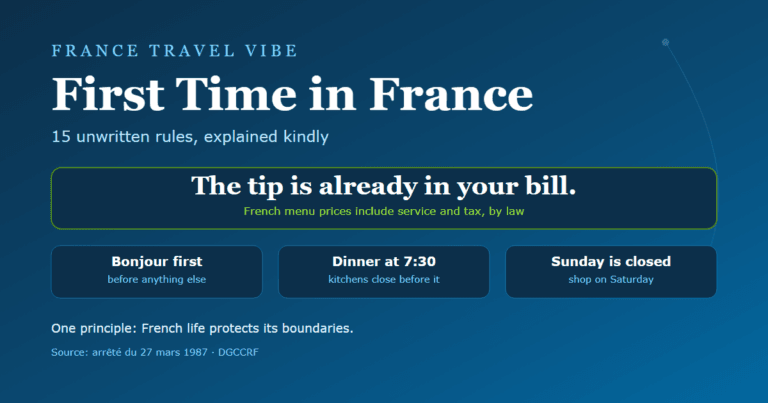
Menus without prices. French law requires displayed prices, so a terrace menu with no numbers, or a waiter quoting “market price” without specifics, is a warning rather than a quirk. Ask before sitting, or choose one of the many places that simply post their prices. The displayed price also already includes service, which is one of the unwritten restaurant rules worth knowing before you order. The rest of the rules, from free tap water to doggy bags, are in my French dining etiquette guide.
Fake ticket resale. Sites reselling entry to the Louvre, the Eiffel Tower or Disneyland at a discount are the cleanest of the France tourist scams, because the arithmetic gives them away. The Louvre’s standard non-EU ticket rose to €32 in 2026, so a €12 “skip-the-line” offer isn’t a bargain, it’s a story. Buy from official domains, and check what things actually cost in 2026 before you judge any deal. For the Louvre in particular, my guide to Louvre tickets shows where to buy without the markup.
One charge that surprises people is entirely legitimate: the nightly taxe de séjour added to your hotel bill, which runs up to €15.93 a night in Paris. My France tourist tax guide explains who levies it and why it’s real.
Where Do France Tourist Scams Actually Happen?
In a surprisingly short list of places. The Sacré-Cœur approach steps, the Eiffel Tower lawns and lift queues, the Louvre forecourt, the Champs-Élysées, and the arrivals halls at CDG and Orly cover most of it, with Riviera parking meters added for the QR variant.
Why those and not others? Every one combines first-time visitors, a queue or a pause, and luggage or a camera in hand. France tourist scams need dwell time and distraction, which is why they cluster at the entrance to a monument rather than three streets away. Volume matters too. France drew a record 102 million international visitors in 2025, and peak-season crowding and peak scam activity are the same curve.
Here’s the reassuring half, and it’s the honest half too. This is a list of specific spots at specific moments, not a description of a city or its residents. Ten minutes’ walk from the Sacré-Cœur steps, nobody is going to tie anything to your wrist. Treat these as places to keep your hands down and your pace up, then relax everywhere else.
What Should You Do If You Already Got Scammed?
It depends on whether they took money or card details, and the two need different speeds. Most France tourist scams cost you cash, which is annoying. The digital ones cost you card data, which is urgent.
If your card is exposed, freeze it in your banking app first, before anything else, then dispute the charge. Scanning a fraudulent QR code and entering card details counts as exposure even if nothing has been charged yet. Banks and insurers will usually want a police report, the constat. It’s the same document that matters for theft claims, but here it supports a fraud dispute rather than an insurance replacement.
If you were overcharged by a taxi, note the plate and the driver’s licence number and ask for the receipt they’re obliged to give you. Report it to the airport taxi authority or the police. The fixed fare is what makes this reportable: there’s an official number to measure the overcharge against.
If you lost cash to a street scam, the honest answer is that small sums are rarely recovered. That isn’t a reason to feel foolish. These tricks are practised hundreds of times a day by people who are good at them. Being caught out once says nothing about you, and it’s exactly why the consent rule is worth more than any remedy.
Frequently Asked Questions
What are the most common France tourist scams?
The friendship bracelet, gold ring, petition and shell game on the street, plus taxi overcharging and, new for 2026, fake QR codes pasted over real ones (The Local, 2026). All of them require you to accept something you didn’t request.
How much is a taxi from CDG to Paris?
€56 to the Right Bank and €65 to the Left Bank, fixed by prefectural order in both directions with no night or holiday surcharge. In August 2026 Le Parisien found fake drivers charging up to €190 (The Local, 2026).
What is the friendship bracelet scam?
Someone on the Sacré-Cœur steps takes your wrist and knots a string bracelet on before you agree, then demands payment, often around €20. The tell is physical contact before conversation. The fix is hands in pockets and no stopping.
Are QR code scams common in France?
Increasingly. French cyber-security authorities warned through 2026 about fake codes pasted over genuine ones at parking meters, fuel stations and restaurant tables (Connexion France, 2026). Feel for a sticker edge and check the URL before scanning.
What should I do if I get scammed in France?
Card details first: freeze the card in your app, then dispute. File a police constat, which banks and insurers require. For taxi overcharging, note the plate and report it. The legally fixed fare gives you a number to measure against.
The Bottom Line: One Rule Beats All Nine
France tourist scams look varied and aren’t. Each one is a transaction someone else started and wants you to complete.
- The rule: if you didn’t start it, you don’t owe it. Hands down, keep walking.
- The number: €56 to the Right Bank from CDG, €65 to the Left Bank. Fixed by order, no exceptions.
- The new one: fake QR codes. Feel for the sticker edge before you scan anything in the street.
- The card habit: always choose euros at the terminal.
- The geography: a handful of landmark spots, not a city. Relax everywhere else.
Start with my complete France travel guide for the rest of the planning, and read whether France is safe for the theft side of the story, covering the risks that don’t need your cooperation at all.