
Last verified: September 29, 2026. The Airbnb Paris rules below are the Ville de Paris and national rules in force on that date. The listing checks come from 48 whole-flat Paris listings I read on Airbnb on September 29, 2026, for the night of November 17.
The Airbnb Paris rules come down to one idea: a whole flat can almost always be let only if someone lives there. In 2025 Paris collected €2.4 million in fines for illegal short lets, almost double 2024 (AFP, via Batiweb, April 2026). City officials estimate that about 25,000 listings still break the rules (The Local, April 2026).
Nearly every guide to those rules is written for hosts, but this one is for you, the person booking. Here are the rules, seven checks and what to book instead. This is the rental chapter of my guide to where to stay in France. Choose your area first with my guide to where to stay in Paris.
Disclosure: Some links in this guide may earn us a commission, at no extra cost to you. It never changes what we recommend.
Key Takeaways
- It’s legal, within limits: a host can let their own main home for 90 nights a year, with a registration number (Ville de Paris).
- You won’t be fined. Fines hit hosts. Your risk is a cancelled or fake booking.
- A number isn’t proof. Of 48 listings I checked, 45 showed a number and 3 of those didn’t fit any arrondissement.
- Pay only on the platform.
Table of Contents
Is Airbnb Legal in Paris?
Yes, within limits. Since January 1, 2025, a Paris host can let their main home for 90 nights a year at most. A main home is one they live in at least eight months a year, and every listing needs a registration number (Ville de Paris, furnished vacation rentals rules, updated April 2026).
Here’s how the three cases work:
- A room in the host’s home needs no registration at all, as long as the host still lives there.
- The host’s whole main home can be let for up to 90 nights a year, with a registration number from the city.
- A second home or a flat bought to let needs a change-of-use permit. On top of that, the owner must “compensate” by turning other space into housing. Only 548 homes have won one since 2010 (APUR, furnished tourist rentals in Paris, note 281, January 2026).
Why 90? Until 2025 the cap was 120 nights. The Le Meur law of November 19, 2024 let towns cut it to 90, and Paris did so straight away (service-public.fr, what the furnished-let law changes, January 2025). That same month, a new planning rule went further, banning any new tourist let in the 1st to 11th arrondissements and in the Montmartre sector of the 18th (APUR, 2026).
More may come. Emmanuel Grégoire was elected mayor on March 29, 2026. On April 14, the city set out the aim of limiting tourist lets to residents’ own homes, with a new brigade to police housing rules (Ville de Paris, the fight against speculation and empty homes, April 2026). By late September, though, no new rental rule had been voted.
Can a Guest Get in Trouble for Staying in an Illegal Airbnb?
No. Every fine in the Paris rules falls on the host or on an agency that runs the flat, never on the guest (Ville de Paris, furnished vacation rentals rules). They reach €100,000 for letting a flat full time without a change-of-use permit.
Your risk is different, and it’s practical: an illegal flat can disappear. Paris has about 30 rental inspectors. In April 2026 it approved a housing brigade of about 150 people to add to them (AFP, via Batiweb). Hosts who get caught may cancel your stay. And the costliest trap is a host who asks you to pay outside the platform “to save fees”. Once you do, the platform can’t help you.
If a host cancels before check-in, Airbnb gives you a full refund and will help you find a similar place where it can. You’ll usually get it as travel credit, and you can ask for it on your card instead (Airbnb, Rebooking and Refund Policy, February 2025). If the flat turns out to be very different from the listing, report it within 72 hours of finding out.
So book a legal flat, pay on the platform, and keep a plan B. For the rest of the budget, including insurance, see what a France trip costs.
How Can You Tell if a Paris Airbnb Is Legal? 7 Checks
Start with the registration number, but don’t stop there. Here are the seven checks I’d run, in order.
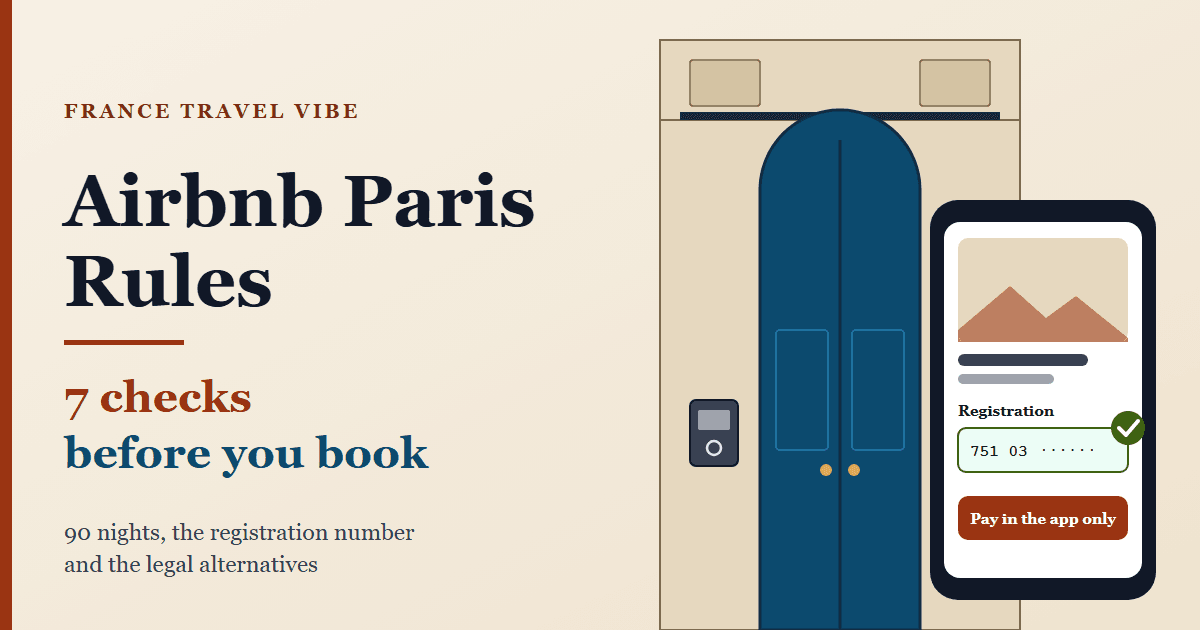
1. The registration number is there, and it makes sense. Paris numbers have 13 characters, a format set by decree no. 2017-678 of April 28, 2017. Their first five digits are the arrondissement’s official code, from 75101 for the 1st to 75120 for the 20th. Next come a six-digit identifier and a two-character key. So a flat in the Marais should start 75103 or 75104. No number, or one that doesn’t fit the area? I’d move on.
2. The host lives there. Look for books, clothes pushed aside and a profile that calls Paris home. Is it a bare “designer” flat with a key box? That fits a full-time rental, which in the 1st to 11th needs a permit.
3. The host doesn’t run a dozen flats. Tap the profile and look at the listing count. Concierge firms can legally manage main homes for their owners, so a big number is a warning sign, not proof.
4. The calendar doesn’t look endless. Airbnb says it closes a Paris main home’s calendar once the legal limit is reached (Airbnb, responsible hosting in France). Still seeing most of the year open in late autumn? Ask the host why.
5. You pay only through the platform. Never pay by bank transfer, gift card or a link sent by message. France’s official cybercrime help service warns about hosts who push you off the platform. Links and QR codes to a “secure” payment page are on its list too (cybermalveillance.gouv.fr, property rental scams, March 2025). You’ll find the same trick in my guide to tourist scams in France.
6. The tourist tax is charged. Every legal Paris listing collects it, so a booking with no tax line is a flag. My guide to France’s tourist tax explains the rates.
7. The photos are its own. Running a reverse image search takes a minute. If the same photos show up under another name or city, it’s a fake.
Here’s what I found when I ran the first checks. On September 29, 2026, I read 48 whole-flat Airbnb listings inside Paris for the night of November 17. Forty-five showed a 13-digit number.
Three were marked exempt as hotel-type listings, a category aparthotels and serviced flats can use. Three of the 45 numbers didn’t match any arrondissement code: one looked like a postcode typed in by mistake, one like a placeholder, and one used a code that doesn’t exist. One number appeared on two listings from two different hosts. That can happen when a flat changes manager, but it’s worth asking about. And 18 of the 48 came from hosts who manage five or more Airbnb listings, including five hosts with 20 or more.
None of that proves a single listing is illegal. It does show why a number on the page isn’t enough on its own.
How Many Airbnbs Are There in Paris, and How Many Are Legal?
In October 2025, Airbnb listed 82,045 Paris homes. Of those, 53,812 were available to book and 48,322 were whole homes, about 3.5% of the city’s dwellings (APUR, note 281, January 2026). How many of those are illegal? The city’s estimate is about 25,000 (The Local, 2026).
Those whole homes cluster in the centre. In Paris Centre, the old 1st to 4th arrondissements, 9.6% of all homes were listed as whole flats. In the 2nd it reached 12.5% (APUR). My guide to where to stay in Paris covers what that means for each area.
How can there be so many if the rules are this strict? Many are legal main homes let for part of the year. In December 2024, Paris counted more than 95,000 declared tourist lets, 78,000 of them main homes (Ville de Paris, rentals limited to 90 days, December 2024). The trouble is the flats rented all year without one of the 548 change-of-use permits.
What Are the Airbnb Paris Rules for Hosts?
A host needs a main home, a registration number and no more than 90 nights a year, or a change-of-use permit. Since the Le Meur law of November 2024, fines run from €10,000 for a missing number to €100,000 for an unauthorised change of use (service-public.fr, what the furnished-let law changes, January 2025). Paris collects them.
The city’s English rules page still prints the older €5,000 and €10,000 for a missing number and for going over the cap. Under the law, it’s now €10,000 and €15,000.
Paris collected €1.3 million in rental fines in 2024 and €2.4 million in 2025. Deputy mayor Jacques Baudrier put the first three months of 2026 at about €1 million more (AFP, via Batiweb). On April 15, 2026, a Paris court handed down the record so far: €585,000. A property company had turned a former social residence in the 9th into 11 tourist flats (AFP, via Batiweb; The Local, April 2026).
You may have read that France’s national rental register started on May 20, 2026. It didn’t. That day an EU regulation, 2024/1028, began making platforms collect and check registration numbers (EUR-Lex, summary of Regulation (EU) 2024/1028). France’s own national registration service is due in the fourth quarter of 2026 (DGE, API Meublés, updated July 2026). Until then, the city’s numbers stay valid.
Is an Apartment Cheaper Than a Hotel in Paris?
For two people, often not. For four, usually yes. In October 2025 the median whole-flat Airbnb in Paris cost €162 a night (APUR, note 281, January 2026). On Booking.com, a 3-star double for a November night had a median of €233.50 in the 1st to 7th. Six outer areas came in at €166.
| One night, November 17, 2026 | 2 adults: room + tax | 4 adults: room + tax |
|---|---|---|
| Whole flat at the Paris median (APUR, Oct 2025) | €162 + €26.33 = €188.33 | €162 + €26.33 = €188.33 (bigger flats cost more) |
| 3-star, 1st to 7th (Booking.com median) | €233.50 + €11.06 = €244.56 | €467 + €22.12 = €489.12 (two rooms) |
| 3-star, 9th, 10th, 11th, 12th, 15th and 18th (Booking.com median) | €166 + €11.06 = €177.06 | €332 + €22.12 = €354.12 (two rooms) |
That’s a model built from medians, not a quote. Hotel prices are the ones I read on Booking.com on September 28, 2026, before tax. APUR’s flat median covers every size, from studios up, and it’s before cleaning and service fees. That median also varies by area, from €252 in the 8th to €110 in the 20th.
Why is the flat’s tax so high? Paris taxes an unclassified flat at 5% of the price per person per night, plus three surcharges, up to €15.93 per adult. Below that cap, it comes to about 16% of the nightly price however many people share it. A 3-star hotel charges a fixed €5.53 per adult (Ville de Paris, 2026 tourist tax rates).
So what tips it? Cleaning fees hit short stays hardest, so a flat pays off over four or five nights, not one. Having a kitchen saves you a restaurant meal or two.
What Are the Legal Alternatives to an Airbnb in Paris?
A hotel, an aparthotel, a room in a host’s home or a hostel. On January 1, 2026, Paris had 92 tourism residences, the formal name for aparthotels, with 16,914 beds. Paris also had 23 hostels with 5,692 beds (INSEE, tourist accommodation capacity, Paris, August 2026). Each is legal by design.
Aparthotels are the easy middle ground. You get a kitchen and a sofa, with a reception desk and no registration puzzle. They’re classified like hotels, so the tourist tax is a fixed amount per night. For families and stays of a week or more, it’s where I’d look first.
A room in someone’s home is the other legal Airbnb. No registration is needed, because the host still lives there (Ville de Paris). Solo travellers and couples on a budget do well here, if they don’t mind sharing a kitchen.
Hostels are cheapest. When I checked in September, a bed at HI Paris Yves Robert started at €30.60 for an October 2026 night.
Hotels still win most first trips, for the reasons in the Paris travel guide. Budget chains fill the gap between hostels and 3-star hotels, and budget hotels in France, priced chain by chain shows which one wins where.
Can You Rent a Paris Apartment for a Month?
Yes, but not the way many sites suggest. The bail mobilité is a furnished lease of one to ten months. It’s only for tenants in study, training, an internship, civic service or a work posting (service-public.fr, bail mobilité rules, 2025). A holiday doesn’t count, which leaves a tourist three options:
- A host’s main home, within their 90 nights. A month uses a third of the host’s year, so these are rare, but they exist.
- An aparthotel, most of which offer weekly and monthly rates.
- A furnished lease of a year or more, if you’re actually moving to Paris.
A “30-day Airbnb” in central Paris can be a full-time rental dressed up as a long let. If a listing only takes stays of 30 nights or more and the host has many flats, I’d be careful.
Staying longer than a month? Check my guide to France’s entry requirements for how long you can stay.
Frequently Asked Questions
Is Airbnb legal in Paris?
Yes. A host can let their main home for up to 90 nights a year, with a registration number on the listing. A second home needs a change-of-use permit, and only 548 have been granted since 2010, according to APUR.
Can I get fined for staying in an illegal Airbnb in Paris?
No. Every fine in the Paris rules falls on the host or the agency, up to €100,000 for an unauthorised full-time rental. Your risk as a guest is practical. The stay can be cancelled if the flat is caught, the listing can be fake, or a host can ask you to pay off the platform.
What does a Paris Airbnb registration number look like?
It has 13 characters. The first five are the arrondissement’s official code, from 75101 for the 1st to 75120 for the 20th. A six-digit identifier and a two-character key follow. When I checked 48 listings in September 2026, 3 numbers didn’t match any arrondissement code.
Is an Airbnb cheaper than a hotel in Paris?
For four people, usually. The median whole-flat Airbnb in Paris cost €162 a night in October 2025, according to APUR. Two 3-star rooms had a median of €332 to €467 for a November 2026 night on Booking.com. For two people, a 3-star hotel outside the centre costs about the same.
How many illegal Airbnbs are there in Paris?
The city estimates about 25,000. For scale, Airbnb listed 48,322 whole homes in Paris in October 2025, according to APUR. Paris collected €2.4 million in rental fines in 2025, almost double the year before, according to the city.
The Bottom Line
- Legal flats are the host’s own home, let for 90 nights a year, or one of the rare flats with a permit.
- You won’t be fined, but an illegal flat can vanish from your trip.
- Check the number: 13 characters, starting 751 plus the arrondissement.
- Pay on the platform, every time.
- For families, a legal flat or an aparthotel beats two hotel rooms.
The Airbnb Paris rules are strict, but they’re easy to use once you know what to check. Pick your area first with my guide to where to stay in Paris, then choose your next base in my guide to where to stay in France.