
Last verified: September 6, 2026. Every price and booking rule in this guide was checked on the operator’s own page on the date above. That means the Louvre, the Château de Versailles, the Eiffel Tower’s operator, the Centre des monuments nationaux, Chambord, Lascaux, the Chamonix lifts, Les 3 Vallées and the cooking schools. Three of these sites changed their pricing in January 2026 and the seasonal rules reset every spring, so I re-check this page monthly and update the date each time.
In 2025 the Louvre took 9 million visitors and France’s hundred national monuments passed 12 million entries for the first time (franceinfo, citing the institutions, January 2026). The Eiffel Tower sold 6.75 million tickets (SETE, 2026). Every one of those records was set before the biggest change in years. In January 2026 the Louvre, Versailles and Chambord started charging by passport.
Most lists of things to do in France don’t know that yet. They run to fifty-five items, carry a booking button on every entry, and print no prices at all. They tell you what’s beautiful. They don’t tell you what now costs €32 because of the passport you carry, what opens for booking three days out, or what’s free.
So I priced the whole list myself. Here are fifteen experiences, ranked by what they actually cost you in euros and in queue. Each comes with its 2026 price, its booking rule, its season, and the deeper guide that goes with it.
Disclosure: Some links in this guide may earn us a commission, at no extra cost to you. It never changes what we recommend.
Key Takeaways
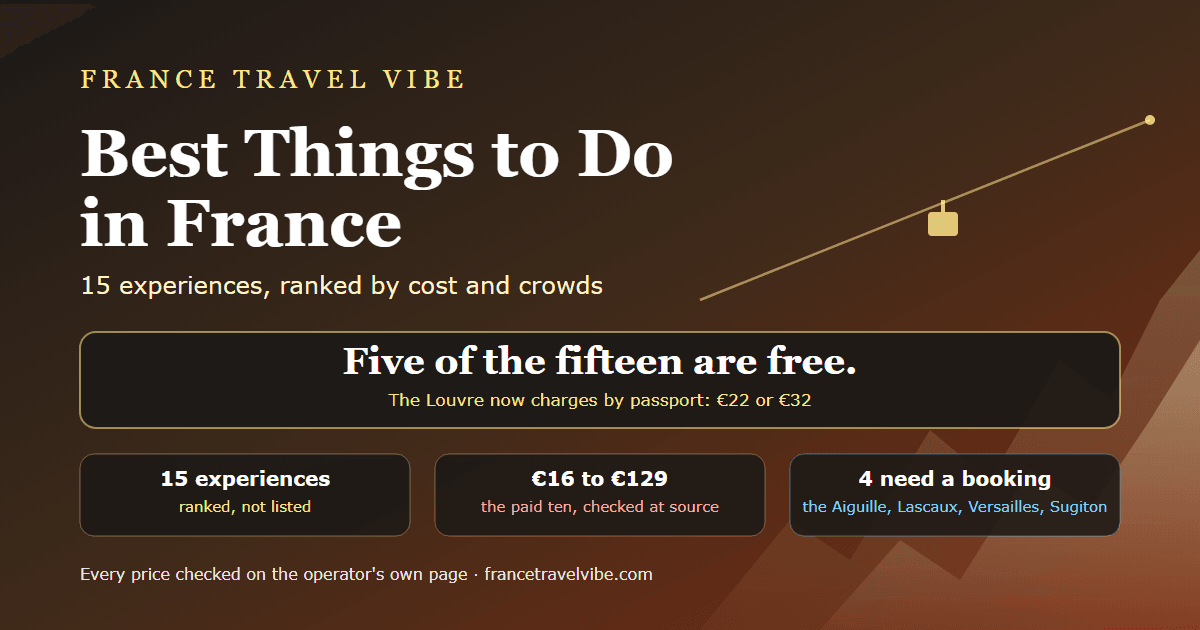
- Five of the fifteen best things to do in France are free. The paid ten’s headline tickets run from €16 at Mont-Saint-Michel’s abbey to €129 for a Paris cooking class, and the Eiffel Tower’s stairs undercut that at €14.80.
- Three flagship sites price by passport since January 2026. The Louvre is €32 for non-European visitors against €22 (Musée du Louvre, 2026), Versailles €35 against €32 in high season, Chambord €31 against €21.
- Four experiences are booking-only in season: the Aiguille du Midi, Lascaux IV, the Versailles palace time slot, and Sugiton cove from late June.
- The Eiffel Tower’s free forecourt drew some 10 million people in 2025, while 6.75 million bought a ticket to go up (SETE, 2026).
- The D-Day beaches joined the UNESCO World Heritage List on July 26, 2026, and they’re still free.
What’s in This Guide
Where Do France’s Visitors Actually Spend Their Time?
On about ten sites. France took 102 million international visitors in 2025, and they spent €760 a stay on average (Atout France, February 2026). The biggest of those sites aren’t all in Paris. In 2025 the Louvre took 9 million visitors (franceinfo, January 2026). Versailles took 8.4 million (News Tank Culture, citing the château, January 2026), and the Eiffel Tower sold 6.75 million tickets. Beyond Paris, Normandy’s memorial sites logged 5.9 million entries (Normandie Tourisme, May 2026) and France’s ski areas sold 54.8 million skier-days (Domaines Skiables de France, 2025).
That second set of numbers is the one the lists miss. Memorial tourism accounts for 27 percent of all visits to Normandy’s sites. The American Cemetery at Colleville-sur-Mer alone took 1.4 million people in 2025 (Normandie Tourisme, bilan 2025 du tourisme de mémoire, May 2026). In Atout France’s last count, 12 million people visited a French vineyard in a year, 5.4 million of them from abroad (Atout France, oenotourisme, 2023 data published 2025).
And the busiest park in France outside the Disneyland Paris resort is a history park in the Vendée. Puy du Fou passed 3 million visitors in 2025 for the first time (France 24, via AFP, October 2025).
What does “most visited” tell you about crowding? Less than you’d think. Versailles spreads 8.4 million people across an 800-hectare estate, and 81 percent of them are foreign, so the palace itself is what fills (News Tank Culture, January 2026). The Aiguille du Midi moves less than a tenth as many people through one cabin on a reservation system, and it feels fuller.
Still choosing regions rather than experiences? My ranking of the best places to visit in France answers where to go. This page answers what to do once you’re there. For entry rules, budgets and the practical layer underneath both, my complete France travel guide covers the rest.
How I Ranked These 15 Experiences
Fame doesn’t decide where an entry lands on this list of things to do in France. Four things do. What it costs in 2026, with the passport tier applied. How much booking friction it carries. How bad peak-season pressure gets. And whether it holds you for more than half a day. The Michelin Guide’s 2026 selection lists 668 starred restaurants in France (Michelin, 2026), which is why “eat well” is a given here rather than an entry.
A few things got left off on purpose. Disneyland Paris is the most visited paid site in the country, at 15.8 million in 2024 (Forbes, citing TEA/AECOM, November 2025), and it needs no help from me. Puy du Fou earns a mention above and will earn its own guide. Corsica’s ferry overhead and Biarritz’s short surf season kept them off too.
The honest disclosure is that a shortlist is a set of trade-offs, not a verdict. I’ve spent weeks at a time in France and my own list would have Lascaux above the Louvre. But the Louvre fits a first trip, and Lascaux needs a car and a week in the south-west. So the ranking below leans on what a real itinerary can carry, not on what I’d do with unlimited days.
The 15 Best Things to Do in France
Ranked by value for what they cost you. Each entry gives the 2026 adult price, both tiers where they exist, the booking rule, the season, and the guide that goes deeper.
1. Stand on the D-Day Beaches
Free, all year, and since July 26, 2026 on the UNESCO World Heritage List as “Les Plages du Débarquement, Normandie, 1944”, six sites over 80 km of coast (Normandie Tourisme, July 2026). In 2025 Normandy’s memorial sites logged 5.9 million entries, and the American Cemetery at Colleville-sur-Mer took 1.4 million of them (Normandie Tourisme, May 2026).
Beaches, cemeteries and Pointe du Hoc cost nothing. The Caen Memorial is the paid anchor.
One thing to route around: the Bayeux Tapestry is in London until July 2027, and its museum reopens in autumn 2027 (Bayeux Museum, 2026). My six-day Normandy itinerary plans the coast around that gap. Whether to do it with a guide or a car depends mostly on how many of you are going, and a guided tour or self-drive on the D-Day coast prices both.
2. Cross to Mont-Saint-Michel at Low Tide
€16 for the abbey from April 1 to September 30, €13 from October to March, free under 18 and for EU residents aged 18 to 25 (Abbaye du Mont-Saint-Michel, Centre des monuments nationaux, 2026). The abbey took 1.6 million ticketed visitors in 2025 (franceinfo, citing the CMN, January 2026). The island itself is free.
What catches people is the car: €28 to park in high season, then a free shuttle from 2.5 km out (Établissement Public du Mont-Saint-Michel, 2026). Arrive for the morning opening or the last two hours, and check the tide table the day before. The bay’s biggest tides cover the causeway’s approaches, which is the show.
3. Walk into Notre-Dame, Then Climb the Eiffel Tower by the Stairs
Notre-Dame’s nave is free again, and about 11 million people walked through it in the first year after the December 2024 reopening, roughly 30 percent more than before the fire (CTV News, via AFP, December 2025). Go before 9am or after 6pm and the queue is minutes.
Its priced half is the Eiffel Tower. Stairs to the second floor cost €14.80 against €23.50 by lift, the lift to the top €36.70, and stairs plus lift to the summit €28 (toureiffel.paris, 2026). If you stop at the second floor, the stairs save you €8.70 against the lift to the same floor, €21.90 against the summit lift, and most of the queue. My four-day Paris guide orders these two with the museums.
4. Hike into the Calanques
Free, on a reservation. Sugiton cove sits in the national park inside Marseille’s city limits, and it needs a free, mandatory booking in season. In 2026 that meant June 20 and 21, every day from June 27 to August 30, and September 5, 6, 12 and 13. The booking opens at 9am three days before your visit and closes at 6pm the day before (Parc national des Calanques, 2026). The quota is 400 a day (Made in Marseille, June 2026), against peaks of 2,500 before the system.
Every other cove is open without booking, subject to the préfecture’s daily fire colour from June to September. The city bus gets you to the trailheads. My Marseille guide has the bus lines, the walk times and the colour map explained.
5. Cycle the Loire Between Châteaux
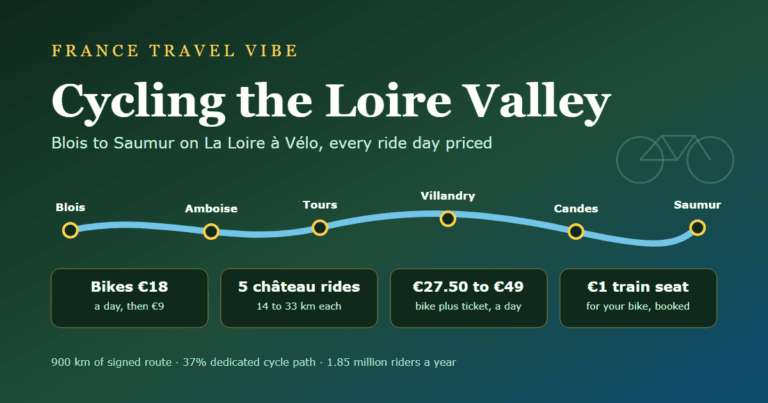
The signed Loire à Vélo route runs 900 km, carried 1.8 million cyclists in the two regions’ last full study, and those cyclists spent about €69 a day (Régions Centre-Val de Loire and Pays de la Loire, étude de fréquentation 2022, published 2024). Riding is flat, the châteaux sit a short detour off the path, and a day’s rental costs less than one palace ticket. My guide to cycling the Loire Valley has the routes, bike rental and château stops.
Which palace? Chambord charges €31 if you’re neither a citizen nor a resident of the European Economic Area, and €21 if you are (Domaine national de Chambord, 2026). My Loire châteaux comparison picks three from the €14 to €31 range.
6. Taste Wine Where It’s Made
In Atout France’s last count, 12 million people visited a French vineyard in a year, 55 percent of them French and 45 percent from abroad, spending €5.4 billion in total (Atout France, 2023 data published 2025). Bordeaux and Champagne take the largest shares of those visitors, at 18 and 17 percent.
Alsace is the budget entry, where cellar-door tastings in the villages between Colmar and Strasbourg are still mostly free. My Alsace wine route runs six villages in three days on that basis. For the big three, my Lyon versus Bordeaux comparison settles which city makes the better wine base. For the regions themselves, Burgundy, Bordeaux and Champagne compared on price, trains and booking picks one by the days you have.
7. Catch the Lavender Window
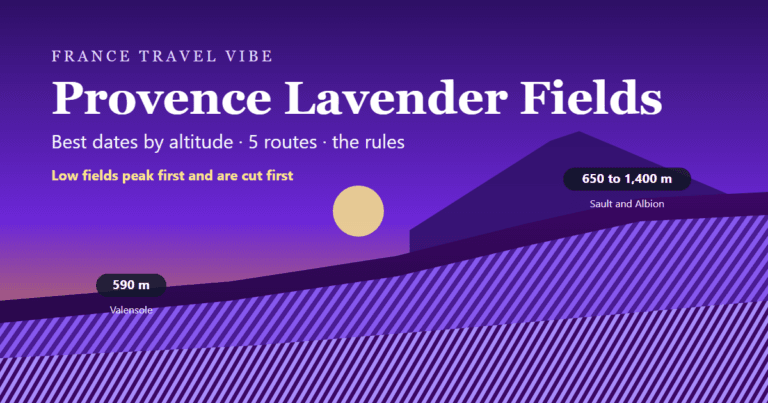
Free, and shorter than the postcards suggest. Lavender has two windows. The Valensole plateau, the lower of the two, peaks from late June to the first week of July, with harvest from mid-July. The Pays de Sault, above 800 metres, holds into August with a fraction of the crowds.
I’ve written the timing and the one rule nobody prints, that Sénanque abbey forbids access to its own field, in my Provence itinerary.
Heat is the honest caveat. In late June 2026 Paris sites were already closing early in the year’s first heatwave (France 24, June 2026), and Provence’s hills close on the préfecture’s colour map in the same weeks. Go at seven in the morning, before the heat and the coaches. The week-by-week calendar, five routes and the bus times are in my Provence lavender fields guide.
8. See the Louvre, and Time It Right
€22 if you’re a citizen or resident of the European Economic Area, €32 if you’re not, since January 14, 2026 (Musée du Louvre, 2026). Under-18s are free, and so are EEA residents under 26. My guide to Louvre tickets works through the six rules that set your price. A time slot is recommended, and in practice it’s sold out for weeks from May to September. It took 9 million visitors in 2025, 73 percent of them foreign, down from 77 percent the year before (franceinfo, January 2026).
Two ways in for less. The Louvre is free on the first Friday of the month after 6pm, except in July and August, and free for everyone on July 14. And the evening slots on any day are the quiet ones. My Paris guide pairs the museum with the days around it.
9. Do Versailles as a Full Day
The Passport ticket, which covers the whole estate, costs €35 in high season (April 1 to October 31) and €25 in low season, or €32 and €22 for EEA residents (Château de Versailles, 2026 ticketing, 2026). Only the palace itself needs a time slot. The Trianon estate alone is €15, or €12 for EEA residents.
That last option is the underrated one. The two Trianon palaces and their gardens take a full afternoon. On musical-fountain days the main gardens need their own €15 ticket, or €20 combined with Trianon (Château de Versailles, 2026), so the plain €15 Trianon day is for the other days. Versailles is under an hour from central Paris by RER, which is why it heads my list of day trips from Paris by train.
10. Walk the Alsace Christmas Markets
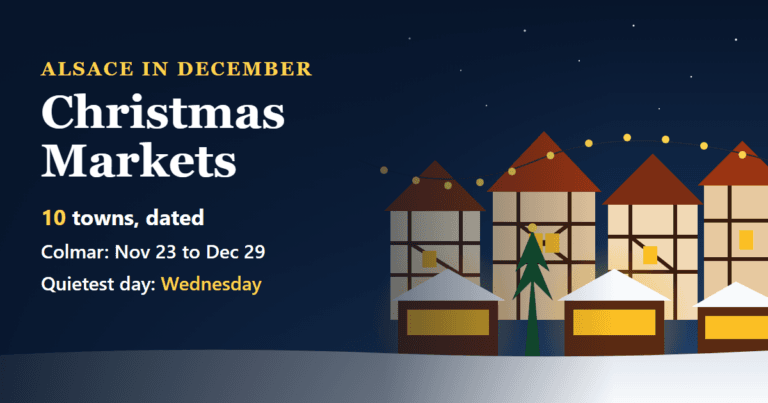
Free. Colmar’s market runs November 23 to December 29, 2026, with Eguisheim, Turckheim and Riquewihr opening from November 27 (Noël à Colmar, 2026). Strasbourg, whose market dates to 1570, had not published its 2026 dates as of September 6; its 2025 edition ran November 26 to December 24 (Noël à Strasbourg, 2026). Paris to Strasbourg is 1h47 by TGV (SNCF Connect, 2026). I’ve put the dates for ten towns and the quiet days in my guide to the Alsace Christmas markets.
Entry to every market is free. The mulled wine, the hotels and the weekend trains are where the money goes, and December Alsace fills fast. Base yourself in a wine village rather than in either city. My Alsace wine route names six.
11. Go Underground at Lascaux IV
€23 for adults, €15 for ages 5 to 12, free under 5 (Lascaux, 2026). Entry is on a timed slot, and the site asks you to arrive 20 minutes before it, with last admission two hours before closing. From late July to late August it opens at 8am and runs until 10pm, which tells you how full the middle of the day gets.
Lascaux is a replica, and it’s better than that word suggests. The original cave closed in 1963, and the full-size copy is the only way anyone will ever see the paintings again. It’s the car-required entry on this list, and the one that turns a Dordogne week into a plan. My Dordogne guide builds the week around it.
12. Cruise the Seine After Dark
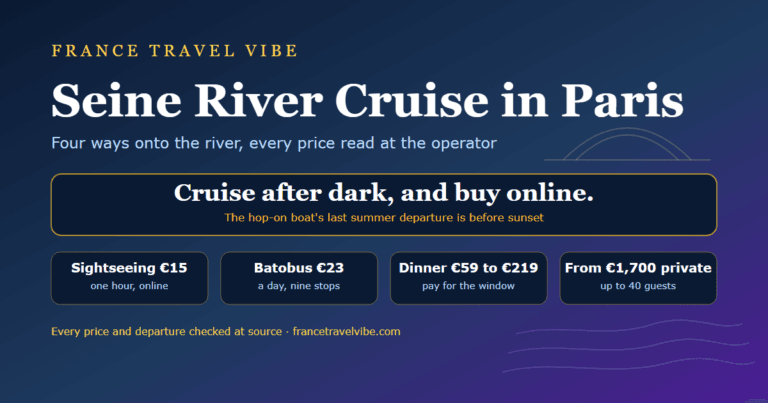
€20 for an adult, €10 for a child under 13, for the one-hour sightseeing loop from Bateaux Mouches at the pier, or €17 online (Bateaux Mouches, 2026). Its dinner cruises run from €90 to €170 a head, and across the river they run €59 to €219. Book the last departure after sunset; the bridges are lit and the boat is half empty.
Is it worth €20 when the riverbank walk is free? Yes, once. The Seine from water level is a different city, and an hour is the right length. For a second river hour, take the hop-on boat for about the same money and get off at the Musée d’Orsay. And which Seine river cruise to book depends more on the hour than on the company.
13. Take a Cooking Class
€129 for a three-hour technical class at La Cuisine Paris, whether that’s choux pastry, macarons or the soufflé (La Cuisine Paris, 2026). Le Cordon Bleu’s public workshops run from €80 for a 2h30 demonstration to €995 for a four-day bread and pastry course (Le Cordon Bleu Paris, 2026).
Pay for the market-then-cook morning: an hour at the stalls with the chef, then the kitchen, then lunch. It’s the most expensive entry on this list, and the only one you take home. Every regional city runs a version. Lyon and the Gard are cheaper, Nice and Bordeaux are not, and which cooking class format is worth the money prices all of them.
14. Ride the Aiguille du Midi
€83 return for an adult, from 1,033 metres in Chamonix to 3,842 metres (Chamonix tourist office, 2026). The whole visit takes two to three hours including the ride. It’s the most expensive single-site ticket here after the cooking class and a day’s ski pass, and one of the few with a reservation system for the cabins. It closes from November 2 to December 18, 2026.
A record 640,000 people rode it in 2024, 70 percent of them from abroad, which makes it the most visited tourist site in the Auvergne-Rhône-Alpes region (Groupe Ecomedia, 2025).
I’d repeat this one. Twenty minutes in a cabin and you’re standing above the Mont Blanc glaciers in a t-shirt at the bottom and a jacket at the top. Book the first cabin of the morning, before the cloud builds. And if you’d rather walk than ride, my Chamonix hiking guide for beginners prices five trails, lifts included.
15. Ski the Biggest Lift Systems in Europe
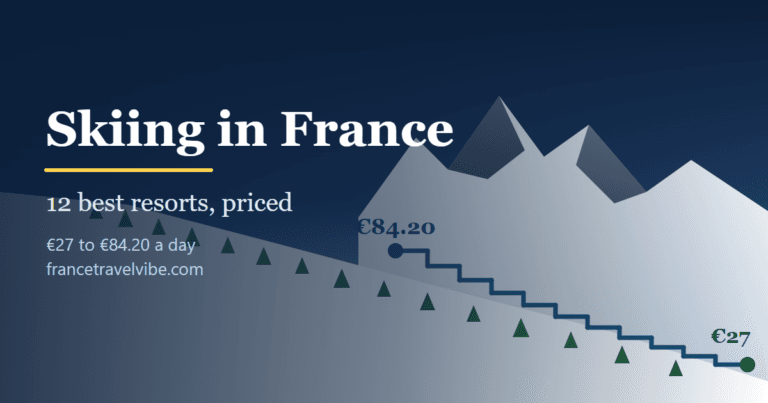
France sold 54.8 million skier-days in the 2024-25 season, up 5.5 percent, second in the world behind the United States and ahead of Austria (Domaines Skiables de France, 2025). In Les 3 Vallées, the largest linked area, a 2026-27 day pass costs €84.20 and a six-day pass €421 (Les Menuires, 2026). The early and late-season dates drop those to €75.70 and €378.50.
It ranks last because of cost alone. Add gear, lessons and a week’s lodging and skiing is the one experience here that behaves like a whole holiday. It’s also the one that needs the right packing list. If the cost is what puts you off, my guide to the best resorts for every budget prices twelve of them, from a €27 day pass upwards.
What Does Each Experience Cost in 2026?
Five of the fifteen are free. The other ten’s headline tickets run from €16 at Mont-Saint-Michel’s abbey in summer to €129 for the cooking class. The Eiffel Tower’s €14.80 stairs are the cheaper way into one of them. The median paid experience costs €33.50, a euro and a half more than the Louvre now charges a visitor from outside Europe (Musée du Louvre, 2026). Do all ten as a non-European adult and the tickets total €489.90. As a European, €466.90.
Every figure in this table was pulled from the operator’s own page on September 6, 2026. The non-EEA column shows a price only where one exists.
| Experience | 2026 adult price | Non-EEA price | Booking | Best window | Time it needs |
|---|---|---|---|---|---|
| D-Day beaches | Free (Caen Memorial paid) | Same | Walk up | April to October | Full day |
| Mont-Saint-Michel abbey | €16 summer, €13 winter | Same | Buy ahead in summer | May, June, September | Half day plus travel |
| Notre-Dame nave | Free | Same | Walk up, off-peak | All year | One hour |
| Eiffel Tower | €14.80 stairs, €36.70 summit lift | Same | Summit lift: book weeks ahead in season | All year, evenings | Two hours |
| Calanques, Sugiton | Free | Same | Free reservation, daily Jun 27 to Aug 30 plus three shoulder weekends | May, June, September | Full day |
| Loire by bike | Rental, plus châteaux from €14 | Chambord €31 vs €21 | Rental only | April to October | Two to three days |
| Wine tasting, Alsace | Mostly free at the cellar door | Same | Walk up | September harvest, December | Two to three days |
| Lavender | Free | Same | None | Late June to early July; Sault into August | Half day |
| Louvre | €22 | €32 | Time slot, weeks ahead in season | Evenings; first Friday free | Half day |
| Versailles Passport | €32 high, €22 low | €35 high, €25 low | Palace time slot mandatory | April to October, weekdays | Full day |
| Alsace Christmas markets | Free | Same | None | Nov 23 to Dec 29 (Colmar) | Two days |
| Lascaux IV | €23 | Same | Timed entry, arrive 20 min early | April to June, September; August for the cool | Half day plus travel |
| Seine cruise | €20 | Same | Same day, online | All year, after sunset | One hour |
| Cooking class | €129 (3 hours) | Same | Days to weeks ahead | All year | Half day |
| Aiguille du Midi | €83 return | Same | Cabin reservation | June to September; closed Nov 2 to Dec 18 | Half day |
| Skiing, Les 3 Vallées | €84.20 day pass | Same | Buy online ahead | Dec 5 to Apr 18 | Full week |
Free and paid pair up inside a single day. Notre-Dame’s nave in the morning and a €20 Seine cruise at dusk is a Paris day for €20. The beaches and the cemetery in the morning and the Caen Memorial after lunch is a Normandy day for one ticket. For how these prices sit inside a daily budget, my France trip cost breakdown does the arithmetic per day and per region.
Which Experiences Now Charge Non-EU Visitors More?
Three of the biggest. Since January 14, 2026 the Louvre charges €32 to visitors from outside the European Economic Area against €22 (Musée du Louvre, 2026). Chambord moved to €31 against €21 on the same date (Domaine national de Chambord, 2026), and Versailles’ 2026 Passport is €35 against €32 in high season (Château de Versailles, 2026). Under-18s stay free at all three, and EEA residents under 26 keep free entry at the state museums.
Notice what the tier isn’t. It isn’t age-based, and it isn’t a tourist surcharge in the Venice sense. It’s residency, checked with an ID at the desk, and it applies to a Swiss visitor as much as to an American. The Eiffel Tower, the Musée d’Orsay, Mont-Saint-Michel, Lascaux and the lifts didn’t follow. Across this whole list, the difference for a non-European adult is €23.
On its past grids the Paris Museum Pass has covered the Louvre and Versailles at one price for everyone, which makes it the workaround for a museum-heavy week. Its 2026 prices and terms sit on the official site only, so check them there before you buy from a reseller. And carry the ID that proves residency if you have it: the Louvre’s own page says residents under 26 need “valid photographic ID”, and the desk asks.
That same passport is the one ETIAS will check once it launches. The EU’s own portal says the system is not yet in operation and gives no start date, only a promise of several months’ notice (European Union, 2026). My France entry requirements guide has the current EES and ETIAS rules in one place.
Which Experiences Need a Booking Before You Fly?
Four are effectively mandatory. The Aiguille du Midi runs a cabin reservation system, and Sugiton cove is reservation-only every day from June 27 to August 30, plus three shoulder weekends. Versailles’ palace requires a time slot, and Lascaux IV sells timed entries and asks you to arrive 20 minutes before yours (Lascaux, 2026). The Louvre and the Eiffel Tower summit are “recommended” in name and sold out in practice from May to September.
How far ahead? It varies more than the lists admit. I’ve lost a Sugiton morning to the 6pm cut-off, and I’ve also walked into the Louvre at seven on a November evening without a slot.
- Sugiton: three days before, at 9am, closing at 6pm the day before (Parc national des Calanques, 2026). Up to five people per booking.
- Louvre and Versailles: weeks ahead for a summer weekend, days ahead in winter. Evening slots go last.
- Eiffel Tower summit: weeks ahead in season. Stairs tickets rarely sell out.
- Aiguille du Midi: book the day you fix your Chamonix dates; the first cabins of a clear morning go first, and a cloudy forecast empties the afternoon ones.
- Mont-Saint-Michel abbey: buy ahead in summer.
- Cooking classes: days to weeks ahead. The small-group market mornings fill first, and the regional schools fill last.
Walk-up entries on this list: the D-Day beaches, the lavender, the Christmas markets, the Seine cruise, and every calanque except Sugiton. Knowing a free reservation from a free site is the whole summer plan.
The destination-level caps, on Porquerolles, on Bréhat, and on cruise ships in Cannes and Nice, sit in my ranking of the best places to visit in France. Both lists reset season by season, which is why this page carries a verification date at the top.
When Each Experience Is at Its Best
This list runs on three calendars. Lavender is two to six weeks from late June, depending on altitude. The Christmas markets are five weeks from late November. Skiing runs from early December to mid-April in the big Alpine areas (Les Menuires, 2026). Everything else is best in May, June, September and early October. The sites keep long hours then, and the third quarter’s crowds, 43 percent of France’s commercial overnight stays, haven’t arrived or have just left (Atout France, bilan 2025, February 2026).
Summer changed the calculation in 2026. Paris sites closed early during the June heatwave (France 24, June 2026), and on July 8, the day of Marseille’s 40.5°C record, the Bouches-du-Rhône préfecture had shut every forest massif in the department, Sugiton bookings included (my Marseille guide has the dates). My own rule after a few French summers: anything with a walk goes before ten, anything with a ticket goes after four. Anything underground or air-conditioned is exempt, which is one more argument for Lascaux in August.
Versailles’ high-season dates double as a price signal. From April 1 to October 31 the Passport costs €10 more, and the palace is fuller. A weekday in the last week of October gets you high-season hours at a week’s distance from low-season prices. My month-by-month guide to the best time to visit France ranks all twelve months on the same trade.
Which of the Best Things to Do in France Are Free?
More than the price ladder suggests. Notre-Dame’s nave, the D-Day beaches and their cemeteries, the lavender fields, the Alsace Christmas markets, Sugiton cove and the Eiffel Tower’s forecourt all cost nothing. In 2025, 10 million people came to that forecourt and 6.75 million bought a ticket to go up (SETE, 2026).
The Louvre is free on the first Friday evening of most months and on July 14. For the price ladder above, the five I count as free are the Alsace tastings, the D-Day beaches, the lavender, Sugiton and the Christmas markets. Notre-Dame sits inside entry 3, which is scored on its paid half, the tower.
Put together, the free layer covers a full Paris day and a full Normandy day. Notre-Dame at nine, the Seine banks on foot, the tower from the Champ de Mars at dusk. Omaha Beach, the cemetery and Pointe du Hoc in one morning, with the only spend being the car. Add the free Friday evening at the Louvre if your dates land on one.
What “free” costs is transport and timing. The Mont’s parking is €28 in high season, the Calanques bus needs a ticket and Sugiton needs the reservation, and the lavender needs a car and a 7am start. None of that is a reason to skip them. Plan them first, and the paid days fit around them. My unwritten rules for a first France trip covers the small logistics that make the free days work. The etiquette behind the experiences, from bonjour to the bill, is in my French culture guide, and the dishes to look for in each region are in my French food guide.
Frequently Asked Questions
What is the number one thing to do in France?
By visitor numbers, the Louvre, at 9 million in 2025 (franceinfo, 2026). By value, Notre-Dame’s nave: free, central, and about 11 million people through the doors in its first year back (AFP, December 2025). With one day and one ticket, spend it on the Eiffel Tower stairs at €14.80 and give the Louvre a free Friday evening.
How many days do you need to see France?
Ten days covers Paris and one region with three or four of these experiences. Two weeks fits three regions. Seven days is Paris plus one day trip. France took 102 million international visitors in 2025, spending an average of €760 per stay (Atout France, 2026). My itinerary comparison settles the 7, 10 and 14-day shapes.
Which attractions in France have to be booked in advance?
Four are mandatory: the Aiguille du Midi’s reservation, Lascaux IV’s timed entry, the Versailles palace time slot, and Sugiton from June 27 to August 30 plus three shoulder weekends (Parc national des Calanques, 2026). The Louvre and the Eiffel Tower summit sell out weeks ahead from May to September. The rest need days, not months.
Do tourists pay more than locals at French museums?
Since January 14, 2026, visitors from outside the European Economic Area pay €32 at the Louvre against €22 (Musée du Louvre, 2026). A Versailles Passport is €35 in high season against €32, Chambord €31 against €21. The tier follows EEA citizenship or residency, not age, and under-18s are free at all three. Across all fifteen experiences here it adds €23.
What are the best things to do in France outside Paris?
The D-Day beaches, UNESCO-listed since July 2026 and free, and Mont-Saint-Michel’s abbey at €16. Then the Loire by bike, the lavender, the Calanques, and the Aiguille du Midi at €83. Normandy’s memorial sites alone drew 5.9 million entries in 2025 (Normandie Tourisme, 2026). Four of the six are under four hours from Paris by train and bus.
The Bottom Line
- Five of the fifteen are free, and the paid ten’s headline tickets run €16 to €129. Every price on this page comes from the operator’s own tariff page, checked September 6, 2026.
- Three flagship sites price by passport since January 2026. Louvre €32 against €22 (Musée du Louvre, 2026), Versailles Passport €35 against €32, Chambord €31 against €21. The whole list costs a non-European adult €23 more.
- Four need a booking before you fly. The Aiguille du Midi, Lascaux IV, the Versailles palace slot, and Sugiton every day from June 27 to August 30 plus three shoulder weekends (Parc national des Calanques, 2026).
- Once French schools go back in the first week of September, the crowd curve drops. The third quarter carries 43 percent of France’s commercial overnight stays (Atout France, 2026).
- The D-Day beaches are one of France’s newest UNESCO sites and still cost nothing. Inscribed July 26, 2026 (Normandie Tourisme, 2026).
One line to carry onto the plane. The best things to do in France aren’t the ones that cost the most. In 2026 the price depends on your passport, your dates, and whether you booked three days out. Start with the free ones, put the tickets where the tiers don’t reach, and the trip arranges itself around what’s left. The Louvre and Paris museums guide comes next, then the wine regions, and this page is re-checked as each one lands.