
Last verified: October 17, 2026. The rules below on what to pack for France were checked against SNCF’s and French customs’ own pages on the date above, not against other packing lists. Both carry penalties and both change, so I re-check this page monthly and update the date each time.
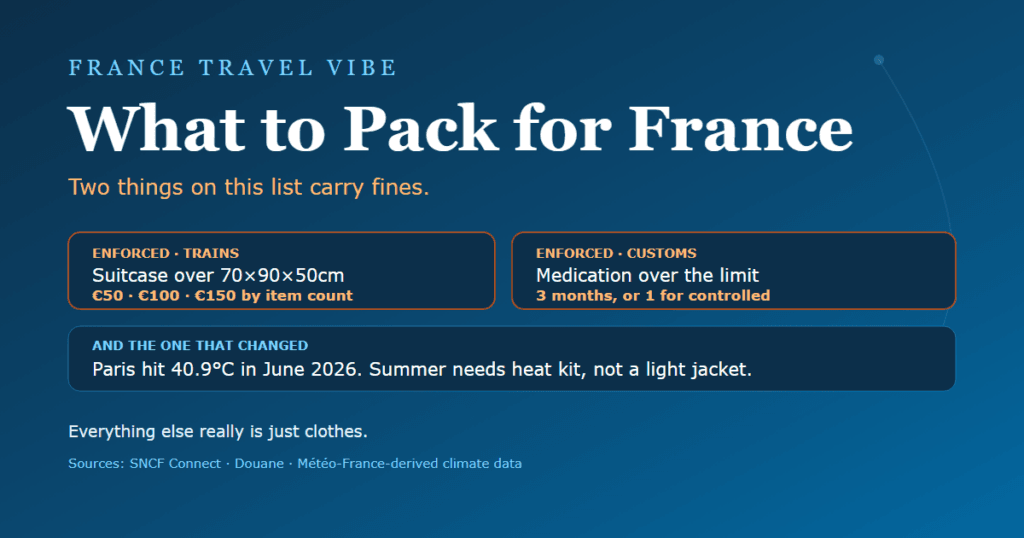
Two things on this list are enforced. French trains fine you €50 for an oversized bag, charged on the spot. French customs sets a legal ceiling on how much of your own medication you may carry. Everything else really is just clothes.
That’s the gap in every guide to what to pack for France I’ve read. They’re wardrobe lists, and the wardrobe is the part that can’t actually go wrong. So this one runs the enforceable rules first. Then a season-by-season list, built on what the French climate is doing now rather than what it did a decade ago.
Disclosure: Some links in this guide may earn us a commission, at no extra cost to you. It never changes what we recommend.
Key Takeaways
- The first rule of what to pack for France is a size limit: SNCF allows two suitcases at 70×90×50cm plus one hand luggage at 40×30×15cm. Fines run €50, €100 or €150 by item count (SNCF Connect, 2026).
- Ouigo is stricter and separate: one cabin bag at 55×35×25cm, €5 per extra item.
- Medication is capped at your prescription’s duration, or three months without one (Douane, 2026).
- Pack for five days whatever your trip length, then use a laverie.
Table of Contents
What Are the Packing Rules That France Actually Enforces?
Two, and the first one decides your suitcase. SNCF allows each passenger two suitcases up to 70×90×50cm plus one piece of hand luggage at 40×30×15cm, and non-compliance costs €50 for one item, €100 for two, and €150 for three or more (SNCF Connect, luggage conditions, 2026).
Here’s what no other packing list will tell you. The answer to what to pack for France changes with the ticket you bought. SNCF’s allowance above covers TGV inOui and Intercités. Ouigo runs a different, tighter policy: the basic fare includes one cabin bag at 55×35×25cm plus a handbag, with €5 for each additional item booked online and €20 if you only sort it out at the station (OUIGO, luggage rules, 2026). My guide to getting around France covers the fare differences in full. A case that’s perfectly legal on an inOui service can cost you on a Ouigo one; I watched a family of four pay the €20 at the Marne-la-Vallée gate for a third suitcase they could have declared for €5 the night before.
Two more requirements from SNCF’s own page rarely surface anywhere. All luggage must be labelled, so pack a luggage tag. And you must be able to carry everything yourself, unaided. That quietly rules out the two-large-cases-plus-a-carry-on approach on a train with stairs at both ends.
Working out what to pack for France is the last step of a longer plan. My complete France travel guide covers entry rules, budget, timing and transport.
Can You Bring Your Medication to France?
Yes, within limits French customs sets explicitly. You may carry a quantity matching your prescription’s duration, or three months’ treatment where there’s no prescription. For narcotics and psychotropics the ceiling drops to one month, and the original prescription becomes mandatory (Douane, travelling with medicines, 2026).
The practical version is short. Keep medication in its original labelled packaging and carry it in your hand luggage rather than the hold. Bring a copy of the prescription even when the rules don’t strictly require one. If you take a controlled medicine, check the documentation with Douane before you fly. The paperwork differs depending on whether you’re travelling inside or outside the Schengen area.
One reassurance from experience. I’ve bought antihistamines in Arles on a Sunday and blister plasters in a one-street village in the Lot, because French pharmacies are excellent, densely distributed, and staffed by pharmacists who advise directly. Anything ordinary you forget, whether painkillers, antihistamines, rehydration salts or blister plasters, you can buy within a short walk of wherever you’re staying. So pack the prescription medicine carefully and stop worrying about the rest.
What Should You Pack for a French Summer Now?
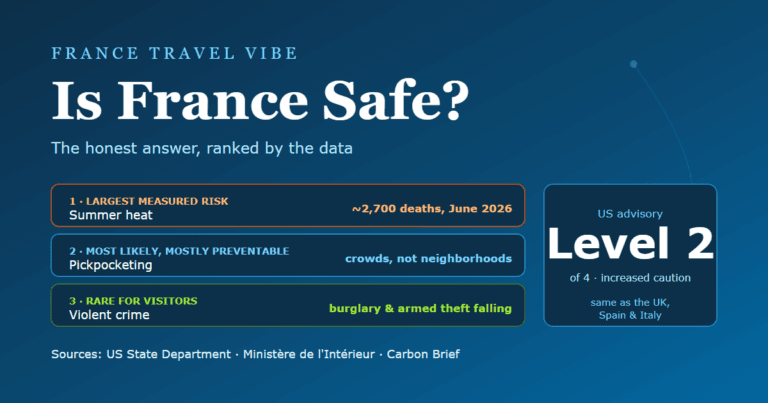
Heat kit, not holiday clothes. In June 2026, Paris set an all-time June record of 40.9°C, France’s national temperature indicator hit 30.0°C on 24 June, and by 25 June 72 of 96 metropolitan departments were under Météo-France red alert (Ara, 2026; Météo-France, bilan climatique juin 2026, 2026). My month-by-month ranking demoted June out of shoulder season entirely on the strength of it.
That changes what to pack for France in ways most guides haven’t caught up with. “A light jacket for cool evenings” was reasonable advice for a French summer that no longer reliably exists. What you want now is sun cover rather than warmth. Loose long sleeves in light fabric beat bare shoulders at 38°C. Add a hat that survives a suitcase, a refillable bottle for the public fontaines, and rehydration tablets. Older French hotel stock frequently has no air conditioning, and a top-floor room under a zinc roof is genuinely punishing. I learned that in a fifth-floor walk-up in Lyon one July, where the €25 fan I bought at Monoprix was the best purchase of the trip.
Pack for the schedule as well as the weather. Shifting sightseeing to before 11am and after 6pm, the habit my France safety guide recommends, means you carry less in the heat. Expect closures during red alerts too. Both the Louvre and the Eiffel Tower closed at 4pm from July 10 to 13, 2026 because of the heat (Sortiraparis, 2026).
What Do You Need for Spring, Autumn and Winter?
Layers and a real rain shell, and one detail catches people out. May is Paris’s wettest month by volume at 65mm, ahead of December’s 60mm. Spring in France is warm, green, and considerably damper than the photographs suggest. A packable waterproof matters more in May than a heavy coat does in December.
September is the month my ranking rates highest, at a 21.5°C average high on 45mm of rain in the 1991-2020 normals (Météo-France, 2025), and it’s the bag I’ve packed most often: light layers, one warm top for evenings, comfortable shoes. October holds up at 16.7°C. Winter city trips need a proper coat and genuinely waterproof shoes rather than snow gear, because Paris winters are mild, grey and wet rather than cold. The Alps are the obvious exception. Christmas market trips want gloves and thermal layers for standing still outdoors.
The “Dressing Like a Parisian” Myth, Debunked
Nobody is grading your outfit. France welcomed a record 102 million international visitors in 2025, more than any country has ever recorded (Campus France, 2026), and Paris in particular is thoroughly accustomed to tourists who look like tourists.
The genre of advice claiming French people “never wear” trainers, shorts or bright colours is unfalsifiable and largely invented. Walk through any French city in August and you’ll see all three; the last time I bothered to count, on the Cours Mirabeau in Aix, trainers won by a wide margin. What does exist is narrow and concrete. Some churches expect covered shoulders and knees, and a handful of higher-end restaurants expect smart-casual. One versatile outfit covers both, and that’s the entire dress code.
So the real constraint on what to pack for France isn’t style, it’s distance. French cities are walking cities with cobblestones, and Métro stations frequently have stairs and no lift. Bring shoes you can genuinely do 15,000 steps in, already broken in. Treat everything else as preference rather than rule. Worrying about looking foreign is normal, and it matters far less than the guidebooks imply.
What Gets Forgotten Most Often?
Four things, and none of them is clothing. Each is specific to what to pack for France rather than to travel generally, which is exactly why generic checklists miss them.
A Type E adapter. France uses the two-round-pin socket with an earth peg, running 230V at 50Hz. Cheap universal adapters sometimes fail to seat properly against the earth pin; I’ve had one drop out of a wall in a Bordeaux rental twice in one evening. Dual voltage matters on hair tools, because a single-voltage 110V styler will destroy itself in a French socket.
A Crit’Air sticker, if you’re driving. France’s low-emission zones (ZFE) are still in force, and entering one without the right vignette carries a €68 flat fine for a car. The official sticker costs €3.85 including postage from certificat-air.gouv.fr (service-public.fr, 2026) and takes a couple of weeks to arrive. Order it well before you travel and ignore the resellers charging ten times that.
A refillable water bottle. Paris and many French cities maintain public drinking fountains, which matter far more during a heat wave than they do in a mild summer.
A crossbody bag you can wear in front, rather than a backpack. That single choice removes most of the pickpocketing exposure described in my France safety guide.
Documents round out what to pack for France. Check your entry requirements for biometric EES readiness. Sort whether you need an eSIM before you fly rather than at the airport. Store a photo of your passport page somewhere separate from the passport itself. And pack that luggage tag, because SNCF requires labelled bags.
How Much Should You Pack for Your Trip Length?
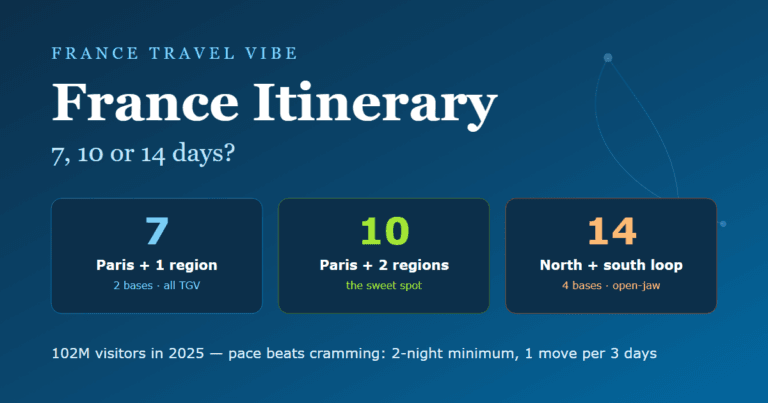
Five days’ worth, whatever the trip length. My 7, 10 or 14-day itinerary comparison shows most France trips change base every three to four days, and a change of base is when laundry becomes possible.
A laverie automatique is easy to find in any French town of reasonable size. I’ve done this in Paris, Lyon and Avignon: a few euros a load, about an hour, and a café next door for the wait. Set against dragging a two-week suitcase up Métro stairs, that hour is cheap. The oversized suitcase is the classic mistake in what to pack for France, and the train rules now put a price on it.
The other half of the same principle: buy what you forget once you arrive. Pharmacies handle anything medical and ordinary. Monoprix and similar cover clothing basics and toiletries, and the cost barely registers against the wider trip budget. Packing for every contingency is how a five-day bag becomes a fined one.
Frequently Asked Questions
What should I pack for France?
Start with the two enforced rules: train luggage within SNCF’s 70×90×50cm limit and medication within customs limits. Then pack about five days of season-appropriate clothing, walking shoes, a Type E adapter and a rain shell. Do laundry rather than packing more.
What plug adapter does France use?
Type E, the two-round-pin socket with an earth peg, running 230V at 50Hz. Check that hair tools are dual-voltage before packing them, since a single-voltage 110V device will be destroyed. Cheap adapters sometimes fail to seat against the earth pin.
How big can my suitcase be on French trains?
On TGV inOui and Intercités, two suitcases up to 70×90×50cm plus hand luggage at 40×30×15cm, with fines of €50, €100 or €150 by item count (SNCF Connect, 2026). Ouigo is stricter: one 55×35×25cm cabin bag, €5 per extra item.
Can I bring my prescription medication to France?
Yes. French customs allows your prescription’s duration, or three months without one, dropping to one month for narcotics and psychotropics where the original prescription is mandatory (Douane, 2026). Original packaging, hand luggage, prescription copy.
What should I wear in France in summer?
Sun cover rather than warmth. Paris hit an all-time June record of 40.9°C in 2026, so pack loose light long sleeves, a hat, a refillable bottle and rehydration tablets. Many older French hotels have no air conditioning.
The Bottom Line: Rules First, Wardrobe Second
Knowing what to pack for France is mostly about knowing which two items carry a penalty, and then relaxing about everything else.
- Train luggage is a rule. SNCF: two cases at 70×90×50cm plus hand luggage; fines from €50. Ouigo is tighter. Label your bags.
- Medication is a rule. Prescription duration, or three months; one month for controlled medicines, with the original script.
- Summer means heat kit. Paris reached 40.9°C in June 2026.
- May is wetter than December. Pack the rain shell for spring.
- Pack five days and do laundry. Then buy anything you forgot when you get there.
Start with my complete France travel guide for the rest of the planning, and pick your dates with the month-by-month ranking, because the month you choose changes this list more than anything else.