
Last verified: October 17, 2026. Every price on this page was checked against the provider’s own site on the date above, not against comparison blogs. eSIM pricing and carrier roaming terms both change often, so I re-check this page monthly and update the date each time. October 2026: Airalo dropped its fixed-data France plans and Orange Holiday became Orange Travel, so every price below is new.
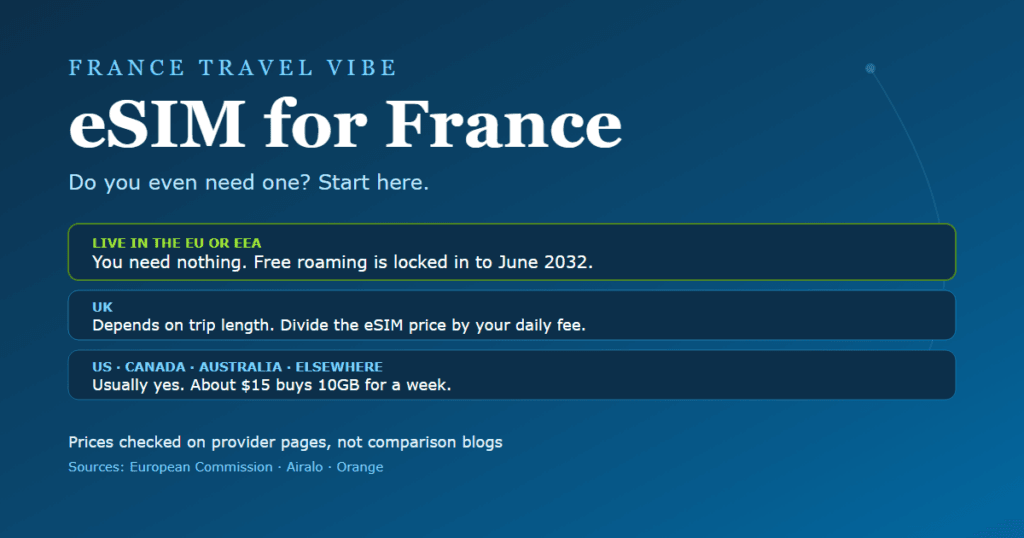
Most people shopping for an eSIM for France already own what they’re about to buy. Live in the EU or the EEA? Your phone works in France at no extra cost, and it will keep doing so until at least 30 June 2032 (European Commission, Roam like at home).
That fact rarely leads these articles, and the reason is structural. Nearly every “best eSIM for France” page earns a commission when you buy one. So here’s the version written the other way round. First, whether you need to buy anything at all. Then the four real options, priced from the providers’ own pages.
Disclosure: Some links in this guide may earn us a commission, at no extra cost to you. It never changes what we recommend.
Key Takeaways
- EU and EEA residents need no eSIM for France at all. “Roam like at home” is guaranteed through 30 June 2032 (European Commission).
- UK travelers pay a daily fee, so a flat-rate eSIM usually wins on longer trips. Find your own break-even below.
- A travel eSIM for France runs £11.99 for 10GB over 7 days on Orange Travel’s own data-only plan, the cheapest fixed-data option I found in October 2026 (Orange Travel, 2026). Airalo now sells France as unlimited-only, €10.50 for 3 days to €22 for 7 (Airalo, 2026).
- Staying weeks, or want a French number? Orange Travel, the renamed Orange Holiday, is £25.49 for 50GB over 30 days data-only, £33.49 with unlimited calls and texts.
Table of Contents
Do You Actually Need an eSIM for France?
Probably not, if you’re European. The EU’s “roam like at home” rules let residents of the EU and EEA use their normal plan across the bloc at no surcharge. In 2022 the regulation was extended for another decade, to 30 June 2032 (European Commission, Roam like at home for 10 more years). Ukraine and Moldova joined the free-roaming area at the start of 2026.
Now put that next to who actually visits France. Around three-quarters of France’s international visitors come from Europe: 76% of 2025’s foreign nights were European (Atout France, bilan 2025, 2026). So the majority of people searching for an eSIM for France are already covered by a regulation they’ve forgotten about. This is the single most useful thing an eSIM guide can tell you, and it’s the one thing a commission-funded guide can’t lead with.
So the real question isn’t which eSIM. It’s which of four situations you’re in:
- You live in the EU or EEA: you need nothing. Check your plan’s fair-use data cap for roaming, and that’s it.
- You live in the UK: it depends on your carrier’s daily fee and how long you’re going. The math is in the next section.
- You live in the US, Canada or Australia: usually yes, unless your plan already includes international data. Check before you buy.
- Anywhere else: almost certainly yes.
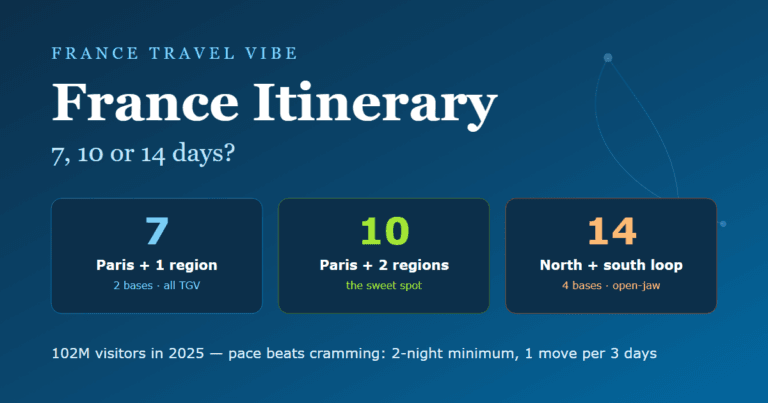
Connectivity is one small piece of a bigger plan. My complete France travel guide covers entry rules, costs, timing and transport, and how long you’re going shapes this decision too, so see the 7, 10 or 14 day comparison.
What If You’re Travelling from the UK?
Then it comes down to arithmetic. Since Brexit, most UK networks charge a daily fee to use your allowance in Europe. Expect somewhere between £2 and £5 a day depending on carrier and plan (MoneySuperMarket, roaming charges explained, 2026). A flat-rate eSIM costs the same whether you stay three days or fourteen.
So there’s a crossover point, and no competitor publishes it. Take Orange Travel’s 10GB France plan at £11.99 for seven days. Against a £2-a-day carrier fee, the daily pass stays cheaper for the first five or six days, then the eSIM wins. Against a £5-a-day fee, the eSIM wins after about two days. Don’t trust a table that goes stale whenever a carrier reprices. Find your own number instead: divide the eSIM price by your carrier’s daily fee, and that’s the trip length where buying starts to pay.
Two caveats before you switch. Some UK plans still include European roaming at no extra charge, particularly business tariffs, so check yours before assuming a fee applies. And a daily pass uses your existing allowance and keeps your own number working normally, which an eSIM data plan does not.
How Much Data Do You Actually Need?
Less than the plans are sized for. Maps, messaging, boarding passes and occasional browsing are light: a week of ordinary travel use typically runs a few gigabytes, not tens. Three things burn data fast, and none of them is navigation. Video streaming, cloud photo backup running quietly over cellular, and hotspotting a laptop for an afternoon of work.
This matters because unlimited plans are the most heavily marketed option in the category, and for most travelers they’re the worst value. Price it per gigabyte you’ll actually use. A 10GB plan at £11.99 works out around £1.20 a gigabyte if you use it all, which beats paying a premium for unlimited data you won’t touch. Unlimited earns its price in exactly two cases: daily video streaming, or tethering a laptop for work.
Three habits cut usage sharply, and the first matters most in France. Download offline maps for your cities and regions before you leave, plus the offline French pack for your translation app, which my basic French for travelers guide explains. That also saves you when the signal drops on a rural drive or in a tunnel, so it’s worth doing whatever your plan, and it pairs well with getting around by TGV and rental car. Turn off cloud photo backup until you’re on wifi. And set streaming apps to download over wifi only.
eSIM or French SIM Card: Which Suits Your Trip?
Trip length decides it. A travel eSIM for France suits stays under about two weeks, while a French carrier plan suits longer stays, heavy use, or anyone needing a French number. Orange Travel, the renamed Orange Holiday, sells data-only France plans from £3.49 for 1GB over 7 days to £25.49 for 50GB over 30 days, and the same 50GB with unlimited calls and texts for £33.49 (Orange Travel, 2026). Airalo’s France eSIM is now unlimited-only, €22 for 7 days and €54.50 for 30, while its Europe regional eSIM still sells fixed data at €24 for 10GB over 7 days (Airalo, 2026). Both shops price in your home currency at checkout; the figures here are what I saw in October 2026.
The distinction people get wrong is eSIM versus physical SIM, which isn’t really the choice any more. Orange Travel is an eSIM too. The actual choice is between a travel data plan and a French carrier plan, and they differ in what you get beyond data.
| Travel eSIM | French carrier plan | |
|---|---|---|
| Example | Orange Travel, 10GB / 7 days | Orange Travel with calls, 50GB / 30 days |
| Price | £11.99 | £33.49 |
| French number | No, data only | Yes |
| Calls & texts | Over apps only | Unlimited calls and texts |
| Setup | Minutes, from home | Minutes, from home |
| Best for | Trips under 2 weeks | Long stays, heavy use |
A French number is worth more than it sounds if you’re staying a while. Restaurant bookings, delivery services and some ticketing flows expect one. For a one-week holiday it’s dead weight, and the cost difference is real money against the rest of your trip budget.
Choosing the Right eSIM for France
Match the plan to trip length, not to brand marketing. On Orange Travel’s published pricing, a week of light use fits a 5GB plan at £7.99 and most one-week trips are comfortable on 10GB at £11.99. Two weeks or shared use is better served by 10GB over 14 days at £12.99, or 20GB at £15.99 (Orange Travel, 2026). Airalo, the brand most comparison sites push, now sells France as unlimited-only, from €10.50 for 3 days to €22 for 7 and €54.50 for 30; its Europe regional eSIM keeps fixed data, but at €24 for 10GB over 7 days it costs about twice Orange’s price (Airalo, 2026).
One detail matters more than brand choice: which French network the plan rides on. Orange Travel’s France eSIM attaches to Orange, Bouygues Telecom, Free Mobile or SFR, whichever is strongest where you stand, and Orange’s own network has broad rural coverage as well as urban. That’s relevant if your trip includes Provence villages or the Dordogne’s river valley rather than only cities. A cheaper plan on a weaker network is a false economy the moment you leave Paris.
Skip the very small plans unless your trip is genuinely tiny. At £3.49 for 1GB over seven days, you’re paying £3.49 a gigabyte, against £1.20 on the 10GB plan. Buying small is buying expensive. And treat “unlimited” claims with mild suspicion. Most unlimited travel plans throttle speeds after a daily threshold the marketing page won’t mention, so read the provider’s own terms instead.
How Do You Set Up an eSIM Before You Fly?
Buy and install it at home, on wifi you trust, then leave it switched off until you land. An eSIM needs a data connection to install itself. So the arrivals hall, jet-lagged and on unfamiliar wifi with a queue behind you, is the worst possible place to discover your phone won’t cooperate. Do it on your sofa.
The sequence that avoids every common problem takes about ten minutes:
1. Check your phone supports eSIM and is carrier-unlocked. Most phones from the last five years do; a locked handset won’t work no matter what you buy. 2. Buy and install at home, scanning the QR code over your home wifi. 3. Label the line something obvious like “France” so you don’t guess later. 4. Leave it disabled until you land. 5. On arrival, enable the eSIM and set it as your data line. 6. Turn data roaming OFF on your home line, keeping it active for SMS so two-factor codes still arrive.
That last pair is what people get wrong, and it’s how you end up with a roaming bill despite having bought an eSIM for France. Doing this before departure also keeps your arrival simple. That matters when biometric EES checks already slow the border and the RER B can stretch the run into central Paris to ninety minutes.
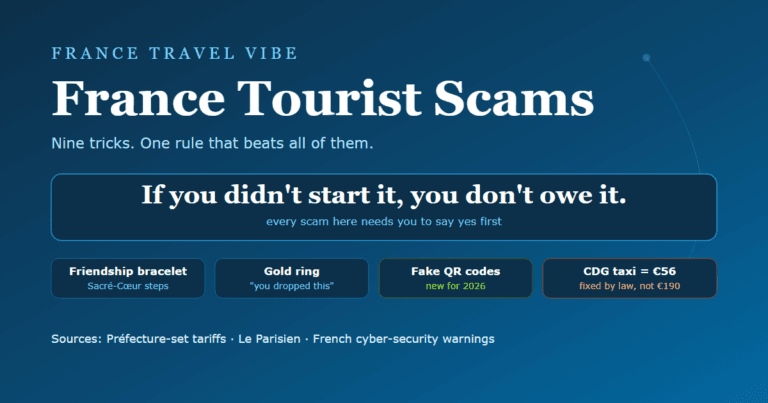
One security note about airport wifi. That’s exactly the environment where fake QR codes and credential-harvesting pages do well. Install from the provider’s own app rather than scanning anything taped to a wall. My guide to France tourist scams covers the fake-QR wave in detail.
What If It Doesn’t Work When You Land?
Nearly always, it’s one of three things, and all three take under a minute. The eSIM isn’t set as the data line, the profile got switched off in transit, or the phone needs a restart to pick up the network. Don’t buy a second plan in a panic.
Work through it in order: toggle airplane mode on and off, check which line is selected for mobile data, confirm the eSIM profile is enabled, then restart. If none of that works, fall back to hotel wifi. Then a phone shop for a physical French SIM, which every carrier sells over the counter with ID.
Here’s the reason not to panic in the arrivals hall: 112 reaches emergency services from most phones with no active plan at all. Connectivity is a convenience problem, not a safety one, and my France safety guide covers what actually matters on arrival.
Frequently Asked Questions
Do I need an eSIM for France?
Not if you live in the EU or EEA. The “roam like at home” rule covers you through 30 June 2032 at no surcharge (European Commission). UK travelers should compare their carrier’s daily fee against a flat eSIM price. Visitors from further afield usually do need one.
What’s the best eSIM for France?
Match it to trip length rather than brand. Orange Travel’s own France plans run £7.99 for 5GB over 7 days, £11.99 for 10GB over 7 days and £16.99 for 20GB over 30 days (Orange Travel, 2026). Airalo’s France eSIM is now unlimited-only, from €10.50 for 3 days. Network coverage matters more than the logo.
How much data do I need for a week in France?
Two to four gigabytes covers a normal week of maps, messaging and light browsing. A 10GB plan gives comfortable headroom. Only daily video streaming or laptop tethering justifies unlimited, which is usually the worst value per gigabyte you actually use.
Is an eSIM or a French SIM card better?
eSIM for trips under about two weeks; a French plan for longer stays. Orange Travel, the renamed Orange Holiday, sells 50GB over 30 days for £25.49 data-only or £33.49 with unlimited calls, texts and a French number. Worth it for a month, dead weight for a week.
Can I use my UK phone in France?
Yes, but most networks charge roughly £2–5 a day post-Brexit, though some plans still include European roaming (MoneySuperMarket, 2026). Divide an eSIM’s price by your daily fee to find the trip length where buying becomes cheaper.
The Bottom Line: Check Before You Buy
The most useful thing to know about an eSIM for France is whether you need one at all.
- EU or EEA resident? Buy nothing. You’re covered through June 2032.
- UK? Divide the eSIM price by your carrier’s daily fee. That’s your break-even day.
- Everyone else? A 10GB plan at around £12 covers a normal week, on Orange’s own network.
- Staying a month, or need a French number? Orange Travel’s 50GB over 30 days, £25.49 data-only or £33.49 with calls.
- Whatever you choose, install it at home and leave it off until you land.
Start with my complete France travel guide for the rest of the planning, then price the whole trip with the honest France trip cost breakdown. Connectivity is one of the smallest lines on it.