
Last verified: October 17, 2026. Everything below that bears on whether France is safe, including the advisory level, the alert posture and the crime figures, was checked against US State Department, French Interior Ministry and public-health sources on the date above. Safety information moves faster than any other travel topic, so I re-check this page monthly and update the date each time.
Is France safe? Yes, and the data says so plainly. Here’s the number that should reframe the question anyway. Over eighteen days in June 2026, roughly 2,700 people in France died of heat (Carbon Brief, France’s June heatwave, 2026). No safety guide mentions the weather.
That gap is the problem with how this question gets answered. You either get brochure reassurance or recycled crime headlines. Neither tells you what to actually do differently. So I’ve written seven honest answers, each with the data behind it, including the risks that never make the lists.
Disclosure: Some links in this guide may earn us a commission, at no extra cost to you. It never changes what we recommend.
Key Takeaways
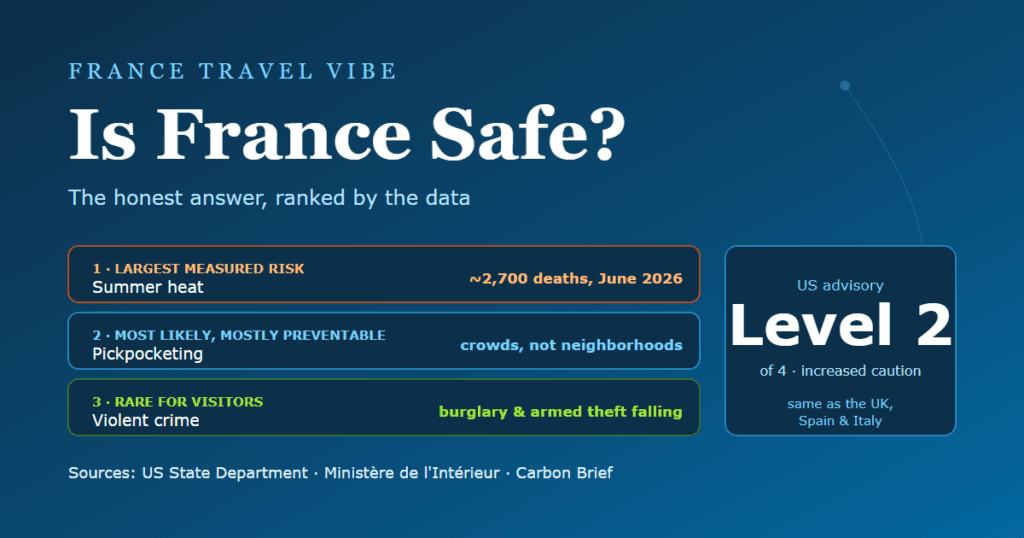
- France sits at Level 2, “Exercise Increased Caution,” on the US State Department’s four-tier scale (US State Department, 2025), the standard tier for most of Western Europe.
- Opportunistic theft, not violence, is the realistic risk. It’s concentrated in a short list of predictable places and is almost entirely preventable.
- France lowered its terror alert posture in June 2026. Most safety guides still say otherwise.
- The largest measured risk to a summer visitor is heat: roughly 2,700 heat-related deaths in France in June 2026 alone.
Table of Contents
Is France Safe to Visit Right Now?
Yes, with ordinary precautions. The US State Department places France at Level 2 of 4, “Exercise Increased Caution,” in an advisory issued May 28, 2025, citing terrorism and civil unrest (US State Department, France Travel Advisory, 2025). That’s the same tier as the United Kingdom, Spain and Italy.
Level 2 is not a warning against travel. It’s the default setting for most of Western Europe, and it sits two full tiers below “Do Not Travel.” The scale runs from Level 1, exercise normal precautions, up to Level 4, do not travel, so reading Level 2 as a red flag misreads the instrument entirely. I’ve flown into Paris under Level 2 more times than I can count, and the only thing it has ever changed is how early I leave for the airport.
Anyone asking “is France safe” deserves the practical test too, which is what visitors actually do. In 2025, a record 102 million international travelers came to France, more than any country has ever recorded (Campus France, 2026). Mass tourism functions normally here, every day, at enormous scale.
Safety is one of five things a first trip turns on. My complete France travel guide covers the other four: entry rules, budget, timing and transport.
What Does France’s Crime Data Actually Say?
It says something more useful than the headline. Recorded physical violence in France rose 5% in 2025 after a near-flat year, while burglaries, armed robbery, vehicle theft and theft from vehicles all fell (Ministère de l’Intérieur, Insécurité et délinquance en 2025, 2026). One number, two very different stories.
Now look inside that 5%. The ministry’s own breakdown shows the rise was led by intrafamily violence, up 6%, with violence outside the family up 5%. Domestic violence is a serious and real problem. It is also, structurally, not a risk profile a visitor shares. A safety article that quotes “French violent crime rose 5%” and stops there hands you a number whose largest component describes something happening inside homes, between people who know each other.
The indicator that genuinely maps to visitors is quieter. Non-violent theft against persons ticked up slightly in 2025, after several years of decline. That’s pickpocketing. So the honest 2026 reading of French crime data, for anyone asking is France safe, runs three ways (Ministère de l’Intérieur, 2026). The property crimes most likely to touch you are flat to slightly up. The violent categories driving headlines mostly aren’t yours. And burglary and vehicle-crime trends are moving the right way. For what it’s worth, in fifteen years of French trips the only crime that has touched me was a phone lifted off a café table in the 11th, which is exactly the category the data points at.
How Bad Is Pickpocketing, Really?
It’s the single most likely thing to go wrong, and it’s close to fully preventable. For most travelers, this is what the safety question really comes down to. The State Department’s advisory names it first: pickpocketing and phone theft are common in crowded places, specifically airports, subways and train cars, tourist attractions and stations (US State Department, 2025).
The geography is boringly predictable, which is good news. Métro line 1 and the airport RER lines carry the most visitors with the most luggage and the least local knowledge. The approach steps below Sacré-Cœur, the lift queues at the Eiffel Tower, any museum escalator: all concentrate distracted people in slow-moving crowds. That’s the whole map, and it isn’t neighborhoods, it’s situations.
Three habits close most of the gap. Wear a crossbody bag in front of you, not behind your hip. Keep your phone off the café table, because a phone beside the pavement is the easiest theft in Paris; mine went that way in under a minute, while I was paying the bill. And loop your bag strap through the arm of your chair. Hung on the chair back, it sits invisibly behind you.
If something does go, act in this order. Call 112, the EU-wide emergency number, if you’re in danger. Otherwise file a police report, the constat. It feels like bureaucracy and it is. But no travel insurer will pay a phone claim without one. Most of the theft risk sits on the Métro and RER lines you’ll actually use, which is worth knowing before your first morning.
Theft’s cousin is the staged scam: the friendship bracelet, the dropped ring, the clipboard petition. All of them work by starting a conversation you didn’t choose, and all of them end the same way: you keep walking. My guide to France tourist scams covers all nine, with the tell and the fix for each.
Is Terrorism Still a Real Risk in France?
The threat is real, and France has just lowered its alert posture. On June 22, 2026 the government replaced the old Vigipirate scale with three levels: vigilance, vigilance renforcée and alerte attentat. It set the summer–autumn posture at the middle one, vigilance renforcée (Ministère de l’Intérieur, Mise en œuvre du plan Vigipirate 2026, 2026).
That matters because France had sat at the old top level, urgence attentat, continuously since March 2024. Nearly every article answering “is France safe” still describes the country as being at maximum terror alert. As of summer 2026, that’s out of date, and the correction runs in the reassuring direction. Under the new system, the top level is activated by explicit decision of the Prime Minister for renewable twelve-day periods, rather than left standing for years.
What I notice as a visitor is modest and unchanged: soldiers on Sentinelle patrols at Gare de Lyon and Gare du Nord, bag checks at museum entrances, and this season, added counter-drone measures at busy tourist sites. The individual statistical risk is negligible, and the visible institutional response is not. For most travelers, that combination is the honest picture.
What Is the Biggest Risk Nobody Warns You About?
Heat, and it’s the one safety answer that almost no guide gives you. Over 12–29 June 2026, France recorded roughly 2,700 heat-related deaths, with daily heat mortality climbing from under 100 to nearly 300 on the hottest days, June 24 and 25 (Carbon Brief, France’s June heatwave, 2026). No mainstream safety guide for France mentions the weather at all.
Two numbers circulate for that heatwave, and they measure different things, so here’s both. The 2,700 figure is a heat-attribution estimate: deaths statistically linked to the heat. France’s public-health excess-death tally for the same event runs closer to 1,000 (Al Jazeera, 2026). Either way, the ranking holds. In a French summer, heat is the largest measured cause of harm a visitor is exposed to, by a wide margin over crime.
Visitors are structurally more exposed than residents, because sightseeing happens at midday and queues are outdoors. Older French hotel stock frequently has no air conditioning. I once spent a July night in a sixth-floor room in the 9th with a fan and an open window and got maybe three hours’ sleep; a top-floor room under a zinc roof in August is genuinely dangerous for an older traveler.
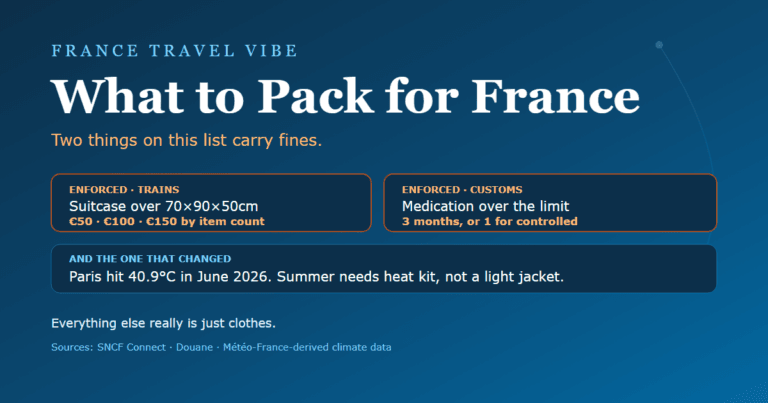
The protocol is simple and it works. Move sightseeing to before 11am and after 6pm. Treat the middle of the day as lunch, museums or a nap, exactly as the French do. Watch the canicule alert map, and expect closures during red alerts, as Paris sites had during the June peak. Packing for the heat matters too, which my guide to what to pack for France covers season by season. My month-by-month ranking of when to visit explains why June no longer counts as shoulder season. My itinerary comparison covers why long August loops suffer most.
Is France Safe for Solo and Women Travelers?
Yes. France is one of Europe’s most established solo destinations, and Paris is the city I’d send a first-time solo traveler to without hesitation. Here the useful answer is situational rather than statistical. National crime numbers say very little about how any individual evening goes.
What changes when you’re alone is logistics. Where you sleep matters more than any area’s reputation. A well-lit street with an active ground floor, a short walk from a station, beats a nominally “better” district with a ten-minute dark approach. Know the last métro time before you go out. It’s the decision that most often turns into an unplanned late walk; I’ve done the 2am walk back from Oberkampf once, and it was long rather than frightening, but I plan around it now.
The common complaint from women traveling in France is street harassment rather than violent crime, and the two shouldn’t be blurred together. Being spoken to on the street is unpleasant and frequent. Being attacked is rare. Late at night, stay on main arteries and use a licensed taxi or an app, not an unmarked car offering a ride. And remember 112 works from any phone, in English.
What Should You Actually Do Before You Go?
Five things, each tied to a real failure mode rather than general caution, and they’re the five I actually do before every trip. None takes more than ten minutes. Together they cover most of what turns “is France safe” from a question into an actual problem: the situations that cost travelers money and time.
- Register with your embassy’s traveler program (STEP for US citizens), which is how you get alerts during a strike, protest or incident.
- Check your travel insurance covers phone and bag theft, and confirm it requires a police constat, because it will.
- Save 112, plus 15 for medical and 17 for police. Download an offline map and save your accommodation’s address in French to read out on the call (the French to say in an emergency), and sort out staying connected before you fly.
- Photograph your passport data page and store it somewhere separate from the passport.
- Plan the arrival day as an arrival day. Border control now includes biometric EES checks for non-EU arrivals, and summer works on the RER B can stretch central Paris to Charles-de-Gaulle to ninety minutes.
One more thing worth knowing. French strikes and demonstrations are announced in advance, routed through published streets, and easy to avoid once you know they’re happening. They’re a schedule problem, not a safety problem. Budgeting a little slack for them, as my France trip cost breakdown suggests for incidentals, is usually all that’s needed.
Frequently Asked Questions
Is France safe to visit right now?
Yes, with ordinary precautions. France sits at Level 2 of 4, “Exercise Increased Caution,” on the US State Department scale (US State Department, 2025), the same tier as the UK, Spain and Italy. A record 102 million international visitors came in 2025 (Campus France, 2026).
Is Paris safe for tourists?
Yes for violence; pickpocketing is the real exposure. The State Department names crowded transport, stations and attractions as the hotspots, which in practice means Métro line 1, the airport RER lines, and the monument queues. A crossbody bag worn in front removes most of the risk.
Is France safe for solo female travelers?
Yes. France is one of Europe’s most-traveled solo destinations, and Paris is where I’d send a first-time solo traveler. Street harassment is the common complaint rather than violent crime. Choose accommodation by street lighting and station distance, know the last métro time, and save 112.
What is the terror alert level in France?
France sits at vigilance renforcée, the middle of three levels under the Vigipirate plan restructured on June 22, 2026 (Ministère de l’Intérieur, 2026). France had held the previous top level since March 2024, so this is a reduction, despite what most travel guides still say.
What’s the emergency number in France?
112 works across the EU from any phone, including in English. Within France, 15 reaches medical services and 17 reaches police. For theft, file a police report called a constat, which travel insurers require before paying any phone or bag claim.
The Bottom Line: Safe, With Two Caveats Worth Taking Seriously
So, is France safe? Yes. The useful version of that answer is that the risks worth your attention aren’t the ones the headlines pick.
- France is at Level 2, the ordinary tier for Western Europe, two levels below “do not travel.”
- Theft, not violence, is your realistic risk. It’s concentrated in predictable crowds and beaten by three habits.
- The terror alert posture was lowered in June 2026, not raised.
- Heat is the underrated danger. Roughly 2,700 heat-related deaths in France in June 2026 should change how you schedule an August day, not whether you go.
- Five ten-minute tasks before you fly cover most of what actually goes wrong.
Start with my complete France travel guide for the rest of the planning. Then pick your dates with the month-by-month ranking. If you’re still weighing whether France is safe in summer, the month you land in is the single biggest safety decision you’ll make.