
Last verified: October 17, 2026. Entry rules changed twice this year and ETIAS still has no start date. I re-check every fact on this page against the European Commission’s ETIAS portal, France Diplomatie and eu-LISA monthly, and update the date above each time.
France broke its own tourism record in 2025, welcoming 102 million foreign visitors and pulling in €77.5 billion in the process (Campus France, 2026). Yet almost every one of those travelers crossed a border that no longer works the way it did two years ago. France entry requirements changed twice this year alone, and most of what’s published online hasn’t caught up.
Passport stamps are gone. Fingerprints are in. A new €20 travel authorization was supposed to arrive this year, and half the articles about it still say so. Confused? You’re not alone, and this page breaks down France entry requirements exactly as they stand today.
Disclosure: Some links in this guide may earn us a commission, at no extra cost to you. It never changes what we recommend.
Key Takeaways
- EES is fully live since April 10, 2026: non-EU visitors are fingerprinted and photographed at the border instead of stamped. There is nothing to apply for and nothing to pay.
- ETIAS has no start date. The EU’s official portal says it is “currently not in operation” and that the date will be announced several months ahead (European Union, 2026). Anyone selling it today is a fraud.
- Visa-exempt travelers (the US, UK, Canada, Australia and about 56 others) need only a passport issued within the last 10 years and valid three months past departure.
- The 90/180 rule is unchanged, but EES now counts the days for you, across all 29 Schengen states, so overstays are flagged instantly.
France Entry Requirements: What’s Covered
What Is the EES, and Is It Already Affecting My Trip to France?
France entry requirements now start with a single automated system: the EES. It has been fully operational since April 10, 2026, according to the French Ministry for Europe and Foreign Affairs. Every non-EU traveler is now fingerprinted and photographed on first entry, instead of getting a passport stamp (France Diplomatie, 2026).
The rollout wasn’t instant. It started gradually on October 12, 2025, with select airports and land borders testing the system before it went nationwide six months later. If you traveled to France in early 2026, you might have gotten a stamp anyway, depending on which checkpoint you used. That’s no longer true.
Here’s what the EES actually collects: your name, passport details, a facial photo, and fingerprints (skipped for children under 12). It logs the date, time, and location of every entry and exit. EU and Schengen nationals aren’t affected, and neither are residents of Andorra, San Marino, Monaco, or the Holy See.
There’s nothing to apply for and nothing to pay. You show up, you get scanned, you move on, at least in theory. Since going fully live, EES has processed roughly 110 million border crossings and refused entry to about 44,500 travelers, according to figures France’s Ministry of the Interior shared with the Financial Times (Forbes, 2026). This isn’t a pilot program anymore. It’s the default way non-EU travelers now cross into France.
Entry rules are only the first decision of a France trip. My complete France travel guide covers the rest: when to go, what it costs, how long to stay, and how to get around once you are through the border.
Do I Still Need ETIAS to Visit France in 2026?
Not yet. eu-LISA, the EU agency building ETIAS, told the Financial Times in mid-July 2026 that launching by the end of the year “was no longer feasible,” largely because of ongoing problems with the EES rollout (Euronews, 2026). One EU source close to the discussions put it bluntly: “Let’s clean up EES first before you put another system that will double the line again.”
This matters more than it sounds. As recently as July 2026, most travel sites, including some updated that same month, were still telling readers to expect ETIAS “in October or November.” That guidance is now out of date. The official ETIAS website quietly dropped its Q4 2026 target, with no press release and no replacement date. eu-LISA’s management board was due to revisit the timeline at its September 2026 meeting. As of October 17, 2026 nothing has been published from it, and the official portal says only that ETIAS “is currently not in operation” and that the EU will announce the start date several months in advance (European Union, ETIAS portal, 2026). Industry reporting still points to 2027 as the earliest realistic launch (Forbes, 2026). Getting France entry requirements right matters more than ever with this much conflicting information online.
That gap between what’s actually true and what’s still published online is the whole reason this page exists. It’s exactly why I track France entry requirements against official sources every month. When ETIAS does launch, expect a €20 fee for travelers aged 18 to 70, a three-year validity window, and a requirement covering roughly 60 visa-exempt nationalities, including the US, UK, Canada, and Australia (European Commission, 2025). Run the EES numbers and the scale looks different than the “chaos” headlines suggest: about 44,500 refused entries against roughly 110 million crossings works out to a refusal rate of around 0.04%, or roughly 1 in 2,500 border checks.
Nothing about your trip changes because of ETIAS right now. Just don’t be surprised if you see the “coming this fall” language elsewhere. It hasn’t been true since mid-July. The €20 fee still belongs in your planning for 2027, though: see what a France trip actually costs for where it lands in the total.
What Are France’s Actual Entry Requirements Right Now?
For visa-exempt nationalities (the US, UK, Canada, Australia, and roughly 56 others), all you need today is a valid passport. No ETIAS, no visa, no pre-registration required. That’s the whole of France entry requirements for most travelers right now.
That passport does have to meet France’s actual standards, though. EU rules require it to have been issued within the last 10 years and to stay valid for at least three months past your planned departure from the Schengen Area (European Commission, Your Europe, 2026). A passport that’s cracked, water-damaged, or has a failing RFID chip can also get you flagged, even if the expiration date checks out fine.
You should also be ready to show proof of accommodation, a return ticket, and enough money to cover your stay, if a border officer asks. Most travelers never get asked. Some do, especially during busier periods, so don’t leave those documents buried at the bottom of your bag. Beyond that, you’re covered by the same 90/180-day rule that’s applied for years. It just gets tracked electronically now instead of by hand.
How Does the 90/180-Day Rule Actually Work?
The 90/180 rule is a rolling count, not a calendar reset. Every day you’ve spent anywhere in the Schengen Area over the past 180 days counts against your 90-day allowance in France, and it doesn’t reset on January 1st the way people often assume.
Say you spent two weeks in Spain in March, then flew home, then came back for 10 days in France in June. Both trips draw from the same 90-day pool, because the count applies across all 29 Schengen countries combined, not per country (European Commission, Your Europe, 2026). A week in Italy and a month in Spain eat into the exact same budget you’d use in France.
Why does this matter more in 2026 than it used to? Because EES now automates the tracking that border officers used to eyeball from stamps. Overstays that once slipped through are now flagged instantly. If your travel math was ever a little fuzzy, this is the year to tighten it up. It’s a small but important part of France entry requirements that catches frequent visitors off guard.
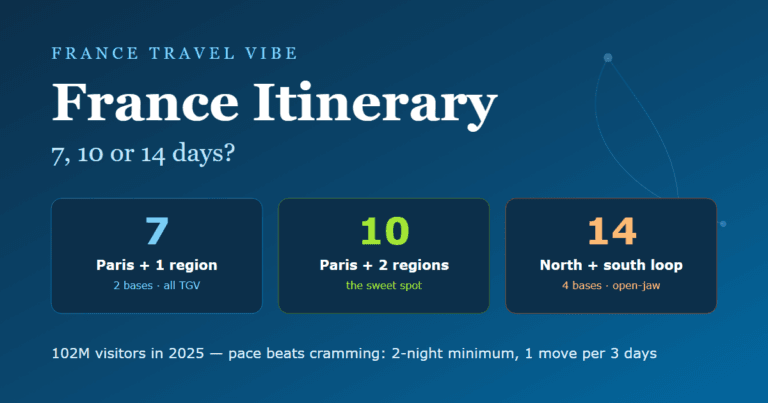
Ninety days is the legal ceiling, not a plan. For how many days a first trip actually needs, and why seven means Paris plus one region, see my 7, 10 or 14-day France itinerary comparison.
What’s Actually Changed at French Airports and Borders Since 2025?
France entry requirements now run through biometric checkpoints at every major airport. Expect a kiosk instead of a stamp, and probably a longer wait than your last trip. That volume, run through a system that only went fully live in April, is exactly why lines have gotten longer. Reports from summer 2026 describe peak-period delays of two to five hours at several major Schengen airports, including Paris CDG, Amsterdam, Frankfurt, Barcelona, and Vienna, not unique to France, but France gets its share (ETIAS.com, 2026).
Add a brand-new biometric system recording every non-EU arrival to that steady growth, and lines were never going to move faster right away. Aviation industry groups warned in early July 2026 that the EES rollout had reached a “critical point” at some checkpoints, though the EU has so far declined to suspend the system (Euronews, 2026). The legal safety valve that let border posts switch biometric capture off at busy moments expired on September 6, 2026, and Brussels refused to extend it. France is one of nine Schengen states reported to be carrying on with the pauses informally, and the French interior ministry says its pre-registration kiosks and tablets stay in place to the end of 2026 (Biometric Update, 2026). A few things help: arriving with your passport already out and ready, checking whether your airline or airport offers priority lanes for EES processing, and avoiding the busiest midday arrival windows where your flight schedule allows.
Queue length is seasonal too. Border halls are worst in the July and August peak, which is one more argument for the shoulder months: see the best time to visit France.
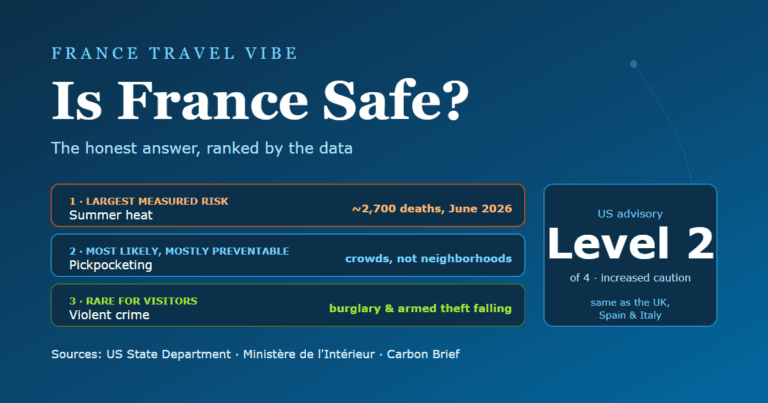
Border queues are an inconvenience, not a danger. For the real risks once you are through, from phone theft to summer heat, read my honest answer to whether France is safe.
Who Is Exempt or Needs Something Different?
EU and Schengen nationals skip both EES and ETIAS entirely. This guide isn’t about them. Travelers from countries that already require a traditional Schengen visa still need one; neither EES nor ETIAS changes that requirement, though EES now logs their entries and exits electronically too. France entry requirements aren’t one-size-fits-all, though. A few groups have their own rules:
- Children under 12 are exempt from EES fingerprint collection, though they still have their photo taken.
- Dual citizens with an EU passport should travel on that passport to skip both systems altogether.
- Long-stay visa and residence permit holders (students, workers, family members) fall outside the short-stay 90/180 framework that EES and ETIAS both track. EES still logs their entries and exits, but their allowed stay is governed by their visa or permit, not the 90-day limit.
- Residents of Andorra, San Marino, Monaco, and the Holy See are excluded from EES by name in the regulation.
Once ETIAS does launch, the fee structure will look like this:
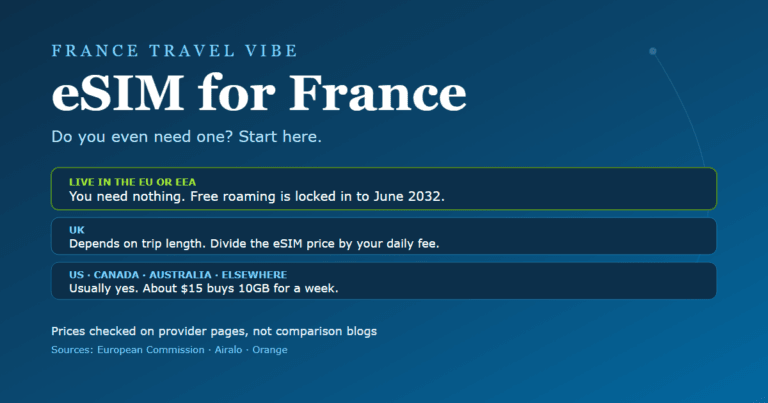
Once you are through passport control, the next queue is for a SIM. Most visitors from the EU can skip it entirely, and my eSIM for France guide explains who actually needs one.
Frequently Asked Questions
Do I need ETIAS to visit France in 2026?
France entry requirements don’t include ETIAS yet. eu-LISA told the Financial Times in mid-July 2026 that a 2026 ETIAS launch “was no longer feasible,” and as of October 2026 the EU has published no new date (Euronews, 2026). Visa-exempt travelers still only need a valid passport to enter France today.
How much will ETIAS cost when it launches?
ETIAS will cost €20 per traveler aged 18 to 70. Travelers under 18 and over 70 are exempt from the fee, though they’ll still need to apply once the system is live (European Commission, 2025).
Does the EES require me to do anything before I fly to France?
No. The EES has been fully automated at the border since April 10, 2026, with no advance registration, application, or fee (France Diplomatie, 2026). You’ll simply be photographed and fingerprinted on arrival.
How long can I stay in France without a visa?
Visa-exempt travelers can stay up to 90 days within any rolling 180-day period. That count is shared across the entire Schengen Area, not reset per country, and it now tracks automatically through EES.
What passport rules apply to enter France?
Passport rules are the one constant in France entry requirements. Your passport needs to have been issued within the last 10 years and stay valid for at least three months beyond your planned departure from the Schengen Area (European Commission, Your Europe, 2026). Damaged or unreadable passports can be rejected regardless of the expiration date.
The Bottom Line
To summarize France entry requirements as they stand today:
- EES is live: expect fingerprints and a photo on your first arrival, tracked electronically instead of by stamp.
- ETIAS isn’t here yet: don’t pay anyone for it now; when it arrives, it’s €20 on the official EU site only.
- Paperwork basics still rule: a passport issued within 10 years with 3+ months’ validity, and proof of accommodation or funds if a border officer asks.
I re-verify every figure on this page monthly against the European Commission, France Diplomatie, and mainstream reporting on the EES/ETIAS rollout. That’s how I keep France entry requirements accurate between full rewrites. A rules guide that’s six months stale is worse than no guide at all.
Budget the border into the trip too. The ETIAS fee will be small when it arrives, but France’s tourist taxes, city by city, add up faster than most visitors expect.
Once your entry paperwork is sorted, start planning the rest of your trip. That guide covers timing, budget, regions and transport, in the order the decisions actually come at you.