
Last verified: September 7, 2026. Every price in this guide was checked on the operator’s own website on the date above: louvre.fr, parismuseumpass.fr, the Centre des monuments nationaux, operadeparis.fr, chateauversailles.fr and toureiffel.paris. Two pages I couldn’t reach, and I’ve quoted no prices from either: the Louvre’s own ticketing site, which sits behind a bot check, and the Musée d’Orsay’s rates page. Five French sites changed their pricing in January 2026, on at least two different dates, so I re-check this page monthly and update the date each time.
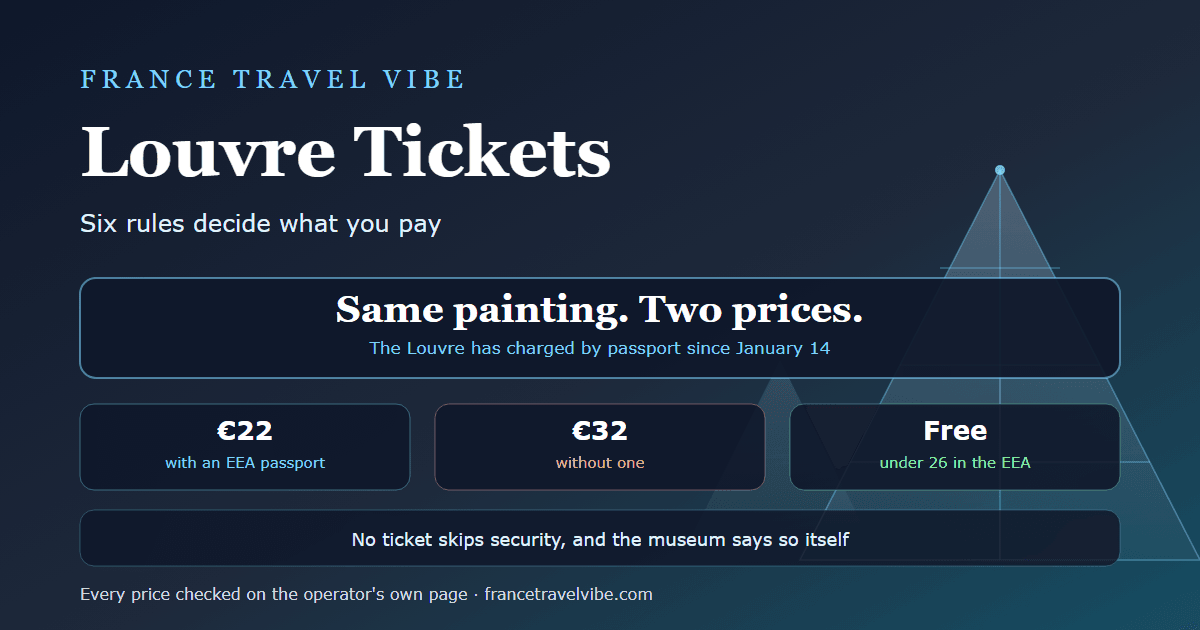
Louvre tickets cost €22 or €32 in 2026, and what decides which you pay isn’t your age or where you book. It’s whether you hold EEA nationality or EEA residence. The split took effect on January 14. Same painting, same queue, a €10 gap.
Almost everyone writing about Louvre tickets is also selling them. So you rarely hear that the museum’s own FAQ warns against the skip-the-line products on offer everywhere. Or that around ten people were detained in February over a €10 million ticket fraud run partly by Louvre staff. Or that the most-repeated warning about the Paris Museum Pass is contradicted by the company that sells it.
Here are the six rules that actually decide what you pay, what the pass saves, and where to buy.
Disclosure: Some links in this guide may earn us a commission, at no extra cost to you. It never changes what we recommend.
Key Takeaways
- A Louvre ticket is €22 with EEA nationality or residence and €32 without it, so UK visitors pay €32, a 45% rise that took effect on January 14, 2026 (Louvre).
- Under-18s of any nationality and EEA residents under 26 pay nothing, every day of the year.
- The Paris Museum Pass costs €85, €105 or €125 and runs on 48, 96 or 144 hours, not calendar days (Paris Museum Pass).
- No ticket skips security screening, and the Louvre’s own FAQ tells you not to buy the ones that claim to.
- The Palais Garnier’s non-EEA premium is 67%, proportionally bigger than the Louvre’s 45%.
Table of Contents
How Much Are Louvre Tickets in 2026?
Louvre tickets carry two adult prices in 2026: €22 for European Economic Area nationals and residents, €32 for everyone else, a split that began on January 14, 2026 (Louvre, Hours & admission). It’s the first time the museum has formally split its adult rate this way, and at 45% it’s the steepest rise in years (CNN, “Louvre museum to hike entrance fee by 45% for non-EEA visitors”, November 2025).
That €22 rate holds for citizens of all 30 EEA countries (AFAR, 2025). It’s nationality and residency that matter, not where you flew in from, so an American living in Lisbon pays €22 with proof. The Louvre is one entry on my ranking of the experiences worth your time in France, and it’s the one whose price moved most this year.
British and Swiss visitors pay €32. Being European isn’t the test, and neither the UK nor Switzerland is in the EEA, so a UK passport buys the higher ticket unless you can show EEA residence. That catches a lot of people out, and I haven’t found a ticket page that says it plainly.
What the ticket buys is broader than most people expect. It covers the permanent collections and the temporary exhibitions, plus the Musée national Eugène-Delacroix on the same or the next day (ticket.louvre.fr). What it doesn’t buy is a second attempt. The museum’s own rule is blunt: any exit is final, so the coffee break you were planning ends your visit.
The Louvre opens 9am to 6pm on Monday, Thursday, Saturday and Sunday, runs late to 9pm on Wednesday and Friday, and closes on Tuesday. Last entry is an hour before closing.
Why Did the Price Jump 45%?
The rise is expected to bring in an extra €17.5 million a year, earmarked for a rebuild the museum says it can’t put off (CNN, November 2025). It landed against €216 million in culture-ministry cuts, and it drew a loud public argument in France about charging visitors differently by origin (France 24, January 2026).
It’s called Louvre Nouvelle Renaissance. It buys a new entrance at the Perrault Colonnade by 2031, plus a dedicated gallery for the Mona Lisa beneath the Cour Carrée. That room will be reached on its own separate ticket. The estimated cost runs up to €800 million (Artforum, 2025).
Then October 2025 happened. Thieves took eight pieces of the French crown jewels from the Apollo Gallery in under eight minutes, and none of it has been recovered (Interpol, 2025). The haul was valued at €88 million (Fortune, February 2026). The review that followed found only 39% of the museum’s rooms had camera coverage, and 100 new cameras went on the same bill (Euronews, November 2025).
So the honest answer to where your extra €10 goes is: cameras, a roof, and a room for one painting. I’ve set out the wider argument over France’s new two-tier museum pricing in my main France guide.
Four Other French Sites Now Charge by Residence
Five French institutions introduced a non-EEA tier in January 2026: the Louvre, Versailles, Chambord, the Sainte-Chapelle and the Palais Garnier (Le Journal des Arts, “Tarifs majorés pour les touristes extra-européens dès 2026 dans cinq hauts lieux culturels”). The Louvre took the headlines. It doesn’t have the biggest premium.
Measured as a percentage rather than in euros, the Palais Garnier is the steepest of the lot. Its self-guided visit went from €15 for EEA visitors to €25 for everyone else, a 67% premium against the Louvre’s 45% (Opéra national de Paris). It’s the steepest of the five in proportional terms.
The Sainte-Chapelle is €16 and €22, with the combined Sainte-Chapelle and Conciergerie ticket at €23 and €30 (Centre des monuments nationaux, rates 2026). Versailles has the smallest gap in the group: €32 against €35 for the high-season Passport (Château de Versailles).
One detail worth knowing if you’re checking a date-specific price: these five sites did not all change on the same day. Chambord and the Louvre moved on January 14, both stated on their own pages. The Centre des monuments nationaux dates the Sainte-Chapelle change to January 12. Versailles publishes a 2026 grid with no start date at all. So take any single “January 2026” date you see with caution and check the operator.
Two big names stayed out of it. Neither the Musée d’Orsay nor the Musée de l’Orangerie is on Le Journal des Arts’ list of five, and neither is the Eiffel Tower. If Versailles is on your list, the fares and timings sit in my guide to Versailles and the other day trips by train.
Who Gets Into the Louvre Free?
Anyone under 18, of any nationality, gets in free, and so does any EEA resident under 26, every day of the year (Louvre). That single rule is worth more to the people it covers than any pass or discount on this page.
That free list runs longer than most guides bother with: disabled visitors and one companion, EEA art teachers, ICOM members, journalists, and jobseekers or income-support recipients from the EEA.
There’s also a free evening. Entry costs nothing on the first Friday of the month after 6pm, except in July and August, and on July 14. The museum doesn’t publish a count of how many of those Fridays fall in a given year, so I won’t invent one, and you should be suspicious of pages that do.
One catch applies to all of it. A time slot is recommended even for free-admission visitors, and free slots are the first to go. I’ve watched a free Friday evening disappear from the calendar the same week it opened, so treat the free entry as something to plan around rather than fall back on. So free Louvre tickets still need the same booking discipline as paid ones, which is the part people miss.
It’s worth checking the free rules at every site on your list, not just this one. The Arc de Triomphe and the Panthéon both charge their low-season price on every Wednesday in high season (Centre des monuments nationaux). That’s a €6 and a €3 saving for picking a midweek day, and neither monument added a passport tier at all.
Is the Paris Museum Pass Worth It in 2026?
The pass costs €85, €105 or €125 for its two-, four- and six-day versions. The seller’s own claim is that savings start on average at the fourth visit for the short pass (Paris Museum Pass, checked September 7, 2026). At 2026 prices, that claim holds up. Ignore the €90, €109 and €139 figures circulating on ticket-comparison sites, which are a year out of step with the operator’s own page.
Here’s the arithmetic nobody prints. Start with the Louvre at €32, add the combined Sainte-Chapelle and Conciergerie ticket at €30, and you’re at €62. Add the Arc de Triomphe in high season at €22 and you reach €84, still one euro short of the two-day pass. Add the Panthéon and you’re at €100, and the pass has paid for itself. Four sites, exactly as the operator says.
Here’s the part that matters more, because the whole English-language internet gets it wrong.
You’ll read everywhere that the pass runs on consecutive calendar days. A two-day pass bought at 3pm on Monday supposedly dies at closing time on Tuesday. The company that sells it says the opposite. Validity is counted per hour, for 48, 96 or 144 consecutive hours, and its own worked example is a two-day pass activated on a Wednesday at 3pm and running until Friday at 3pm (Paris Museum Pass). An afternoon start costs you nothing.
Two rules do bite. The pass’s own rule is that it starts paying from 26 if you’re an EU resident and from 18 if you aren’t, because below those ages most of what it covers is already free. And it doesn’t exempt you from booking: you still need a Louvre time slot, free with the pass, and you’ll be turned away without one.
The longer passes need proportionally less work. The four-day at €105 clears its own price on the fifth site and the six-day at €125 on the sixth, which is the seller’s stated average for each (Paris Museum Pass). Add Versailles at €35 to the run above and the four-day is already ahead.
The Paris museum ticket ledger
Here’s the whole picture in one place. Every price below came from the operator’s own page on September 7, 2026, and every pass answer from the official site list.
| Site | EEA rate | Non-EEA rate | On the Paris Museum Pass | What to know |
|---|---|---|---|---|
| Musée du Louvre | €22 | €32 | Yes | Closed Tuesday. Free first Friday after 6pm, except July and August |
| Château de Versailles (Passport, high season) | €32 | €35 | Yes | Low season €22 / €25. Only the palace needs a time slot |
| Château de Chambord | €21 | €31 | No | Loire Valley, not Paris. Tier began January 14 |
| Sainte-Chapelle | €16 | €22 | Yes | Combined with the Conciergerie: €23 / €30. Tier began January 12 |
| Palais Garnier (self-guided) | €15 | €25 | No | The steepest premium of the five, at 67% |
| Arc de Triomphe (high season) | €22 | €22 | Yes | No passport tier. Low season €16, and the low price every Wednesday in high season |
| Panthéon (high season) | €16 | €16 | Yes | No passport tier. Low season €13, same Wednesday rule |
| Musée d’Orsay | No tier | No tier | Yes | Price not quoted here: its rates page blocked me on the verification date |
| Musée de l’Orangerie | No tier | No tier | Yes | Same as above |
| Eiffel Tower (lift to summit) | €36.70 | €36.70 | No | No passport tier. Stairs to the second floor are €14.80 |
| Notre-Dame (nave) | Free | Free | Towers only | The nave costs nothing and always has |
| Musée Carnavalet (permanent) | Free | Free | No | Free permanent collection, and it is the city’s own museum |
| Centre Pompidou | Closed | Closed | Still listed | Shut until 2030. Programme running at the Grand Palais and Metz |
Two things fall straight out of that table. Of the seven paid Paris-area sites listed, the pass covers five, and the two it misses are the Eiffel Tower and the Palais Garnier. And the passport tier is the exception, not the rule: five sites nationally, against a long list of others that kept a single price. For how museum spending sits inside a wider budget, see what a France trip costs in 2026.
Where Should You Actually Buy Louvre Tickets?
Buy from the museum’s official service at ticket.louvre.fr, and treat everything else with suspicion. The museum’s own FAQ is unusually direct about it. Don’t buy tickets that supposedly let you jump the queue, and never buy from street vendors, because you may be refused entry (Louvre FAQ).
There’s a reason it’s phrased that strongly. In February 2026, French police detained around ten people over a Louvre ticket fraud that had run for years. The scheme sold counterfeit passes and reused the same tickets for group after group, with the complicity of museum staff (Euronews, February 2026). Single tickets were reused up to twenty times a day, and the damage to the museum is put at €10 million (Fortune, February 2026).
If you’re wondering why the museum is blunt about where to buy Louvre tickets, that’s why.
There’s a second half to this, and the resellers won’t tell you either. Skip-the-line does not skip the line. Every visitor passes through security screening, and what a timed slot actually saves you is the ticket-purchase queue plus the risk of arriving to find nothing available. That’s genuinely worth having. The product name simply promises more than it delivers.
I’ve stopped buying anything at the Louvre except the plain timed ticket. The upsells I’ve tried bought me a laminated card and the same queue as everyone else. If you want the calmest version, take a Wednesday or Friday evening slot and go in at 7pm, when the day crowd has thinned and you’ve still got two hours.
Other institutions say the same thing. The Paris Museum Pass opens its own homepage with a notice about sites imitating official ticketing to sell fakes, and about platforms charging “excessively high prices” (Paris Museum Pass). The Musée d’Orsay carries a similar warning on its official ticketing site. Fake resale sites are one of the most common traps in the country, and I’ve covered buying tickets without the markup alongside the rest of them.
A Louvre Ticket Is Not a Guarantee of Entry
This is the rule nobody selling you a ticket will mention. On June 16, 2025, Louvre staff walked out without warning over crowding and understaffing. The museum simply shut, leaving thousands of people outside holding valid tickets (Finestre sull’Arte, June 2025). It wasn’t a one-off: staff walked out again twice more before the end of 2025, closing rooms each time.
Crowding is the reason, and the Louvre has been trying to manage it for years. Daily admissions are capped at 30,000, brought in after days approaching 45,000 in 2019 (ARTnews, 2023). That cap is what makes the timed slot binding rather than advisory.
It’s concentrated in one room. In 2019 the museum’s own figures put 80% of that year’s visitors in front of the Mona Lisa, roughly 8 million of them through the Salle des États, with an average stay of 3 to 4 minutes (Musée du Louvre press release, 2019). By the 2025 walkout, coverage of the strike put around 20,000 people a day through that single room (Finestre sull’Arte, June 2025).
That crush is why the passport tier raises real money. In 2025 the Louvre took 9.0 million visitors, 73% of them from outside France, down from a 77% foreign share in 2024 (franceinfo, citing the Louvre, January 2026).
How far ahead should you book? I can’t give you a rule, because the Louvre doesn’t publish one. What the museum does say is that tickets are sold on site when attendance is low, and that a slot is recommended otherwise. Treat any confident “book three months ahead” figure as a guess. In practice, book as soon as your date is fixed. Which month you pick changes the queue as much as the hour does, and my month-by-month guide to when to visit France covers the summer closures that hit Paris sites in July.
Two Paris Headliners You Cannot See Right Now
Two headline absences, and neither appears on a single ticket-selling page. The Apollo Gallery has reopened with no jewels in it, returned to being an empty 17th-century ceremonial room after the October theft (NBC News, 2025). If the crown jewels were on your list, they’re gone.
The Centre Pompidou closed on September 22, 2025 and won’t reopen until 2030, a five-year, €460 million rebuild (Centre Pompidou). Its programme continues at the Grand Palais and at Centre Pompidou-Metz, so the collection isn’t lost, just scattered.
It’s been a rough stretch for the Louvre generally. A pipe burst near the Mona Lisa in February 2026. Separately, water leaks damaged rare books, and the museum’s president, Laurence des Cars, resigned on February 24 after the theft, the fraud and the state of the building (Fortune, February 2026).
So where does that leave a museum day? Better than you’d think, if you widen the frame. The Musée Carnavalet’s permanent collection is free (Paris je t’aime), the nave of Notre-Dame still costs nothing (Paris Museum Pass), and at €16 the Panthéon is the cheapest of the big paid monuments. The other Paris experience that lives by a booked slot is a cooking class, and where to take a cooking class in France prices every format. And once the museums close, a dinner cruise, the hop-on boat or a private hire on the Seine takes the evening.
Frequently Asked Questions
How much is a Louvre ticket in 2026?
€22 for European Economic Area nationals and residents, €32 for everyone else, since January 14, 2026. A UK or Swiss passport does not qualify. Under-18s of any nationality and EEA residents under 26 pay nothing (Louvre). The ticket also covers the Musée national Eugène-Delacroix on the same or the next day.
Why do Americans pay more at the Louvre?
The tier is set by residency and nationality, not by where you flew from, so an American resident in the EEA still pays €22. The 45% rise is expected to raise €17.5 million a year toward the museum’s rebuild (CNN, 2025).
Is the Paris Museum Pass worth it in 2026?
It breaks even around the fourth site. The Louvre, the Sainte-Chapelle and Conciergerie combined ticket, and the Arc de Triomphe come to €84 at non-EEA rates, one euro under the €85 two-day pass (Paris Museum Pass). Its validity runs in hours, not calendar days.
Do I need to book the Louvre in advance?
A timed slot is recommended, including for free-admission visitors, and the museum caps entries at 30,000 a day (ARTnews, 2023). Tickets are sold on site when attendance is low. The Louvre publishes no rule about how far ahead slots are released.
Do skip-the-line Louvre tickets work?
No ticket bypasses security screening, and the Louvre’s FAQ warns against tickets sold as queue-jumping and against street vendors, saying you may be refused entry (Louvre FAQ). A timed slot from the official site is the real version of what those products claim to sell.
The Bottom Line
Six rules, in the order they hit your wallet:
- Your nationality or residence sets the base price: €22 in the EEA, €32 outside it, and the UK is outside it.
- Your age can wipe it out: free under 18 anywhere, free under 26 in the EEA.
- The day and the hour matter: closed Tuesday, late on Wednesday and Friday, free on the first Friday evening of most months.
- Where you buy decides your markup: ticket.louvre.fr, and nothing sold on the forecourt.
- A pass changes the maths from the fourth site, and runs on hours rather than calendar days.
- A ticket isn’t entry: the cap, the slot and the occasional strike all sit between you and the door.
Book your Louvre tickets before anything else in Paris. It’s the one item on a first-time itinerary that can’t be rearranged on the day.
Once that slot is fixed, build the rest of the city around it with my four-day Paris plan and what it costs, or step back and pick your regions from where to go in France.